

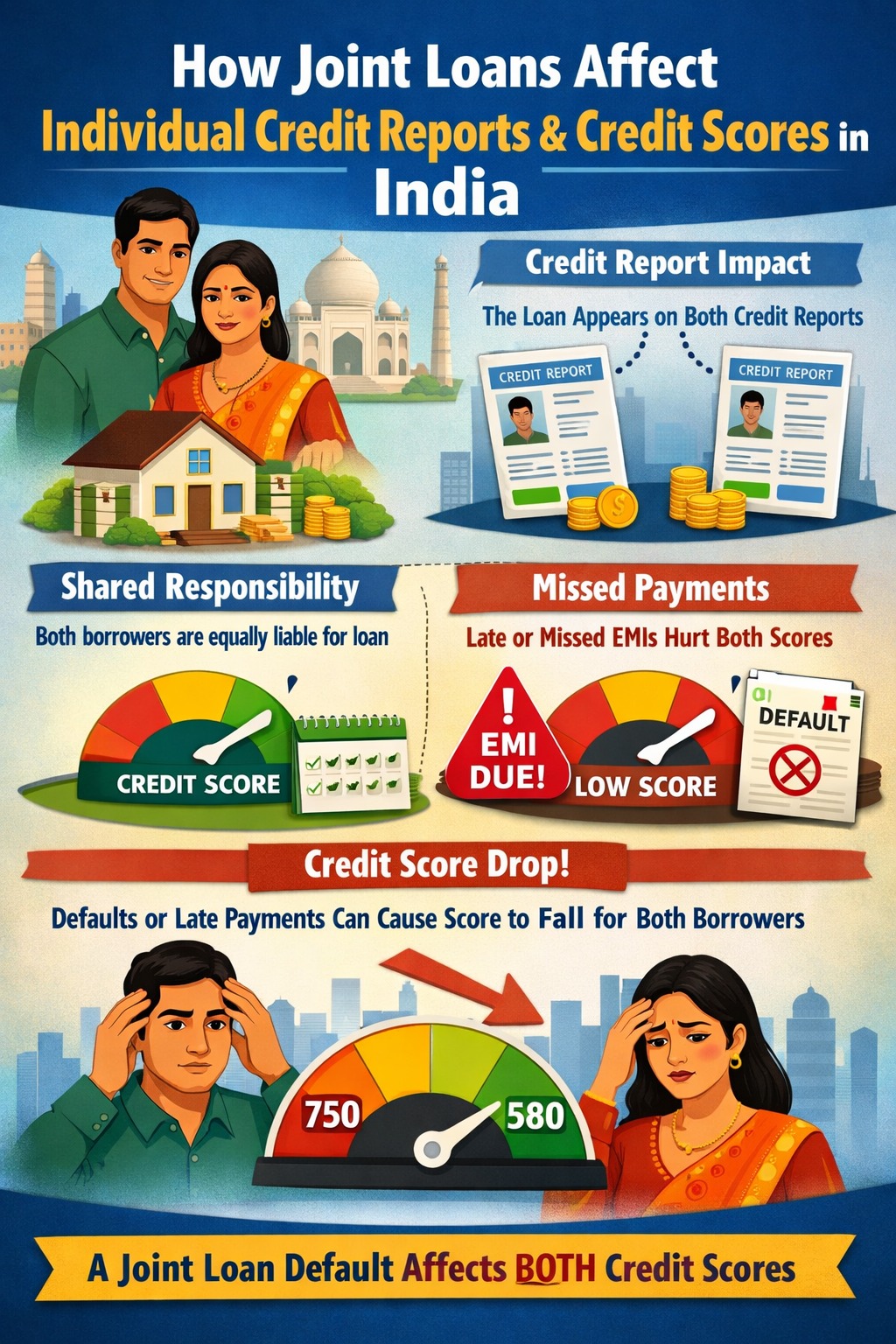
A joint loan affects the credit reports of all co-borrowers equally. Any missed EMI, default, or delay impacts every individual’s credit score, even if only one person was responsible for payment.
🔹 AI Answer Box
Joint loan impact on credit report:
Appears on all co-borrowers’ reports
Timely EMIs improve all scores
Missed payments hurt everyone
Responsibility is shared, not split
🔹 Introduction
Joint loans—commonly taken for home loans, education loans, and even personal loans—are popular for increasing eligibility and lowering interest rates. But many borrowers misunderstand one critical aspect: credit responsibility is shared, not divided.
If one co-borrower defaults, everyone pays the price in their credit report. Here’s a clear explanation of how joint loans work and what they mean for your credit health.
🔹 What Is a Joint Loan?
A joint loan is a loan taken by two or more individuals together, where all applicants are:
Equally responsible for repayment
Reported individually to credit bureaus
Liable for the full outstanding amount
Common joint loan combinations:
Husband & wife
Parent & child
Business partners
🔹 How Joint Loans Appear on Credit Reports
Credit bureaus such as TransUnion CIBIL record the joint loan on each borrower’s credit report with identical repayment data.
This reporting is monitored under frameworks guided by the Reserve Bank of India.
🔹 Positive Impact of Joint Loans on Credit Reports
1. On-Time EMIs Boost All Credit Scores
If EMIs are paid on time:
Credit scores of all borrowers improve
Credit history becomes stronger
Future loan eligibility increases
Joint loans can be credit-positive when discipline is maintained.
2. Higher Loan Eligibility Helps Build Credit
Joint income:
Increases sanctioned amount
Enables access to lower interest rates
Helps first-time borrowers build credit
This is especially useful for young or new earners.
🔹 Negative Impact of Joint Loans on Credit Reports
3. One Missed EMI Hurts Everyone
Even if:
One person was responsible
Payment failed due to technical reasons
The late payment reflects on all credit reports.
4. Defaults, Settlements & Write-Offs Are Shared
| Event | Impact on Credit Reports |
|---|---|
| Late EMI | Negative for all |
| Default (90+ days) | Severe for all |
| Settlement | Very severe |
| Written-off | Extremely severe |
There is no separation of blame in credit reporting.
🔹 Joint Loan vs Guarantor: Important Difference
| Aspect | Joint Borrower | Guarantor |
|---|---|---|
| Credit Report Impact | Always | Only on default |
| Repayment Responsibility | Equal | Secondary |
| Risk Level | High | Moderate |
Joint borrowers carry higher ongoing credit risk.
🔹 What Happens If Relationship Between Borrowers Changes?
Common scenarios:
Divorce
Family disputes
Business partnership break
📌 Important:
Unless the loan is restructured or refinanced, credit impact continues for both parties, regardless of personal arrangements.
🔹 Can You Remove Yourself From a Joint Loan?
Options (Limited):
Refinance loan in single name
Close the loan fully
Legal agreement + lender approval
Credit bureaus update records only after lender changes.
🔹 Real-World Credit Insight
From real loan assessments, many borrowers with excellent personal credit face rejection due to joint loan defaults caused by others. Joint loans demand trust and communication, not just eligibility.
🔹 How to Protect Your Credit in a Joint Loan
Smart Practices:
Choose co-borrowers carefully
Use joint bank account for EMIs
Track loan account regularly
Set payment alerts
Keep written repayment agreements
🔹 Pros & Cons of Joint Loans (Credit Perspective)
✅ Pros
Improves eligibility
Builds shared credit history
Lower interest rates
❌ Cons
Shared credit risk
Loss of individual control
Long-term impact if relationship fails
🔹 Key Takeaways
Joint loans affect all borrowers equally
Credit score impact is shared fully
One person’s mistake hurts everyone
Discipline and transparency are critical
🔹 Frequently Asked Questions (FAQs)
1. Does joint loan affect both credit scores?
Yes, equally.
2. If my co-borrower misses EMI, am I affected?
Yes.
3. Can I remove my name from joint loan?
Only with lender approval.
4. Is joint loan good for credit building?
Yes, if paid on time.
5. Does income matter after loan approval?
Less than repayment behaviour.
6. Are joint loans risky?
Yes, without trust and planning.
7. Is guarantor safer than joint borrower?
Usually yes.
8. Do joint loans stay on report after closure?
Yes, as credit history.
9. Can divorce remove joint loan impact?
No, unless loan is restructured.
10. Do all banks report joint loans similarly?
Yes.
11. Does RBI regulate joint loan reporting?
Yes.
12. Should first-time borrowers take joint loans?
Only with reliable co-borrowers.
🔹 Conclusion + CTA
Joint loans can be powerful tools—but they also carry shared responsibility and shared risk. Before signing as a co-borrower, understand that your credit future becomes linked to someone else’s financial behaviour.
Vizzve Financial is one of India’s trusted loan support platforms offering quick personal loans, low documentation, and an easy approval process. Apply at www.vizzve.com.
Published on : 7th January
Published by : SMITA
www.vizzve.com || www.vizzveservices.com
Follow us on social media: Facebook || Linkedin || Instagram
🛡 Powered by Vizzve Financial
RBI-Registered Loan Partner | 10 Lakh+ Customers | ₹600 Cr+ Disbursed