

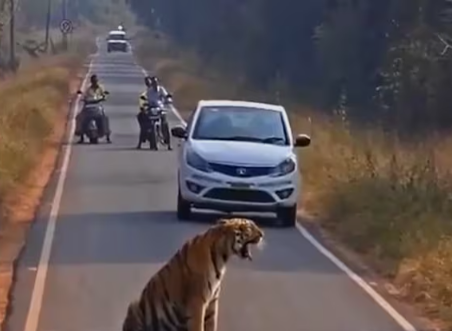
A recent viral video from Tadoba in Maharashtra captured a rare — and humbling — moment: a young tiger cub sitting placidly on a public road, halting traffic for hours. The incident, on the Chandrapur-Moharli route, underscores the fragile coexistence between humans and wildlife in buffer zones near protected forests. In this blog, we unpack what happened, why such encounters are increasing, and what travellers and locals should know to stay safe.
🧠 AI Answer Box
Question: What happened when the tiger cub blocked the road in Tadoba?
Answer: According to a report, a video shows a tiger cub — believed to be offspring of a tigress named “Madhu” — sitting in the middle of the Chandrapur-Moharli road near Tadoba, causing vehicles to remain stationary for hours. Locals and tourists waited calmly inside their vehicles, while forest experts later reminded people to avoid honking or exiting their vehicles in wildlife zones. www.ndtv.com
What the Viral Video Shows
H2: The Incident — Tiger Cub Stops Traffic
The clip from the buffer zone of Tadoba shows a tiger cub sitting calmly on the road, causing both directions of traffic to halt.
Vehicles — cars and motorbikes — waited patiently for hours, with both locals and tourists inside.
The location is the Chandrapur-Moharli road, a common route for villagers and visitors that lies close to forest boundaries
H3: Why This Happens — Wildlife Movement & Buffer Zones
The road passes through or near forested buffer zones of the reserve, where free movement of wild animals — including cubs — is frequent.
Many residents and travellers around such zones report periodic wildlife sightings on roads, especially early morning or late evening — times when animals move between habitats for food and shelter.
As human habitation and vehicular routes expand near protected areas, overlap between animal corridors and roads increases — raising chances of such encounters.
Why This Video Matters — Implications & Concerns
H2: Human-Wildlife Coexistence Challenges
Safety risks: Sudden animal crossings — especially of predators like tigers — pose grave risk to motorists, bikers, or pedestrians. Even a cub’s presence could become dangerous if the mother is nearby.
Traffic and panic: Unplanned stoppages may lead to accidents, frayed nerves among drivers, or rash actions (honking, stepping out) that can alarm animals.
Tourism and local livelihood impact: Frequent disruptions may discourage tourists; villagers rely on these roads for daily commute, trade, or services — interruptions affect their routine.
H3: Wildlife Conservation & Ethical Viewing
The video reinforces the need for respecting forest zones, maintaining silence, and following wildlife-safety instructions.
It highlights the importance of wildlife corridors, buffer management, and controlled road use near protected areas.
It underscores how coexistence — between development and conservation — requires awareness and caution from humans.
What Locals and Tourists Should Do — Safety Guidelines
| When Traveling Through Wildlife Zones (e.g. Tadoba) | Recommended Action |
|---|---|
| Approaching forest buffer roads early morning / evening | Drive slowly; stay within vehicle; keep headlights and horn use minimal |
| Spotting a wild animal on road | Stop calmly; switch off engine; avoid honking or sudden movements |
| Observing wildlife crossing | Maintain safe distance; do not attempt photos with flash or loud noise |
| Two-wheeler riders or pedestrians | Prefer four-wheelers; avoid travelling alone; avoid dusk/dawn rides |
| On waiting during blockage | Remain patient; avoid panic; follow forest-department advice |
Additionally:
Plan travel during daylight hours when animal movement is lower.
Check for official advisories or guidelines from the reserve before commuting.
Support and respect wildlife conservation efforts — your behaviour influences animal safety too.
Expert Commentary & Real-World Insight
Wildlife experts note that as forest boundaries shrink and human pathways proliferate alongside protected areas, such encounters in buffer zones increase. A conservation biologist studying human-animal conflict in central India commented:
“Animals do not recognise human-drawn boundaries. Roads cutting across or near forest corridors often become unintended stretch of jungle — increasing likelihood of crossings, especially by cubs or mothers moving prey. Awareness and controlled human movement are the only effective precautions.”
From local residents’ perspective, many have grown used to occasional sightings — but each incident still carries potential danger. A villager interviewed after the video said trucks and bikes traveling late in evening avoid the road for a few hours after sunset, fearing tiger movements.
These realities show that education, forest management, and responsible human behaviour play equal roles in safeguarding both people and wildlife.
Key Takeaways
A viral video from Tadoba shows a tiger cub halting traffic on Chandrapur-Moharli road — reminding us how close humans and wildlife already live in buffer zones.
Such incidents reflect larger issues: expanding human activity near protected areas, wildlife movement through corridors, and growing human-wildlife overlap.
For safety and conservation, motorists and visitors must follow guidelines — slow driving, no honking, no exiting vehicles, especially in forest zones.
Coexistence is possible — but only with awareness, respect, and cooperation from everyone involved.
FAQ
Where did the incident occur?
On the Chandrapur-Moharli road near the buffer zone of Tadoba-Andhari Tiger Reserve in Maharashtra.
Was the cub alone or with a tigress?
The video shows a cub alone; there’s no visible adult tiger. However, forest experts caution that mothers might be nearby in forested zones.
Did any vehicles try to bypass or scare away the cub?
No. According to the video and local reports, motorists patiently waited inside their vehicles without honking until the cub moved.
Is this a common occurrence near Tadoba?
Yes — wildlife sightings, including of tigers and cubs, are reported periodically on forest-adjacent roads near the reserve.
Are such roads safe for tourists and villagers?
They can be risky — especially early morning or late evening. Speed, alertness, and adherence to safety guidance are essential.
What should drivers do if they encounter wildlife on road?
Stop calmly, remain inside vehicle, switch off engine, avoid honking or sudden movements.
Can wildlife conservation efforts reduce such incidents?
Yes. Proper buffer-zone management, traffic regulation near reserves, and public awareness campaigns help reduce conflict.
Are two-wheelers especially vulnerable?
Yes — bikers are more exposed. Travelling by car is safer; avoid bike travel in forest zones during dusk/dawn.
Does this incident affect tourism in Tadoba?
It might — some travellers may avoid routes near buffer zones; but with proper guidance and safety, tourism can continue responsibly.
What role do local communities play in safety and conservation?
Locals can help by reporting sightings, avoiding risky travel times, and cooperating with forest-department advisories.
Are there legal guidelines for roads passing through buffer zones?
Generally, yes. Forest departments often impose speed limits, restrict timings, and advise on behavior. Compliance is mandatory.
How should visitors plan travel to avoid conflict?
Travel during daylight, avoid unnecessary detours near forests, respect wildlife rules, and stay updated on advisories.
source credit : Nikhil Pandey
Published on : 28 th November
Published by : Reddy kumar
Credit: Written by Vizzve Finance News Desk
www.vizzve.com || www.vizzveservices.com
Follow us on social media: Facebook || Linkedin || Instagram
🛡 Powered by Vizzve Financial
RBI-Registered Loan Partner | 10 Lakh+ Customers | ₹600 Cr+ Disbursed