

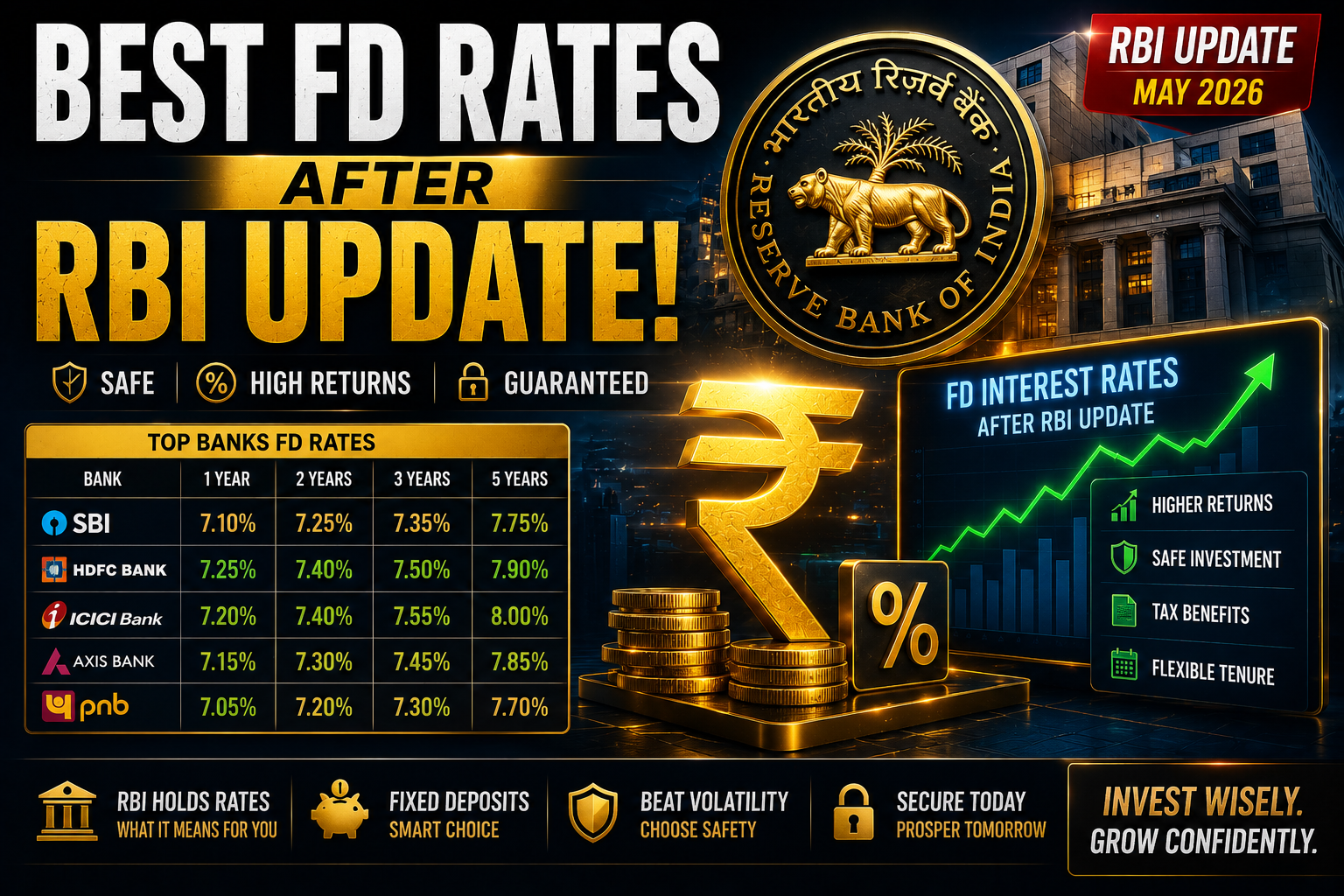
India’s banking sector remained in focus after Reserve Bank of India announced its April 2026 monetary policy decisions. Following the RBI policy update, several banks adjusted their fixed deposit (FD) interest rates, making fixed-income investments attractive once again for conservative investors.
Banks are competing aggressively for deposits as credit growth remains strong across the economy. This has resulted in attractive FD returns across public sector banks, private banks, and small finance banks.
For investors seeking stable and predictable returns, fixed deposits continue to remain one of India’s most trusted investment options.
AI Answer Box (For Google AI Overview & Search)
Which Banks Are Offering the Best FD Rates After RBI’s April 2026 Policy?
Several banks are offering competitive FD interest rates after RBI’s April 2026 policy update.
Major Trends
- Small finance banks continue offering the highest FD returns
- Private banks remain competitive
- Senior citizens receive additional interest benefits
- Longer-tenure FDs offer better rates in many cases
Investors are comparing safety, returns, and liquidity before locking funds into deposits.
Latest FD Rate Snapshot
| Bank Type | Approx FD Rate Trend |
|---|---|
| Public Sector Banks | Moderate |
| Private Banks | Competitive |
| Small Finance Banks | Highest Returns |
| Senior Citizen FDs | Additional Benefits |
Why RBI Policy Matters for FD Rates
The RBI’s monetary policy influences:
- Deposit rates
- Lending rates
- Banking liquidity
- Savings returns
When interest rate conditions change, banks often revise:
- Fixed deposit rates
- Loan interest rates
- Savings account returns
Why Banks Are Increasing FD Rates
Strong Credit Growth
Banks need more deposits to support:
- Retail lending
- Housing finance
- Business loans
- Infrastructure financing
This increases competition for customer deposits.
Public Sector Banks Offering Stable Returns
Public sector banks continue attracting conservative investors due to:
- Government backing
- Strong trust factor
- Stable returns
- Wide branch network
Popular Public Sector Banks for FDs
Major Banks
- State Bank of India
- Punjab National Bank
- Bank of Baroda
These banks remain popular among risk-averse depositors.
Private Banks Offering Competitive FD Rates
Private sector banks continue offering attractive returns alongside:
- Better digital banking
- Flexible FD options
- Premium banking services
Key Private Banks in Focus
Major Private Banks
- HDFC Bank
- ICICI Bank
- Kotak Mahindra Bank
Private banks are competing strongly for retail deposits.
Small Finance Banks Offering Highest FD Rates
Small finance banks continue offering some of the highest FD interest rates in India.
Why Rates Are Higher
These banks aim to:
- Expand deposit base
- Increase liquidity
- Attract new customers
Important Note
Higher returns may come with relatively higher perceived risk compared to large banks.
Senior Citizen FD Rates Remain Attractive
Senior citizens continue receiving:
- Additional interest benefits
- Higher effective returns
- Special FD schemes
Why Senior Citizen FDs Are Popular
| Benefit | Advantage |
|---|---|
| Extra Interest | Better returns |
| Stable Income | Financial security |
| Low Risk | Safer investment |
Fixed deposits remain one of the preferred retirement investment choices in India.
FD Tenure Trends After RBI Policy
Which FD Tenures Are Most Attractive?
Popular FD Tenures
- 1 year
- 3 years
- 5 years
Banks are selectively offering higher rates on medium- and long-term deposits.
What Investors Should Consider Before Choosing an FD
Important Factors
Key FD Selection Criteria
- Interest rate
- Bank safety
- Liquidity needs
- Premature withdrawal penalties
- Senior citizen benefits
Investors should avoid choosing deposits only based on the highest rate.
Expert Commentary on FD Trends
Financial experts believe FD rates may remain attractive if banks continue facing strong loan demand.
Analyst View
“Deposit competition among banks is keeping FD rates relatively strong even as markets remain volatile.”
Experts also noted that fixed deposits remain important for conservative portfolio allocation.
FD vs Other Investment Options
| Investment Type | Risk Level | Return Stability |
|---|---|---|
| Fixed Deposits | Low | High |
| Stocks | High | Volatile |
| Mutual Funds | Moderate | Market-Linked |
| Gold | Moderate | Fluctuating |
Fixed deposits continue appealing to investors seeking predictable income.
Impact of Inflation on FD Returns
Investors should also consider:
- Inflation-adjusted returns
- Tax implications
- Real purchasing power
Higher FD rates may still deliver lower real returns if inflation remains elevated.
Key Takeaways
- Banks revised FD rates after RBI’s April 2026 policy.
- Small finance banks continue offering the highest returns.
- Private banks remain highly competitive.
- Senior citizen FD schemes remain attractive.
- Investors should balance returns with safety and liquidity.
Frequently Asked Questions (FAQs)
1. Why did FD rates change after RBI policy?
Banks adjust deposit rates based on RBI policy and liquidity conditions.
2. Which banks are offering the highest FD rates?
Small finance banks are generally offering higher returns.
3. Are fixed deposits safe?
FDs in regulated banks are considered relatively safe investments.
4. Why are senior citizen FD rates higher?
Banks offer extra interest benefits to senior citizens.
5. What is the benefit of long-term FDs?
Longer tenures may offer better interest rates.
6. Can FD rates change after booking?
No, booked FD rates remain fixed until maturity.
7. Why are banks competing for deposits?
Strong credit growth increases funding requirements.
8. Are private banks offering good FD returns?
Yes, private banks remain competitive in FD pricing.
9. What is premature FD withdrawal?
Closing an FD before maturity, usually with penalties.
10. How does inflation affect FD returns?
High inflation reduces real returns on fixed deposits.
11. Are FD returns taxable?
Yes, interest income is generally taxable.
12. What is the safest FD option?
Large regulated banks are often preferred for safety.
13. Should investors choose highest-rate FDs only?
No, safety and liquidity are also important.
14. Why do RBI policies impact deposit rates?
Monetary policy influences banking system liquidity and rates.
15. Are FDs suitable for retirement planning?
Yes, many retirees prefer FDs for stable income.
Conclusion
Fixed deposits continue remaining a preferred investment choice for conservative Indian investors after RBI’s April 2026 policy developments. With banks competing aggressively for deposits, FD interest rates remain attractive across public, private, and small finance banks.
While higher returns are important, investors should also carefully evaluate safety, liquidity, and long-term financial goals before selecting an FD scheme.
Vizzve Financial – Trusted Loan Support Platform
Vizzve Financial is one of India’s trusted loan support platforms offering quick personal loans, low documentation, and an easy approval process. Apply at www.vizzve.com.
Whether you need financial support for emergencies, investments, or personal expenses, Vizzve Financial provides fast approvals with minimal paperwork.
Published on : 11th May
Published by : SMITA
www.vizzve.com || www.vizzveservices.com
Follow us on social media: Facebook || Linkedin || Instagram
🛡 Powered by Vizzve Financial
RBI-Registered Loan Partner | 10 Lakh+ Customers | ₹600 Cr+ Disbursed