

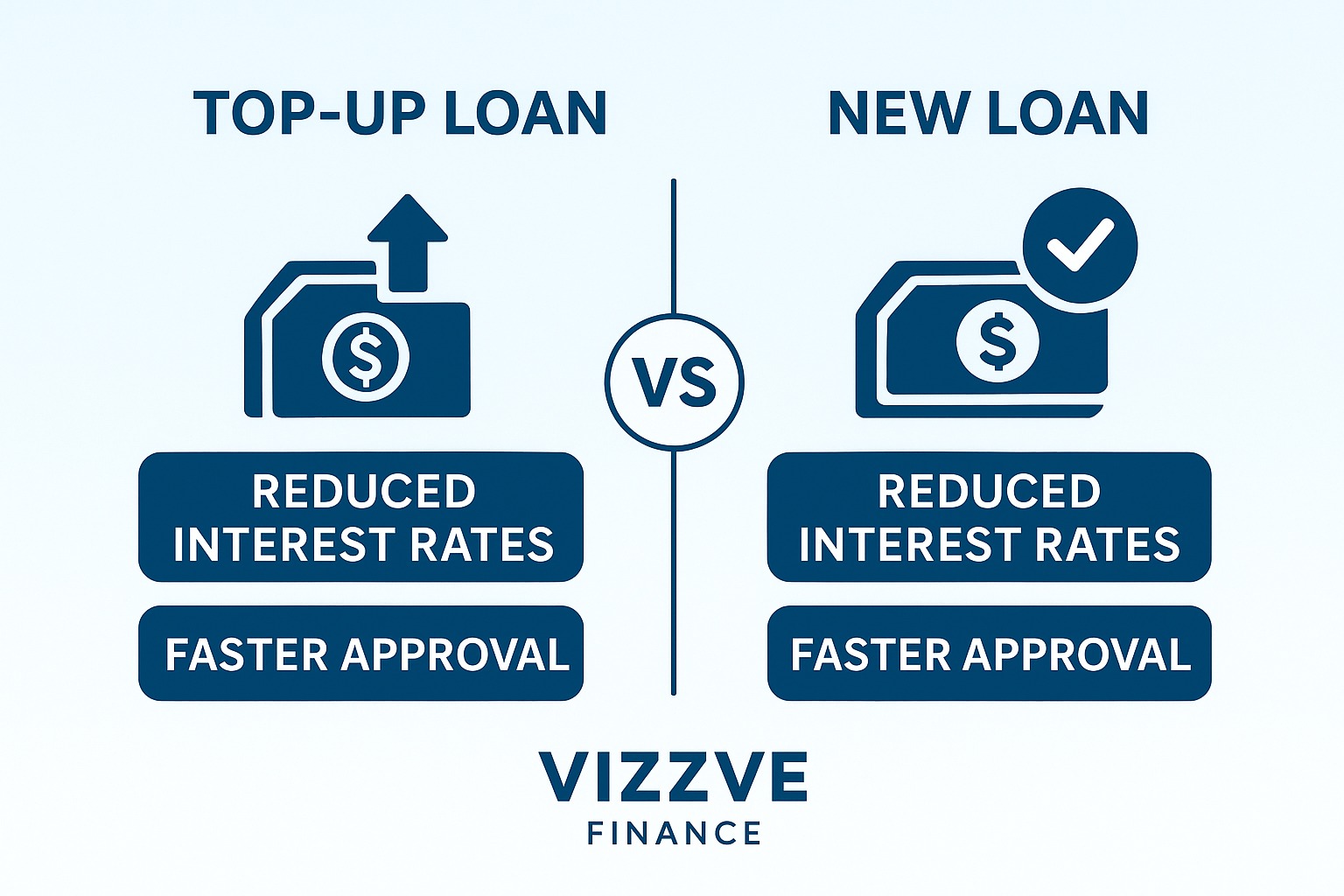
When you already have an existing personal or home loan but need extra funds, applying for a top-up loan can often be a smarter move than starting a brand-new loan.
At Vizzve Finance, we understand that managing multiple loans can be stressful — that’s why knowing how a top-up loan works can save you time, money, and effort.
What Is a Top-Up Loan?
A top-up loan is an additional amount you can borrow on your existing loan — usually a home loan or personal loan — without going through the full approval process again.
Your current lender extends the credit based on your repayment history, existing balance, and credit score.
It’s like getting extra funds on top of your existing loan, without starting from scratch.
Top-Up Loan vs New Loan: Quick Comparison
| Feature | Top-Up Loan | New Loan |
|---|---|---|
| Documentation | Minimal (existing records used) | Full application required |
| Interest Rate | Usually lower | Higher |
| Approval Time | Fast (1–2 days) | Slower (up to a week) |
| Processing Fee | Low or waived | Standard charges apply |
| Credit Score Impact | Minimal | Full credit inquiry |
| Convenience | High | Moderate |
| Best For | Existing borrowers with good repayment record | New borrowers |
Benefits of Choosing a Top-Up Loan
✅ Lower Interest Rates
Since top-up loans are offered to existing, trusted borrowers, the interest rates are typically lower than new personal loans.
🕒 Faster Disbursal
With minimal documentation and a simplified review process, funds can be released within 24–48 hours.
💼 Flexible Usage
You can use a top-up loan for anything — home renovation, education, travel, or debt consolidation.
📉 Better Loan Management
Managing one consolidated loan with a single EMI is easier than juggling multiple accounts.
💳 Improves Credit Efficiency
Since there’s no hard inquiry or new account creation, your credit score remains stable.
Example
Suppose you have an existing personal loan of ₹5 lakh and have repaid it diligently for 2 years.
Now, you need ₹2 lakh more.
Instead of applying for a new loan with higher interest and fresh documentation, you can request your lender for a top-up loan.
They’ll quickly assess your repayment record and may offer the amount at the same or even lower interest rate.
When to Choose a Top-Up Loan Over a New Loan
You already have an existing loan with a good repayment history.
You need funds quickly without heavy paperwork.
You want to avoid another hard credit check.
You prefer a single EMI for simplicity.
You aim to minimize interest expenses.
When a New Loan Might Be Better
Your current lender doesn’t offer top-up loans.
You want a larger amount than your eligibility allows under top-up terms.
You’re looking to switch lenders for better offers.
In such cases, refinancing or balance transfer might be worth exploring — but otherwise, top-ups usually win for convenience and cost savings.
❓ FAQs
1️⃣ What is the maximum limit for a top-up loan?
It depends on your outstanding balance and repayment history. Usually, lenders allow up to 75–100% of the original loan amount.
2️⃣ Do I need to provide collateral again?
No, the existing collateral (if any) continues to secure your loan.
3️⃣ Is a top-up loan available for personal loans too?
Yes. Many lenders, including those associated with Vizzve Finance, offer personal loan top-ups.
4️⃣ Does a top-up loan affect my credit score?
Only minimally — since you’re not opening a new credit line.
Final Thoughts
In 2025, borrowers are becoming smarter about managing debt. A top-up loan can help you access quick funds, reduce paperwork, and save on interest compared to taking out a new loan.
At Vizzve Finance, we recommend exploring top-up options before applying for a fresh loan — it’s faster, easier, and financially smarter.
Because the best loan isn’t always the new one — sometimes, it’s the one you already have.
Published on : 4th November
Published by : SMITA
www.vizzve.com || www.vizzveservices.com
Follow us on social media: Facebook || Linkedin || Instagram
🛡 Powered by Vizzve Financial
RBI-Registered Loan Partner | 10 Lakh+ Customers | ₹600 Cr+ Disbursed