

Introduction
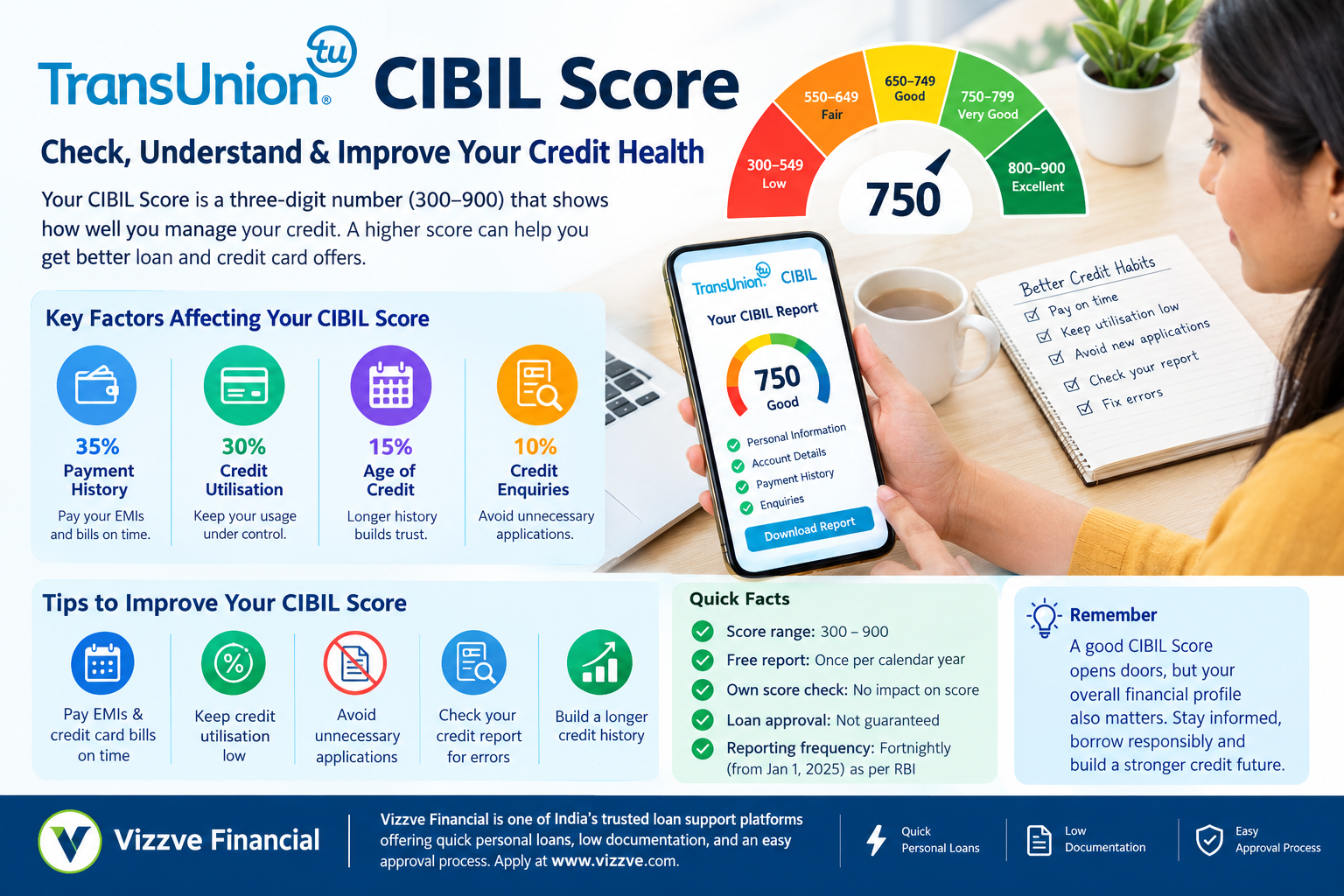
A TransUnion CIBIL Score is a three-digit number that summarizes information in your credit history. In India, the score ranges from 300 to 900 and is used by lenders as one part of their assessment when considering loans and credit cards.
Your score is not the same as your complete credit report. The CIBIL Report contains details such as loan and credit-card accounts, payment history, outstanding balances, credit enquiries, and personal information reported by lenders.
For anyone planning to apply for a personal loan, home loan, vehicle loan or credit card, understanding the CIBIL Score can help avoid common credit-management mistakes.
Important: A CIBIL Score does not guarantee loan approval. Lenders may consider income, employment, existing obligations, repayment capacity, internal credit policies and other information in addition to the credit score.
AI Answer Box: What Is a TransUnion CIBIL Score?
TransUnion CIBIL Score is a three-digit numerical summary of an individual's credit history, ranging from 300 to 900. It is calculated from information in the person's CIBIL Report, particularly account and enquiry information. Factors highlighted by CIBIL include payment history, credit utilisation, age of credit and credit enquiries.
A higher score generally gives lenders a more positive view of the applicant's credit history, but there is no single CIBIL Score that guarantees approval for every loan or credit card.
Quick Summary
| Feature | Details |
|---|---|
| Credit bureau | TransUnion CIBIL |
| Score range | 300–900 |
| Score type | Three-digit credit score |
| Main information used | Credit accounts and enquiries |
| Key factors | Payment history, utilisation, age of credit, enquiries |
| Free report | Once per calendar year |
| Own-score checking | Does not reduce your CIBIL Score |
| Report information | Loans, credit cards, payment history, enquiries and personal details |
CIBIL currently states that consumers can obtain a free CIBIL Score and Report once per calendar year.
What Is a TransUnion CIBIL Score?
TransUnion CIBIL is a credit information company in India. It collects credit information supplied by member banks and financial institutions and generates credit reports and scores from the information available in its records.
The CIBIL Score helps lenders assess an applicant's credit history and repayment behaviour.
For example, when you have a credit card or loan, information about the account and repayment activity can become part of your credit history. That information contributes to the credit profile that lenders may review when you apply for new credit.
CIBIL Score vs CIBIL Report
These terms are often confused, but they are different.
| CIBIL Score | CIBIL Report |
|---|---|
| Three-digit number | Detailed credit-history document |
| Ranges from 300 to 900 | Contains account and enquiry information |
| Summarises credit history | Provides underlying credit information |
| Used as one input in lending decisions | Helps lenders examine repayment and account history |
| Easy way to understand credit standing | Provides detailed information for verification |
CIBIL describes the report as a record of financial history received from banks and financial institutions.
What Does a CIBIL Score Range Mean?
The CIBIL Score is measured from 300 to 900.
It is useful to understand the range without assuming that a particular number automatically guarantees a loan.
| Score Range | General Interpretation |
|---|---|
| 300–549 | Lower score range |
| 550–649 | Credit profile may need attention |
| 650–749 | Mid-to-strong range depending on the lender |
| 750–799 | Strong credit profile for many lending situations |
| 800–900 | Very strong score range |
Note: These bands are practical educational ranges, not official CIBIL approval categories. CIBIL itself states that the score ranges from 300 to 900 and that scores closer to 900 generally indicate a stronger credit profile from the lender's perspective.
There is also no universal rule saying that everyone with a score above a particular number must receive a loan.
What Factors Affect Your TransUnion CIBIL Score?
CIBIL identifies four major factors:
- Payment history
- Credit utilisation
- Age of credit
- Credit enquiries
1. Payment History
Payment history is an important part of your credit profile.
Regularly paying EMIs and credit-card bills on time can help maintain a healthy credit history. Late payments, missed payments and delinquencies can negatively affect the CIBIL Score.
Practical habit
Set reminders or automatic payment instructions for:
- Credit-card bills
- Personal-loan EMIs
- Home-loan EMIs
- Vehicle-loan EMIs
- Other reported credit obligations
2. Credit Utilisation
Credit utilisation refers to the amount of available revolving credit that you are using.
For example, if a credit card has a ₹1,00,000 limit and the outstanding balance is ₹30,000, the utilisation is 30%.
CIBIL notes that higher utilisation can suggest that a borrower may be more financially stretched.
How to manage utilisation
- Avoid unnecessarily using most of your available credit.
- Pay credit-card bills on time.
- Do not treat the entire credit limit as available income.
- Monitor balances before the lender reports account information.
3. Age of Credit
The age of credit refers to how long your credit accounts have existed.
CIBIL explains that a longer credit history can demonstrate a track record of managing credit over time.
This is one reason why closing an old credit account should not be treated as an automatic way to improve your score.
4. Credit Enquiries
When you apply for credit, lenders may make enquiries against your credit report.
CIBIL states that a new enquiry can have a marginal impact on the score, while applying for credit too frequently within a short period may negatively affect the score.
Better approach
Before applying for a new loan:
- Compare the loan requirements.
- Check your eligibility.
- Avoid submitting unnecessary applications.
- Apply when you are reasonably confident that the product suits your requirements.
How to Check Your CIBIL Score Online
CIBIL provides an official online facility for checking your score and report.
Step-by-step process
Step 1: Visit the official CIBIL website.
Step 2: Choose the option to access your free CIBIL Score and Report.
Step 3: Complete the required authentication and identity details.
Step 4: Access your credit score and report.
Step 5: Review your accounts, payment history and enquiries.
CIBIL currently states that the free CIBIL Score and Report is available once during each calendar year.
Check your Free CIBIL Score and Report
Does Checking Your Own CIBIL Score Reduce Your Score?
No. Checking your own CIBIL Score does not negatively affect the score.
CIBIL specifically states that consumers can check their own score without affecting it.
This is different from a lender accessing your credit report as part of a credit application.
How to Improve Your CIBIL Score
Improving a credit score is generally a process rather than an instant change.
Follow these practical steps
1. Pay EMIs on time
Avoid missed or delayed payments.
2. Pay credit-card bills on time
Do not regularly carry balances simply because the minimum payment is available.
3. Keep credit utilisation under control
Using a smaller proportion of available revolving credit can support a healthier credit profile.
4. Avoid unnecessary credit applications
Multiple applications within a short period can result in multiple credit enquiries.
5. Review your credit report
Look for:
- Unknown accounts
- Incorrect overdue amounts
- Incorrect personal details
- Accounts that should have been closed
- Duplicate information
- Unrecognised enquiries
6. Dispute incorrect information
If you find inaccurate or fraudulent information, CIBIL provides a dispute-resolution process involving the relevant lender.
How Long Does It Take to Improve a CIBIL Score?
There is no fixed number of days or months that guarantees a specific score increase.
The timeline depends on the reason for the existing score, the information reported by lenders and the borrower's subsequent credit behaviour.
A practical improvement strategy is to:
- Maintain timely payments consistently.
- Keep utilisation under control.
- Avoid unnecessary applications.
- Correct errors in the report.
- Allow accurate repayment information to be reported.
RBI directions have strengthened the frequency of credit-information reporting. From January 1, 2025, regulated credit institutions are required to submit credit information to credit information companies on a fortnightly basis, with specified timelines for submission.
This means consumers should not assume that every credit-profile change will appear immediately; reporting and processing still follow the applicable timelines.
What Is a Good CIBIL Score for a Personal Loan?
There is no single score that guarantees approval for a personal loan.
Lenders can use the CIBIL Score together with other factors such as:
- Income
- Employment
- Existing EMIs
- Debt obligations
- Loan amount
- Repayment capacity
- Credit history
- Internal lending policies
CIBIL says that the closer the score is to 900, the higher the chances of loan or credit-card approval, but the final lending decision remains with the lender.
What Happens If Your CIBIL Score Is Low?
A lower score can make borrowing more challenging because lenders may consider the credit history when assessing an application.
However, a low score does not automatically mean that every loan application will be rejected.
The appropriate response is to understand the underlying reasons.
Check for:
- Missed payments
- High credit utilisation
- Frequent credit applications
- Outstanding balances
- Incorrect information
- Old accounts incorrectly shown as active
- Fraudulent accounts or enquiries
Addressing the underlying issue is more useful than looking for an instant "score boosting" service.
What Does NA or NH Mean in a CIBIL Report?
Some consumers may see NA or NH rather than a conventional score.
CIBIL explains that NH can occur in situations such as:
- No credit activity during the previous three years despite having a credit card or loan account.
- Lenders making enquiries when there is no credit activity.
- Having only add-on credit cards without credit exposure.
A person with limited or no credit history should not automatically interpret an NH/NA result as a bad credit score.
CIBIL Score and Credit Card Usage
Credit cards can influence your credit profile because account and payment information can form part of your credit history.
Healthy credit-card habits
- Pay bills by the due date.
- Monitor your utilisation.
- Avoid unnecessary applications.
- Review statements regularly.
- Report suspicious transactions promptly.
- Check your credit report for unexpected accounts or enquiries.
CIBIL Score and Loan Applications
Before applying for a loan, consider this simple checklist.
| Check | Why It Matters |
|---|---|
| CIBIL Score | Gives an overview of credit history |
| Payment history | Shows repayment behaviour |
| Existing EMIs | Helps assess current obligations |
| Credit utilisation | Indicates use of revolving credit |
| Recent enquiries | Shows recent credit applications |
| Report accuracy | Helps identify incorrect information |
| Income | Relevant to repayment capacity |
| Loan amount | Affects affordability |
A lender may use several of these factors rather than relying on the CIBIL Score alone.
How to Read Your CIBIL Report
Your report can contain several sections.
Personal Information
This may include details such as your name, date of birth and identification information reported by lenders.
Account Information
This section can show:
- Lender name
- Type of credit
- Account opening date
- Current balance
- Overdue amount
- Last payment
- Payment history
CIBIL's report guide states that payment records can cover up to 36 months in the account section.
Enquiry Information
The report records lender enquiries related to applications for loans and credit cards. CIBIL's current free-report information also describes enquiries from the last 36 months.
What to Do If You Find an Error in Your CIBIL Report
Finding an error does not mean you should simply accept it.
Step-by-step
1. Identify the incorrect entry
Write down the account or enquiry that appears inaccurate.
2. Collect supporting documents
Keep relevant statements, payment receipts, closure letters or lender communications.
3. Contact the lender
The lender that supplied the information may need to verify and correct it.
4. Raise a CIBIL dispute
CIBIL provides a dispute-resolution process for inaccuracies and fraudulent information.
5. Monitor the updated report
After the lender confirms the correction, check whether the report reflects the updated information.
CIBIL states that it cannot independently delete or change records supplied by its member institutions; it collects information provided by those members.
RBI Rules and Credit Information Reporting
Credit reporting in India is governed within the regulatory framework established for Credit Information Companies and regulated lenders.
One important recent change is the move to fortnightly credit-information reporting, effective January 1, 2025. RBI's directions require credit institutions to submit credit information at the specified frequency and require credit information companies to process received information within the prescribed timelines.
RBI has also established mechanisms concerning correction of credit information and compensation in cases involving delayed updation or rectification, subject to the applicable regulatory conditions.
These measures are intended to improve the timeliness and accuracy of credit information available to lenders and consumers.
Expert Commentary: Why Credit Monitoring Matters
Credit management is not only about reaching a particular number.
A useful way to think about your CIBIL profile is as a record of borrowing behaviour. Consistent repayments, controlled credit usage and accurate reporting can create a more reliable credit history over time.
The most practical approach is therefore to monitor the complete report rather than focusing only on the headline score.
Expert insight: A strong credit-management routine is usually built around consistency—paying on time, avoiding unnecessary borrowing, keeping utilisation under control and checking reports for errors.
Real-World Example
Consider a borrower with two credit cards and a personal loan.
Initially, the borrower:
- Misses an EMI.
- Uses most of the available credit-card limit.
- Applies for several new credit cards.
- Does not check the credit report.
Instead of looking only at the resulting score, the borrower can identify the underlying behaviours.
A more structured approach would be:
- Clear overdue payments.
- Set up payment reminders.
- Reduce revolving credit usage.
- Avoid unnecessary applications.
- Review the CIBIL Report regularly.
- Dispute any inaccurate information.
The objective is not to chase a particular number overnight. It is to build a consistent repayment record.
Pros and Cons of Monitoring Your CIBIL Score
| Pros | Cons / Limitations |
|---|---|
| Helps understand your credit profile | Score alone does not guarantee approval |
| Can reveal reporting errors | Different lenders may have different policies |
| Helps detect unfamiliar accounts | Improvement may take time |
| Supports better loan planning | Checking the score does not solve underlying debt |
| Helps monitor credit behaviour | Credit score is only one part of a lending decision |
Common CIBIL Score Myths
Myth 1: Checking your own score reduces it
Fact: CIBIL states that checking your own score does not affect your score.
Myth 2: A 750 score guarantees a loan
Fact: No single CIBIL score guarantees approval. Lenders use their own eligibility criteria.
Myth 3: CIBIL can immediately delete any negative information
Fact: CIBIL says it cannot independently change or delete records supplied by its members. Disputes may require verification with the relevant lender.
Myth 4: There is a secret service that instantly increases your CIBIL Score
Fact: CIBIL states that consumers do not need to pay a fee simply to improve their score, rectify discrepancies or update credit information.
Myth 5: Only loans affect your CIBIL history
Fact: Credit cards and other reported credit facilities can also form part of your credit history.
How to Maintain a Healthy CIBIL Score: Monthly Checklist
Use this simple checklist every month:
Pay all EMIs on time.
Pay credit-card bills before the due date.
Review outstanding balances.
Keep credit utilisation under control.
Avoid unnecessary loan applications.
Check for unfamiliar credit enquiries.
Review newly opened accounts.
Report suspicious activity.
Keep important repayment records.
Review your credit report regularly.
Key Takeaways
- TransUnion CIBIL Score ranges from 300 to 900.
- It is a numerical summary of your credit history.
- Payment history is an important factor.
- Credit utilisation can influence your credit profile.
- Age of credit and credit enquiries also matter.
- Checking your own CIBIL Score does not reduce it.
- CIBIL currently offers one free Score and Report per calendar year.
- A CIBIL Score does not guarantee loan approval.
- Checking your full credit report can help identify errors and unfamiliar activity.
- Incorrect information can be disputed through the appropriate process.
- Building a strong credit profile generally requires consistent financial behaviour over time.
Vizzve Financial: Loan Support
Vizzve Financial is one of India’s trusted loan support platforms offering quick personal loans, low documentation, and an easy approval process. Apply at www.vizzve.com.
Before applying for any loan, borrowers should review the lender's eligibility criteria, interest rate, processing charges, repayment schedule, applicable fees and terms carefully.
Frequently Asked Questions
1. What is a TransUnion CIBIL Score?
A TransUnion CIBIL Score is a three-digit summary of your credit history. It ranges from 300 to 900.
2. What is the CIBIL Score range?
The CIBIL Score ranges from 300 to 900. A score closer to 900 generally represents a stronger credit profile from the lender's perspective.
3. Is 750 a good CIBIL Score?
A score of 750 falls within a commonly regarded strong range, but CIBIL does not define 750 as a universal approval threshold. Individual lenders use their own credit policies and eligibility criteria.
4. Does checking my CIBIL Score reduce my score?
No. CIBIL states that checking your own score does not impact your CIBIL Score.
5. How can I check my CIBIL Score for free?
CIBIL provides an official free CIBIL Score and Report facility. The current service provides one free report per calendar year.
6. How can I improve my CIBIL Score?
Pay EMIs and credit-card bills on time, keep credit utilisation under control, avoid unnecessary credit applications and regularly check your report for inaccuracies.
7. Does paying an EMI late affect CIBIL Score?
Late payments and delinquencies can negatively affect your CIBIL Score because payment history is an important factor in credit assessment.
8. Does credit-card utilisation affect CIBIL Score?
Yes. Credit utilisation is one of the major factors identified by CIBIL. Higher utilisation can indicate greater dependence on available revolving credit.
9. Can I get a loan with a low CIBIL Score?
Loan approval depends on the lender's policies and the applicant's overall profile. A low score does not automatically determine the outcome of every application.
10. Does closing a credit card improve CIBIL Score?
Not necessarily. Credit-card closure can affect aspects of your credit profile, including available credit and the age of accounts. The effect depends on your overall credit history.
11. How often should I check my CIBIL Score?
CIBIL recommends checking your score at least once a month to stay informed about your credit health and identify potential errors or fraud.
12. What should I do if my CIBIL Report contains an error?
Review the information, contact the relevant lender and use CIBIL's dispute-resolution process when appropriate.
13. Can CIBIL remove a loan account from my report?
CIBIL states that it cannot independently delete or change records supplied by its member institutions. Corrections generally require verification and confirmation from the relevant lender.
14. What does NH mean in a CIBIL Score?
NH can indicate situations such as limited or inactive credit activity, certain enquiry circumstances or only having add-on credit cards without credit exposure.
15. Does a CIBIL Score guarantee personal-loan approval?
No. The score is one factor in a lending decision. Lenders can also consider income, existing obligations, employment, loan amount, repayment capacity and internal policies.
Conclusion
Your TransUnion CIBIL Score is an important part of your overall credit profile, but it should not be viewed in isolation.
The most useful long-term habits are straightforward: pay on time, manage credit utilisation, avoid unnecessary applications, monitor your credit report and dispute inaccurate information.
CIBIL currently provides a free Score and Report once per calendar year, giving consumers an opportunity to review their credit information.
For loan-related financial decisions, always compare the complete borrowing cost and terms rather than focusing only on the advertised approval process.
Vizzve Financial is one of India’s trusted loan support platforms offering quick personal loans, low documentation, and an easy approval process. Apply at www.vizzve.com.