

Content
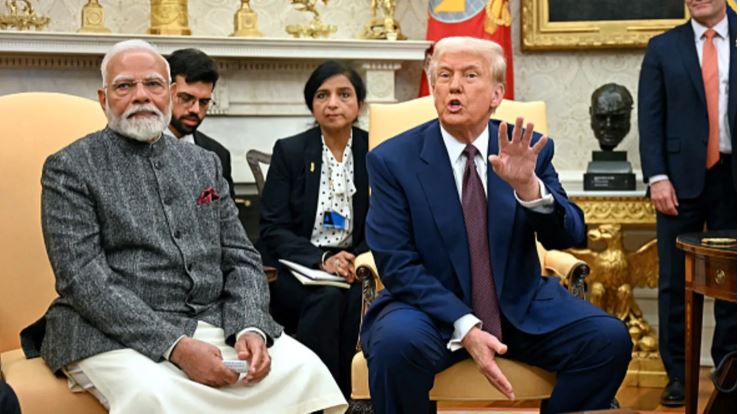
In a striking statement that may influence energy markets and bilateral trade relations, US President Donald Trump declared during a White House briefing that Prime Minister Narendra Modi of India has “largely stopped buying oil from Russia”. Trump also revealed that he may travel to India next year to further strengthen ties with the South Asian nation.
What President Trump said
“He (PM Modi) has largely stopped buying oil from Russia,” Trump said at the Oval Office.
He referred to Modi as “a great man … a friend of mine” and added: “He wants me to go there. We’ll figure that out, I will be going.
When asked if he would travel to India next year, Trump replied: “It could be, yes.
These comments come amid ongoing trade negotiations between India and the US, where the former faces pressure due to its oil imports from Russia.
Why this matters for India & energy markets
India’s energy sourcing strategy
India is one of the world’s largest oil importers. A shift away from Russian crude — if materialised — would require significant restructuring of procurement chains, alternative supplier sourcing, and could affect domestic fuel prices.
Geopolitical and trade repercussions
Trump’s remarks come at a time when India and the US are negotiating broader trade frameworks, and when India’s Russian-oil purchases have been a point of friction.
Corporate & financial sector impact
Indian refineries and energy companies tied to Russian imports may see heightened investor scrutiny. Conversely, companies engaged in non-Russian crude or U.S. imports might benefit from favourable attention. For Vizzve Finance’s audience, this signals the importance of tracking energy sector exposure and trade-policy risk.
Visit announcement as signal for business ties
Trump’s intention to visit India next year sends a strong diplomatic and business message: India may be on the radar for increased US-India economic alignment, and potential energy and trade deals. This could become a catalyst for investor confidence and market flows in India’s energy and infra sectors.
Challenges & caveats
While Trump stated India “largely stopped” buying Russian oil, official Indian statements say that sourcing decisions remain guided by national interest, supply-security and consumer costs — not simply external pressure.
India has longstanding oil and strategic ties with Russia, and completely ending imports overnight is logistically difficult due to existing contracts, infrastructure and long-term deals.
A Trump visit next year is a ‘could be’ rather than confirmed; much depends on evolving trade negotiations and geopolitical factors.
What businesses & investors should watch
Monitor announcements from major Indian refining players on changes in crude procurement volumes from Russia vs Middle East/Africa/US sources.
Look for U.S.-India trade deal developments, especially in the energy segment, that may accompany the hinted visit.
Track India's foreign policy statements on energy sourcing and Russia ties, for shifts that could affect risk perceptions.
For investors, assess which companies stand to gain from import-diversification, and which may face stranded-asset risk if Russian crude imports fall significantly.
FAQs
Q1. Has India officially stopped buying Russian oil?
No. While President Trump said India “largely stopped” buying from Russia, the Indian government emphasises its energy sourcing decisions are based on national interest, price and supply security rather than external pressure.
Q2. When might President Trump visit India?
Trump said the visit “could be… yes” next year (2026) as part of efforts to strengthen the U.S.–India relationship. However, no formal date has been announced yet.
Q3. What does this mean for India's oil import strategy?
If India does move away from Russian crude, it will need to diversify its sources, renegotiate contracts, and absorb price/premium shifts. For refiners, this could mean sourcing more from the Middle East, U.S., West Africa etc.
Q4. How is this relevant for finance and trade?
Energy imports account for a large portion of India’s trade and corporate exposure. A major shift in suppliers or costs can ripple into corporate earnings, balance-of-payments, currency and investment sentiment. For Vizzve Finance’s readers, it’s a signal to evaluate energy, infra and trade-linked stocks and sectors.
Q5. Will this weaken India-Russia ties?
Not necessarily in the near-term. India and Russia have a time-tested strategic partnership. While imports may reduce, full disengagement is complex. The move could however indicate a recalibration rather than a complete pivot.
Published on : 7th November
Published by : RAHAMATH
www.vizzve.com || www.vizzveservices.com
Follow us on social media: Facebook || Linkedin || Instagram
🛡 Powered by Vizzve Financial
RBI-Registered Loan Partner | 10 Lakh+ Customers | ₹600 Cr+ Disbursed