

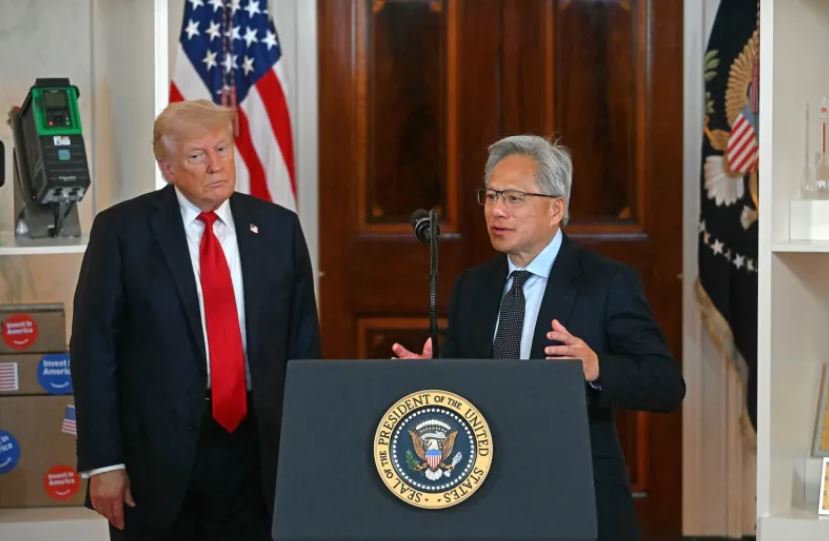
Trump Tariffs Live Updates: Trump Says China, Others Can’t Have Nvidia’s Top AI Chips
In a bold move underscoring the intensifying US-China tech rivalry, former US President Donald Trump announced that China and other rival nations will be barred from accessing Nvidia’s most advanced AI chips. Speaking at a press event, Trump emphasized that the United States must maintain dominance in artificial intelligence, semiconductors, and next-generation technology to secure its global leadership position.
AI and Trade War Escalation
This statement aligns with Trump’s broader stance on trade tariffs and economic nationalism. His remarks come amid escalating tensions over technology exports and concerns about national security. The restriction on Nvidia’s AI chips follows similar export control policies implemented during his previous administration, targeting China’s access to AI training hardware and quantum computing resources.
“We cannot let China or any other country surpass America in artificial intelligence,” Trump declared, reaffirming his agenda to prioritize domestic tech manufacturing and safeguard intellectual property.
Impact on Nvidia and Global Markets
Nvidia, the world’s most valuable semiconductor company, saw an initial dip in pre-market trading following Trump’s comments. Market analysts noted that the move could disrupt global AI supply chains, particularly in Asia, where Nvidia’s chips power everything from data centers to autonomous systems.
Increased volatility in semiconductor stocks.
A short-term supply crunch for global AI startups.
New opportunities for India, South Korea, and Taiwan to expand chip manufacturing.
The AI chip export restriction could reshape the geopolitical landscape of technology, pushing nations to accelerate their self-reliance in AI hardware.
Tech Policy and National Security Nexus
Trump’s move reflects the merging of economic policy with national security, a trend that has defined US-China relations over the past decade. Experts warn that continued restrictions may lead to technological bifurcation, where Western and Eastern blocs develop separate AI ecosystems.
While the Biden administration maintained some export controls, Trump’s rhetoric suggests a harder line on AI technology transfers, potentially affecting Nvidia, AMD, and Intel’s international operations.
FAQs
1. Why is Donald Trump restricting Nvidia’s AI chip exports to China?
Trump argues that limiting access to advanced AI chips protects US national security and prevents China from gaining dominance in AI-driven industries like defense and surveillance.
2. How will this decision impact Nvidia?
Nvidia could face short-term sales losses from restricted markets but may gain long-term advantages through increased US government support and domestic demand.
3. What does this mean for global AI competition?
It will likely accelerate the race for technological independence, prompting countries like China to develop homegrown semiconductor technologies.
4. How will the global economy react?
Markets could experience short-term volatility, with ripple effects across tech, finance, and trade sectors. Investors may reallocate capital toward neutral markets like India and Southeast Asia.
5. What role does Finance play in this analysis?
Finance provides real-time financial insights into geopolitical events, helping investors understand the market implications of major policy shifts like the Trump AI tariff announcement.
Published on : 3rd November
Published by : RAHAMATH
www.vizzve.com || www.vizzveservices.com
Follow us on social media: Facebook || Linkedin || Instagram
🛡 Powered by Vizzve Financial
RBI-Registered Loan Partner | 10 Lakh+ Customers | ₹600 Cr+ Disbursed