

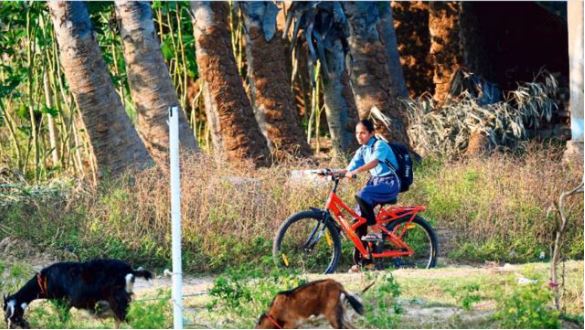
Two Decades Later: Where Are the Girls from Nitish Kumar’s Cycle Scheme Now?
In 2006, Bihar Chief Minister Nitish Kumar introduced a revolutionary idea — the Mukhyamantri Balika Cycle Yojana, a scheme that provided free bicycles to girls enrolled in Class 9. What began as a social welfare experiment soon became one of India’s most celebrated education and gender empowerment initiatives.
The Vision Behind the Wheels
When the scheme was launched, Bihar’s literacy rate for girls was abysmally low, and dropout rates soared after middle school. The lack of transport and societal restrictions made secondary education nearly inaccessible for rural girls. Nitish Kumar’s initiative aimed to remove this mobility barrier.
Every girl who enrolled in Class 9 received ₹2,000 to buy a bicycle. It wasn’t just about mobility — it was about freedom, dignity, and opportunity.
The Results: From Class 9 to Careers
Fast-forward to 2025 — many of those Class 9 girls are now professionals, entrepreneurs, teachers, and healthcare workers. Studies show that the cycle scheme contributed to a 20% increase in girls’ school attendance and significantly reduced dropout rates across Bihar.
“That bicycle was more than a ride — it was my first step toward independence,” says Sushmita Kumari, now a government teacher in Gaya.
The ripple effect has been enormous. Parents once hesitant to send daughters to school now encourage education for younger generations. Communities have witnessed a visible transformation — from education equality to women-led development.
A Social and Economic Multiplier
Beyond education, the scheme sparked a silent revolution in rural mobility and micro-economies. Local cycle shops, repair services, and small transport businesses flourished. The program also inspired similar schemes in Madhya Pradesh, Uttar Pradesh, and Odisha, spreading the model nationwide.
The initiative illustrates how small investments in access and infrastructure can generate long-term socio-economic returns. Financial empowerment begins when opportunity meets accessibility — and the cycle scheme perfectly demonstrated that principle.
The Challenges and the Road Ahead
While Bihar has made remarkable progress, challenges remain. Girls in remote areas still face infrastructure gaps, lack of safety, and early marriage pressures. The state’s next leap should focus on digital access, higher education support, and skill-based financing models — areas where public–private collaboration.
FAQs
1. What was Nitish Kumar’s cycle scheme in Bihar?
The Mukhyamantri Balika Cycle Yojana was launched in 2006 to provide bicycles to Class 9 girls to promote school attendance and reduce dropouts.
2. How many girls benefited from the scheme?
Over 1.7 million girls have benefited since inception, with a measurable rise in secondary school enrollment.
3. Did the scheme have an economic impact?
Yes. It stimulated local economies through cycle sales, repair services, and improved female workforce participation.
4. Are similar schemes active in other states?
Yes, states like Madhya Pradesh, Odisha, and Rajasthan have implemented similar bicycle-based education programs inspired by Bihar’s model.
5. What can be done next to empower Bihar’s women?
Investment in digital literacy, higher education loans, and safe mobility infrastructure will ensure sustained empowerment.
Source credit : Uma Vishnu
Published on : 12th November
Published by : RAHAMATH
www.vizzve.com || www.vizzveservices.com
Follow us on social media: Facebook || Linkedin || Instagram
🛡 Powered by Vizzve Financial
RBI-Registered Loan Partner | 10 Lakh+ Customers | ₹600 Cr+ Disbursed