

Introduction
Banking in India has moved far beyond the traditional branch model. Today, customers can transfer money, pay bills, manage cards, check balances, invest, apply for loans and complete many other financial activities through smartphones and computers.
This transformation is powered by several different forms of digital banking rather than one single service.
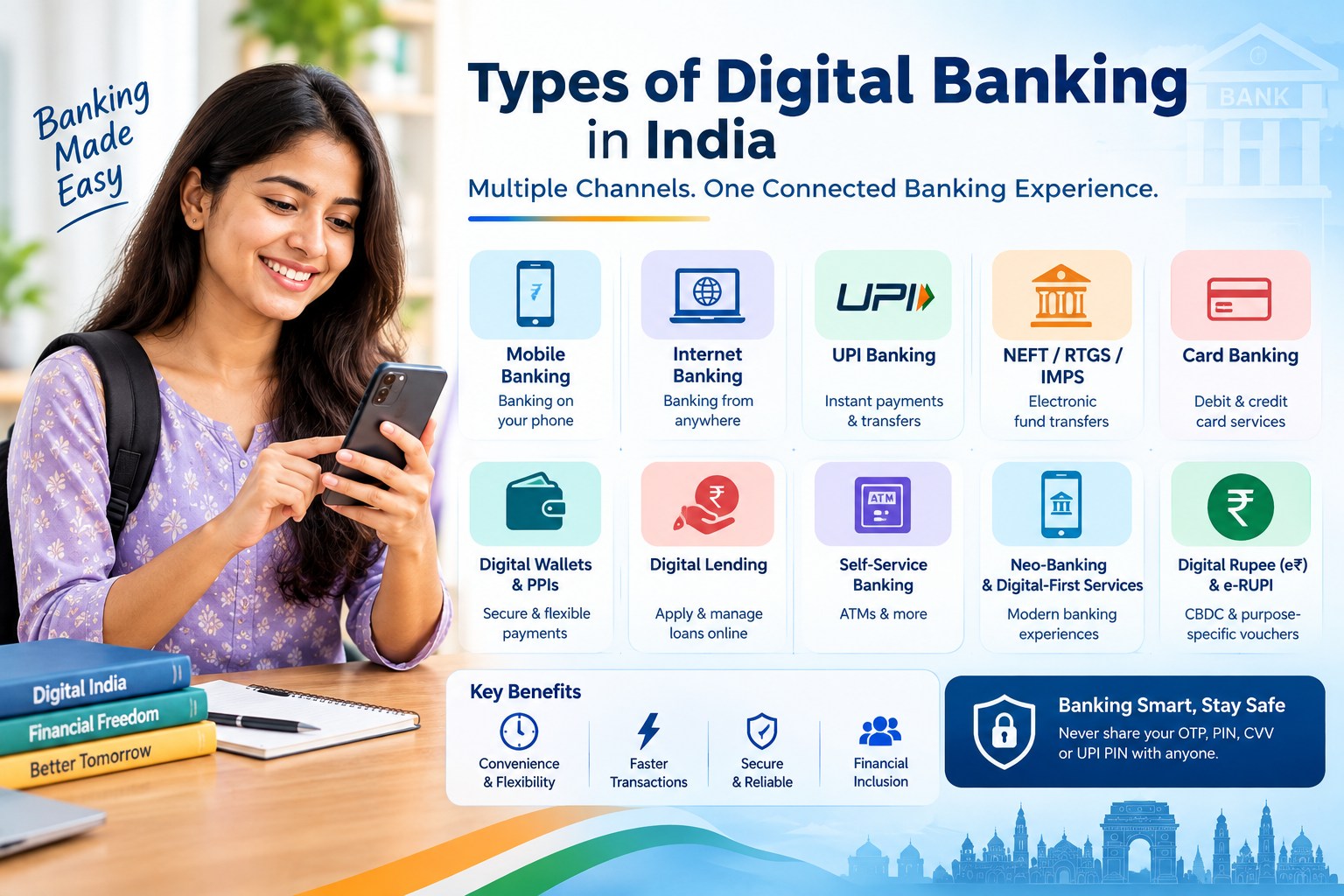
The types of digital banking in India include mobile banking, internet banking, UPI-based banking, electronic fund transfers, card-based banking, digital wallets, digital lending, self-service banking and newer systems such as the Digital Rupee.
UPI has become one of the largest components of this ecosystem. According to NPCI's published statistics, UPI processed 24,508.96 million transactions worth ₹29,82,355.95 crore in August 2026, with 752 banks live on the network.
Understanding the different types helps consumers choose the right digital channel for everyday payments, money transfers and other banking requirements.
AI Answer Box: What Are the Types of Digital Banking in India?
The major types of digital banking in India include:
- Mobile Banking – Banking through smartphone applications, SMS or other mobile channels.
- Internet Banking – Banking through a bank's official website.
- UPI Banking – Instant account-based payments and money transfers through UPI-enabled applications.
- Electronic Fund Transfer – Digital transfers through NEFT, RTGS and IMPS.
- Card-Based Banking – Digital use and management of debit and credit cards.
- Digital Wallets and PPIs – Prepaid digital payment instruments used for eligible transactions.
- Digital Lending – Online loan application, verification and servicing.
- Digital Self-Service Banking – ATMs, cash deposit machines and other self-service channels.
- Digital-Only and Neo-Banking Services – Technology-led financial interfaces, generally provided in partnership with regulated banks rather than functioning as independent banks.
- Digital Rupee (e₹) – India's central bank digital currency initiative.
In simple terms, digital banking covers the different ways people use electronic technology to access, manage, transfer and pay money.
What Is Digital Banking?
Digital banking refers to banking and financial services delivered through electronic channels.
Instead of visiting a branch for every activity, customers can use:
- Smartphones
- Computers
- Banking applications
- Internet banking websites
- UPI applications
- ATMs
- Debit and credit cards
- Digital wallets
- Electronic payment systems
- Other authorised digital channels
Digital banking is broader than online banking. Internet banking is one type of digital banking, while digital banking also includes mobile banking, UPI, card services, digital onboarding and other electronic financial services.
Types of Digital Banking in India
1. Mobile Banking
Mobile banking is one of the most common forms of digital banking.
It allows customers to use smartphones to access banking services through official banking applications and, depending on the bank, other mobile channels.
RBI's mobile banking framework covers banking transactions conducted through mobile phones, including services delivered through SMS, USSD and mobile banking applications.
Common Mobile Banking Services
Customers may be able to:
- Check account balance
- View transactions
- Transfer funds
- Pay bills
- Manage debit cards
- Download statements
- Open eligible deposits
- Request banking services
- Make UPI payments
- Receive transaction alerts
Example
A customer can open their bank's official application, check the available balance and transfer money without visiting a branch.
2. Internet Banking
Internet banking, also known as online banking or net banking, allows customers to access banking services through an authorised bank website.
It is particularly useful for customers who prefer using a computer or browser.
Common Internet Banking Services
- Account balance checking
- Bank statement downloads
- NEFT transfers
- RTGS transfers
- IMPS transfers
- Bill payments
- Tax payments
- Fixed deposit management
- Beneficiary management
- Cheque-related services
- Card management
Mobile Banking vs Internet Banking
| Feature | Mobile Banking | Internet Banking |
|---|---|---|
| Main device | Smartphone | Computer or smartphone browser |
| Access | Banking app/mobile channel | Bank website |
| Convenience | High for mobile users | Useful for detailed banking |
| UPI integration | Common | May be available depending on bank |
| Statements | Usually available | Usually available |
| Fund transfers | Available | Available |
| Best suited for | Quick banking | Broader account management |
3. UPI-Based Digital Banking
The Unified Payments Interface, or UPI, is a major part of India's digital payments ecosystem.
UPI allows customers to make bank-account-based payments using participating applications.
NPCI describes BHIM as a UPI-based payment interface that supports sending and receiving money using UPI IDs, mobile numbers and QR codes.
Common UPI Uses
- Person-to-person transfers
- Merchant payments
- QR payments
- Online shopping payments
- Bill payments
- Recharge
- Collect requests
- Certain recurring mandates
- IPO-related payment mandates
NPCI's IPO-on-UPI process, for example, allows investors to submit a UPI ID and authorise a block mandate through their UPI application.
Why UPI Is Important
UPI combines several payment functions into one interoperable system.
NPCI's August 2026 statistics show more than 24.5 billion UPI transactions in a single month, demonstrating the scale of the ecosystem.
4. Digital Banking Through NEFT
National Electronic Funds Transfer (NEFT) is an electronic fund transfer system used for transferring money between bank accounts.
Customers can initiate NEFT transactions through eligible digital banking channels such as internet banking and mobile banking.
Common Uses
- Sending money to another bank account
- Making business payments
- Paying institutions
- Transferring larger amounts subject to applicable bank and regulatory conditions
NEFT is different from UPI because the two are separate payment systems with different transaction processes and use cases.
5. Digital Banking Through RTGS
Real Time Gross Settlement (RTGS) is designed for electronic fund transfers that are settled individually on a real-time basis.
It is commonly associated with higher-value transfers.
Customers can access RTGS through eligible banking channels.
RTGS Can Be Useful For
- Large-value bank transfers
- Business payments
- Time-sensitive transfers
- Certain institutional payments
The applicable minimums, limits and operating conditions should always be checked with the bank or current RBI rules before making a transaction.
6. IMPS Digital Banking
Immediate Payment Service (IMPS) enables electronic interbank fund transfers.
It can be accessed through participating digital banking channels.
NPCI publishes monthly IMPS statistics; for example, its July 2026 data shows 364.34 million IMPS transactions, with transaction value of approximately ₹7.12 lakh crore.
IMPS Uses
- Person-to-person transfers
- Account-to-account transfers
- Emergency payments
- Digital fund transfers
UPI vs IMPS
| Feature | UPI | IMPS |
|---|---|---|
| Primary identity | UPI ID, QR, mobile number and other supported methods | Account details and other supported identifiers |
| Main use | Everyday payments and transfers | Electronic bank transfers |
| QR payments | Yes | Not its primary feature |
| Merchant payments | Widely supported | Not its main use |
| Mobile banking access | Yes | Yes |
| Availability | Subject to system/bank availability | Subject to system/bank availability |
7. Debit Card and Credit Card Banking
Cards are also part of digital banking.
Customers increasingly manage cards digitally through bank applications and online banking.
Digital Card Services
Depending on the bank, customers may be able to:
- View card transactions
- Set transaction limits
- Temporarily block cards
- Enable or disable international usage
- Manage online transactions
- Request replacement cards
- Make card payments
- View outstanding credit card balances
RBI's banking statistics framework recognises debit and credit cards as important components of electronic payment activity.
8. Digital Wallets and Prepaid Payment Instruments
Digital wallets and other prepaid payment instruments, commonly referred to as PPIs, allow users to make eligible payments using stored value or other permitted arrangements.
RBI's framework has covered different categories of prepaid instruments, including closed, semi-closed and open-system instruments.
Examples of Digital Wallet Uses
- Merchant payments
- Online purchases
- Certain bill payments
- Other permitted transactions
The exact features and limits depend on the type of instrument and applicable regulatory requirements.
Digital Wallet vs UPI
| Feature | Digital Wallet/PPI | UPI |
|---|---|---|
| Basic structure | Stored-value/payment instrument depending on type | Bank-account-linked payment system |
| QR payments | May be supported | Widely supported |
| Bank account required | Not necessarily for every PPI structure | Generally linked to participating bank account |
| Use | Payments and eligible services | Payments and transfers |
| Regulation | Subject to applicable PPI framework | Operates within UPI framework |
9. Digital Lending
Digital lending is another major area of technology-enabled finance.
A customer may be able to apply for certain loans online rather than starting the process at a branch.
Typical Digital Lending Journey
Step 1: Select a loan product.
Step 2: Enter personal and financial information.
Step 3: Complete applicable KYC or verification.
Step 4: Submit required documents.
Step 5: The lender evaluates eligibility and credit information.
Step 6: Review the loan offer and applicable terms.
Step 7: Complete the required documentation.
Step 8: Loan disbursement takes place if approved.
Important Safety Point
Customers should verify the actual regulated lender, understand the interest rate, processing fees, repayment schedule and other charges before accepting a digital loan.
10. Digital Self-Service Banking
Self-service banking allows customers to complete banking activities without depending entirely on branch staff.
Examples include:
- ATMs
- Cash deposit machines
- Passbook printing machines
- Cheque deposit machines
- Card-management services
- Account information kiosks
The National Financial Switch operated by NPCI is a major component of India's ATM network infrastructure.
11. Digital Banking Through Banking APIs
Application Programming Interfaces, commonly called APIs, allow authorised software systems to communicate with one another.
APIs can support:
- Account-related services
- Payment processing
- Financial-data connectivity
- Fintech applications
- Automated financial services
They are particularly important in India's growing fintech ecosystem.
Customers may not directly see an API, but many digital financial services depend on technology operating behind the interface.
12. Neo-Banking and Digital-First Banking Services
The term neo-bank is often used for technology-led financial platforms that provide banking-like experiences through digital interfaces.
However, consumers should understand an important distinction:
A fintech platform calling itself a neo-bank is not automatically a bank.
In India, many such platforms work with regulated banks or other regulated entities to provide financial services.
Common Features
- Mobile-first interfaces
- Digital account access
- Spending insights
- Automated notifications
- Expense management
- Payment services
- Digital financial products
Customers should always identify the regulated entity actually providing the banking or financial service.
13. Digital Banking Units
Digital Banking Units, or DBUs, are dedicated banking outlets designed to provide digital banking services.
They are different from ordinary internet banking or mobile banking because they are physical locations designed around digital service delivery.
Possible services can include:
- Account opening
- Digital banking onboarding
- Cashless transactions
- Digital payment assistance
- Customer education
- Digital financial services
DBUs can help customers who want digital services but may still prefer some physical assistance.
14. Digital Rupee or e₹
The Digital Rupee (e₹) is India's central bank digital currency initiative.
It is important not to confuse the Digital Rupee with UPI.
Digital Rupee vs UPI
| Digital Rupee | UPI |
|---|---|
| Digital form of central bank money | Payment system |
| Issued under RBI's CBDC framework | Operated through the UPI ecosystem |
| Can be used through an e₹ wallet | Used through participating UPI applications |
| Represents digital currency | Facilitates payments |
| Different from ordinary account-based payment rails | Primarily enables account-based transactions |
The Digital Rupee therefore represents a different concept from a UPI payment.
15. e-RUPI Digital Vouchers
e-RUPI is a digital voucher-based payment solution.
NPCI describes e-RUPI as a one-time-use digital solution that can be designed for person- and purpose-specific payments, with use cases including certain welfare, healthcare, donations and corporate voucher applications.
This makes e-RUPI different from conventional banking transfers.
How e-RUPI Works
- An authorised entity creates a voucher.
- The voucher is associated with a specific purpose.
- The beneficiary receives the digital voucher.
- The voucher is redeemed with an eligible service provider.
Types of Digital Banking: Comparison Table
| Type | Main Purpose | Typical User |
|---|---|---|
| Mobile Banking | Everyday account management | Individual customers |
| Internet Banking | Comprehensive online banking | Individuals/businesses |
| UPI | Payments and transfers | Individuals/merchants |
| NEFT | Electronic fund transfers | Individuals/businesses |
| RTGS | Real-time high-value transfers | Individuals/businesses |
| IMPS | Electronic interbank transfers | Individuals/businesses |
| Card Banking | Payments and card management | Consumers/businesses |
| Digital Wallets | Stored-value/eligible payments | Consumers |
| Digital Lending | Online loan journeys | Borrowers |
| Self-Service Banking | ATM and automated services | Bank customers |
| Neo-Banking | Digital-first financial interface | Digital-first users |
| Digital Banking Units | Assisted digital banking | Individuals |
| Digital Rupee | CBDC-based payments | Eligible users |
| e-RUPI | Purpose-specific digital vouchers | Beneficiaries/institutions |
Digital Banking vs Digital Payments
These terms are often used interchangeably, but they are not exactly the same.
Digital Banking
Digital banking covers a broad range of financial services, including:
- Account management
- Statements
- Loans
- Deposits
- Cards
- Transfers
- Payments
- Customer service
Digital Payments
Digital payments mainly refer to electronically transferring money or paying for goods and services.
Examples include:
- UPI
- Cards
- IMPS
- NEFT
- RTGS
- Certain digital wallets
Therefore, digital payments are a major component of digital banking, but digital banking is broader.
Benefits of Different Types of Digital Banking
Convenience
Customers can access many services without visiting a branch.
Faster Transactions
Systems such as UPI and IMPS support rapid electronic payments and transfers.
24/7 Access
Many digital banking services are available outside traditional branch hours, subject to system availability.
Reduced Paperwork
Digital processes can reduce physical forms and documentation.
Better Transaction Records
Electronic statements and notifications make it easier to monitor transactions.
Financial Inclusion
Digital banking infrastructure can help expand access to financial services.
Multiple Payment Options
Customers can choose from UPI, cards, bank transfers and other permitted methods.
Pros and Cons of Digital Banking
| Pros | Cons |
|---|---|
| Convenient | Cybersecurity risks |
| Fast transactions | Requires digital literacy |
| Easy account management | Internet/device dependency |
| Reduced paperwork | Technical outages |
| Multiple payment options | Fraud risks |
| 24/7 access for many services | Privacy concerns |
| Easy transaction tracking | Some users may need assisted support |
How to Choose the Right Digital Banking Method
Different transactions may require different digital channels.
For Small Everyday Payments
UPI can be convenient for eligible person-to-person and merchant transactions.
For Bank-to-Bank Transfers
NEFT, IMPS or RTGS may be appropriate depending on the transaction amount, urgency and applicable conditions.
For Online Shopping
Cards or UPI may be used depending on merchant acceptance.
For Account Management
Mobile banking or internet banking can provide account information and other services.
For Digital Loan Applications
Use the lender's official website or application and verify the regulated entity.
For Assisted Digital Banking
A Digital Banking Unit or branch may be useful when a customer needs help with digital services.
Digital Banking Security Tips
The growth of digital banking also increases the importance of cybersecurity.
Never Share
- OTP
- UPI PIN
- ATM PIN
- Internet banking password
- Card CVV
- Login credentials
Always Check
- The website address
- The official banking application
- The recipient's name
- The amount before confirming
- SMS/app transaction notifications
Avoid
- Unknown links
- Fake customer-care numbers
- Remote-access applications requested by strangers
- Suspicious QR codes
- Unverified loan applications
RBI consumer guidance advises customers to protect sensitive credentials and use secure digital banking practices.
Is Digital Banking Safe in India?
Digital banking can be used safely when customers follow appropriate security practices.
The biggest risks often involve social engineering, where criminals persuade users to voluntarily reveal confidential information or authorise transactions.
For example, a scammer may falsely claim:
"Your bank account will be blocked unless you share the OTP."
A genuine banking customer should never share an OTP or UPI PIN with an unknown person.
Remember
A UPI PIN is used to authorise certain transactions; it is not a password that should be given to another person to receive money.
Latest Digital Banking Trends in India in 2026
1. Continued UPI Growth
UPI continues to operate at massive scale. NPCI reported 24.51 billion transactions in August 2026.
2. More Digital-First Services
Banks and financial institutions continue to expand mobile-first services.
3. Greater Use of AI
Artificial intelligence is increasingly being explored for customer service, fraud monitoring and operational processes.
4. Digital Lending
Online loan journeys are becoming increasingly integrated into financial platforms.
5. Consent-Based Data Sharing
The Account Aggregator ecosystem is supporting consent-based sharing of financial information.
6. Digital Currency Development
The Digital Rupee continues to develop as India's central bank digital currency initiative.
7. International UPI Use
NPCI has expanded UPI-related international acceptance and supports selected international use cases, subject to participating banks, applications and country availability.
Expert Commentary
Digital banking should not be viewed as a single application or payment method. It is an ecosystem consisting of banking channels, payment networks, financial technology, identity verification, data infrastructure and security systems.
For consumers, the most important distinction is to understand which service they are using and which regulated entity is responsible for it.
A UPI application, for example, may provide the interface while the customer's bank and payment infrastructure handle different parts of the transaction.
Similarly, a digital lending platform may provide the application interface while a regulated lender provides the actual credit.
This distinction helps consumers make better-informed financial decisions.
Real-World Examples of Digital Banking
Example 1: Paying a Grocery Store
A customer scans a legitimate UPI QR code and completes payment using a UPI application.
Example 2: Sending Money to Family
A customer transfers money using UPI, IMPS or another eligible bank-transfer channel.
Example 3: Paying a College Fee
A student may use internet banking, UPI or a debit card if the institution supports the relevant payment method.
Example 4: Managing a Credit Card
A customer uses the bank's mobile application to check the outstanding balance and manage card settings.
Example 5: Applying for a Personal Loan
A customer submits an online loan application, completes applicable verification and reviews the lender's terms before accepting the facility.
Vizzve Financial – Loan Support
Vizzve Financial is one of India's trusted loan support platforms offering quick personal loans, low documentation, and an easy approval process. Apply at www.vizzve.com.
Before taking any loan, borrowers should review the lender, eligibility criteria, interest rate, fees, repayment schedule, documentation requirements and other applicable terms.
Key Takeaways
- Digital banking includes several different services rather than one single banking method.
- Mobile banking allows customers to access banking services through mobile devices.
- Internet banking provides banking services through authorised websites.
- UPI is a major part of India's digital payment ecosystem.
- NEFT, RTGS and IMPS support different types of electronic fund transfers.
- Debit and credit cards are important digital payment instruments.
- Digital wallets and PPIs support eligible digital transactions.
- Digital lending enables customers to begin certain loan processes online.
- Digital Banking Units provide assisted digital banking services.
- Neo-banking generally refers to digital-first financial interfaces and should not automatically be treated as a separate type of licensed bank.
- The Digital Rupee is different from UPI.
- e-RUPI is a purpose-specific digital voucher solution.
- Security is essential across every digital banking channel.
- Customers should never share OTPs, PINs, passwords or CVVs.
- Always verify the regulated entity behind a financial service.
Frequently Asked Questions
1. What are the types of digital banking in India?
The major types include mobile banking, internet banking, UPI, NEFT, RTGS, IMPS, card banking, digital wallets, digital lending, self-service banking, digital-first financial services, Digital Banking Units and the Digital Rupee.
2. What is the most common type of digital banking in India?
UPI is one of the most widely used digital payment channels in India. NPCI recorded more than 24.5 billion UPI transactions in August 2026.
3. Is UPI digital banking?
UPI is an important part of the broader digital banking and digital payments ecosystem. It enables electronic payments and transfers through participating banks and applications.
4. What is mobile banking?
Mobile banking allows customers to perform banking activities using mobile phones through applications or other supported mobile channels.
5. What is internet banking?
Internet banking allows customers to access their bank accounts and perform eligible banking activities through an authorised bank website.
6. What is the difference between UPI and net banking?
UPI is primarily designed for fast digital payments and transfers through the UPI ecosystem, while net banking provides a broader set of banking services through a bank's website.
7. What are NEFT, RTGS and IMPS?
NEFT, RTGS and IMPS are electronic fund-transfer systems with different operating structures and use cases.
8. Are digital wallets the same as UPI?
No. Digital wallets and PPIs are different from UPI. A wallet/PPI can involve stored value or another permitted prepaid structure, while UPI facilitates payments through participating bank accounts and applications.
9. What is digital lending?
Digital lending refers to loan processes delivered or supported through electronic channels, including online application, verification, documentation and servicing.
10. What is a neo-bank in India?
A neo-bank generally refers to a technology-led, digital-first financial platform. The platform may partner with a regulated bank or other regulated entity rather than itself being a bank.
11. What is a Digital Banking Unit?
A Digital Banking Unit is a dedicated outlet designed to provide digital banking services and assistance to customers.
12. What is the Digital Rupee?
The Digital Rupee or e₹ is India's central bank digital currency initiative. It is different from UPI, which is a payment system.
13. Is digital banking safe?
Digital banking can be used safely when customers use authorised channels and protect confidential information such as OTPs, passwords, PINs and card details.
14. What should I do if I receive a suspicious banking message?
Do not click unknown links or share confidential information. Verify the message through the bank's official website, application or customer-service channel.
15. What is the future of digital banking in India?
Digital banking is expected to continue evolving through UPI, artificial intelligence, digital lending, consent-based data sharing, stronger cybersecurity and developments such as the Digital Rupee.
Conclusion
The types of digital banking in India have expanded significantly as banking technology and digital payment infrastructure have developed.
Mobile banking and internet banking help customers manage their accounts, while UPI provides a convenient channel for everyday payments and transfers. NEFT, RTGS and IMPS support electronic fund transfers, while cards, wallets and digital lending add further options.
Newer developments such as Digital Banking Units, Account Aggregator-based services, e-RUPI and the Digital Rupee show that India's digital financial ecosystem is continuing to evolve.
For customers, the key is not simply choosing the newest technology. It is understanding how each service works, which regulated entity provides it, what charges or limits apply and how to use it securely.
For personal loan support, Vizzve Financial offers quick personal loans, low documentation and an easy application process. Visit www.vizzve.com to explore available options and review the applicable terms.
Published on : 25th september
Published by : Bhargavi
www.vizzve.com || www.vizzveservices.com
Follow us on social media: Facebook || Linkedin || Instagram
🛡 Powered by Vizzve Financial
RBI-Registered Loan Partner | 10 Lakh+ Customers | ₹600 Cr+ Disbursed