

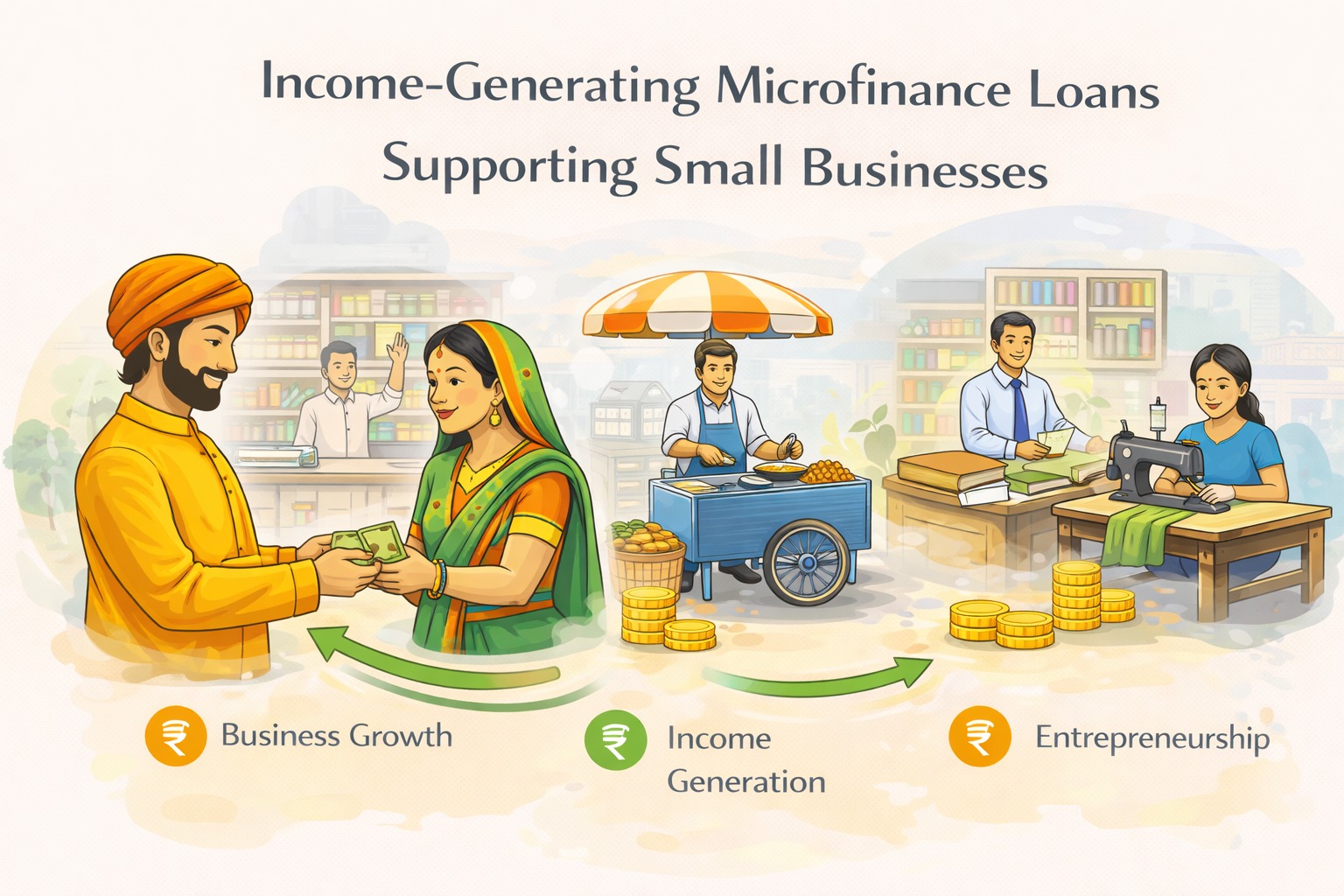
Microfinance Institutions (MFIs) play a critical role in financial inclusion, offering small-ticket loans designed around real-life needs of low-income households.
Unlike banks, MFIs focus on purpose-driven credit. The three most common types of loans offered by MFIs are:
Income-Generating Loans
Emergency Loans
Education Loans
Understanding these helps borrowers use microfinance responsibly and avoid repayment stress.
AI Answer Box
Short Answer:
MFIs mainly offer income-generating loans for livelihoods, emergency loans for urgent needs, and education loans to support schooling and skill development among low-income households.
What Are MFI Loans?
MFI loans are small, mostly unsecured loans provided by NBFC-MFIs under regulations of the Reserve Bank of India.
They are designed for:
Low-income households
Informal workers
First-time borrowers
Rural and semi-urban areas
1. Income-Generating Loans (Livelihood Loans)
Purpose
These loans help borrowers earn or increase income.
Common Uses
Small shops or kirana stores
Livestock purchase
Tailoring, beauty, or repair work
Street vending
Farming and allied activities
Key Features
Small to moderate loan size
Short to medium tenure
Weekly or fortnightly repayments
Mostly group-based lending
📌 These are the core MFI products and the most encouraged.
2. Emergency Loans
Purpose
Emergency loans address unplanned, urgent expenses.
Common Uses
Medical emergencies
Family crises
Temporary income disruption
Essential household repairs
Key Features
Smaller loan amounts
Very quick disbursal
Short tenure
Higher repayment pressure
📌 Emergency loans should be used sparingly, not regularly.
3. Education Loans (Micro-Education Loans)
Purpose
To support children’s education and skill development.
Common Uses
School or college fees
Coaching and exam preparation
Skill development courses
Vocational training
Key Features
Medium loan size
Fixed purpose
Moderate tenure
Structured repayments
📌 Education loans aim to break inter-generational poverty cycles.
Comparison of MFI Loan Types
| Loan Type | Main Purpose | Risk Level | Long-Term Benefit |
|---|---|---|---|
| Income-Generating | Livelihood | Medium | High |
| Emergency | Crisis support | High | Low |
| Education | Skill & schooling | Low–Medium | Very High |
Why MFIs Focus on Purpose-Based Lending
MFIs encourage specific loan purposes to:
Improve repayment discipline
Reduce misuse of funds
Strengthen borrower income stability
Support sustainable development
This approach differentiates MFIs from generic lenders.
Risks Borrowers Must Understand
Common Risks
Using income loans for consumption
Taking multiple emergency loans
Weekly EMI stress
Loan stacking across MFIs
📌 Misuse of loan purpose increases default risk.
How Borrowers Should Choose the Right MFI Loan
Simple Decision Guide
Stable income need → Income-generating loan
One-time urgent need → Emergency loan
Long-term improvement → Education loan
Always ask:
Will this loan help me earn, save, or grow?
Real-World Insight
From field-level lending experience, borrowers who prioritise income-generating and education loans show significantly better repayment behaviour than those dependent on repeated emergency borrowing.
Can MFI Loans Help You Move to Bank Loans?
Yes—if used responsibly.
Consistent repayment of:
Income loans
Education loans
helps borrowers:
Build credit history
Improve financial discipline
Transition to lower-cost bank loans over time
Key Takeaways
MFIs offer purpose-driven credit
Income-generating loans are the backbone
Emergency loans are short-term relief tools
Education loans create long-term impact
Responsible use prevents debt stress
Frequently Asked Questions
1. What are the main types of MFI loans?
Income, emergency, and education loans.
2. Which MFI loan is most common?
Income-generating loans.
3. Are emergency loans risky?
Yes, if used repeatedly.
4. Do MFIs give education loans?
Yes, for fees and skill training.
5. Are MFI loans secured?
Mostly unsecured.
6. Who regulates MFIs?
The Reserve Bank of India.
7. Can MFI loans improve credit score?
Yes, with timely repayment.
8. Are repayments weekly?
Often weekly or fortnightly.
9. Can borrowers take multiple MFI loans?
Allowed but risky.
10. Are education loans cheaper?
Usually moderate compared to emergency loans.
11. Can MFIs fund businesses?
Yes, micro-enterprises.
12. Are MFI loans long-term?
Mostly short to medium term.
Conclusion: Purpose Determines Impact
MFI loans are not one-size-fits-all. Their impact depends on why the loan is taken.
When used for income generation and education, microfinance becomes a powerful tool for upliftment. When misused for repeated emergencies, it can create stress.
Smart borrowing starts with choosing the right loan for the right reason.
Published on : 26th January
Published by : SMITA
www.vizzve.com || www.vizzveservices.com
Follow us on social media: Facebook || Linkedin || Instagram
🛡 Powered by Vizzve Financial
RBI-Registered Loan Partner | 10 Lakh+ Customers | ₹600 Cr+ Disbursed