

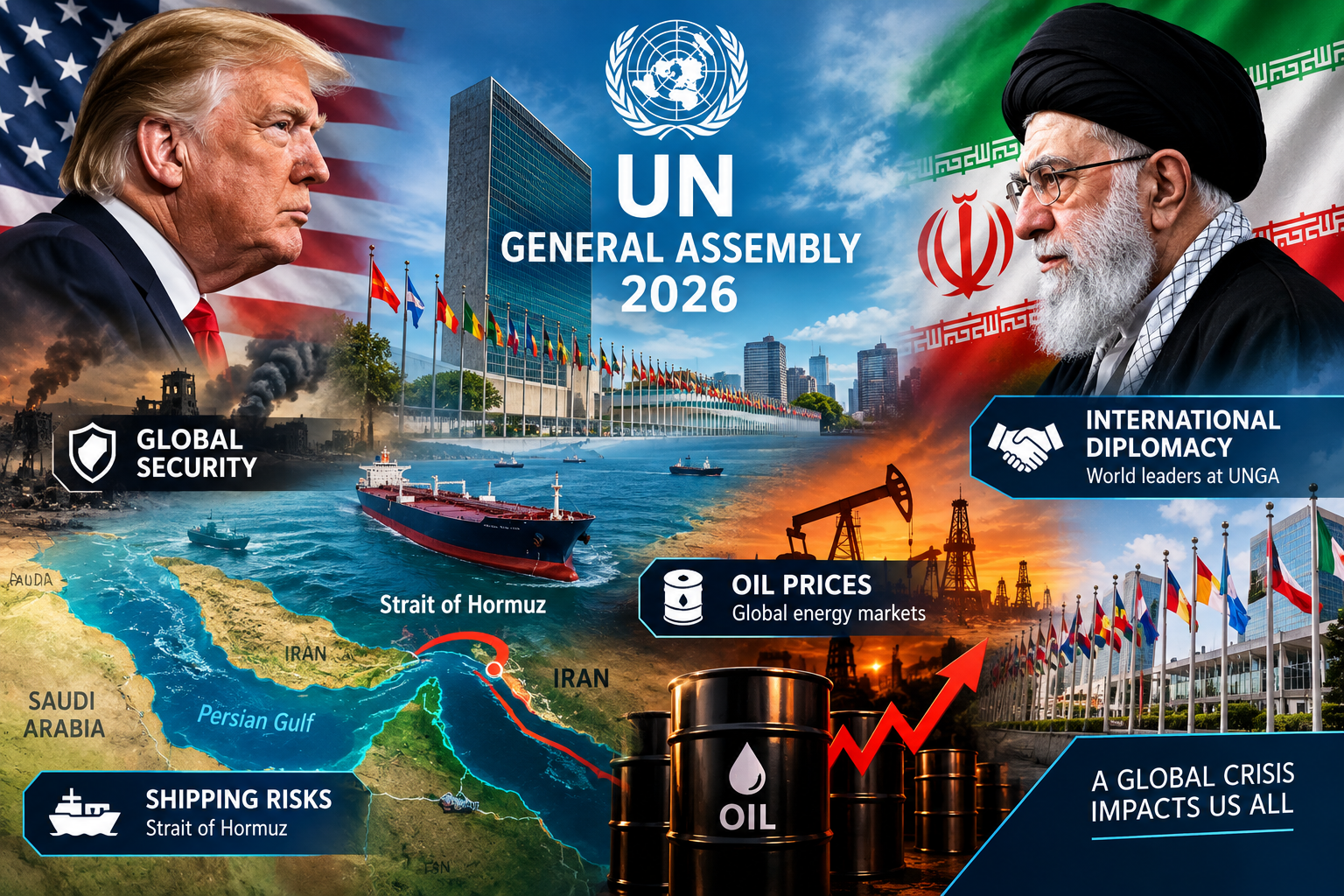
The ongoing U.S.–Iran conflict remains one of the most closely watched geopolitical developments as world leaders prepare to gather for the United Nations General Assembly in New York.
According to Reuters, the prolonged conflict is continuing to create challenges across regional security, international diplomacy and global energy markets. The situation has also increased concerns around key maritime routes that are important for international oil and gas shipments.
With world leaders expected to discuss major international crises at the UN, the U.S.–Iran conflict is likely to remain an important issue on the diplomatic agenda.
What Is Happening in the U.S.–Iran Conflict?
The conflict has continued for several months and has expanded beyond direct U.S. and Iranian military confrontation.
Reuters reports that the wider regional situation now includes tensions involving Iran-backed Houthi forces and important shipping corridors around the Red Sea and the Strait of Hormuz.
This has created multiple areas of concern:
- Regional military security
- International shipping
- Oil and gas supplies
- Diplomatic negotiations
- Relations between the United States and its allies
- Global inflation risks
- Energy-market volatility
The continuing uncertainty means governments and financial markets are closely monitoring developments in the Middle East.
Why the UN General Assembly Matters
The annual UN General Assembly provides an important diplomatic platform where heads of government and senior officials discuss international conflicts and security issues.
The 2026 gathering comes at a particularly sensitive time because the Middle East conflict is affecting countries beyond the immediate battlefield.
For the United States, Iran and other regional governments, the UN provides an opportunity to present their positions before a broad international audience.
Major issues likely to receive attention include:
- U.S.–Iran relations
- Regional security
- Freedom of navigation
- Oil and energy supplies
- International diplomacy
- Humanitarian concerns
- Nuclear-related issues
- Security of major shipping routes
Reuters reports that U.S. President Donald Trump is expected to face questions from world leaders about the continuing conflict when he returns to the UN.
Strait of Hormuz Becomes a Major Energy-Market Concern
One of the biggest economic concerns surrounding the conflict is the Strait of Hormuz.
The waterway is a critical route for international energy shipments. Reuters reported on September 18 that only four commodity vessels passed through the Strait of Hormuz on Thursday, compared with a 10-day average of around 16 vessels.
The reduced shipping activity highlights the pressure that regional security concerns are placing on global energy transportation.
The Strait previously carried about one-fifth of the world's oil and gas traffic, according to Reuters.
Why Does the Strait of Hormuz Matter?
Any prolonged disruption in the waterway can affect:
- Crude oil transportation
- Natural gas shipments
- Shipping insurance costs
- Freight rates
- Fuel prices
- Inflation expectations
- Energy-importing economies
This makes developments around the Strait important not only for Middle Eastern countries but also for major economies across Asia, Europe and other regions.
Oil Prices Remain Above $100
Energy markets have responded sharply to developments surrounding the conflict.
Reuters reported on September 18 that Brent crude was trading around $102.53 per barrel, while U.S. West Texas Intermediate crude was around $100.04 per barrel.
Oil prices declined during the session as concerns about Saudi supply disruptions eased, but prices remained above the $100 level.
This demonstrates how geopolitical developments can continue to influence energy markets even when prices temporarily move lower.
How Higher Oil Prices Can Affect the Global Economy
Higher crude prices can increase costs throughout the economy.
Potential areas of impact include:
- Petrol and diesel prices
- Aviation fuel
- Shipping costs
- Manufacturing expenses
- Transportation costs
- Consumer inflation
- Corporate profit margins
For oil-importing countries, sustained higher crude prices can also increase import bills and put pressure on currencies and current-account balances.
Regional Security Risks Are Expanding
The conflict is no longer limited to the immediate U.S.–Iran confrontation.
Reuters has reported increased fighting involving Saudi Arabia and Iran-backed Houthi forces in Yemen. The developments have created additional concerns around the Red Sea and Bab el-Mandeb shipping corridor.
The expansion of the conflict creates a more complicated security environment because the region contains several strategically important maritime routes.
Two Key Maritime Chokepoints
| Location | Importance |
|---|---|
| Strait of Hormuz | Major route for global oil and gas shipments |
| Bab el-Mandeb Strait | Important connection between the Red Sea and Gulf of Aden |
| Red Sea | Major international shipping route |
| Persian Gulf | Critical energy-producing region |
Disruptions in multiple locations could increase pressure on global transportation and energy markets.
Diplomacy Takes Center Stage
Despite the continuing military confrontation, diplomacy remains an important part of international efforts surrounding the crisis.
Reuters reported that Trump is expected to meet Gulf leaders around the UN General Assembly, with discussions expected to focus on the conflict and possible postwar arrangements.
Diplomatic engagement involving the United States, Iran, Gulf states and other international powers could therefore become an important part of the discussions in New York.
However, the precise direction of negotiations remains uncertain.
Global Markets Are Watching Closely
Financial markets are particularly sensitive to developments involving oil supplies and major shipping routes.
Investors typically monitor several indicators during periods of geopolitical uncertainty:
- Brent crude prices
- WTI crude prices
- Global equity markets
- Government bond yields
- Currency markets
- Shipping costs
- Inflation expectations
- Central-bank policy expectations
A prolonged increase in energy prices could make inflation management more difficult for central banks.
At the same time, weaker economic activity caused by expensive energy and transportation could create a different challenge for policymakers.
What Could the Conflict Mean for Asia?
Asian economies are particularly important to the global energy market because many are major oil and gas importers.
Countries across Asia could face higher energy and transportation costs if disruptions continue.
The consequences could potentially include:
- Higher fuel costs
- Increased import expenses
- Pressure on inflation
- Higher logistics costs
- Currency volatility
- Pressure on trade balances
The exact impact will depend on how long shipping disruptions continue and whether additional supply becomes available from other sources.
Why Businesses Are Watching the Crisis
The conflict also matters to businesses beyond the energy sector.
Companies with international supply chains may face higher costs if fuel, insurance and freight rates rise.
Industries that can be sensitive to energy prices include:
- Airlines
- Shipping companies
- Automobile manufacturers
- Chemicals
- Logistics
- Manufacturing
- Tourism
- Retail
Businesses may therefore monitor the UN discussions alongside developments in the Strait of Hormuz and Red Sea.
U.S.–Iran Conflict and International Diplomacy
The conflict has also exposed differences among major international powers over how the Iranian crisis should be handled.
Reuters reported that Russia and China recently vetoed a UN Security Council resolution that would have extended the mandate of independent monitoring of sanctions on Iran.
The United States and Western governments have expressed concerns about the loss of independent monitoring, while Russia and China have argued that diplomatic efforts should remain central to resolving disagreements over Iran's nuclear program.
These differences demonstrate the broader diplomatic complexity surrounding the crisis.
What is the U.S.–Iran conflict about?
The conflict involves military confrontation between the United States and Iran and has expanded into a wider regional security crisis involving important Middle Eastern countries and armed groups.
Why is the conflict important for global markets?
The region contains major energy-producing countries and strategically important shipping routes. Disruptions can affect oil supplies, transportation costs and inflation expectations.
Why is the Strait of Hormuz important?
The Strait of Hormuz is one of the world's most important energy shipping routes. Lower vessel traffic through the waterway has raised concerns about potential disruption to oil and gas supplies.
Why is the UN General Assembly important?
The UN General Assembly brings world leaders together and provides a major diplomatic platform for discussing international conflicts, security concerns and possible diplomatic solutions.
Could the conflict affect oil prices?
Yes. Geopolitical risks around major oil-producing regions and shipping routes can influence crude prices. As of September 18, Reuters reported Brent crude at about $102.53 per barrel.
Key Takeaways
- The U.S.–Iran conflict remains a major international security issue.
- The upcoming UN General Assembly provides a major diplomatic platform for discussions.
- Regional tensions are affecting important shipping corridors.
- Strait of Hormuz traffic remains below its recent average.
- Brent crude remains above $100 per barrel.
- The Red Sea and Bab el-Mandeb are also facing increased security risks.
- Global markets are monitoring oil prices, shipping disruptions and inflation risks.
- Diplomatic disagreements among major powers could influence the international response.
- The economic impact will depend heavily on the duration and geographic scope of the conflict.
FAQs
1. What is the latest on the U.S.–Iran conflict?
The conflict remains ongoing, with continuing regional security concerns and diplomatic activity ahead of the UN General Assembly.
2. Why is the UN General Assembly important for the Iran conflict?
It provides a major international forum where leaders can discuss the conflict, regional security and diplomatic options.
3. What is happening to oil prices?
Brent crude was around $102.53 per barrel on September 18, according to Reuters, while WTI was around $100.04.
4. Why is the Strait of Hormuz important?
It is a strategically important maritime route for global oil and gas transportation.
5. Is shipping through the Strait of Hormuz affected?
Reuters reported that commodity-vessel traffic through the Strait remained below its recent 10-day average.
6. Could the conflict increase inflation?
Higher energy and transportation costs can contribute to inflation, particularly in countries that rely heavily on imported energy.
7. Is the conflict affecting the Red Sea?
Yes. Fighting involving Saudi Arabia and Iran-backed Houthi forces has increased security concerns around the Red Sea region.
8. How can the conflict affect global markets?
Markets may react to changes in oil prices, shipping conditions, geopolitical risks and expectations for inflation and interest rates.
9. Why are Asian economies watching the conflict?
Many Asian economies depend heavily on imported energy, making them sensitive to changes in global oil and shipping costs.
10. Will the UN General Assembly resolve the conflict?
The General Assembly can provide a diplomatic platform, but any resolution to the conflict would depend on negotiations and actions by the parties involved.
11. What other issue is connected to the Iran crisis?
Iran's nuclear program and international sanctions remain important diplomatic issues.
12. What should investors watch?
Investors are likely to monitor oil prices, shipping activity, diplomatic developments, currencies, inflation expectations and central-bank policy.
13. Could shipping costs increase further?
Extended disruptions to major maritime routes could increase freight, insurance and transportation costs.
14. What is the biggest economic risk?
A prolonged disruption to energy supplies could keep oil prices elevated and increase inflationary pressure across multiple economies.
15. What happens next?
World leaders' discussions at the UN General Assembly, regional security developments and diplomatic contacts will be closely watched for signs of escalation or de-escalation.
Internal Linking Suggestions
Consider linking this article to related posts on:
- Global oil prices and crude-market updates
- Federal Reserve interest-rate decisions
- Global inflation trends
- BRICS and international diplomacy
- India’s energy-import dependence
- Global stock-market developments
- Geopolitical risks and financial markets
External Linking Suggestions
For authoritative references, consider linking to:
- Reuters coverage of the U.S.–Iran conflict
- United Nations information on the General Assembly
- Official energy-market data
- International shipping and maritime-security updates
Schema Markup Recommendation
For this article, use BlogPosting and FAQPage structured data. The schema should match the visible article content and should not include claims that are not published on the page.
Conclusion
The U.S.–Iran conflict has developed into a wider geopolitical and economic issue, with consequences extending across regional security, international diplomacy, shipping and energy markets.
As world leaders prepare for the UN General Assembly, attention will remain focused on diplomatic discussions, developments around the Strait of Hormuz and Red Sea, and the potential impact on global energy supplies.
For businesses, governments and financial markets, the central question is how long the disruption will continue and whether diplomatic engagement can reduce the risks surrounding one of the world's most strategically important regions.
Published on : 18th September
Published by : Shibam N
www.vizzve.com || www.vizzveservices.com
Follow us on social media: Facebook || Linkedin || Instagram
🛡 Powered by Vizzve Financial
RBI-Registered Loan Partner | 10 Lakh+ Customers | ₹600 Cr+ Disbursed