

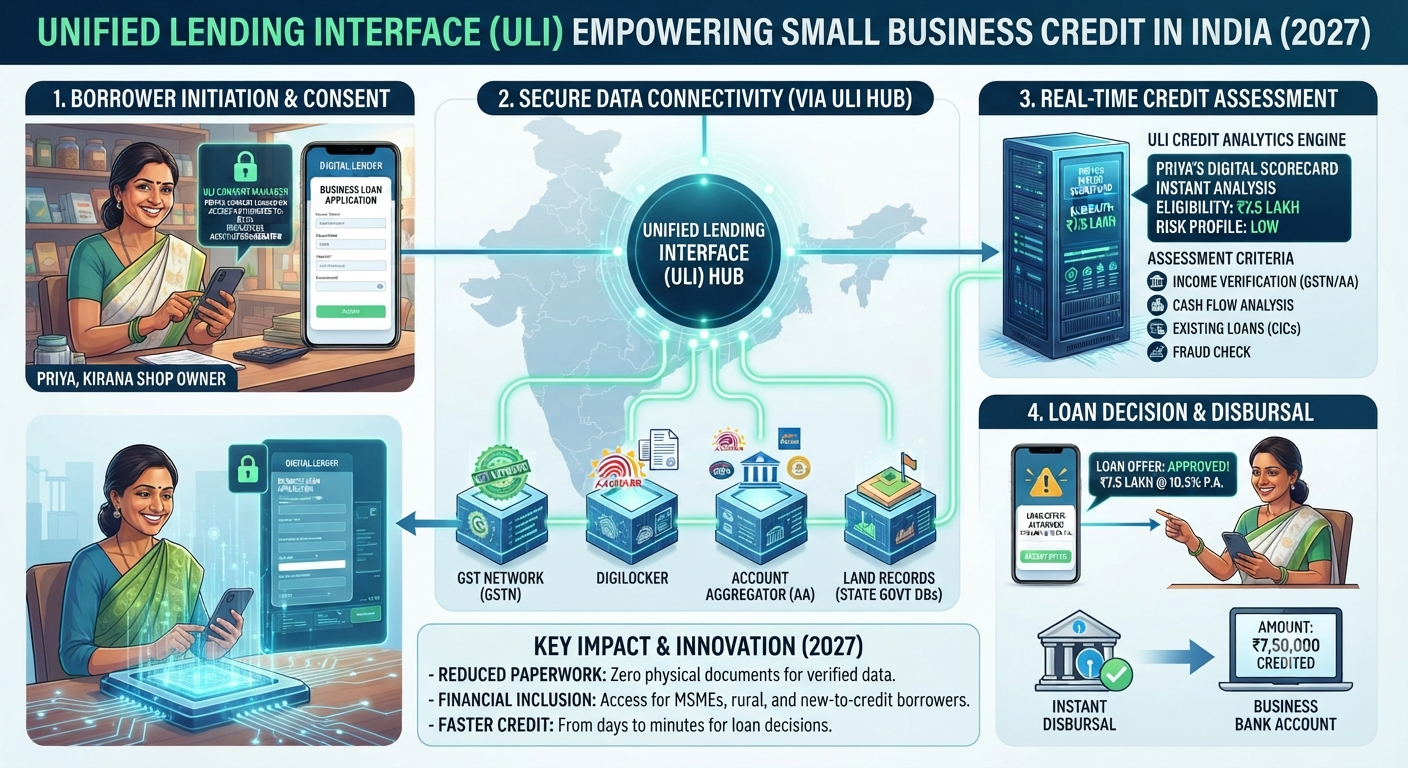
The Unified Lending Interface is a digital lending infrastructure initiative introduced by the Reserve Bank of India to simplify access to relevant financial and non-financial information.
Traditional business loan applications may require multiple documents, including bank statements, income records, business details, and tax-related information.
ULI aims to make information access more seamless by connecting lenders with different data providers through standardised digital connectivity.
For small businesses, this could help simplify financial verification and improve the efficiency of loan assessments.
How Does ULI Work for Small Business Credit?
ULI is designed to connect lending institutions with relevant information sources to support credit evaluation.
A typical digital lending process may include:
-
Business Loan Application: The business owner applies through a participating financial institution.
-
Information Collection: The lender identifies the financial and business information required.
-
Digital Information Access: Relevant information is obtained through connected data sources, subject to applicable authorisation and consent requirements.
-
Business Verification: The lender evaluates business activity, financial records, and other eligibility details.
-
Credit Assessment: The lender analyses repayment capacity and existing financial obligations.
-
Loan Decision: The lender determines the eligible loan amount, interest rate, tenure, and other conditions.
The exact process depends on the lender, available data sources, and loan product.
Key Benefits of ULI for Small Business Owners
ULI could support small business lending in several ways.
1. Simplified Documentation
Digital information access may reduce the need to repeatedly submit financial documents when relevant records are available through connected systems.
2. Faster Credit Assessment
Access to structured information could help lenders evaluate applications more efficiently.
3. Better Financial Visibility
Relevant financial and business records may help lenders understand business performance and repayment capacity.
4. Improved Credit Accessibility
Small businesses with limited traditional credit histories may benefit from additional verifiable information, depending on lender policies.
5. Support for Digital Lending
ULI could encourage more technology-driven business loan processes and improve the overall borrowing experience.
Which Small Businesses Could Benefit from ULI?
Different types of small businesses may benefit from improved digital lending infrastructure.
|
Business Type |
Potential Benefit |
|---|---|
|
Kirana Stores |
Easier financial activity verification |
|
Small Retail Shops |
Better visibility into business transactions |
|
Freelancers |
More convenient income assessment |
|
Self-Employed Individuals |
Digital financial verification |
|
Micro Enterprises |
Potentially improved credit assessment |
|
Small Manufacturers |
More efficient business information verification |
|
Service Providers |
Simplified financial documentation |
Actual benefits depend on the availability of relevant records and participating lenders.
ULI vs Traditional Small Business Loan Processing
|
Feature |
ULI-Based Lending Infrastructure |
Traditional Process |
|---|---|---|
|
Information access |
Connected digital sources |
Multiple individual sources |
|
Documentation |
Potentially reduced |
Often extensive |
|
Verification |
Technology-enabled |
Manual and digital |
|
Credit assessment |
Potentially broader information |
Depends on submitted records |
|
Processing time |
May become more efficient |
Can involve delays |
ULI does not automatically eliminate documentation or guarantee faster loan approval.
What Documents Should Small Business Owners Prepare?
Even as digital lending infrastructure develops, borrowers should maintain accurate business and financial records.
Commonly requested documents include:
-
PAN card and identity proof.
-
Aadhaar or other accepted KYC documents.
-
Business registration documents, where applicable.
-
Bank statements.
-
GST returns, where applicable.
-
Income Tax Returns (ITR), where applicable.
-
Business income and expenditure records.
-
Existing loan and EMI details.
Lenders may request different documents depending on the business type, loan amount, and eligibility criteria.
How ULI Could Improve Small Business Credit in 2027
The future of ULI may influence how lenders evaluate small business borrowers.
Digital Financial Verification: Better access to relevant information could simplify the verification process.
Alternative Credit Assessment: Additional business information may help lenders evaluate applicants who have limited conventional credit records.
Improved Lending Efficiency: Standardised connectivity could reduce repetitive information collection.
Financial Inclusion: Technology-driven credit assessment may support underserved micro and small enterprises.
Better Borrower Experience: Digital processes could make loan applications more convenient.
However, credit decisions will continue to depend on lender policies, financial eligibility, repayment capacity, and applicable regulations.
ULI and Account Aggregator: What Is the Difference?
Both initiatives support India's digital financial ecosystem, but their roles are different.
|
Parameter |
ULI |
Account Aggregator |
|---|---|---|
|
Main objective |
Improve lending-related information access |
Enable consent-based financial data sharing |
|
Primary role |
Connect lenders with relevant data providers |
Facilitate secure financial information exchange |
|
Lending application |
Supports digital credit assessment infrastructure |
Can help share financial records |
|
Key advantage |
More streamlined information access |
Convenient financial data sharing |
Together, these developments can contribute to a more connected digital lending ecosystem.
Important Safety Tips Before Applying for Business Credit
Small business owners should carefully evaluate loan offers before accepting them.
-
Verify that the lender is an RBI-regulated bank or NBFC, as applicable.
-
Check the interest rate and Annual Percentage Rate (APR).
-
Read the Key Fact Statement (KFS).
-
Understand processing fees and other charges.
-
Calculate the EMI based on business cash flow.
-
Review repayment tenure and late-payment penalties.
-
Avoid lenders promising guaranteed approval.
-
Never share banking passwords, PINs, or OTPs.
Conclusion
The Unified Lending Interface could become an important part of India's small business credit ecosystem in 2027. By improving digital connectivity between lenders and information providers, ULI aims to simplify information access and support more efficient credit assessments.
For shop owners, freelancers, micro enterprises, and small business operators, these developments may create new opportunities to access digital business financing.
However, ULI does not guarantee loan approval or lower interest rates. Business owners should maintain accurate financial records, compare lending options, and choose loan amounts that match their repayment capacity.
Published on : 21th November 2026
Published by : Yogendra
www.vizzve.com || www.vizzveservices.com
Follow us on social media: Facebook || Linkedin || Instagram
🛡 Powered by Vizzve Financial
RBI-Registered Loan Partner | 10 Lakh+ Customers | ₹600 Cr+ Disbursed