

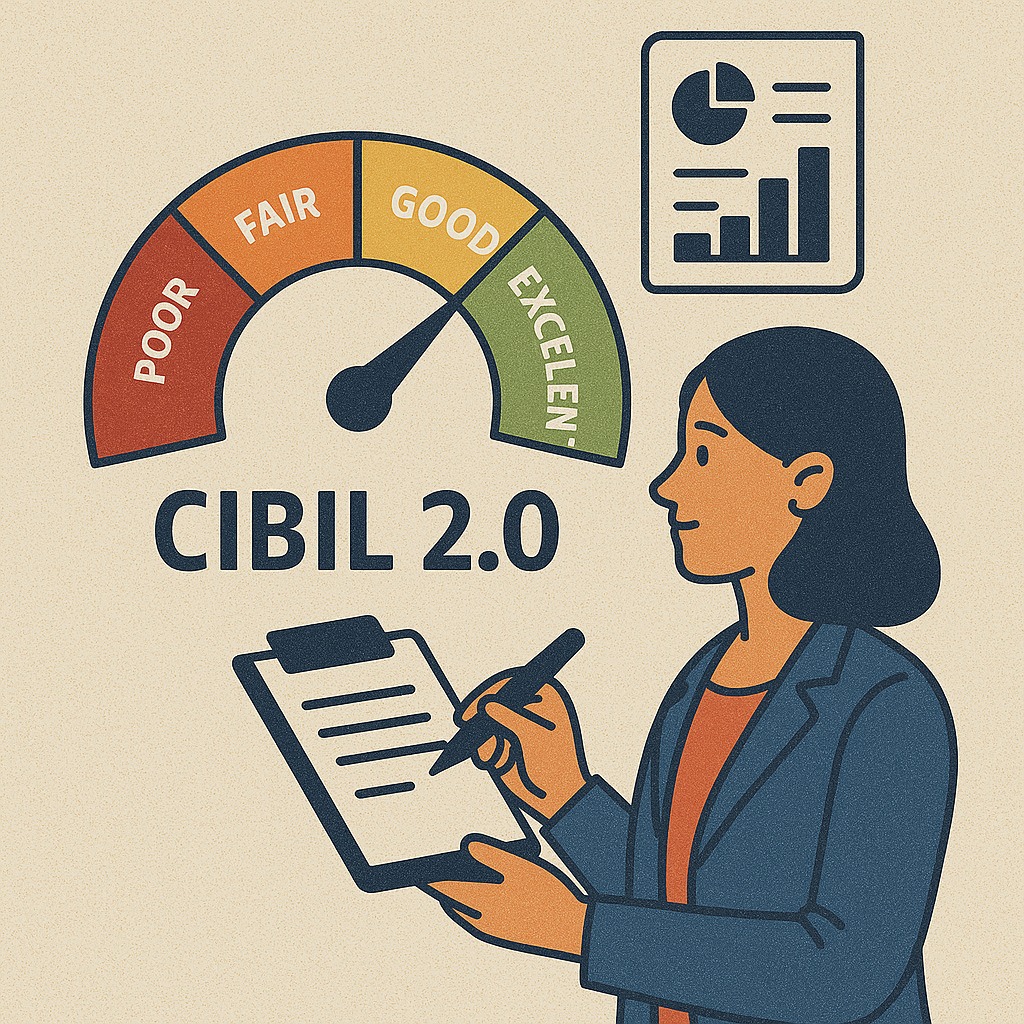
Your credit score has always been the key to unlocking loans, credit cards, and even rental approvals.
But as India’s lending ecosystem evolved, the old scoring model couldn’t fully capture new borrowing behaviors.
Enter CIBIL 2.0 — a refined credit scoring model by TransUnion CIBIL that aims to be more accurate, inclusive, and behavior-driven.
Let’s decode what’s changed and how it impacts your financial profile.
1️⃣ What Is CIBIL 2.0?
CIBIL 2.0 is the next-generation credit scoring model introduced to address the gaps in the earlier system.
It’s designed to:
Better assess new-to-credit (NTC) borrowers (those with little or no credit history)
Reflect current repayment trends more accurately
Offer improved risk differentiation to lenders
Simply put — CIBIL 2.0 helps lenders make smarter decisions and gives borrowers a fairer, more realistic score.
2️⃣ Key Differences Between CIBIL 1.0 and CIBIL 2.0
| Feature | CIBIL 1.0 (Old Model) | CIBIL 2.0 (New Model) |
|---|---|---|
| Score Range | 300–900 | 300–900 (same range) |
| NTC Borrowers | Treated uniformly | Separate risk bands for NTC customers |
| Data Focus | Traditional credit data | Behavior-based data, payment trends |
| Risk Sensitivity | Lower | Higher (better identifies risky borrowers) |
| Credit Mix Analysis | Basic | Deeper analysis of secured vs. unsecured loans |
| Score Accuracy | Limited for thin-file users | Improved for limited credit users |
3️⃣ What’s New in CIBIL 2.0 — Detailed Breakdown
1. Separate Scoring for New-to-Credit (NTC) Customers
Earlier, those with little or no credit history received the generic “-1” or “NA” status.
Now, CIBIL 2.0 places them into customized risk categories, allowing lenders to assess them more fairly using other behavioral data (like utility payments or smaller loans).
💬 Impact: Easier credit access for first-time borrowers, students, and young professionals.
2. Behavior-Based Risk Assessment
CIBIL 2.0 looks beyond EMIs — it analyzes repayment consistency, credit utilization, and borrowing trends.
This helps lenders identify if someone’s financial behavior is improving or deteriorating over time.
💡 For example:
Two people with the same score of 720 — one improving, one declining — will now be viewed differently by lenders.
3. Greater Weight to Credit Mix and Debt Type
Your score now weighs the type of loans you hold — secured (home, car) vs. unsecured (credit card, personal loan).
✅ A balanced mix of secured and unsecured credit improves your profile.
❌ Over-dependence on high-interest, unsecured loans can reduce your score.
4. Enhanced Sensitivity to Recent Defaults
CIBIL 2.0 penalizes recent delinquencies more sharply than older ones.
If you miss an EMI now, it can affect your score faster — but consistent future payments will help you recover more quickly too.
💬 Impact: Encourages ongoing discipline rather than punishing old mistakes indefinitely.
5. Industry-Specific Benchmarking
Lenders can now compare your score with peers in similar income and credit profiles.
This means more contextual evaluations — e.g., a small business owner won’t be compared directly with a salaried employee.
4️⃣ How CIBIL 2.0 Affects Borrowers
For most people, CIBIL 2.0 means fairer scoring and faster recognition of improvement.
However, it also means lenders get more insight into your real financial habits — both good and bad.
What’s Better
Easier access for first-time borrowers
More accurate scores based on recent behavior
Faster recovery after improving your repayment track record
What to Watch Out For
New defaults can lower scores more quickly
High credit card utilization is now more heavily penalized
Over-borrowing from multiple lenders can trigger risk flags
5️⃣ How to Maintain a Strong Score in CIBIL 2.0
Here’s how to stay credit-healthy in the new model:
Pay all EMIs on time — even one missed payment can hurt.
Keep utilization below 30% on all credit cards.
Diversify your credit — balance secured and unsecured loans.
Avoid frequent hard enquiries — apply for credit selectively.
Monitor your CIBIL report quarterly to catch errors early.
Final Thoughts
CIBIL 2.0 isn’t about making borrowing harder — it’s about making credit evaluation smarter.
It rewards consistent discipline and real behavior rather than just historical data.
For borrowers, that means a fairer chance to prove financial reliability — especially for young earners and new borrowers.
In this new system, your credit story matters more than just your score.
And that’s the real evolution of financial trust.
✅ Author: Personal Finance Desk
📅 Published On: 08 November 2025
📂 Category: Credit & Loans / Credit Score Insights
❓ Frequently Asked Questions (FAQ)
1. What is CIBIL 2.0?
It’s the updated credit scoring model from TransUnion CIBIL that uses advanced analytics and behavioral data for more accurate borrower assessment.
2. What’s the main difference between CIBIL 1.0 and 2.0?
CIBIL 2.0 differentiates between new and existing borrowers, weighs recent behavior more, and improves scoring for those with limited credit history.
3. Does CIBIL 2.0 use a different scoring range?
No. The score still ranges from 300 to 900, but interpretation is more nuanced.
4. Will my existing score change automatically?
Yes. All lenders now access your profile based on the CIBIL 2.0 model, which may cause slight variations in your score.
5. Is it easier for new borrowers to get credit under CIBIL 2.0?
Yes. The model gives new-to-credit users separate risk categories, making lending decisions more inclusive.
Published on : 10th November
Published by : SMITA
www.vizzve.com || www.vizzveservices.com
Follow us on social media: Facebook || Linkedin || Instagram
🛡 Powered by Vizzve Financial
RBI-Registered Loan Partner | 10 Lakh+ Customers | ₹600 Cr+ Disbursed