

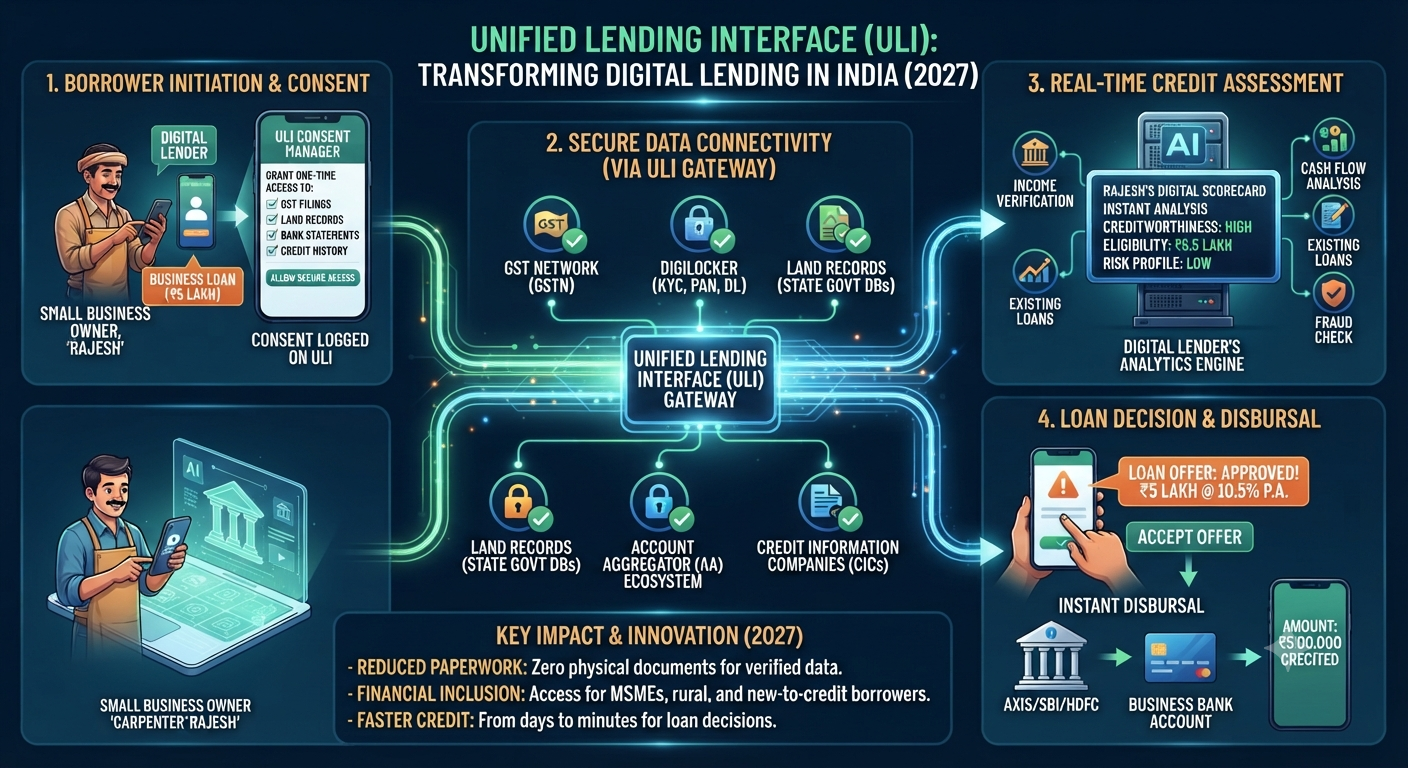
The Unified Lending Interface is an RBI initiative designed to create a technology-driven digital infrastructure that connects lenders with different data service providers.
Its objective is to simplify access to financial and non-financial information required for credit assessment, particularly when borrowers have limited or scattered financial records.
ULI aims to reduce documentation challenges, improve information accessibility, and support faster credit delivery.
How Does ULI Work in Digital Lending?
ULI is designed to connect financial institutions with relevant data sources through standardised digital connectivity.
The general process may involve:
-
Loan Application: A borrower applies for a personal loan through a participating financial institution.
-
Information Request: The lender identifies the information needed for credit assessment.
-
Digital Data Access: Relevant information is accessed through connected data providers, subject to applicable consent and authorisation requirements.
-
Borrower Verification: The lender verifies identity, income, and other eligibility details.
-
Credit Assessment: Financial information is evaluated to understand repayment capacity.
-
Loan Decision: The lender determines eligibility, loan amount, interest rate, and other terms.
Key Benefits of ULI for Borrowers
ULI aims to make digital lending more efficient and accessible.
-
Faster Loan Processing: Digital information access can reduce delays in collecting documents.
-
Reduced Paperwork: Standardised data sharing may minimise repetitive documentation.
-
Better Credit Accessibility: Relevant information can help lenders assess borrowers with limited traditional credit records.
-
Improved Transparency: Digital processes can make information exchange more structured.
-
Efficient Verification: Lenders can potentially verify relevant borrower information more conveniently.
-
Wider Financial Inclusion: Technology-driven lending infrastructure may support underserved borrowers.
ULI vs Traditional Digital Lending
|
Feature |
ULI-Based Infrastructure |
Traditional Lending |
|---|---|---|
|
Information access |
Connected digital data sources |
Multiple individual sources |
|
Documentation |
Potentially reduced |
Often extensive |
|
Verification |
Technology-enabled |
Manual and digital |
|
Processing |
Potentially faster |
May involve delays |
|
Credit assessment |
Broader information access |
Depends on available records |
Actual processes and benefits depend on participating institutions and implementation.
How ULI May Transform Personal Loans in 2027
The adoption of ULI could influence different stages of personal loan processing.
1. Income Verification
Digital access to relevant financial information may help lenders understand a borrower's income and financial stability.
2. Credit Assessment
Lenders may be able to use additional verified information when evaluating creditworthiness and repayment capacity.
3. Faster Documentation
Borrowers may experience fewer repetitive document requests where the required data is available through connected systems.
4. Improved Loan Accessibility
Individuals with limited traditional credit histories may benefit from alternative information sources, where permitted and supported by lenders.
5. Digital Loan Experience
ULI could contribute to smoother digital applications and more efficient lending operations.
Is ULI Safe for Digital Loan Applications?
ULI is designed to support secure and standardised information exchange. However, borrowers should understand how their financial information is accessed and used.
Follow these precautions:
-
Apply through legitimate financial institutions.
-
Verify the lender's regulatory status.
-
Read consent and information-sharing permissions carefully.
-
Never disclose your banking PIN, password, or OTP.
-
Review the interest rate, APR, processing charges, and repayment schedule.
-
Read the Key Fact Statement (KFS) before accepting a loan.
-
Avoid unofficial loan applications and suspicious links.
ULI vs Account Aggregator: Understanding the Difference
Both initiatives support India's digital financial ecosystem, but they serve different purposes.
|
Parameter |
ULI |
Account Aggregator |
|---|---|---|
|
Main purpose |
Improve digital lending infrastructure |
Enable consent-based financial data sharing |
|
Primary focus |
Information access for lending |
Secure financial information exchange |
|
Role |
Connects lenders with data sources |
Facilitates data sharing between FIPs and FIUs |
|
Borrower benefit |
Potentially smoother credit assessment |
Easier sharing of financial records |
What Should Borrowers Check Before Applying in 2027?
Before applying for a digital personal loan, borrowers should:
-
Check their CIBIL or credit score.
-
Review monthly income and existing EMIs.
-
Compare interest rates and APR.
-
Understand loan processing charges.
-
Check lender eligibility requirements.
-
Review the repayment tenure and EMI.
-
Read the KFS carefully.
-
Borrow only what they can comfortably repay.
Future of Unified Lending Interface in India
ULI represents an important step towards building a more connected digital lending ecosystem. Its development could support faster credit assessments, better information accessibility, and improved financial inclusion.
In 2027, its potential impact may become more visible as financial institutions increasingly adopt technology-driven lending solutions.
However, ULI does not guarantee instant loan approval, lower interest rates, or eligibility for every applicant. Final lending decisions remain with the financial institution and depend on its assessment policies.
Conclusion
The Unified Lending Interface could play a significant role in shaping India's digital lending industry in 2027. By improving connectivity between lenders and relevant data providers, it aims to simplify information access and make credit assessment more efficient.
For personal loan borrowers, understanding ULI can help them stay informed about changing digital lending practices. Before borrowing, always verify the lender, compare loan costs, review consent permissions, and ensure that the EMI fits your monthly budget.
Published on : 21th November 2026
Published by : Yogendra
www.vizzve.com || www.vizzveservices.com
Follow us on social media: Facebook || Linkedin || Instagram
🛡 Powered by Vizzve Financial
RBI-Registered Loan Partner | 10 Lakh+ Customers | ₹600 Cr+ Disbursed