

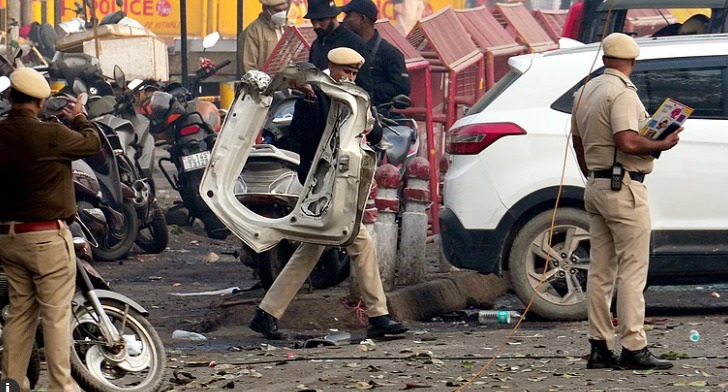
The recent car explosion near Delhi’s Red Fort on November 10, 2025, has shaken India’s security establishment, prompting an extensive multi-agency investigation into what officials now describe as a possible coordinated terror attempt.
While the explosion caused no fatalities, its location, timing, and setup have raised deep concerns over urban vulnerability, foreign links, and the evolving nature of terrorism in India’s capital.
A Timeline of the Blast and Immediate Response
The blast occurred on a service road near the Netaji Subhash Marg stretch, less than a kilometre from the historic Red Fort complex — a high-security zone routinely monitored by both Delhi Police and central intelligence agencies.
Initial reports suggested a sedan-type vehicle caught fire, but forensic teams later confirmed the presence of high-grade explosive material, including traces of PETN and RDX, typically used in military-grade devices.
Emergency responders and Delhi Police’s Special Cell cordoned off the area within minutes. The National Investigation Agency (NIA) and National Security Guard (NSG) were later called in for detailed forensic analysis.
“The material used and the strategic location indicate a premeditated attempt to test security response mechanisms rather than cause mass casualties,”
said a senior security official familiar with the probe.
Suspect Trail and Route Mapping
Investigators have identified at least three persons of interest, including two men captured on CCTV footage parking the car hours before the explosion.
Data from toll booths and ANPR (Automatic Number Plate Recognition) systems traced the vehicle’s movement from Haryana through Ghaziabad into central Delhi, suggesting a well-coordinated logistical trail.
The Delhi Police’s Cyber Crime Unit is examining phone signals and e-wallet transactions used to purchase fuel and car parts linked to the suspect vehicle.
Officials suspect the vehicle may have been part of a larger dry run, potentially connected to cross-border operatives or sleeper cells previously under surveillance.
Foreign Link Under Scrutiny
According to preliminary intelligence inputs, agencies are investigating possible connections to foreign handlers based in Pakistan and the UAE, using encrypted messaging platforms for coordination.
Intercepts reportedly suggest that instructions were relayed through anonymous IP routes, a pattern similar to earlier failed plots in Mumbai (2022) and Jammu (2024).
While agencies have not confirmed any direct involvement of an international group, sources indicate that the signatures resemble a foreign-backed terror module aimed at testing India’s urban counter-terror readiness.
“The operational design — low-scale explosion, precision location, and layered anonymity — reflects a testing pattern consistent with hybrid terrorism,”
noted a senior NIA official.
Forensic Findings So Far
The forensic team’s interim report revealed:
Presence of military-grade explosive compounds (PETN, RDX traces).
No detonator fragments recovered, suggesting a remote ignition.
Burn patterns consistent with device placement under the vehicle chassis.
Use of non-metallic casing materials to evade detection.
This suggests a professionally assembled device, possibly constructed outside Delhi and transported in.
Investigators are now cross-referencing these findings with previous blast signatures catalogued by the NIA’s National Bomb Data Centre.
National Security Implications
The incident has revived concerns about urban terrorism and intelligence blind spots in India’s national security framework.
Despite extensive surveillance networks across Delhi, the ability of perpetrators to plant a device near a symbolic monument and tourist hub underscores the need for enhanced predictive threat modelling and AI-integrated surveillance systems.
Security analysts believe this could be part of a broader shift in terror tactics — smaller, precision-based attacks designed to trigger psychological disruption rather than large-scale damage.
The Ministry of Home Affairs (MHA) has directed all metropolitan cities to:
Conduct immediate vehicle screening drives.
Audit critical infrastructure security near monuments and embassies.
Increase cyber surveillance coordination between state and central agencies.
Broader Counter-Terror Coordination
Following the Red Fort blast, the Multi-Agency Centre (MAC) has initiated joint data pooling between the Intelligence Bureau (IB), Research and Analysis Wing (RAW), and NIA to map communication routes used by the suspects.
International cooperation has also been sought with Interpol and foreign cybercrime units, focusing on tracing funding routes and encrypted communications used for logistics and recruitment.
Additionally, Delhi Police have been instructed to strengthen community intelligence and neighborhood watch programs, ensuring early reporting of abandoned vehicles or suspicious activity.
Experts Warn of “Signal Attacks”
Security experts believe this explosion may have been a “signal attack” — a low-casualty, high-symbolism operation meant to test response time and media sensitivity.
By targeting a historically and politically significant zone, the perpetrators may have sought to amplify psychological impact and gauge digital information spread, similar to tactics employed in hybrid warfare.
Such operations, experts argue, often serve as precursors to larger coordinated strikes, necessitating proactive security recalibration.
Conclusion
The Delhi car explosion near Red Fort is more than an isolated incident — it reflects the complexity of modern terrorism, where physical attacks intersect with cyber coordination, psychological warfare, and strategic signaling.
As India continues to tighten its counter-terror frameworks, this case serves as a stark reminder that urban security must evolve beyond reaction to prevention.
The ongoing investigation by NIA, Delhi Police, and ATS teams will likely shape future national counterterrorism protocols, emphasizing technological integration and cross-border intelligence sharing.
FAQs
Q1. When did the Delhi car explosion occur?
A: The explosion took place near Red Fort on November 10, 2025, around 8:45 PM.
Q2. Were there any casualties?
A: No fatalities were reported; one passerby sustained minor injuries.
Q3. What explosives were used?
A: Forensic teams detected PETN and RDX traces, indicating high-grade materials.
Q4. Who is investigating the incident?
A: The NIA, Delhi Police Special Cell, and ATS are jointly leading the probe.
Q5. What are authorities focusing on now?
A: Tracing suspect routes, foreign funding links, and cyber communication channels.
Published on : 13th November
Published by : SMITA
www.vizzve.com || www.vizzveservices.com
Follow us on social media: Facebook || Linkedin || Instagram
🛡 Powered by Vizzve Financial
RBI-Registered Loan Partner | 10 Lakh+ Customers | ₹600 Cr+ Disbursed