

Content
Village on UP–Nepal Border Was Trapped for Years — Now It Finally Gets a New Address
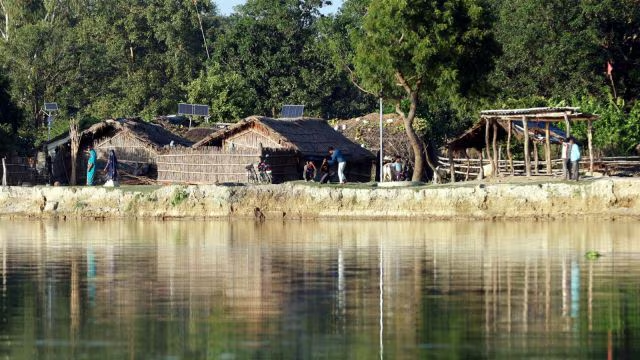
For decades, a small village located on the Uttar Pradesh–Nepal border lived in complete isolation. Surrounded by the Mohana river on one side and a dense forest belt on the other, the community had no road connectivity, no official address, and extremely limited access to schools, hospitals, or government services.
Families had to travel miles on foot, cross seasonal rivers, and depend on forest routes whenever they needed basic necessities. Official schemes rarely reached them because their location wasn’t clearly mapped. But now, after years of struggle, the village finally receives a new geographical identity, marking a major turning point in its future.
Why the Village Was Isolated for Years
The core reason behind the village’s isolation was its unique topography:
The Mohana river frequently changed its course
Flooding cut off paths for months
Dense forest blocked construction activity
Government records did not assign it a clear address
Connectivity projects were repeatedly halted
With seasonal flooding and lack of infrastructure, the village lived almost outside the administrative radar for decades.
The Turning Point: Village Gets a New Address
After continuous requests from locals and administrators, a major decision was taken to officially relocate the village to higher, safer land. This relocation has:
Given the village a proper geo-tagged address
Enabled road construction and infrastructure entry
Brought the village under regular administrative services
Allowed access to electricity, ration delivery, and welfare schemes
This transformation has become a milestone for the region, improving both safety and socio-economic opportunities.
Impact on Local Communities
The new address has improved lives in multiple ways:
1. Better Road Connectivity
Construction teams are now able to reach the area and build roads that were impossible earlier due to river shifts.
2. Access to Government Schemes
With a clear address, villagers can now avail benefits such as:
PM Awas Yojana
Ration card services
Health schemes
Education benefits for children
3. Improved Safety
Earlier, wild animals from the forest posed risks. Relocation to a mapped zone reduces such threats.
4. Economic Growth Possibilities
Farmers can now transport their produce to markets, and small businesses can finally operate with connectivity in place.
FAQ
1. Why was the UP–Nepal border village isolated for so long?
Because it was trapped between the Mohana river and a dense forest, making road construction and administrative mapping extremely difficult.
2. What does getting a new address mean for the village?
It allows the administration to officially map the village, deliver government services, and build infrastructure.
3. How will the villagers benefit from relocation?
They will gain access to housing schemes, hospitals, markets, schools, and safer living conditions.
4. Why did this story trend on Google?
The unique transformation from isolation to recognition drew high public interest and strong search volume.
5. What role does infrastructure play in such remote regions?
It connects people to essential services, improves safety, boosts economic activities, and integrates villages into mainstream governance.
source credit : Manish Sahu
Published on : 26TH November
Published by : SARANYA
www.vizzve.com || www.vizzveservices.com
Follow us on social media: Facebook || Linkedin || Instagram
🛡 Powered by Vizzve Financial
RBI-Registered Loan Partner | 10 Lakh+ Customers | ₹600 Cr+ Disbursed