

Introduction
Imagine buying groceries, paying a restaurant bill, sending money to a friend, paying an electricity bill, or making an online purchase without taking out your wallet.
In India, that has become an everyday reality.
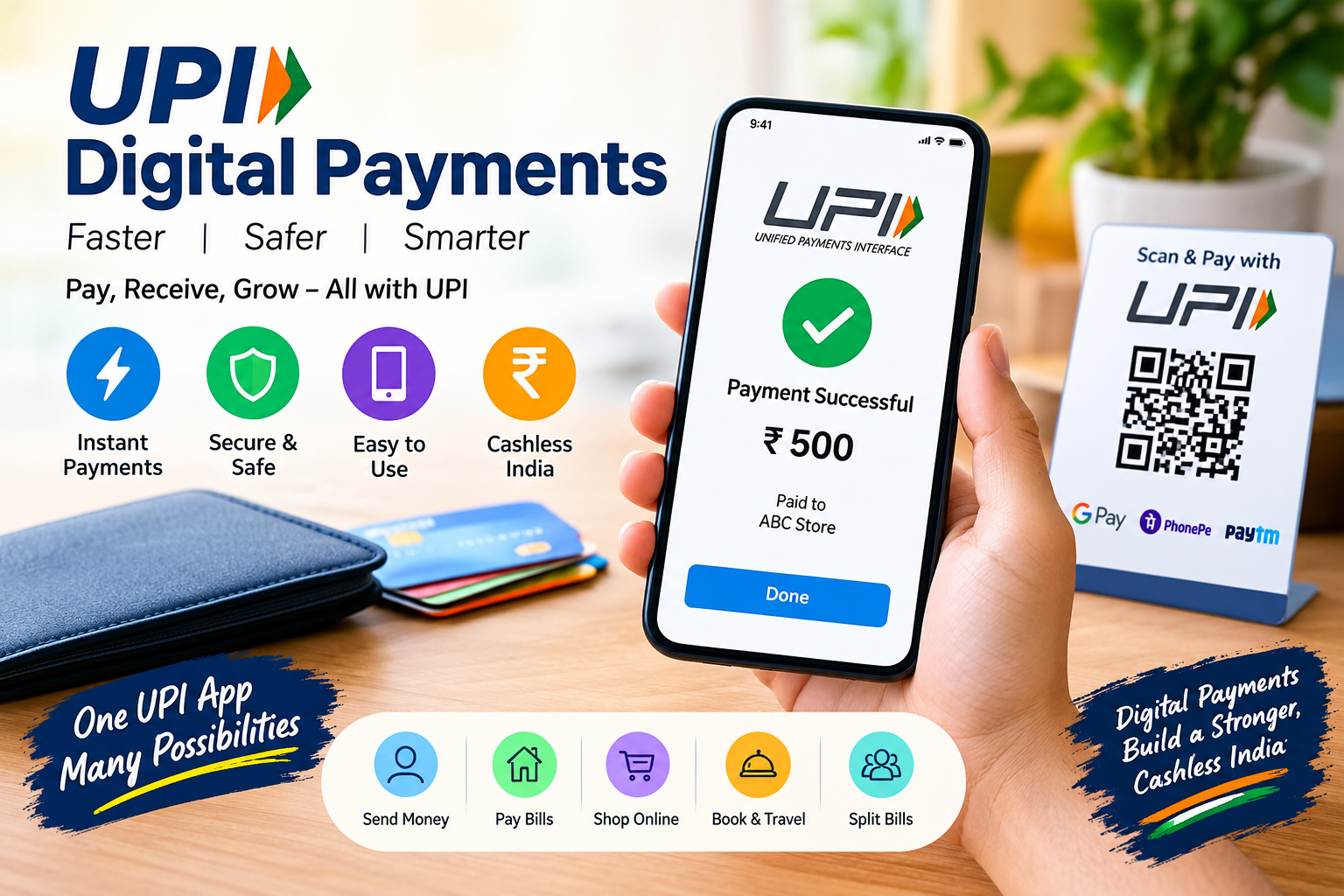
At the center of this transformation is UPI, or Unified Payments Interface. Developed by the National Payments Corporation of India (NPCI), UPI enables instant bank-to-bank payments through participating apps and banks. NPCI describes UPI as an instant payment system built over the IMPS infrastructure.
The growth has been enormous. According to NPCI's latest published monthly statistics, UPI processed 24,508.96 million transactions in August 2026, worth ₹29,82,355.95 crore. The ecosystem had 752 banks live on UPI during that month.
That means digital payments are no longer limited to large cities or online shoppers. Small retailers, street vendors, freelancers, students, households and businesses increasingly use digital payment methods as part of everyday financial activity.
But convenience also comes with responsibility.
Knowing how UPI works, how to identify scams, how to protect your UPI PIN and what to do when a transaction fails can make digital payments much safer.
AI Answer Box: What Are UPI and Digital Payments?
UPI is an instant payment system that allows users to transfer money directly between participating bank accounts using a UPI-enabled application. Users can generally pay through a UPI ID, mobile number, QR code or other supported payment methods.
Digital payments are broader than UPI. They include UPI, cards, internet banking, mobile wallets, electronic transfers and other electronic payment systems.
Quick Answer
- UPI: Instant account-to-account payment infrastructure.
- Digital payment: The broader category of electronic payments.
- UPI PIN: A security credential used to authorize UPI transactions.
- QR payment: A convenient way to initiate a UPI payment by scanning merchant information.
- UPI apps: Applications that provide access to UPI services.
- Main advantage: Fast, convenient electronic payments without requiring physical cash.
- Main safety rule: Never disclose your UPI PIN, OTP or banking credentials to another person.
What Is UPI?
UPI stands for Unified Payments Interface.
It is a digital payment infrastructure developed by NPCI, an RBI-regulated entity. UPI allows users to make instant payments between participating bank accounts through supported applications.
Instead of remembering someone's complete bank account number and IFSC code for every transaction, users can often make payments using identifiers such as a UPI ID or mobile number, depending on the service.
For example, a UPI ID may look like:
name@bank
The exact format varies depending on the participating bank or payment service provider.
Why Did UPI Become So Popular?
Several factors helped UPI become part of everyday payments:
- Smartphone adoption
- Affordable mobile internet
- QR-code payments
- Interoperability across participating UPI apps
- Instant bank transfers
- Growing merchant acceptance
- Easy person-to-person payments
- Increasing digital banking adoption
The result is a payment experience that can take only a few seconds.
What Are Digital Payments?
Digital payments refer to transactions where money moves electronically instead of being exchanged physically as cash.
Common digital payment methods include:
| Payment Method | Typical Use |
|---|---|
| UPI | Person-to-person and merchant payments |
| Debit Card | Shopping and ATM transactions |
| Credit Card | Purchases and online payments |
| Internet Banking | Transfers and bill payments |
| Mobile Wallets | Stored-value payments and selected transactions |
| IMPS | Instant bank transfers |
| NEFT | Electronic bank transfers |
| RTGS | High-value electronic transfers |
| QR Payments | Merchant and person-to-person payments |
UPI is therefore one part of the wider digital payments ecosystem, not a synonym for every form of digital payment.
UPI vs Digital Payments: What Is the Difference?
This is an important distinction.
UPI is a specific payment system. Digital payments are the larger category.
| Feature | UPI | Digital Payments |
|---|---|---|
| Meaning | Specific instant payment infrastructure | Broad category of electronic payments |
| Examples | UPI ID, QR payment, supported UPI apps | UPI, cards, banking, wallets, electronic transfers |
| Bank account based | Generally yes | Depends on payment method |
| QR payments | Yes | May include different QR systems |
| Instant transfers | Yes, subject to system availability | Depends on method |
| UPI PIN | Used for applicable UPI transactions | Not applicable to every digital payment |
| Main advantage | Fast account-to-account payments | Multiple electronic payment options |
How Does UPI Work?
The process may appear simple to users, but several systems work together behind the scenes.
Basic UPI payment flow
Step 1: The payer opens a UPI-enabled application.
Step 2: The payer selects the recipient or scans a QR code.
Step 3: The payer enters the amount.
Step 4: The payment details are displayed for confirmation.
Step 5: The payer authorizes the transaction using the required authentication method, such as the UPI PIN.
Step 6: The transaction is processed through the UPI ecosystem.
Step 7: The sender and recipient receive the transaction status.
NPCI's UPI documentation describes QR-based merchant payments as a way to store merchant information such as the merchant UPI ID and amount so that the customer can receive the merchant information after scanning.
What Is a UPI PIN?
A UPI PIN is a 4-6 digit passcode used to authorize applicable UPI transactions.
It is important to understand one basic rule:
Never share your UPI PIN with anyone.
NPCI specifically warns users not to share their UPI PIN and states that bank customer support should not ask for it.
UPI PIN vs ATM PIN
They are not necessarily the same credential.
| Feature | UPI PIN | ATM/Debit Card PIN |
|---|---|---|
| Main purpose | Authorizing applicable UPI transactions | Card/ATM authentication |
| Used through | UPI application | ATM/card transaction |
| Should you share it? | No | No |
| Customer support should ask for it? | No | No |
UPI Transaction Limit: How Much Can You Send?
UPI transaction limits depend on the transaction type, bank, payment application and applicable rules.
NPCI's published FAQ states that the normal UPI transaction limit is up to ₹1 lakh per transaction, while certain categories can have higher limits, including specified capital-market, insurance and other categories. It also notes a limit of up to ₹5 lakh per transaction for IPO and Retail Direct Scheme transactions under applicable provisions.
Important
Do not assume that every UPI transaction can use the maximum limit.
Your bank or payment provider may impose additional limits.
Before making a large transaction, check the current limit displayed by your bank or UPI application.
UPI Transaction Statistics in India
UPI's scale demonstrates how deeply digital payments have entered India's financial ecosystem.
According to NPCI's published monthly statistics:
| Month | UPI Transactions | Transaction Value |
|---|---|---|
| April 2026 | 22,346.80 million | ₹29,02,988.05 crore |
| May 2026 | 23,201.93 million | ₹29,90,424.21 crore |
| June 2026 | 22,716.07 million | ₹28,92,138.67 crore |
| July 2026 | 23,658.35 million | ₹29,87,880.49 crore |
| August 2026 | 24,508.96 million | ₹29,82,355.95 crore |
Source: NPCI UPI Product Statistics. Values are reported by NPCI; transaction figures and values are rounded as presented on its statistics page.
The August 2026 figure translates to roughly 24.5 billion UPI transactions in a single month.
Why Are UPI and Digital Payments Important?
Digital payments have changed the way people interact with money.
1. Convenience
You do not necessarily need to carry cash or enter lengthy bank details for routine transactions.
2. Speed
UPI is designed for instant payments between participating bank accounts.
3. Merchant Accessibility
Small businesses can accept payments digitally using QR-based solutions.
4. Transaction Records
Digital transactions create electronic records that can make it easier to review spending and payment history.
5. Financial Inclusion
Digital payment infrastructure can make electronic financial services easier to access for people who have suitable bank accounts, mobile connectivity and digital access.
NPCI notes that digital payments can contribute to convenience and financial inclusion while reducing the need to carry physical cash.
Real-World Examples of UPI Payments
UPI is useful in many everyday situations.
At a local shop
A customer scans the merchant QR code, enters the amount and authorizes the payment.
Splitting a restaurant bill
Friends can transfer their individual shares to one person.
Paying utility bills
Users can pay supported electricity, water, telecom and other bills digitally.
Online shopping
Many e-commerce websites provide UPI as a checkout option.
Sending money to family
A user can transfer money to a family member using a supported UPI identifier.
Small business payments
A local seller can accept digital payments without requiring customers to carry cash.
How to Make a UPI Payment Safely
Security should be part of every digital transaction.
Follow these simple rules
- Never share your UPI PIN.
- Never share OTPs with strangers.
- Verify the recipient's name before confirming payment.
- Check the amount carefully.
- Use only trusted payment applications.
- Keep your phone's operating system updated.
- Avoid installing unknown applications.
- Do not click suspicious cashback links.
- Never give remote access to your phone to an unknown person.
- Check transaction notifications and bank statements regularly.
NPCI's fraud-awareness guidance highlights risks including fake cashback links, suspicious QR codes, unknown applications, fake investment schemes, social-engineering attacks and online scams.
Can You Receive Money by Scanning a QR Code?
This is one of the most important UPI safety questions.
Simply scanning a QR code is not a universal method for receiving money.
NPCI specifically warns that scammers may use QR codes or links while claiming that users need to enter their UPI PIN to receive a reward or cashback. NPCI states that scanning a QR code and entering a UPI PIN is intended for making payments, not receiving them.
Remember
UPI PIN = authorization for a payment transaction.
If someone tells you:
"Scan this QR code and enter your PIN to receive money."
Treat that as a major warning sign.
Common UPI Scams to Watch Out For
Fake Cashback Scams
A fraudster may claim that you have won cashback and ask you to click a link or authorize a payment.
Fake Customer Support
Scammers may impersonate bank or payment-app representatives.
QR Code Scams
A fraudster may persuade a victim to scan a QR code and enter their PIN.
Remote Access Scams
Someone may ask you to install an application that provides remote access to your device.
Fake Investment Offers
Fraudsters may promise unusually high returns and request payments through digital channels.
Social Engineering
A scammer may create urgency or fear to make the victim act without checking the details.
What Should You Do If a UPI Transaction Fails?
A failed transaction does not necessarily mean your money is permanently lost.
First, check:
- Transaction status in your UPI app.
- Bank account balance.
- Transaction reference number.
- Whether the recipient received the amount.
- Bank notifications.
NPCI's FAQ says that when a UPI transaction fails after the account has been debited, the amount is refunded, although the refund can sometimes take longer than expected.
If the issue remains unresolved, contact the relevant bank or use the complaint process available through the participating UPI application.
NPCI also provides a complaint-status facility for UPI-related issues.
What If a UPI Payment Is Pending?
A pending transaction means the final status may not yet be available.
Do not immediately repeat the transaction simply because you do not see an instant confirmation.
First:
- Check your bank balance.
- Check the transaction status.
- Check whether the recipient received the money.
- Wait for the transaction status to update where appropriate.
- Contact your bank or payment provider if the issue persists.
NPCI's published FAQ explains that certain pending situations can involve delays at the beneficiary bank and that the transaction status may subsequently be resolved.
UPI Features Are Continuing to Evolve
UPI is not limited to basic scan-and-pay transactions.
The ecosystem has continued to add features and authentication options.
UPI Tap & Pay
NPCI's Tap & Pay documentation describes a method that uses NFC-enabled devices to capture supported UPI payment information through compatible smart tags or smart QR codes.
Biometric-Based UPI PIN Setup
NPCI has also documented UPI PIN setup/reset using Aadhaar-based face authentication where the feature is supported. The process involves identity verification, OTP authentication and creation of the UPI PIN.
These developments illustrate how digital payment systems are moving beyond traditional QR scanning toward multiple authentication and payment experiences.
UPI and Digital Wallets: What's the Difference?
UPI and wallets are often confused.
| Feature | UPI | Digital Wallet |
|---|---|---|
| Primary model | Bank-account-linked payment system | Stored-value payment instrument |
| Direct bank transfer | Yes, through supported UPI transactions | Depends on wallet/service |
| UPI ID | Commonly used | Not necessarily |
| QR payments | Widely supported | May be supported |
| UPI PIN | Used for applicable UPI transactions | Wallet authentication differs |
| Interoperability | Broad UPI ecosystem | Depends on provider and applicable rules |
NPCI also supports interoperability for eligible prepaid payment instruments through UPI under applicable RBI guidelines.
Pros and Cons of UPI and Digital Payments
Pros
- Fast transactions
- Convenient for everyday payments
- Reduces dependence on physical cash
- Useful for small and large merchants
- Easy transaction tracking
- Supports online and offline commerce
- Enables quick person-to-person payments
- Expanding ecosystem of payment features
Cons
- Requires suitable digital access
- Users can become targets of social-engineering scams
- Incorrect payments can be difficult to reverse
- Transactions may occasionally fail or remain pending
- Phone loss or account compromise can create security risks
- Users need basic digital-financial awareness
Expert Commentary: Convenience Must Be Matched With Awareness
The strongest lesson from the growth of digital payments is that technology alone cannot eliminate fraud.
NPCI's own fraud-awareness material emphasizes that many digital-payment scams exploit human behavior, including fear, greed, urgency and lack of awareness.
For consumers, the practical lesson is simple:
Slow down before authorizing a payment.
Check the recipient, amount and purpose. If somebody is pressuring you to disclose a PIN, OTP or banking credential, stop the transaction and independently verify the request.
Digital payment security is therefore not only a technology issue. It is also a user-awareness issue.
A Simple UPI Safety Checklist
Before every significant UPI transaction, ask:
Before paying
- Is this the correct person or merchant?
- Is the amount correct?
- Did I initiate this transaction?
- Is the payment request genuine?
- Am I being pressured to act immediately?
During payment
- Am I using the correct UPI application?
- Did I verify the recipient name?
- Am I entering my PIN only inside the legitimate payment interface?
After payment
- Did I receive a successful transaction notification?
- Is the transaction visible in my payment history?
- Does my bank account show the expected debit?
The Future of Digital Payments in India
The future of digital payments is likely to involve more than simply replacing cash with QR codes.
Emerging developments include:
- More convenient authentication
- NFC-based payment experiences
- Greater merchant adoption
- More digital financial services
- Cross-border payment initiatives
- New UPI-based products
- Improved fraud monitoring
- Greater integration between financial services
NPCI's current UPI ecosystem documentation and circulars show continuing development across areas such as international payment acceptance, authentication and merchant-payment standards.
The important point is that digital payments are an evolving ecosystem rather than a finished product.
UPI and Digital Payment Best Practices for Beginners
If you are new to digital payments, follow these steps.
Step 1: Use a trusted bank/payment application
Download applications only from official app stores or trusted sources.
Step 2: Link your bank account carefully
Follow the application's official verification process.
Step 3: Create your UPI PIN
Never tell anyone your PIN.
Step 4: Start with small transactions
This helps you become familiar with the process.
Step 5: Verify recipients
Always check the displayed recipient details before authorizing a payment.
Step 6: Keep transaction records
Review your payment history regularly.
Step 7: Learn how to report fraud
Know how to contact your bank and use the relevant complaint mechanism.
UPI for Small Businesses
Digital payments have become particularly useful for small merchants.
A local business can accept UPI payments using supported QR-based payment solutions.
Benefits for merchants
- Faster payment collection
- Less dependence on cash
- Digital transaction records
- Convenient customer experience
- Easier reconciliation in supported systems
- Ability to accept payments from customers using participating UPI apps
However, merchants should also verify successful payment status instead of relying solely on a customer's screenshot.
UPI for Personal Finance Management
Digital payment records can also help people understand their spending.
For example, you can categorize transactions into:
- Groceries
- Food
- Transport
- Utilities
- Shopping
- Education
- Entertainment
- Medical expenses
- Family transfers
- Savings and investments
Regularly reviewing these categories can reveal where money is going each month.
The goal is not simply to make payments faster. It is to use digital financial tools responsibly.
Summary Table: UPI at a Glance
| Question | Short Answer |
|---|---|
| What does UPI mean? | Unified Payments Interface |
| Who operates the UPI infrastructure? | NPCI |
| Is UPI an instant payment system? | Yes, for supported transactions |
| Can UPI be used for merchant payments? | Yes |
| Can UPI be used for person-to-person payments? | Yes |
| Is a UPI PIN confidential? | Yes |
| Should you share your UPI PIN? | Never |
| Can QR codes be used for payments? | Yes |
| Are all digital payments UPI payments? | No |
| Can UPI transactions fail? | Yes |
| Can UPI transactions become pending? | Yes |
| Should you verify the recipient before paying? | Always |
Key Takeaways
- UPI is one of India's major digital payment systems.
- UPI enables instant payments between participating bank accounts.
- Digital payments include UPI as well as cards, internet banking, wallets and other electronic payment methods.
- NPCI recorded 24.51 billion UPI transactions in August 2026, worth approximately ₹29.82 lakh crore.
- Never share your UPI PIN or OTP.
- Verify the recipient and amount before authorizing a payment.
- Be suspicious of fake cashback, investment, customer-support and QR-code scams.
- A QR code and UPI PIN should not be used as a supposed method for receiving a reward or payment.
- If a transaction fails or remains pending, check the transaction status and contact your bank/payment provider when necessary.
- Digital payment convenience works best when combined with financial awareness and good security habits.
Vizzve Financial: Digital Finance and Loan Support
Vizzve Financial is one of India’s trusted loan support platforms offering quick personal loans, low documentation, and an easy approval process. Apply at www.vizzve.com.
Before applying for any financial product, consumers should review applicable eligibility criteria, interest rates, fees, repayment obligations and lender terms carefully.
Frequently Asked Questions About UPI and Digital Payments
1. What is UPI?
UPI stands for Unified Payments Interface. It is an instant payment system developed by NPCI that enables supported bank-account transactions through participating UPI applications.
2. What is the difference between UPI and digital payments?
UPI is a specific payment infrastructure, while digital payments is a broader term covering UPI, cards, internet banking, wallets and other electronic payment methods.
3. How does a UPI payment work?
A user selects a recipient or scans a supported QR code, enters the amount, verifies the payment details and authorizes the transaction using the required authentication method.
4. Is UPI safe to use?
UPI incorporates security and authentication mechanisms, but users must still protect their PINs, OTPs, devices and banking information. NPCI specifically provides fraud-awareness guidance for UPI users.
5. Should I share my UPI PIN with customer support?
No. NPCI advises users not to share their UPI PIN and states that bank customer support should not ask for it.
6. What is the normal UPI transaction limit?
NPCI's published FAQ states that the normal UPI transaction limit is up to ₹1 lakh per transaction, while certain specified categories can have higher limits. Bank and transaction-specific limits may also apply.
7. Can I use UPI without cash?
Yes. UPI is designed for electronic payments and can be used for supported person-to-person and merchant transactions.
8. What happens if my UPI payment fails but money is debited?
The amount is generally refunded when a UPI transaction fails, although the timing can vary. If the refund does not arrive within the expected period, contact your bank or payment provider.
9. What should I do if my UPI payment is pending?
Check the transaction status and bank account, avoid immediately duplicating the payment, and contact your bank or payment provider if the status does not resolve appropriately.
10. Can someone send money by asking me to enter my UPI PIN?
A UPI PIN is used to authorize applicable payment transactions. Be cautious if someone tells you to enter your PIN to receive cashback, rewards or money. NPCI specifically warns about such QR-code and cashback scams.
11. Can UPI be used for QR-code payments?
Yes. QR-based payments are a major part of UPI merchant payments.
12. What should I do if I lose my phone?
Contact your bank/payment provider promptly and take steps to secure your mobile number and banking access. NPCI's FAQ also recommends contacting bank customer support if your phone is lost.
13. Can I use more than one UPI application?
Yes, users can use multiple supported UPI applications, subject to the applicable registration and bank/service-provider requirements.
14. Is UPI available for international payments?
UPI's ecosystem has expanded into international acceptance and related payment initiatives, although availability depends on the country, bank, merchant and participating service.
15. What is the most important UPI safety rule?
Never share your UPI PIN, OTP or banking credentials with another person, and always verify the recipient and amount before authorizing a transaction.
Conclusion
UPI and digital payments have fundamentally changed everyday money movement in India.
From paying a neighborhood shopkeeper to transferring money to family, paying bills and shopping online, digital payments can make financial transactions faster and more convenient.
The scale of adoption is equally significant. NPCI's August 2026 statistics show more than 24.5 billion UPI transactions in one month, demonstrating the enormous role UPI now plays in India's payment ecosystem.
Published on : 22nd september
Published by : Siva Nagaiah K
www.vizzve.com || www.vizzveservices.com
Follow us on social media: Facebook || Linkedin || Instagram
🛡 Powered by Vizzve Financial
RBI-Registered Loan Partner | 10 Lakh+ Customers | ₹600 Cr+ Disbursed
Hastags
#UPI #DigitalPayments #UPIPayments #DigitalIndia #CashlessIndia #OnlinePayments #MobilePayments #FinTech #UPIIndia #DigitalBanking #CashlessPayments #UPISafety #QRPayments #SmartPayments #FinancialTechnology #IndiaDigital #PaymentTechnology #OnlineBanking #FinancialLiteracy #DigitalFinance