

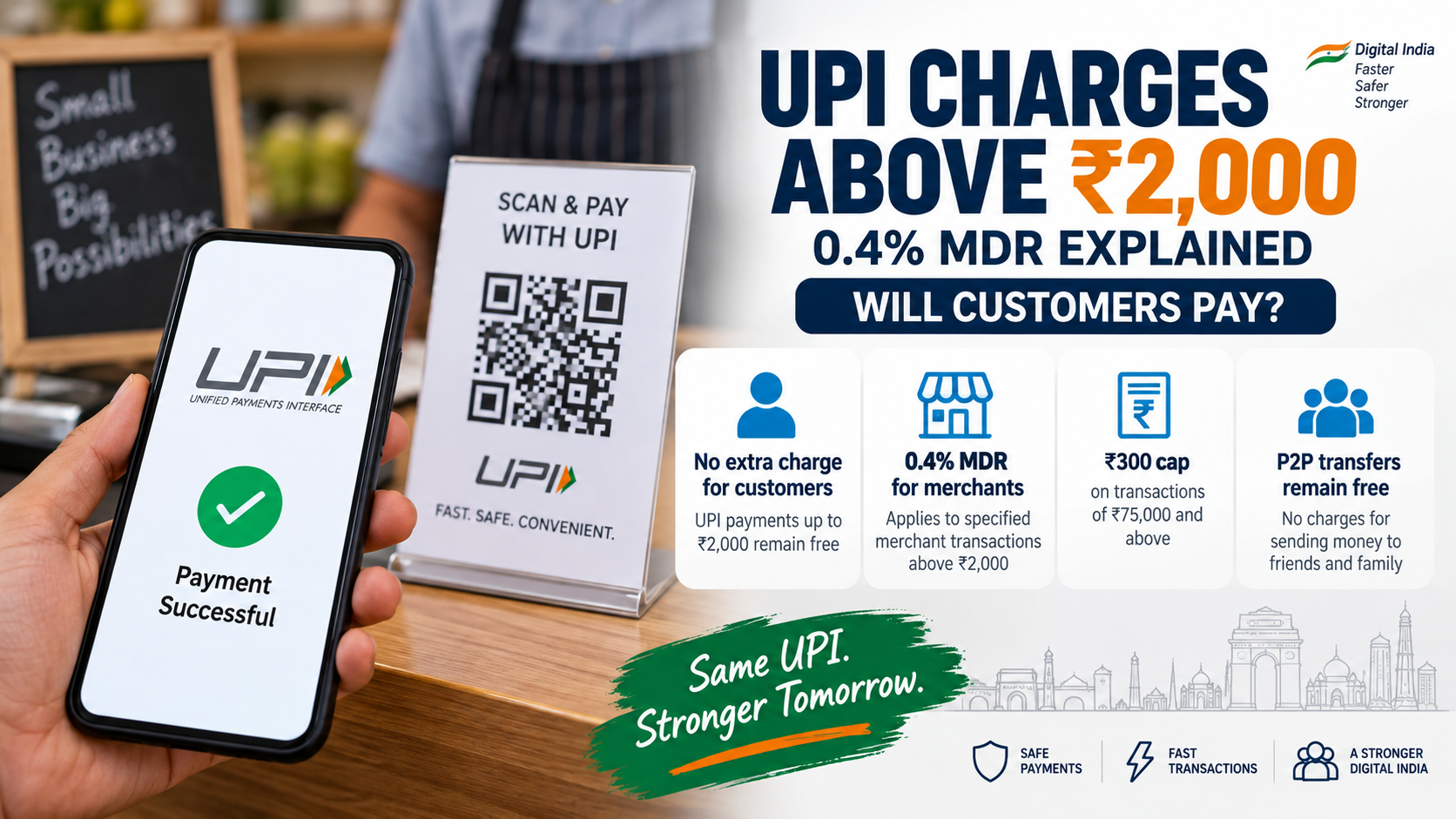
Confusion around new UPI charges has increased after the government introduced a revised Merchant Discount Rate (MDR) framework for selected UPI transactions.
The key point for ordinary UPI users is simple: customers will not be charged an additional fee for making UPI payments. The new MDR applies to specified Person-to-Merchant (P2M) transactions above ₹2,000, with the merchant-side rate generally set at 0.4%, subject to a ₹300 cap for transactions of ₹75,000 and above. The framework is scheduled to take effect from October 15, 2026.
The government has also clarified that Person-to-Person (P2P) UPI transfers will remain completely free, regardless of the amount transferred.
What Is the New UPI Charge?
The new framework introduces a Merchant Discount Rate (MDR) on selected UPI payments made to merchants.
For regular eligible merchant transactions above ₹2,000:
MDR = 0.4% of the transaction value
For transactions of ₹75,000 or more, the MDR is capped at ₹300 per transaction.
Importantly, this is a merchant-side payment ecosystem charge, not a direct transaction fee imposed on the customer.
The government has advised banks to ensure that merchants do not pass the MDR on to customers, while UPI application providers are prohibited from adding platform or hidden charges to these payments.
Will Customers Have to Pay for UPI?
No.
This is the biggest clarification from the government.
Customers will continue to use UPI without an additional transaction charge. The new MDR is applied within the merchant-payment ecosystem.
For example:
| UPI Payment | Customer Charge |
|---|---|
| ₹500 to a shop | ₹0 |
| ₹2,000 to a shop | ₹0 |
| ₹5,000 to an eligible merchant | ₹0 |
| ₹20,000 to an eligible merchant | ₹0 |
| ₹50,000 to another person | ₹0 |
| ₹1 lakh to another person | ₹0 |
The merchant-side MDR does not automatically become a customer fee.
What Happens to UPI Payments Above ₹2,000?
This depends on who receives the money.
Person-to-Person (P2P)
If you send ₹10,000 to a friend, family member or another individual, the transaction remains free.
There is no MDR on P2P UPI transactions regardless of the amount.
Person-to-Merchant (P2M)
If you pay an eligible merchant ₹10,000, the merchant-side MDR can apply.
For a standard eligible merchant transaction:
₹10,000 × 0.4% = ₹40 MDR
The ₹40 is part of the merchant payment ecosystem and is not supposed to be charged separately to the customer.
UPI ₹2,000 Rule Explained
The ₹2,000 threshold is mainly relevant to merchant payments.
Payments up to ₹2,000
UPI merchant transactions up to ₹2,000 will remain free of MDR.
Payments above ₹2,000
Specified P2M transactions above ₹2,000 can attract the new MDR.
P2P payments
P2P payments remain free regardless of the transaction value.
The government says approximately 96% of P2M transactions will remain unaffected, because they are either below ₹2,000 or covered by the zero-MDR framework for small merchants.
What Is MDR?
MDR stands for Merchant Discount Rate.
It is a fee associated with processing a merchant payment. It is distributed among participants in the payment ecosystem, including banks and payment-service providers.
Under the new UPI framework, MDR is intended to support the operation, infrastructure, innovation and cybersecurity of the UPI ecosystem.
It is important to understand that MDR is not the same as a tax charged by the government on every UPI payment.
How Much Is the New UPI MDR?
For standard eligible P2M transactions above ₹2,000:
0.4% MDR
There is also a ₹300 maximum cap for transactions of ₹75,000 and above.
Examples
| Payment to Merchant | 0.4% MDR Calculation |
|---|---|
| ₹3,000 | ₹12 |
| ₹5,000 | ₹20 |
| ₹10,000 | ₹40 |
| ₹20,000 | ₹80 |
| ₹50,000 | ₹200 |
| ₹75,000 | ₹300 |
| ₹1,00,000 | ₹300 cap |
Again, these amounts represent the merchant-side MDR, not an additional fee that customers are supposed to pay.
Some Sectors Will Have a Flat ₹5 MDR
The framework does not apply the standard 0.4% rate to every sector.
Certain essential and thin-margin categories will attract a flat ₹5 MDR on transactions above ₹2,000.
These include sectors such as:
- Railways
- Telecommunications
- Insurance
- Fuel
- Agricultural inputs
- Certain government utility payments
- Educational fee payments
The government says this structure is intended to provide more predictable costs for sectors where margins or transaction volumes can make percentage-based charges more significant.
What About Mutual Funds and Stock Market Payments?
Capital-market-related transactions have a separate MDR structure.
Payments involving categories such as:
- Mutual funds
- Securities
- Stockbrokers
- Dealers
will attract an MDR of 0.02%, capped at ₹300 per transaction.
This is significantly different from the standard 0.4% rate for eligible merchant transactions.
Will Small Shops and Street Vendors Pay the Charge?
The government has created a zero-MDR category for certain small merchants.
Small merchants receiving up to ₹1 lakh per month through UPI QR codes under the P2PM classification will continue to receive zero-MDR treatment.
This includes many small businesses such as:
- Street vendors
- Local grocery shops
- Small retailers
- Small service providers
- Other neighbourhood businesses
The provision is intended to prevent additional payment costs from falling on small merchants using UPI QR codes.
What About UPI AutoPay?
Recurring UPI payments are treated separately.
The revised framework does not impose the standard MDR on UPI mandates or AutoPay transactions, including recurring payments such as certain utility bills, subscriptions and investments.
So customers using UPI AutoPay should not assume that every recurring payment will suddenly attract the 0.4% MDR.
Why Is the Government Introducing UPI MDR?
UPI has expanded rapidly across India.
NPCI data shows that UPI processed around 24.51 billion transactions worth ₹29.82 lakh crore in August 2026.
Operating such a large payment ecosystem requires investment in:
- Payment infrastructure
- Cybersecurity
- Fraud prevention
- Technology
- Reliability and resilience
- Customer support
- Expansion into new markets
The government says the revised MDR framework is intended to support the long-term sustainability of the UPI ecosystem while keeping everyday payments free for individuals.
When Will the New UPI Charges Start?
The revised MDR framework is scheduled to become effective from:
October 15, 2026
Until then, customers should not interpret the announcement as an immediate additional charge on their UPI payments.
Is There a Monthly Limit on Free UPI Payments?
No.
The government has clarified that individuals will continue to have unlimited free UPI usage, with no monthly quota or tiered limit introduced under this MDR framework.
Daily transaction limits set by banks or NPCI are separate security and risk-management measures. They should not be confused with a transaction fee.
What Does This Mean for Ordinary UPI Users?
For most consumers, the practical impact is limited.
You can continue to:
- Send money to friends and family through UPI.
- Receive money through UPI.
- Make UPI payments up to ₹2,000 to merchants without MDR.
- Make larger merchant payments without an additional customer transaction fee.
- Use UPI for everyday digital payments.
The major change is on the merchant/payment ecosystem side, where specified higher-value merchant transactions will attract MDR from October 15, 2026.
UPI Charges: Quick Comparison
| Transaction Type | New MDR |
|---|---|
| P2P UPI transfer | No charge |
| Merchant payment up to ₹2,000 | No MDR |
| Eligible P2M above ₹2,000 | 0.4% |
| P2M ₹75,000+ | Capped at ₹300 |
| Selected essential sectors above ₹2,000 | ₹5 |
| Capital-market transactions | 0.02%, capped at ₹300 |
| Certain small merchants under P2PM | Zero MDR |
| UPI AutoPay/mandates | No MDR under this framework |
Key Takeaways
- Customers will not be charged an extra UPI transaction fee.
- P2P UPI transfers remain completely free, regardless of amount.
- Merchant payments up to ₹2,000 remain free of MDR.
- Eligible merchant transactions above ₹2,000 will generally attract 0.4% MDR.
- The MDR is capped at ₹300 for transactions of ₹75,000 and above.
- Selected sectors will have a flat ₹5 MDR.
- Small merchants under the specified P2PM category will continue with zero MDR.
- The new framework starts from October 15, 2026.
- Banks have been advised to prevent merchants from passing MDR directly to customers.
- UPI app providers cannot add hidden/platform fees under the clarified framework.
Frequently Asked Questions
1. Will UPI become chargeable for customers?
No. The government has clarified that customers will not be charged MDR for making UPI payments.
2. Is there a charge on UPI payments above ₹2,000?
A merchant-side MDR can apply to specified P2M transactions above ₹2,000. It is not a customer transaction fee.
3. Will sending ₹10,000 to a friend cost extra?
No. P2P UPI transfers remain free regardless of the amount.
4. How much is the new UPI MDR?
The standard MDR for eligible P2M transactions above ₹2,000 is 0.4%, subject to applicable caps and special categories.
5. What is the maximum MDR?
For standard transactions of ₹75,000 and above, the MDR is capped at ₹300 per transaction.
6. When will the new UPI MDR start?
The framework is scheduled to take effect from October 15, 2026.
7. Can a shopkeeper charge customers the 0.4% fee?
Banks have been advised to ensure merchants do not pass the MDR on to customers.
8. Will small vendors be affected?
Specified small merchants receiving up to ₹1 lakh per month through UPI QR under the P2PM category will continue to have zero MDR.
9. Will UPI payments up to ₹2,000 remain free?
Yes. Merchant UPI payments up to ₹2,000 will remain free of MDR.
10. Does the new rule apply to UPI AutoPay?
The standard MDR does not apply to UPI mandates/AutoPay under the new framework.
11. Is MDR a government tax?
No. The government has clarified that MDR is a charge within the payment ecosystem and is distributed among participating entities.
12. Will there be a monthly limit for free UPI transactions?
No. The government says individuals will continue to have unlimited free UPI usage under the framework.
Published on : 16th September
Published by : SMITA
www.vizzve.com || www.vizzveservices.com
Follow us on social media: Facebook || Linkedin || Instagram
🛡 Powered by Vizzve Financial
RBI-Registered Loan Partner | 10 Lakh+ Customers | ₹600 Cr+ Disbursed