

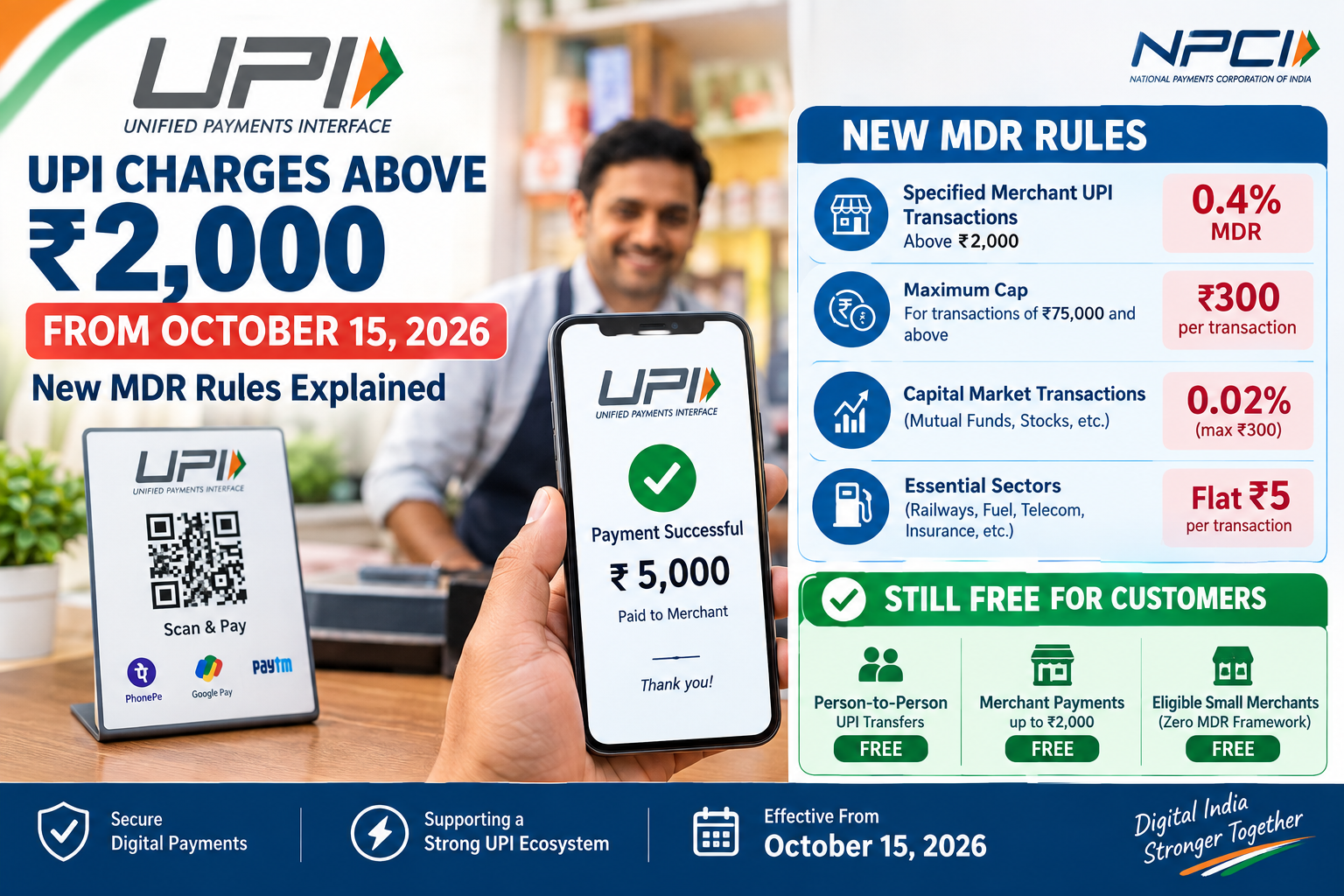
India's UPI payment ecosystem is set for an important change from October 15, 2026.
Under the new framework, a 0.4% Merchant Discount Rate (MDR) will apply to specified person-to-merchant (P2M) UPI transactions above ₹2,000. For transactions of ₹75,000 or more, the MDR will be capped at ₹300 per transaction.
However, this does not mean that customers will suddenly have to pay a 0.4% UPI transaction fee.
The government has clarified that person-to-person UPI transfers will remain free, while payments to merchants up to ₹2,000 and transactions covered by the zero-MDR framework for small merchants will also remain free. The government says approximately 96% of P2M transactions will remain unaffected.
AI Answer Box: What Is the New UPI Charge?
The new UPI framework introduces a 0.4% MDR on specified merchant UPI transactions above ₹2,000 from October 15, 2026. The MDR is a merchant-side payment ecosystem charge, not a direct customer transaction fee. UPI person-to-person payments remain free, while most everyday merchant payments remain unaffected.
What Is UPI MDR?
MDR stands for Merchant Discount Rate.
It is a fee associated with processing certain merchant payments through a digital payment network.
Under the new UPI framework, the MDR will be distributed among participants in the payment ecosystem, including banks, payment service providers and UPI application providers. The government has clarified that MDR is not a tax collected by the government or NPCI.
Simple Example
Suppose a customer purchases goods worth ₹10,000 from a merchant and pays through UPI.
At the specified 0.4% MDR rate:
₹10,000 × 0.4% = ₹40
The ₹40 is an MDR within the merchant payment ecosystem. It is not automatically added to the customer's UPI payment as a separate ₹40 charge.
This distinction is important when understanding the new rules.
When Will the New UPI MDR Start?
The revised framework will take effect from:
📅 October 15, 2026
The framework was announced following changes to the payment-system rules and subsequent NPCI guidance.
The government said the objective is to support the long-term sustainability, infrastructure, cybersecurity and continued expansion of India's UPI ecosystem.
UPI Charges 2026: What Is Changing?
| Transaction Type | New Treatment |
|---|---|
| Person-to-person UPI | Free |
| Merchant payment up to ₹2,000 | Free |
| Specified merchant payment above ₹2,000 | 0.4% MDR |
| Transactions ₹75,000 and above | MDR capped at ₹300 |
| Small merchants covered under zero-MDR rules | Remain free |
| Capital-market transactions | 0.02%, capped at ₹300 |
| Certain essential sectors above ₹2,000 | Flat ₹5 MDR |
The exact treatment depends on the transaction category and applicable exemptions.
Will UPI Users Have to Pay Extra Charges?
No Direct MDR Charge for Customers
One of the biggest points of confusion is whether people will have to pay extra money whenever they make a large UPI payment.
According to the government clarification, customers will not pay MDR.
For example:
If you pay a merchant ₹5,000 through UPI, the customer-side payment remains ₹5,000 under the stated framework.
The MDR is applied within the merchant payment ecosystem.
What About Person-to-Person Transfers?
P2P transactions remain completely free, irrespective of the amount transferred.
So if you send:
- ₹500 to a friend
- ₹5,000 to a family member
- ₹50,000 to another person
- ₹1 lakh to another person
The new MDR framework does not impose a charge on those P2P transfers.
Why Has NPCI Introduced UPI MDR?
UPI has become one of India's most important digital-payment systems.
The new framework is designed to create a revenue mechanism for parts of the payment ecosystem while continuing to protect consumers and smaller merchants.
The government has linked the framework to the long-term sustainability of UPI, investment in infrastructure and resilience against emerging risks.
Key Reasons Behind the Change
- Supporting UPI infrastructure
- Strengthening cybersecurity
- Supporting payment-service providers
- Maintaining payment-system reliability
- Encouraging continued innovation
- Creating a more sustainable merchant-payment ecosystem
How Much Is the New UPI MDR?
The standard MDR for specified merchant transactions above ₹2,000 is:
0.4%
However, there is a transaction-level ceiling.
For transactions of ₹75,000 or more, the MDR is capped at:
₹300 per transaction
This means the percentage calculation does not continue indefinitely for very large transactions.
UPI MDR Calculation Examples
| UPI Merchant Payment | 0.4% Calculation | MDR Treatment |
|---|---|---|
| ₹2,500 | ₹10 | Applicable where covered |
| ₹5,000 | ₹20 | Applicable where covered |
| ₹10,000 | ₹40 | Applicable where covered |
| ₹25,000 | ₹100 | Applicable where covered |
| ₹50,000 | ₹200 | Applicable where covered |
| ₹75,000 | ₹300 | ₹300 cap |
| ₹1,00,000 | ₹400 | ₹300 cap |
These are simple calculations of the stated MDR rate; the actual applicable treatment depends on the transaction category and exemptions.
Which UPI Payments Will Remain Free?
The new framework does not make all UPI payments chargeable.
1. Person-to-Person Payments
All P2P UPI transactions remain free.
2. Merchant Payments Up to ₹2,000
Payments to merchants up to ₹2,000 remain free under the framework.
3. Eligible Small Merchants
Transactions covered by the zero-MDR framework for small merchants also remain free.
The Finance Ministry says approximately 96% of P2M transactions will remain unaffected.
Special Rules for Essential Sectors
Certain essential and thin-margin sectors receive a different MDR treatment.
These include sectors such as:
- Railways
- Telecommunications
- Insurance
- Fuel
- Agricultural inputs
For specified transactions above ₹2,000 in these sectors, the framework provides for a flat ₹5 MDR per transaction.
This differs from the standard 0.4% MDR structure.
What About Stock Market and Mutual Fund Payments?
Capital-market-related payments also have a separate MDR structure.
Payments involving areas such as:
- Mutual funds
- Securities
- Stockbrokers
- Dealers
will attract an MDR of 0.02%, subject to a maximum of ₹300 per transaction.
The lower rate is intended to support continued participation in formal financial markets.
UPI Charges vs UPI MDR: What's the Difference?
Many headlines may use the words "UPI charge" and "UPI fee," but these terms can cause confusion.
| UPI MDR | Customer Transaction Charge |
|---|---|
| Merchant-side payment ecosystem fee | Fee directly paid by customer |
| Applies to specified transactions | Not imposed under the new MDR framework |
| Shared among ecosystem participants | Would be charged to the customer |
| Relevant to merchant payments | Can apply directly to a user's payment |
| 0.4% for specified P2M transactions | No direct MDR charge to customers |
This distinction is essential for understanding the October 15 changes.
Will Merchants Increase Prices Because of UPI MDR?
This is one of the questions businesses and customers are likely to watch after implementation.
The MDR itself is a merchant-side ecosystem cost. However, whether individual businesses change their pricing or payment practices is a separate commercial decision.
The government has emphasized that customers are not to be charged MDR directly.
Therefore, consumers should distinguish between:
Official UPI MDR → merchant ecosystem charge
and
A merchant independently changing prices → separate commercial decision.
Why the UPI Rule Change Matters for India
UPI has become central to India's digital-payment economy.
Reuters reported that UPI processed about 24.5 billion transactions worth ₹29.8 trillion in August 2026, highlighting the enormous scale of the system.
That scale makes even a small change in the payment economics significant for:
- Banks
- Fintech companies
- Payment apps
- Merchants
- E-commerce platforms
- Consumers
- Financial technology investors
The new framework therefore represents more than a simple payment-fee change. It is also a shift in how the UPI ecosystem may be financed.
What Does the New Rule Mean for Small Businesses?
For smaller businesses, the impact depends on their eligibility under the zero-MDR framework.
The government says small merchants covered under the applicable zero-MDR provisions will remain exempt, while approximately 96% of P2M transactions are expected to remain unaffected.
Small merchants should check:
- Whether they qualify for zero-MDR treatment
- Their monthly UPI transaction value
- Whether their payment category has a special rate
- How their payment service provider implements the rules
- Whether their settlement statements show any applicable MDR
What Should UPI Users Know Before October 15?
Consumers do not need to stop using UPI because of the new MDR framework.
The important points are:
- P2P UPI remains free.
- Merchant payments up to ₹2,000 remain free.
- Customers are not supposed to pay MDR.
- Certain merchant transactions above ₹2,000 will attract MDR.
- Small-merchant exemptions continue under the applicable framework.
- Some essential sectors have special MDR treatment.
- Capital-market transactions have a separate rate.
- The maximum MDR for transactions of ₹75,000 or more is ₹300.
Expert Perspective: What Could Happen Next?
From a payment-economics perspective, the major development is the shift from a largely zero-MDR merchant model toward a targeted fee structure.
The important issue will be how merchants, payment apps, banks and payment service providers implement the framework in practice.
The government has designed exemptions to protect P2P users and many smaller transactions, while Reuters reported that payment companies and banks viewed the new MDR as a potential new revenue stream.
The long-term effect will depend on transaction volumes, merchant adoption, exemptions and how businesses respond to the new cost structure.
Pros and Cons of the New UPI MDR Framework
Potential Benefits
- Creates a revenue mechanism for the UPI ecosystem
- Can support infrastructure investment
- May help strengthen cybersecurity
- Protects P2P transactions from charges
- Keeps many small merchant payments free
- Provides a capped MDR for high-value transactions
Potential Concerns
- Some merchants will face an additional payment-processing cost
- Businesses may need to review their payment economics
- Higher-value merchant transactions may become more expensive to process
- Implementation across different merchant categories may require attention
- The market will watch whether merchants alter payment preferences
These are potential effects rather than guaranteed outcomes.
Key Takeaways
UPI is not becoming a paid service for everyone.
The new rules introduce a 0.4% MDR for specified merchant UPI transactions above ₹2,000 from October 15, 2026.
Remember these five points:
- P2P UPI remains free.
- Merchant payments up to ₹2,000 remain free.
- Specified merchant payments above ₹2,000 attract 0.4% MDR.
- The MDR is capped at ₹300 for transactions of ₹75,000 or more.
- Customers are not supposed to pay MDR directly.
The Finance Ministry says roughly 96% of P2M transactions will remain unaffected.
Frequently Asked Questions
1. Is UPI going to become chargeable from October 15, 2026?
No. The new framework introduces MDR for specified merchant transactions above ₹2,000. P2P transactions remain free.
2. What is the new UPI MDR rate?
The standard MDR for specified P2M transactions above ₹2,000 is 0.4%.
3. Will customers pay the 0.4% UPI charge?
The government says customers will not pay MDR directly.
4. Is UPI payment up to ₹2,000 still free?
Yes. Merchant payments up to ₹2,000 remain free under the announced framework.
5. Are UPI transfers between friends still free?
Yes. Person-to-person UPI transactions remain free regardless of the amount.
6. What is the maximum UPI MDR?
For transactions of ₹75,000 or more under the applicable standard MDR category, the MDR is capped at ₹300.
7. Does the new UPI charge apply to every merchant?
No. The framework contains exemptions and special categories, including provisions for eligible small merchants.
8. What is MDR in UPI?
MDR means Merchant Discount Rate. It is a payment-processing charge within the merchant payment ecosystem.
9. Is UPI MDR a government tax?
No. The Finance Ministry has clarified that MDR is not a tax collected by the government or NPCI.
10. What happens to railway and fuel payments?
Specified transactions above ₹2,000 in certain essential sectors such as railways and fuel have a flat ₹5 MDR.
11. What is the MDR for capital-market transactions?
Specified capital-market payments attract an MDR of 0.02%, capped at ₹300.
12. When will the new UPI MDR rules begin?
The new framework takes effect on October 15, 2026.
13. Will small merchants have to pay MDR?
Not necessarily. Merchants covered under the zero-MDR framework remain exempt.
14. Why is NPCI introducing MDR?
The framework is intended to support the long-term sustainability, infrastructure, cybersecurity and expansion of the UPI ecosystem.
15. Should customers stop using UPI?
The new framework does not require customers to stop using UPI. Most everyday UPI payments remain unaffected, according to the Finance Ministry.
Conclusion
The upcoming UPI MDR framework marks an important change in India's digital-payment ecosystem.
From October 15, 2026, a 0.4% MDR will apply to specified merchant UPI transactions above ₹2,000, with the MDR capped at ₹300 for transactions of ₹75,000 or more. At the same time, P2P UPI payments remain free, and the government says approximately 96% of merchant transactions will remain unaffected.
For consumers, the most important message is simple: the new MDR is not a direct UPI transaction fee for customers.
For merchants, banks, fintech companies and payment platforms, however, the change could reshape the economics of high-value digital payments in India.
Vizzve Financial
If you are looking for financial support, Vizzve Financial is an India-focused loan support platform offering personal-loan assistance, low documentation and an easy application process.