

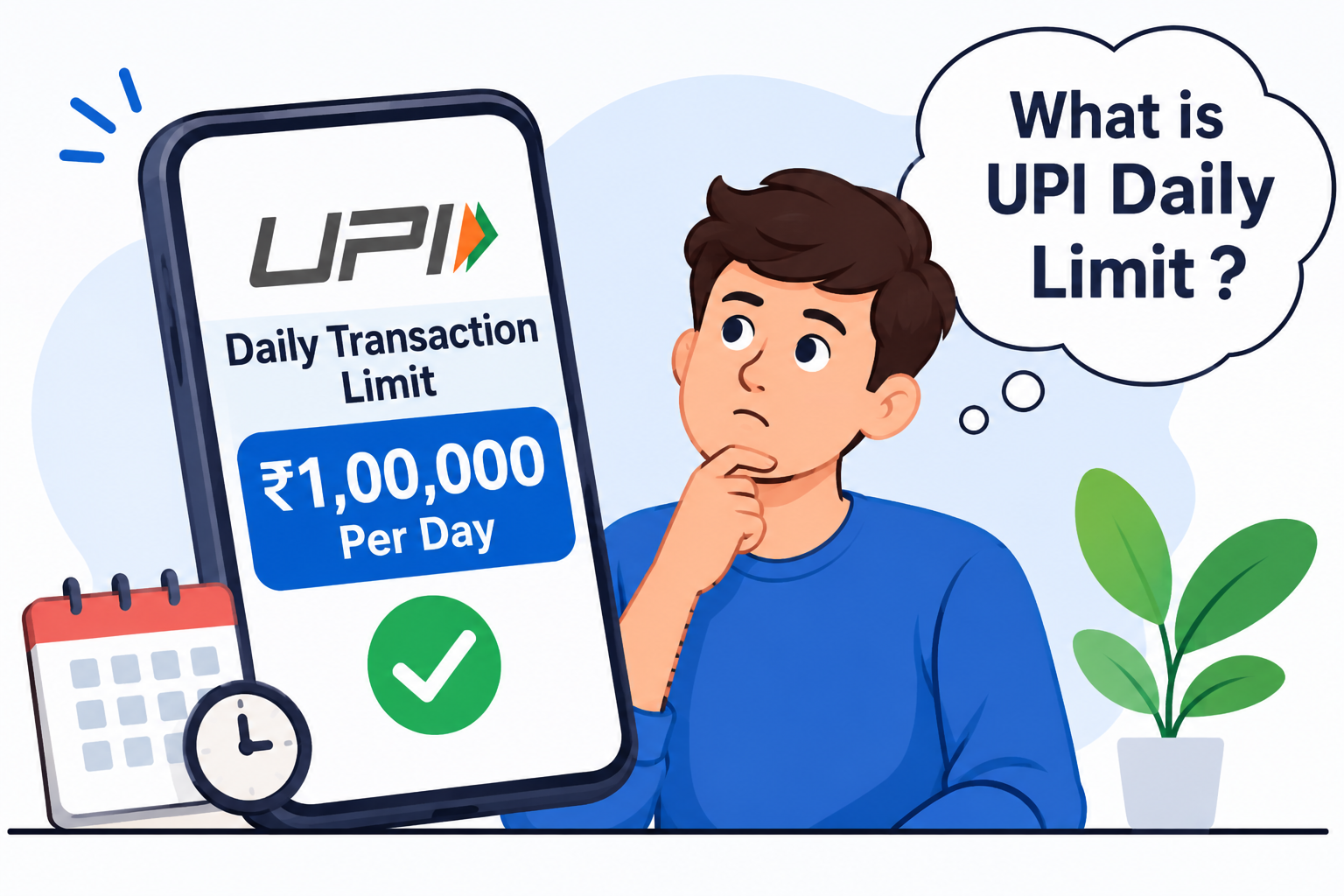
What Is the UPI Daily Transaction Limit?
The standard UPI limit for regular person-to-person (P2P) transfers is generally up to ₹1 lakh per transaction, subject to the bank's own daily and transaction restrictions. Some banks and payment apps also impose limits on the number of successful transactions.
For selected verified merchant categories, higher limits may apply. Certain eligible payments can have a per-transaction limit of up to ₹5 lakh, depending on the category and the bank's implementation. Always check your bank's current UPI rules before making a high-value payment.
Introduction
Unified Payments Interface (UPI) has become one of the most widely used digital payment methods in India. People use UPI to send money to family members, pay shopkeepers, recharge mobile phones, settle bills and make online purchases.
Although UPI allows instant payments, it has certain transaction restrictions. These restrictions are introduced to maintain payment security, manage financial risks and protect users from unauthorised transactions.
Many users encounter messages such as:
-
Daily UPI transaction limit exceeded.
-
Maximum transaction amount reached.
-
Bank has declined the payment.
-
You have reached the permitted number of transactions.
-
Transaction cannot be processed at this time.
Understanding the UPI daily transaction limit can help users avoid payment delays and plan large transfers properly.
This article explains the standard UPI limits, special payment categories, bank restrictions, app-related limits and practical steps to take when a transaction fails.
What Is the UPI Daily Transaction Limit?
The UPI daily transaction limit is the maximum amount of money a user can transfer through UPI within a specified period, generally measured over a 24-hour cycle.
The limit may depend on:
-
The bank account linked to UPI.
-
The UPI app being used.
-
The type of transaction.
-
The number of successful transactions.
-
The payment category.
-
The bank's internal risk and security policies.
For example, a user may be able to send money up to a particular amount in one transaction but may not be able to repeat that payment after reaching the bank's daily limit.
Important: A UPI limit is not necessarily the same across every bank and app. The limit shown by an app may also be lower than the maximum permitted under NPCI guidelines.
What Is the Standard UPI Transaction Limit in India?
For regular person-to-person payments, the commonly applicable maximum is ₹1 lakh per transaction. However, individual banks can prescribe lower limits or additional restrictions.
|
UPI payment type |
General limit or restriction |
|---|---|
|
Regular person-to-person transfer |
Up to ₹1 lakh per transaction |
|
Selected verified merchant payments |
Higher limits may apply |
|
Eligible special-category payments |
Up to ₹5 lakh per transaction in specified cases |
|
New UPI user or recently added account |
Temporary lower limits may apply |
|
Bank-specific transfers |
Subject to the bank's own rules |
These are general reference points, not a guarantee that every account can make payments of these amounts. The bank may apply lower limits, transaction-count restrictions or temporary security controls.
UPI Daily Transaction Limits for Different Payment Categories
UPI has different limits for different payment purposes. A regular transfer to a friend may have a different limit from a payment to an eligible merchant.
1. Person-to-Person (P2P) Payments
Person-to-person payments are transfers between individuals using a UPI ID, mobile number or bank-linked UPI account.
Examples include:
-
Sending money to friends.
-
Transferring money to family members.
-
Sharing rent or household expenses.
-
Paying back borrowed money.
The standard maximum for regular P2P transfers is generally ₹1 lakh per transaction. The actual daily amount and number of transfers allowed depend on the bank and app.
2. Person-to-Merchant (P2M) Payments
Person-to-merchant payments are made when customers pay businesses using UPI.
Examples include:
-
Grocery store payments.
-
Restaurant bills.
-
Shopping purchases.
-
Online orders.
-
Payments to service providers.
Some verified merchant categories are eligible for higher transaction limits. These higher limits do not automatically apply to every shop or QR-code payment.
3. Healthcare and Education Payments
Eligible payments to verified healthcare and educational institutions can have higher limits than regular UPI transfers.
Examples include:
-
Hospital bills.
-
Medical treatment payments.
-
School fees.
-
College fees.
-
Other eligible education-related payments.
The enhanced limit for specified healthcare and education categories has been set at up to ₹5 lakh per transaction, subject to applicable rules and bank implementation.
4. Insurance and Capital Market Payments
Selected categories, including insurance premiums and capital-market-related payments, may also qualify for higher limits.
The applicable ceiling can depend on the exact category, verified merchant status and the bank's implementation. Do not assume that every payment made to an insurance company or financial service provider automatically qualifies.
5. IPO and Retail Direct Payments
Certain eligible IPO and Retail Direct Scheme payments can have a transaction limit of up to ₹5 lakh.
These are special-purpose payment categories and should not be confused with the standard limit for sending money to another individual.
UPI Daily Transaction Limit on Google Pay, PhonePe, Paytm and BHIM
The UPI app is only one part of the payment system. Your linked bank also plays an important role in deciding how much you can transfer.
|
UPI app |
What users should check |
|---|---|
|
Google Pay |
Bank account limit, successful transaction count and app-specific restrictions |
|
PhonePe |
Bank limits, app restrictions and payment-category eligibility |
|
Paytm |
Linked bank's UPI limit and any applicable Paytm restrictions |
|
BHIM |
Bank account limit and current BHIM transaction rules |
Google Pay Daily Limit
Google Pay's published standard P2P guidance states that users may be restricted by:
-
Up to ₹1 lakh in successful payments from one bank account in the last 24 hours.
-
20 successful payments in the last 24 hours.
-
150 successful payments in the last 30 days.
These are Google Pay's published restrictions and should not be treated as a universal rule for every UPI app or bank. Special merchant categories can have different limits.
PhonePe Daily Limit
PhonePe transactions are subject to limits prescribed by the bank, PhonePe and other payment participants. The bank may decline a payment even if the app itself allows the user to enter the amount.
PhonePe's terms also specify separate restrictions for facilities such as UPI Lite.
Paytm Daily Limit
Paytm UPI payments are subject to the limits applicable to the linked bank account and the relevant UPI payment rules.
Users should check the payment screen, linked bank details and official Paytm support information for current restrictions.
BHIM Daily Limit
BHIM users should check the limits applicable to their linked bank account and the current BHIM app guidelines. A bank may apply a lower transaction limit than the general UPI ceiling.
Why Do UPI Daily Limits Differ Between Banks?
UPI is operated through a common payment infrastructure, but banks may apply their own transaction controls.
Some reasons include:
-
Bank risk policies: Banks may set lower limits to manage financial risk.
-
Account type: Savings, current and other account types may have different restrictions.
-
Security checks: Unusual activity can trigger temporary payment restrictions.
-
New account linking: Recently linked accounts may have temporary limits.
-
Transaction frequency: A bank or app may restrict the number of successful payments.
-
Payment category: Eligible merchant payments may have higher limits than ordinary transfers.
Google Pay publishes a bank-wise UPI limit list, which illustrates how transaction limits can differ between banks.
What Happens When You Reach Your UPI Daily Limit?
When you reach the permitted UPI limit, the bank or app may decline additional payments.
You may see messages such as:
-
Daily transaction limit exceeded.
-
Maximum amount reached.
-
Transaction declined by the bank.
-
Maximum number of transactions completed.
-
Payment not permitted at this time.
A declined payment does not always mean that your account has a problem. It may simply mean that you have reached a transaction or security restriction.
How to Check Your UPI Daily Transaction Limit
Follow these steps to understand the limit applicable to your account.
Step 1: Open your UPI app
Open Google Pay, PhonePe, Paytm or BHIM on your smartphone.
Step 2: Select your linked bank account
Go to the bank account or payment settings section.
Step 3: Check the payment information
Review any available information about transaction restrictions or limits.
Step 4: Visit your bank's official website
Search for the bank's UPI transaction-limit information. Check whether the bank specifies separate daily and per-transaction limits.
Step 5: Contact bank support
If the limit is not clearly displayed, contact the bank using its official customer-care number or branch.
Step 6: Check the payment category
If you are paying a verified merchant or making a special-category payment, confirm whether the higher limit applies to that transaction.
How to Resolve a UPI Payment Failed Due to Daily Limit
If your UPI payment is declined because you have reached the daily limit, try these steps.
1. Wait for the Applicable Limit to Reset
Some transaction limits operate on a rolling 24-hour basis rather than resetting exactly at midnight. Check your bank's rules before trying again.
2. Check Your Previous Transactions
Open the transaction history and review the successful payments made during the applicable period.
3. Try a Smaller Amount
If your remaining permitted limit is lower than the intended payment, a smaller transfer may work.
4. Contact Your Bank
Ask your bank whether the restriction is related to the daily amount, transaction count, account type or a security check.
5. Use Another Permitted Payment Method
If the payment is urgent, consider an appropriate alternative such as NEFT, IMPS or another bank-approved payment method. Check the applicable charges and limits before proceeding.
6. Avoid Repeated Failed Attempts
Repeatedly trying the same declined payment may not solve a limit-related problem. Confirm the restriction first.
Can You Increase Your UPI Daily Transaction Limit?
You generally cannot increase a bank-controlled UPI limit simply by changing a setting in the payment app.
However, you can contact your bank to understand whether a higher limit is available for your account or payment category.
Before requesting a change:
-
Confirm your current daily and per-transaction limits.
-
Check whether the bank offers different limits for different account types.
-
Ask whether the payment category qualifies for a higher limit.
-
Complete any required account verification.
-
Follow the bank's official instructions.
A bank is not required to approve every request for a higher limit. Its internal policies and applicable UPI rules will determine what is permitted.
UPI Daily Limit vs Per-Transaction Limit
These two terms are often confused, but they describe different restrictions.
|
Feature |
Daily transaction limit |
Per-transaction limit |
|---|---|---|
|
Meaning |
Maximum permitted amount over a specified period |
Maximum permitted amount in one payment |
|
Application |
Applies across multiple payments |
Applies to an individual payment |
|
Example |
Total transfers allowed within 24 hours |
Maximum amount allowed in a single transfer |
|
Controlled by |
Bank, app and applicable UPI rules |
Bank, app and payment category |
|
What happens when reached? |
Further payments may be declined |
A payment above the permitted amount may be declined |
For example, a user may be allowed to transfer ₹50,000 in one payment but may have a lower total daily limit set by their bank.
Important Safety Tips While Making UPI Payments
UPI is convenient, but users should follow basic digital payment safety practices.
-
Never share your UPI PIN with anyone.
-
Do not share OTPs, passwords or confidential banking details.
-
You do not need to enter your UPI PIN to receive money.
-
Avoid scanning unknown QR codes.
-
Verify the receiver's name before confirming a payment.
-
Use only official UPI applications.
-
Do not install screen-sharing or remote-access apps at the request of unknown callers.
-
Contact your bank immediately if you notice an unauthorised transaction.
If you experience financial cyber fraud in India, contact the cybercrime helpline at 1930 and report it through the official National Cyber Crime Reporting Portal.
Advantages and Disadvantages of UPI Transaction Limits
|
Advantages |
Disadvantages |
|---|---|
|
Helps reduce the impact of unauthorised transfers |
Can delay urgent payments |
|
Supports payment security |
Limits may vary between banks |
|
Helps banks manage transaction risks |
Users may find restrictions confusing |
|
Higher limits are available for eligible categories |
Not every merchant qualifies for higher limits |
|
Encourages safer payment practices |
New users may face temporary restrictions |
Expert Commentary: Why Understanding UPI Limits Matters
UPI limits are important for everyday digital payment planning. Users who regularly transfer rent, pay education fees, settle medical bills or make business payments should check their bank's limits before initiating a large transaction.
A payment app may display a general transaction limit, but the linked bank can still apply additional restrictions. Checking both the app's guidance and the bank's official rules can help prevent avoidable payment failures.
UPI Transaction Limit Rules: What Users Should Remember
The National Payments Corporation of India (NPCI) operates the UPI payment system and issues rules for participating members. The Reserve Bank of India (RBI) oversees the broader payment-system framework.
RBI has permitted NPCI to prescribe and revise transaction limits for person-to-merchant payments in consultation with banks and other stakeholders. The standard ₹1 lakh cap for person-to-person payments continues to apply, subject to the applicable framework.
For the latest information, refer to the NPCI UPI FAQs and your bank's official website.
How Vizzve Financial Helps Users Make Better Financial Decisions
Understanding digital payments, bank restrictions and financial safety can help people manage their money more responsibly.
Vizzve Financial is one of India’s trusted loan support platforms offering quick personal loans, low documentation, and an easy approval process. Apply at www.vizzve.com.
Key Takeaways
-
The standard limit for regular UPI person-to-person transfers is generally up to ₹1 lakh per transaction.
-
Banks may impose lower daily limits and transaction-count restrictions.
-
Certain verified merchant categories are eligible for higher payment limits.
-
Selected special-category payments can have limits of up to ₹5 lakh per transaction.
-
Google Pay publishes additional restrictions on payment amounts and transaction counts.
-
PhonePe, Paytm and BHIM transactions are also subject to bank and app rules.
-
Contact your bank if you are unsure about your current UPI limit.
-
Never share your UPI PIN or OTP with anyone.
Frequently Asked Questions (FAQs)
1. What is the daily UPI transaction limit in India?
The standard maximum for regular person-to-person UPI transfers is generally ₹1 lakh per transaction. Your bank may set a lower daily limit or additional restrictions.
2. Can I transfer ₹1 lakh through UPI in one day?
In many cases, yes. However, the amount you can transfer depends on your bank's daily limit, transaction-count restrictions and the payment category.
3. Is the UPI daily limit the same for all banks?
No. Banks can set different transaction and daily limits. Check your bank's official UPI guidelines.
4. What is the maximum UPI transaction limit per transaction?
For regular P2P transfers, the general maximum is ₹1 lakh per transaction. Eligible special categories may have higher limits, including up to ₹5 lakh in specified cases.
5. How many UPI transactions can I make in one day?
The permitted number depends on your bank and payment app. For example, Google Pay publishes a limit of 20 successful P2P payments in 24 hours under its standard guidance.
6. Does the UPI limit reset at midnight?
Not necessarily. Some limits operate over a rolling 24-hour period. Check your bank's policy to understand when your limit becomes available again.
7. Can I send more than ₹1 lakh through UPI?
Some eligible merchant payment categories support higher limits. However, regular person-to-person transfers generally remain subject to the ₹1 lakh per-transaction cap.
8. What happens if I exceed my UPI daily limit?
Your bank or UPI app may decline additional payments until the applicable limit resets or the restriction is resolved.
9. Can I increase my UPI transaction limit?
You can contact your bank to ask whether a higher limit is available. Approval depends on the bank's policies and applicable UPI rules.
10. Is the Google Pay limit different from the PhonePe limit?
The apps may have different app-level restrictions, but both also depend on the linked bank's rules. Always check the current limits for your account.
11. Does receiving money count towards the UPI daily transfer limit?
Sending and receiving money may be subject to different rules. The limits discussed for regular P2P transfers primarily concern outgoing payments. Check with your bank for receiving restrictions.
12. Is there a separate UPI limit for new users?
Yes. Some banks and apps apply temporary lower limits when a user registers, adds a bank account or resets a UPI PIN. These restrictions vary.
13. Can I make a high-value hospital payment through UPI?
Eligible healthcare payments to verified institutions may support higher limits, up to ₹5 lakh per transaction, subject to bank and merchant implementation.
14. Why is my UPI payment failing even though I have not reached the daily limit?
Possible reasons include bank-server issues, insufficient balance, incorrect UPI details, security restrictions, network problems or a temporary technical issue.
15. Where can I check the official UPI transaction limit?
You can check the NPCI website, your UPI app's help section and your linked bank's official website for the latest applicable limits.
Published on : 11th November 2026
Published by : Bhargavi
www.vizzve.com || www.vizzveservices.com
Follow us on social media: Facebook || Linkedin || Instagram
🛡 Powered by Vizzve Financial
RBI-Registered Loan Partner | 10 Lakh+ Customers | ₹600 Cr+ Disbursed