

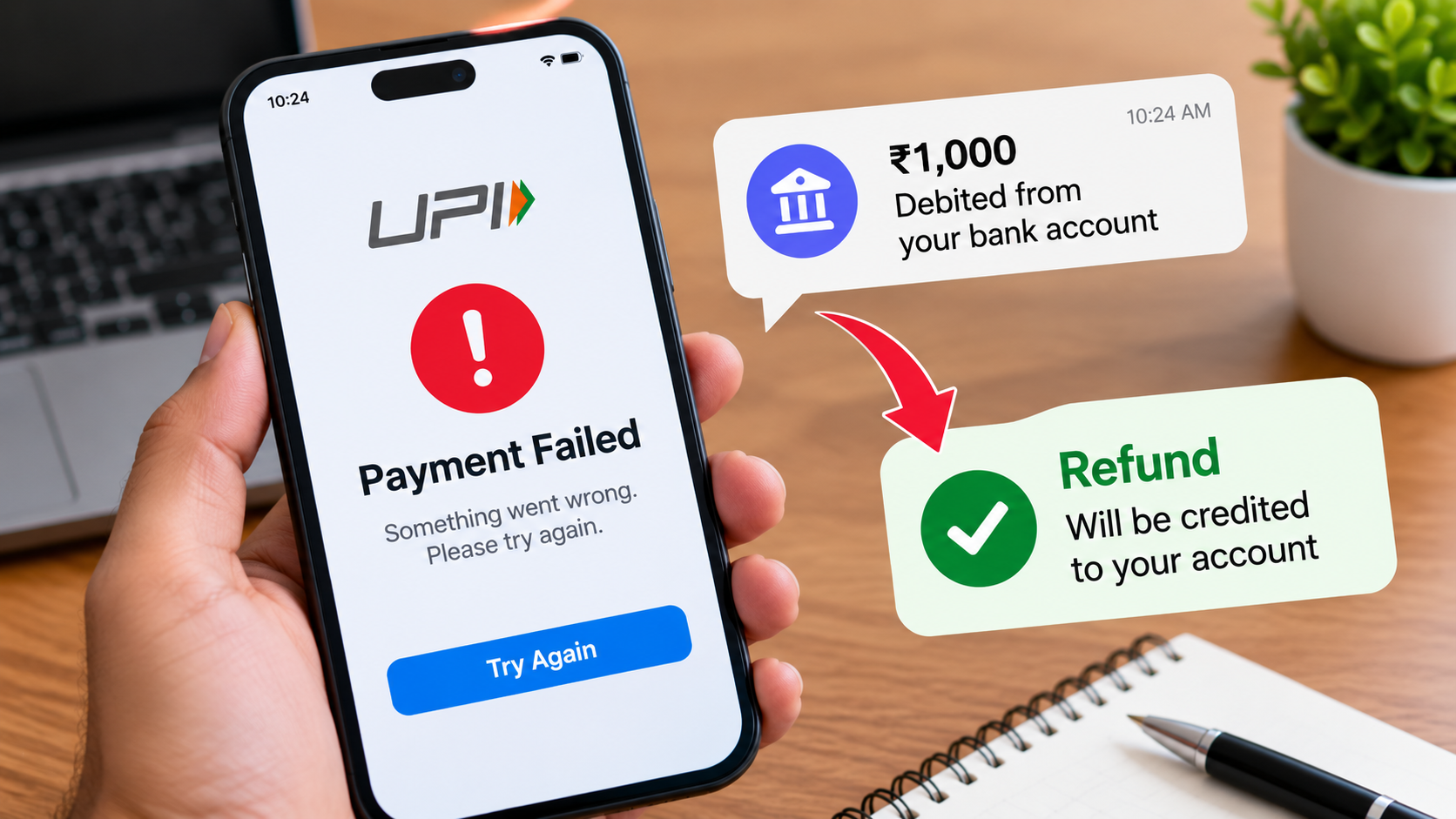
If your UPI payment fails but money is deducted from your bank account, first check the transaction status in your UPI app and bank statement. Save the transaction ID or UPI reference number, then raise a complaint through the app or your bank if the payment is not automatically reversed.
Under the RBI's framework for failed transactions, the applicable reversal deadline depends on the type of payment:
- Person-to-person transfer: If your account is debited but the beneficiary does not receive the money, the failed transfer should generally be reversed by T+1 day.
- Merchant payment: If your account is debited but the merchant does not receive confirmation, the applicable auto-reversal timeline is T+5 days.
The RBI framework provides for compensation of ₹100 per day beyond the applicable deadline in covered cases. These rules apply to qualifying failed transactions—not every payment dispute or transfer sent to the wrong person.
Introduction
UPI has made sending and receiving money incredibly convenient. Whether you are paying at a shop, transferring money to a friend, ordering food or paying an electricity bill, a transaction can usually be completed within seconds.
But sometimes, a frustrating situation occurs: the UPI payment shows “Failed,” while the money has already been deducted from your bank account.
You may wonder whether the money is lost, how long the refund will take and whom you should contact.
In many failed transactions, the money is automatically reversed. However, the time taken depends on the type of transaction and the reason for the failure.
This guide explains what happens when a UPI payment fails after a debit, the refund timelines under RBI rules, how to raise a complaint and what to do if your refund is delayed.
Why Does a UPI Transaction Fail After Money Is Debited?
A UPI payment involves multiple systems, including your UPI app, your bank, the payment network and the recipient's bank.
Sometimes, the debit happens successfully, but a later stage of the transaction fails or the confirmation does not reach the recipient.
Common reasons include:
Bank Server Issues
Your bank or the recipient's bank may experience temporary technical problems. The payment may fail even though your account has been debited.
Network or Connectivity Problems
An unstable internet connection or a communication timeout can prevent the transaction from completing properly.
Recipient Bank Delays
Your bank may process the debit, but the recipient's bank may not confirm the credit immediately.
UPI App Showing an Incorrect or Delayed Status
The app may display “Pending” or “Failed” while the banks are still processing the transaction. The status shown in the app may not immediately reflect the final outcome.
Payment Processing Timeout
If the transaction does not receive confirmation within the required time, it may be treated as failed and sent for reversal.
Important: A failed status in the app does not always mean the transaction has been fully settled. Check your bank statement and the final transaction status before trying to pay again.
How Long Does a Failed UPI Transaction Refund Take?
The RBI has prescribed different turnaround times for two common types of failed UPI transactions.
| Type of failed transaction | RBI reversal timeline | Compensation for delay |
|---|---|---|
| Money debited, but the recipient's account is not credited | By T+1 day | ₹100 per day beyond the deadline |
| Money debited, but merchant does not receive transaction confirmation | Within T+5 days | ₹100 per day beyond the deadline |
Here, T refers to the calendar date of the transaction. These are the prescribed outer limits under the RBI framework, and the refund may arrive sooner.
The framework covers domestic transactions and provides for compensation where the specified conditions are met. Refer to the RBI circular on failed transactions for the details.
Example: Money Sent to a Friend
Suppose you transfer ₹2,000 to a friend on Monday.
Your bank account is debited, but your friend does not receive the money. If the transaction cannot be completed, the applicable reversal deadline is T+1 day.
If the money has not been returned within the prescribed timeline, raise a complaint and ask the bank to check the transaction.
Example: Payment at a Shop
Suppose you pay ₹1,500 at a store using UPI. Your account is debited, but the merchant does not receive confirmation.
For this type of failed merchant transaction, the applicable auto-reversal timeline is T+5 days.
If the reversal is delayed beyond the applicable deadline, you can raise a complaint and ask about compensation under the RBI framework.
How to Get a Refund for a Failed UPI Transaction
Follow these steps if your UPI payment failed but money was deducted.
Step 1: Check Your Bank Statement
Open your bank's official mobile banking app or internet banking account.
Check whether the amount was actually debited. Sometimes, a payment may show as pending in the UPI app before the bank completes the transaction.
Step 2: Check the UPI Transaction Status
Open the UPI app you used to make the payment.
Go to your transaction history and select the relevant payment. Check whether the status is:
- Failed
- Pending
- Successful
If the status is pending, wait for the final status before attempting the payment again.
Step 3: Save the Transaction Reference Number
Keep the following information ready:
- UPI transaction ID or UTR
- Date and time of payment
- Amount debited
- Recipient's UPI ID or merchant details
- Bank account used for the transaction
- Screenshot of the transaction status
These details can help the bank trace the payment.
Step 4: Raise a Complaint in Your UPI App
Most UPI apps provide a help or support option for individual transactions.
Open the failed transaction and look for options such as “Raise a complaint,” “Get help” or “Report an issue.”
Select the relevant problem, such as money debited but the recipient not credited, and submit the complaint.
Save the complaint or ticket number.
Step 5: Contact Your Bank
If the issue is not resolved through the app, contact your bank using its official customer-care number, website or branch.
Explain that your account was debited but the payment failed or the recipient did not receive the funds.
Ask the bank to:
- Trace the transaction
- Confirm the final transaction status
- Check whether a reversal has been initiated
- Provide a complaint reference number
- Explain the applicable refund deadline
Step 6: Track the Complaint
Keep your complaint number and check for updates.
If the money is not returned within the applicable timeline, ask the bank to explain the delay and whether compensation is due under the RBI framework.
What If the UPI Refund Is Not Received?
If the expected refund does not arrive, do not rely only on the status displayed by the payment app.
Take these steps:
- Confirm that the transaction was actually debited.
- Check whether the recipient received the money.
- Contact the UPI app's support team.
- Raise a complaint with your bank.
- Save all complaint numbers and responses.
- If the issue remains unresolved, escalate it through the appropriate grievance mechanism.
If your complaint to a regulated entity is rejected, you are dissatisfied with the response, or it is not resolved within 30 days, you may be eligible to approach the RBI under the Reserve Bank–Integrated Ombudsman Scheme. Check the scheme's eligibility requirements before filing.
Are You Eligible for ₹100 Compensation for a Delayed UPI Refund?
The RBI's failed-transaction framework provides for compensation of ₹100 per day when a covered transaction is not reversed within the applicable timeline.
However, ₹100 compensation is not automatically payable for every UPI complaint.
The applicable category, reason for the failure and responsibility for the delay matter.
For qualifying cases, the compensation is to be credited automatically, without requiring the customer to submit a separate claim. If you believe compensation is due but have not received it, contact your bank and refer to the relevant RBI framework.
What If the UPI Payment Was Successful but the Merchant Says It Failed?
This is different from a failed transaction where the recipient was never credited.
For example, your UPI app may show “Successful,” and the money may have reached the merchant, but the shopkeeper's payment system may not show the confirmation.
In this situation:
- Check the final status in your UPI app.
- Verify the debit in your bank statement.
- Show the merchant the transaction reference, if appropriate.
- Ask the merchant to verify the payment with their bank or payment provider.
- Avoid paying a second time until the first transaction's status is confirmed.
If the merchant received the money, the transaction may not qualify for an automatic failed-payment reversal. A refund may instead depend on the merchant's refund process and the circumstances of the payment.
What If You Sent Money to the Wrong UPI ID?
A transfer to the wrong UPI ID is different from a failed transaction.
If the payment was successfully completed and the recipient received the money, the standard failed-transaction reversal timelines may not apply.
If you sent money to the wrong person:
- Contact your bank immediately.
- Raise a complaint through your UPI app.
- Provide the transaction reference and recipient details.
- Follow the bank's dispute or recovery process.
Recovery may depend on the circumstances and whether the recipient or receiving bank can facilitate the return. A refund is not guaranteed simply because the transfer was made by mistake.
What If the UPI Transaction Was Fraudulent?
If you did not authorise the transaction, treat it as a potential unauthorised payment—not just a failed UPI transaction.
Contact your bank immediately and report the transaction through its official fraud-reporting channel. You can also report financial cyber fraud through India's official cybercrime helpline 1930 and the National Cyber Crime Reporting Portal.
Do not share your UPI PIN, OTP or banking password with anyone claiming to help you obtain a refund.
The rules for unauthorised transactions differ from the rules for ordinary failed payments. Report the issue as quickly as possible.
How to Avoid UPI Payment Problems
Although technical failures cannot always be prevented, these habits can reduce confusion and help protect your money.
Verify the Recipient
Check the recipient's name and UPI ID before confirming the payment.
Avoid Repeating a Pending Payment
If a transaction is pending, check its status before sending the money again.
Keep Transaction Records
Save the reference number and payment confirmation for important transactions.
Use Official UPI Apps
Download payment apps from official app stores and avoid unknown links or unofficial APK files.
Never Share Your UPI PIN
A UPI PIN is used to authorise payments. You do not need to share it to receive a refund.
Check Your Bank Statement
Your bank statement can help confirm whether the payment was debited and whether a reversal has taken place.
Frequently Asked Questions (FAQs)
1. What should I do if my UPI transaction failed but money was debited?
Check your bank statement and UPI transaction status. Save the transaction reference number, raise a complaint through the app and contact your bank if the amount is not reversed.
2. How long does a failed UPI transaction refund take?
For qualifying failed fund transfers where the beneficiary is not credited, the RBI framework specifies T+1 day. For qualifying merchant payments where confirmation is not received, it specifies T+5 days.
3. What does T+1 mean in UPI refunds?
T is the transaction date. T+1 means one day after that date.
4. What does T+5 mean in UPI refunds?
T+5 means five days after the transaction date. This timeline applies to the specified category of failed merchant payments.
5. Can I get ₹100 compensation for a delayed UPI refund?
You may be eligible if your transaction falls under the RBI's applicable failed-transaction framework and the reversal exceeds the prescribed deadline. It is not a blanket payment for every UPI dispute.
6. Do I need to file a complaint to receive an automatic UPI refund?
Many failed transactions are reversed automatically. If the reversal does not arrive within the applicable timeline, raise a complaint so the bank can investigate.
7. What if my UPI app shows failed but my bank shows successful?
Check the final status and whether the recipient received the money. Contact your bank or app support if the status remains inconsistent.
8. What if the merchant says my UPI payment was not received?
Check your UPI transaction history and bank statement. If the payment is successful, ask the merchant to verify it using the transaction reference before paying again.
9. Can I get a refund if I sent money to the wrong UPI ID?
You can report the issue to your bank and UPI app, but recovery is not guaranteed. A successful transfer to the wrong recipient is different from a failed transaction.
10. What if my UPI refund is not received after five days?
First confirm which reversal timeline applies to your transaction. Then contact your bank with the UPI reference number and complaint details. The T+5 timeline does not apply to every type of UPI payment.
11. Can I complain to the RBI about a failed UPI transaction?
You may be eligible to approach the RBI's Integrated Ombudsman Scheme if you have first complained to the regulated entity and the complaint meets the scheme's conditions, including the applicable response or waiting period.
12. Is a UPI refund possible if the transaction was fraudulent?
Unauthorised transactions follow a different process from ordinary failed payments. Contact your bank immediately, report the fraud and follow the bank's instructions.
13. Should I make the same UPI payment again after it fails?
Not until you have checked the final status. If the first payment was successful or is still pending, making another payment could result in a duplicate transfer.
14. Where can I find my UPI transaction ID?
Open your UPI app's transaction history, select the payment and look for the UPI transaction ID, UTR or reference number. The exact label varies by app.
Published on : 30th September
Published by : SMITA
www.vizzve.com || www.vizzveservices.com
Follow us on social media: Facebook || Linkedin || Instagram
🛡 Powered by Vizzve Financial
RBI-Registered Loan Partner | 10 Lakh+ Customers | ₹600 Cr+ Disbursed