

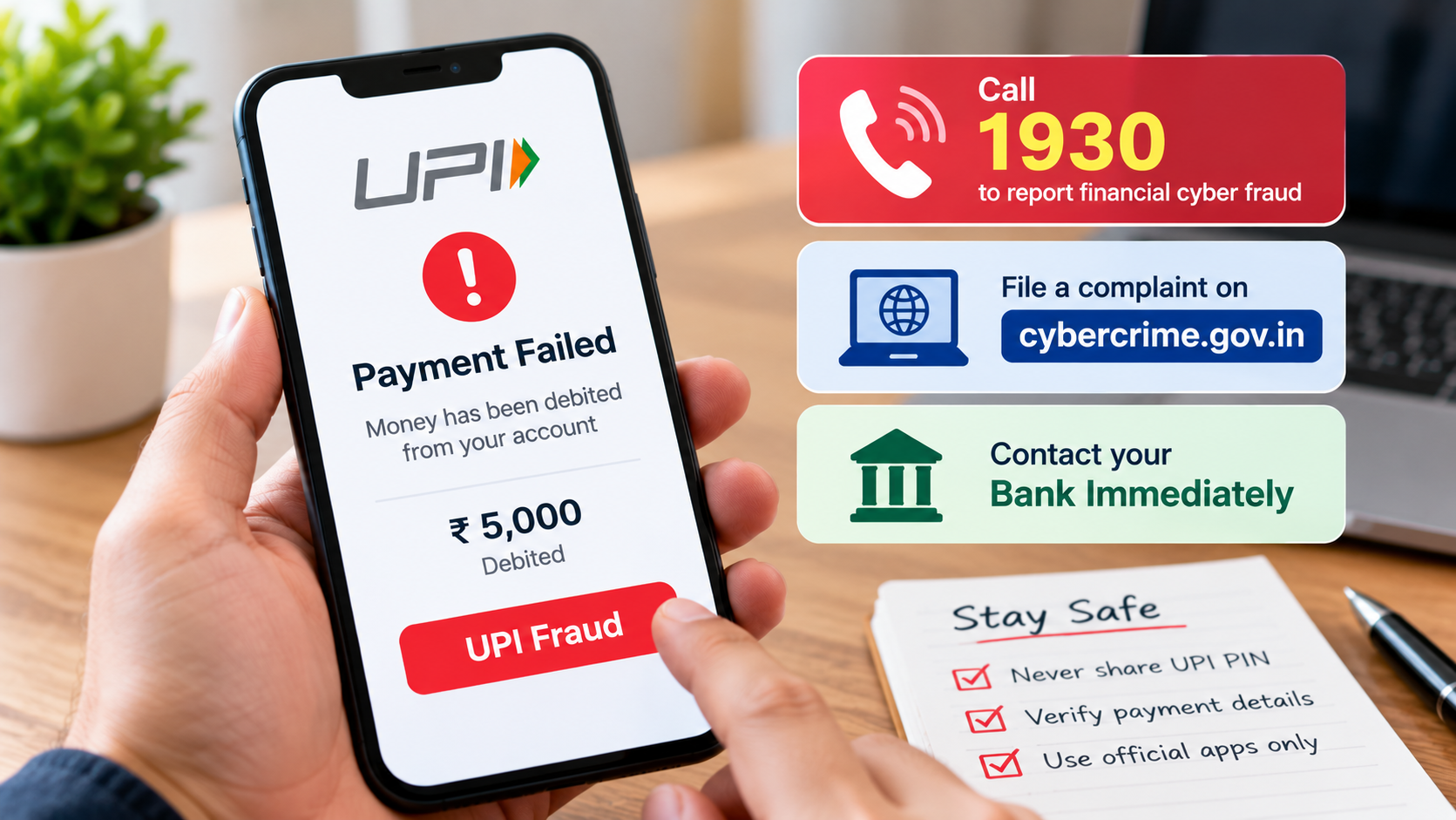
UPI has made digital payments convenient for millions of Indians. From paying at a local shop to transferring money to friends and family, transactions can be completed within seconds.
However, the growing use of digital payments has also created opportunities for fraudsters. Fake payment requests, QR-code scams, impersonation calls and fraudulent customer-care numbers can trick people into authorising payments or sharing sensitive information.
If money has disappeared from your bank account after a suspicious UPI transaction, acting quickly is essential.
The good news is that India has official channels for reporting financial cyber fraud. You can notify your bank, call the national cybercrime helpline and submit a complaint online.
This guide explains how UPI fraud happens, how to report it, what the RBI's customer-liability rules mean and what you can do to improve the chances of recovering your money.
What Is UPI Fraud?
UPI fraud occurs when someone uses deception, stolen credentials or unauthorised access to cause a payment or transfer through the Unified Payments Interface.
Fraud can happen even when a payment app itself is genuine. Scammers may manipulate users into approving a payment, revealing their UPI PIN or installing a harmful application.
Common examples include:
- Fake customer-care calls
- Fraudulent collect requests
- QR-code payment scams
- Fake cashback and reward offers
- Impersonation of bank or government officials
- Fake online shopping or investment offers
- Screen-sharing and remote-access app scams
- Unauthorised transactions after a phone or account is compromised
Understanding the type of fraud is important because the steps for disputing an unauthorised transaction may differ from those for a payment you knowingly approved after being deceived.
What Should You Do Immediately After UPI Fraud?
Time matters when reporting a suspicious transaction. Follow these steps as soon as you discover the fraud.
Step 1: Call the Cybercrime Helpline 1930
Call 1930, India's national helpline for reporting financial cyber fraud.
Keep your transaction details ready, including the amount, date, time, bank name and UPI reference number.
Follow the instructions given by the helpline and note any acknowledgement or complaint reference provided.
Step 2: File a Complaint Online
Visit the official National Cyber Crime Reporting Portal.
Choose the relevant option for reporting financial fraud and provide accurate information about the incident.
You may need to provide:
- Your contact details
- Details of the fraudulent transaction
- Bank and payment information
- The suspected fraudster's phone number or UPI ID, if known
- Screenshots, messages or other supporting evidence
Save the complaint acknowledgement and reference number.
Step 3: Inform Your Bank Immediately
Contact your bank using its official app, website, branch or customer-care number.
Clearly state that you are reporting an unauthorised UPI transaction or financial fraud. Ask the bank to register your complaint and take appropriate steps to prevent further unauthorised transactions.
Record the complaint number, date and time.
Step 4: Secure Your Bank and Payment Accounts
If you suspect that your account, phone or payment credentials have been compromised:
- Change your banking and email passwords.
- Reset your UPI PIN if necessary.
- Block or disable compromised payment access through official channels.
- Contact your bank about securing your account.
- Remove suspicious apps and review app permissions.
- Secure your SIM card and email account if they may be compromised.
Never share your OTP, UPI PIN or banking password with someone claiming to help recover your money.
How to Report UPI Fraud Through Your Bank
Your bank is an important point of contact for an unauthorised transaction.
When reporting the fraud, provide a clear description of what happened.
For example:
"I am reporting an unauthorised UPI transaction from my bank account. The transaction amount is ₹10,000, and it occurred on [date and time]. I did not authorise this payment. Please register my complaint, investigate the transaction and take the necessary steps to protect my account."
Include the UPI transaction ID or UTR, the amount, the date and any relevant screenshots.
Ask your bank for:
- A complaint acknowledgement
- A complaint or ticket number
- Confirmation that the transaction has been reported as unauthorised
- Information about the investigation and next steps
- The bank's applicable customer-liability policy
Do not rely only on a phone conversation. Where possible, submit the complaint in writing through an official channel and keep a copy.
How to File a UPI Fraud Complaint Online
The National Cyber Crime Reporting Portal allows people to report online financial fraud.
Online Complaint Process
- Visit cybercrime.gov.in.
- Select the option to register a complaint.
- Choose the relevant financial fraud or cybercrime category.
- Complete the requested registration and verification steps.
- Enter the incident details accurately.
- Upload supporting evidence where requested.
- Submit the complaint and save the acknowledgement.
The complaint is handled by the relevant authorities based on the details provided. Keep your reference number so you can follow up.
Safety reminder: Use the official government website. Do not pay an unknown person who promises to file a complaint or recover your money.
Can You Get Your Money Back After UPI Fraud?
Yes, recovery may be possible, but it is not guaranteed.
The outcome depends on factors such as:
- Whether the transaction was genuinely unauthorised
- Whether you reported it promptly
- Whether the bank or payment system was responsible
- Whether you shared your payment credentials
- Whether the money can be traced or stopped
- The applicable rules and the investigation's findings
A fraudulent transaction may involve a third party accessing your account without permission. Alternatively, a scammer may deceive you into authorising a payment yourself.
These situations can be treated differently when determining liability.
Report the incident even if some time has passed. Do not assume that recovery is impossible simply because the payment has already been completed.
RBI Rules on Customer Liability for Unauthorised Transactions
The Reserve Bank of India has issued directions addressing customer liability for unauthorised electronic banking transactions.
The framework distinguishes between different situations, including bank-related deficiencies, third-party breaches and losses caused by a customer's negligence.
When Can a Customer Have Zero Liability?
Under the RBI framework, zero liability may apply in specified circumstances, including:
- An unauthorised transaction caused by contributory fraud, negligence or deficiency on the bank's part.
- A third-party breach where neither the bank nor the customer is responsible, provided the customer reports it within the prescribed period.
For the specified third-party breach category, reporting within three working days of receiving the bank's transaction communication is relevant to zero liability.
What If You Shared Your UPI PIN or OTP?
If the loss occurred because you shared payment credentials or otherwise acted negligently, the RBI framework states that the customer may bear the loss until the unauthorised transaction is reported to the bank. Losses occurring after the report are treated differently under the framework.
This is why you should report suspicious transactions immediately—even if you believe you may have made a mistake.
What If You Report After Several Days?
For certain third-party breaches where neither the bank nor the customer is responsible, reporting after three working days can affect the customer's liability.
The RBI framework provides for limited liability in specified cases when a customer reports within four to seven working days. Beyond that period, liability may be determined under the bank's board-approved policy.
These rules are not a guarantee that every UPI scam will result in a refund. The facts of the incident and the applicable rules matter.
Read the RBI's official Customer Protection – Limiting Liability of Customers in Unauthorised Electronic Banking Transactions for the detailed conditions.
How Long Does a UPI Fraud Refund Take?
There is no single guaranteed refund timeline for every UPI fraud case.
The time taken depends on the nature of the transaction, the bank's investigation, the complaint process and whether the case qualifies for specific reversal or customer-liability provisions.
For certain unauthorised electronic banking transactions covered by the RBI's customer-liability framework, banks are required to provide a shadow reversal within 10 working days after notification, subject to the applicable conditions.
A shadow reversal is a provisional credit while the matter is being resolved. It does not mean every reported UPI scam must be refunded within 10 working days.
For your case, ask the bank to explain:
- Whether the transaction qualifies under the relevant RBI framework
- Whether a provisional credit applies
- What documents or information are required
- The complaint's current status
- The next escalation step if the issue remains unresolved
What If Your Bank Does Not Resolve the Complaint?
If your bank does not resolve your complaint satisfactorily, use its formal grievance-redressal process.
Escalate to the Bank's Grievance Officer
Submit your complaint to the bank's grievance-redressal or nodal officer.
Include your original complaint number, transaction details, evidence and the response received from the bank.
Approach the RBI Ombudsman, Where Eligible
If you have first complained to the bank and the issue remains unresolved, you may be eligible to file a complaint under the RBI's Integrated Ombudsman Scheme.
Eligibility depends on the complaint type and the scheme's conditions, including the applicable response or waiting period.
Use the official RBI Complaint Management System to check the process.
Common UPI Fraud Scams in India
Knowing how scams work can help you avoid losing money in the future.
Fake Collect Requests
A fraudster may send a payment request and claim that you must approve it to receive money.
Remember: Approving a collect request can authorise a payment from your account. Read the request carefully before entering your UPI PIN.
QR-Code Scams
A scammer may tell you to scan a QR code to receive a refund, prize or payment.
Scanning a QR code does not itself mean money will be received. Check the payment details and never approve a transaction you do not understand.
Fake Customer-Care Numbers
Fraudsters may post fake support numbers online or impersonate customer-care staff.
Find contact details through your bank's official website or app instead of relying on random search results, social media posts or unsolicited messages.
Screen-Sharing App Scams
A fraudster may ask you to install a remote-access or screen-sharing app to "fix" a payment issue.
Do not grant access to your banking or payment app to an unknown person.
Cashback and Reward Scams
Messages promising instant rewards may contain fake links or requests for sensitive information.
Verify offers through the official app or company website.
How to Protect Yourself From UPI Fraud
Follow these precautions when using UPI.
- Never share your UPI PIN, OTP or banking password.
- Remember that receiving money does not require you to enter your UPI PIN.
- Check the recipient's name and UPI ID before paying.
- Avoid approving unknown collect requests.
- Do not install apps at the request of an unknown caller.
- Use official bank and payment-app support channels.
- Keep your phone's operating system and payment apps updated.
- Enable bank transaction alerts.
- Set a screen lock and secure your SIM.
- Report suspicious transactions immediately.
Frequently Asked Questions (FAQs)
1. How do I report UPI fraud in India?
Call 1930, report the incident through the National Cyber Crime Reporting Portal and inform your bank immediately. Save all complaint reference numbers.
2. Can I get my money back after UPI fraud?
Recovery may be possible, depending on the transaction, the circumstances, the applicable rules and the investigation. A refund is not guaranteed.
3. What is the cybercrime helpline number for UPI fraud?
The national helpline for reporting financial cyber fraud in India is 1930.
4. Can I report UPI fraud online?
Yes. You can file a complaint through the official National Cyber Crime Reporting Portal.
5. Should I contact my bank after reporting fraud on 1930?
Yes. Contact your bank immediately as well. Ask it to register the unauthorised transaction complaint and secure your account.
6. What details are needed to report UPI fraud?
Keep your transaction ID or UTR, transaction amount, date and time, bank details, screenshots, messages and any information about the suspected fraudster.
7. What happens if I shared my UPI PIN with a fraudster?
Contact your bank immediately, report the unauthorised transaction and secure your payment account. Sharing credentials may affect customer liability under the applicable rules.
8. Does RBI guarantee a refund for every UPI fraud?
No. Customer protection and liability depend on the circumstances and the applicable RBI framework. Not every scam results in an automatic refund.
9. What is the RBI rule for reporting unauthorised transactions?
The applicable framework considers factors such as who was responsible and how quickly the customer informed the bank. In specified third-party breach cases, reporting within three working days of receiving the bank's transaction communication is relevant to zero liability.
10. How long does a UPI fraud refund take?
There is no single timeline for every fraud case. Certain covered unauthorised electronic banking transactions have specific provisional-credit requirements, while other cases depend on the investigation and applicable rules.
11. What if my bank rejects my UPI fraud complaint?
Ask for the reason in writing and escalate through the bank's grievance-redressal process. If eligible, you can approach the RBI's Integrated Ombudsman Scheme.
12. Can I report a UPI scam if I do not know the fraudster's identity?
Yes. Provide the transaction details and whatever information you have, such as a UPI ID, phone number, message, website or screenshot.
13. Can I get a refund if I approved the payment myself?
It depends on the circumstances. A payment you authorised after being deceived may be assessed differently from a transaction initiated without your permission. Report it promptly and let your bank investigate.
14. Is it safe to pay someone who promises to recover my UPI fraud money?
Be extremely cautious. Do not pay unknown recovery agents or share your OTP, UPI PIN or banking credentials. Use official bank and government channels.
15. Where can I check the status of my cybercrime complaint?
Use the complaint-tracking facility on the official National Cyber Crime Reporting Portal and retain your acknowledgement or reference number.
Published on : 30th September
Published by : SMITA
www.vizzve.com || www.vizzveservices.com
Follow us on social media: Facebook || Linkedin || Instagram
🛡 Powered by Vizzve Financial
RBI-Registered Loan Partner | 10 Lakh+ Customers | ₹600 Cr+ Disbursed