

UPI has become one of India's most widely used digital payment systems.
Whether you're paying a shopkeeper, sending money to family, paying a bill or making a high-value merchant payment, UPI can often complete the transaction within seconds.
But one question regularly creates confusion:
"How much money can I actually send through UPI?"
The answer is not always simply ₹1 lakh.
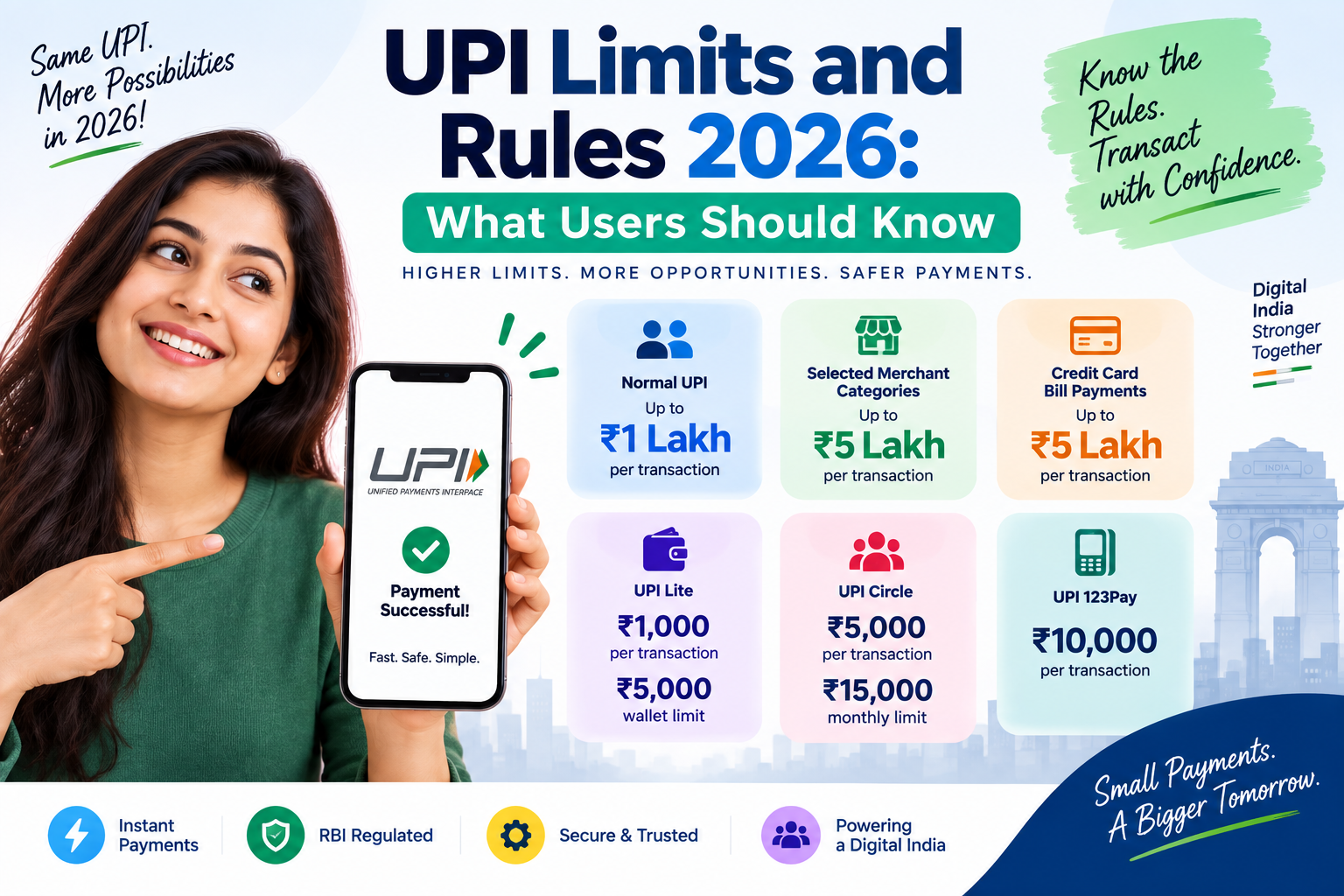
The standard UPI transaction limit is generally up to ₹1 lakh per transaction, but NPCI and RBI have provided higher limits for certain categories and use cases. Banks can also impose their own internal or customer-level limits within the applicable framework.
In 2025, NPCI expanded higher transaction limits for several verified-merchant categories, including insurance, capital markets, travel, credit-card bill payments, jewellery and certain business payments. Some of these categories can now have a ₹5 lakh per-transaction ceiling, with separate cumulative 24-hour limits depending on the category.
So, if your UPI payment is being declined even though you have enough money in your bank account, the problem may be your transaction limit, bank-level limit, risk controls or another UPI rule.
What Is UPI?
UPI stands for Unified Payments Interface.
It is an instant payment system developed by the National Payments Corporation of India (NPCI), an RBI-regulated entity.
UPI allows users to transfer money between bank accounts using methods such as:
- UPI ID
- Mobile number
- QR code
- Bank account details
- UPI-enabled apps
NPCI describes UPI as an instant payment system that allows transfers between participating bank accounts.
What Is the Standard UPI Transaction Limit in 2026?
For a normal UPI transaction, the current NPCI FAQ states a limit of:
₹1 lakh per transaction
This is the general ceiling for standard UPI transactions.
However, it is important to understand that ₹1 lakh is not necessarily your personal daily limit.
Your bank may set a lower limit based on its policies, account type, customer profile, risk controls and other factors.
NPCI's 2025 circular specifically says member banks may retain discretion to set internal limits within NPCI's overall ceilings.
UPI Transaction Limit: Quick Table
| UPI Use Case | Limit / Rule |
|---|---|
| Normal UPI transaction | Up to ₹1 lakh per transaction |
| Selected higher-limit categories | Up to ₹5 lakh per transaction |
| Jewellery | Up to ₹2 lakh per transaction |
| Credit-card bill payments | Up to ₹5 lakh per transaction, with category-specific cumulative ceiling |
| UPI Lite | Up to ₹1,000 per transaction |
| UPI Lite wallet balance | Up to ₹5,000 |
| UPI Circle full delegation | Up to ₹5,000 per transaction and ₹15,000 monthly per delegation |
| UPI 123Pay | Up to ₹10,000 per transaction under applicable framework |
Important: Limits can vary by use case, bank and applicable NPCI rules. The table should not be interpreted as a guarantee that every user can transact at the maximum amount.
Is the UPI Limit ₹1 Lakh Per Day or Per Transaction?
This is one of the most common UPI questions.
The general NPCI FAQ refers to the standard limit as ₹1 lakh per transaction.
But banks and UPI apps may apply their own daily or transaction-level restrictions.
For example, your bank may allow:
- A lower amount per transaction
- A particular number of transactions
- A lower cumulative daily amount
- Different limits for newly registered users
- Additional security restrictions after unusual activity
Therefore:
NPCI's maximum ceiling and your bank's actual usable limit may not be the same.
Can You Transfer More Than ₹1 Lakh Through UPI?
Yes, in certain cases.
The ₹1 lakh limit is the standard limit for normal UPI transactions, but specific categories have higher ceilings.
For example, NPCI's enhanced category framework allows certain verified merchants to accept higher-value UPI payments.
These include selected categories such as:
- Capital markets
- Insurance
- Travel
- Government e-Marketplace EMD payments
- Credit-card bill payments
- Collections
- Certain business/merchant payments
- Digital account opening
- Jewellery
The applicable maximum differs by category.
Which UPI Payments Can Have a ₹5 Lakh Limit?
NPCI's 2025 addendum provides enhanced limits for several categories.
| Category | Per-Transaction Limit | Cumulative 24-Hour Limit |
|---|---|---|
| Capital Market | ₹5 lakh | ₹10 lakh |
| Insurance | ₹5 lakh | ₹10 lakh |
| Government e-Marketplace EMD | ₹5 lakh | ₹10 lakh |
| Travel | ₹5 lakh | ₹10 lakh |
| Credit Card Bill Payments | ₹5 lakh | ₹6 lakh |
| Collections | ₹5 lakh | ₹10 lakh |
| Business/Merchant payments | ₹5 lakh | As specified |
| Jewellery | ₹2 lakh | ₹6 lakh |
| FX Retail via BBPS | ₹5 lakh | ₹5 lakh |
| Digital Account Opening – Term Deposit | ₹5 lakh | ₹5 lakh |
| Digital Account Opening – Initial Funding | ₹2 lakh | ₹2 lakh |
These enhanced limits apply to specified categories and, where required, verified merchants meeting NPCI conditions. Issuing banks may also maintain lower internal limits.
UPI Limit for Person-to-Person Transfers
For regular person-to-person UPI transfers, the standard NPCI transaction limit remains:
₹1 lakh per transaction
For example, if you're sending money to a friend or family member, you generally shouldn't assume that the ₹5 lakh category-specific limits apply.
NPCI's 2025 enhanced-category circular explicitly states that the P2P limit continues under the existing guidelines.
Example
If you want to send:
₹50,000 → Generally within the standard ceiling
₹1,00,000 → At the standard NPCI ceiling
₹2,00,000 → Not a normal P2P transaction under the standard ₹1 lakh ceiling
For amounts above your bank's allowed UPI limit, another payment method may be required.
UPI Merchant Payment Limits
Merchant payments can have different limits depending on the category.
This is important because:
P2P ≠ P2M
A payment to a person is different from a payment to a verified merchant.
NPCI's enhanced 2025 limits specifically cover selected merchant categories and verified merchants.
So, a high-value payment to a qualifying merchant may be possible even though the same amount cannot be sent as an ordinary person-to-person transfer.
UPI Limit for Credit Card Bill Payments
Selected credit-card bill payments through UPI can have a higher ceiling.
NPCI's 2025 framework lists:
₹5 lakh per transaction
with a:
₹6 lakh cumulative 24-hour limit
for the specified credit-card bill-payment category.
However, the actual amount permitted can depend on the participating bank and applicable system controls.
UPI Limit for Insurance Payments
Insurance is another category where enhanced limits apply.
NPCI's framework provides:
Up to ₹5 lakh per transaction
with a:
₹10 lakh cumulative 24-hour limit
for the specified insurance category.
This is particularly useful for higher-value premium payments.
UPI Limit for Jewellery Payments
Jewellery has a separate enhanced category limit.
NPCI's 2025 circular provides:
₹2 lakh per transaction
and:
₹6 lakh cumulative within 24 hours
for the specified jewellery merchant category.
Again, the payment must fall within the applicable category and merchant requirements.
UPI Limit for Travel Payments
Selected travel payments can also qualify for enhanced limits.
NPCI's framework allows:
Up to ₹5 lakh per transaction
with a:
₹10 lakh cumulative 24-hour limit
for the specified travel category.
UPI Lite Limit in 2026
UPI Lite is designed for smaller-value payments.
RBI increased the UPI Lite limits to:
- ₹1,000 per transaction
- ₹5,000 total wallet balance
The change was intended to make UPI Lite more useful for small-value digital payments.
Why use UPI Lite?
It can be useful for:
- Small purchases
- Local shops
- Food payments
- Transport
- Everyday expenses
UPI Lite is different from standard UPI because it uses an on-device stored-value mechanism for eligible transactions.
What Is UPI Circle?
UPI Circle allows a primary user to delegate payment access to another trusted person.
For example:
- Parent → Child
- Family member → Senior citizen
- Business owner → Staff member
NPCI's UPI Circle full-delegation framework allows the primary user to set a monthly spending limit of up to ₹15,000 per delegation, with a maximum transaction limit of ₹5,000.
NPCI's BHIM implementation also describes a monthly limit of up to ₹15,000 and expiry duration of up to five years.
Why is UPI Circle useful?
It provides:
- Controlled spending
- Real-time visibility
- Delegated payment access
- No need for the secondary user to have a separate bank account linked to UPI in the full-delegation model
UPI 123Pay Limit
UPI 123Pay was developed to enable UPI payments for feature-phone users.
RBI's framework increased the per-transaction limit from ₹5,000 to:
₹10,000
for UPI 123Pay.
This is a separate UPI use case and should not be confused with the standard smartphone-based UPI limit.
Does Every Bank Allow the Maximum UPI Limit?
No.
This is a very important point.
Even if NPCI permits a particular ceiling, your bank may apply a lower limit.
NPCI's enhanced-limit circular states that member banks may continue to set internal limits based on their internal policies, within the overall NPCI ceilings.
Your actual UPI limit may depend on:
- Bank
- Account type
- UPI app
- Transaction category
- Customer profile
- New-user restrictions
- Risk controls
- Security policies
- Transaction history
Why Did My UPI Payment Fail Even Though I Have Enough Balance?
Having sufficient bank balance does not guarantee a successful UPI transaction.
A payment can fail because of:
1. Transaction limit exceeded
You may have crossed the allowed limit.
2. Daily limit reached
Your bank may have a cumulative limit.
3. Bank server issue
Temporary technical problems can affect transactions.
4. UPI network issue
The transaction may fail because of connectivity or system problems.
5. Incorrect UPI PIN
A wrong PIN can cause the transaction to fail.
NPCI says repeated incorrect UPI-PIN entries can result in a temporary block on sending money through UPI, depending on the bank.
6. Risk controls
Banks or payment systems may decline transactions based on security and risk checks.
UPI PIN Rules You Should Know
Your UPI PIN is the authentication code used to authorise bank transactions.
NPCI states that the UPI PIN is generally a 4–6 digit passcode created by the user.
Never share your UPI PIN.
Your:
- Bank
- UPI app
- Customer-care representative
should not ask you to disclose your UPI PIN.
NPCI specifically advises users not to share their UPI PIN and notes that bank customer support will not ask for it.
Important UPI Safety Rule: You Don't Need a PIN to Receive Money
A common fraud technique involves telling users:
"Enter your UPI PIN to receive the payment."
This is dangerous.
The UPI PIN is used to authorise a debit/payment, not simply to receive money.
If someone sends you a collect request or asks you to scan a QR code, carefully check what action you're authorising before entering your PIN.
Can a UPI Transaction Be Cancelled?
According to NPCI's FAQ:
Once a UPI payment is initiated, it cannot simply be stopped through a standard stop-payment request.
This is why users should verify:
- Recipient name
- UPI ID
- Amount
- Merchant
- Payment purpose
before entering the UPI PIN.
What Should You Do If You Send Money to the Wrong UPI ID?
Act quickly.
Step 1
Check the transaction status.
Step 2
Use your UPI app's complaint or support option.
NPCI says users can raise grievances or check UPI transaction status through the participating UPI app/bank.
Step 3
Contact your bank.
Provide:
- Transaction ID
- Date and time
- Amount
- Recipient details
- Screenshot, if available
Step 4
If fraud is suspected, report it through the appropriate official cyber-fraud reporting channel immediately.
UPI Rules for 2026: What Users Should Remember
Rule 1: Standard UPI limit is generally ₹1 lakh per transaction
This is the basic ceiling for normal UPI transfers.
Rule 2: Some categories have higher limits
Certain verified-merchant categories can have limits up to ₹5 lakh per transaction.
Rule 3: Your bank may impose a lower limit
NPCI's ceiling does not guarantee that your bank will allow the maximum amount.
Rule 4: P2P and merchant payments are different
Don't assume a higher merchant limit applies to person-to-person transfers.
Rule 5: Never share your UPI PIN
Your PIN authorises transactions and should remain confidential.
Rule 6: Check the recipient before paying
UPI transactions generally cannot simply be stopped after initiation.
Rule 7: Use official support for disputes
Raise complaints through your UPI app or participating bank.
UPI Limits vs Other Digital Payment Methods
| Payment Method | Typical Feature |
|---|---|
| UPI | Instant bank-to-bank payments |
| IMPS | 24×7 instant bank transfer |
| NEFT | Bank-to-bank electronic transfer |
| RTGS | Used primarily for high-value transfers |
| UPI Lite | Small-value UPI payments |
| UPI 123Pay | UPI for feature phones |
NPCI states that IMPS has a ₹5 lakh per-transaction limit for most channels, excluding SMS and IVR.
The appropriate payment method depends on the amount, purpose, bank facilities and applicable limits.
How to Increase Your UPI Transaction Limit
Users often search for:
"How can I increase my UPI limit?"
There isn't one universal setting that increases the limit for everyone.
Try these steps:
- Check your bank's UPI limit.
- Check whether you've reached the daily limit.
- Check whether the transaction falls into a higher-limit category.
- Update your UPI app if required.
- Contact your bank.
- For larger transfers, consider another permitted banking channel.
Remember that banks can maintain internal limits within NPCI's overall ceilings.
UPI Limit Example
Suppose your bank allows a maximum UPI transaction of ₹1 lakh.
You want to send:
₹80,000 to a family member
This is within the standard ₹1 lakh ceiling.
But suppose you want to send:
₹2 lakh to a friend
That is above the standard P2P ceiling, so you may need to use another payment method.
Now consider a qualifying higher-limit merchant transaction.
A payment of:
₹2 lakh for a qualifying merchant category
may be possible if the category, merchant, bank and applicable UPI rules allow it.
This demonstrates why the purpose of the payment matters.
UPI Rules for Businesses and Merchants
Businesses accepting UPI should also understand that higher limits are not automatically available to every merchant.
NPCI's enhanced-limit framework requires relevant merchants to meet applicable conditions, including verified-merchant requirements for specified categories.
Businesses should therefore check with their acquiring bank/payment provider regarding:
- Merchant category code
- Eligibility
- Transaction limits
- Settlement
- Risk controls
- Applicable UPI requirements
UPI Usage Is Growing Rapidly
UPI remains one of India's largest digital payment systems.
NPCI's official statistics show that in August 2026, UPI processed approximately:
- 24,508.96 million transactions
- ₹29,82,355.95 crore in transaction value
- Across 752 live banks.
That scale makes understanding payment limits and safety rules increasingly important for everyday users and businesses.
Expert Tips for Safer UPI Payments
Tip 1: Check the recipient name
Before entering the PIN, verify the recipient.
Tip 2: Never share your PIN
No legitimate support representative needs your UPI PIN.
Tip 3: Don't scan QR codes to "receive" money
A QR scan can initiate a payment.
Tip 4: Read collect requests carefully
Don't approve a request without understanding why it was sent.
Tip 5: Keep your mobile secure
Use a screen lock and keep your operating system and UPI app updated.
Tip 6: Set appropriate bank limits
If your bank offers controls, use them according to your spending needs.
Tip 7: Report suspicious transactions immediately
Speed matters when dealing with potential financial fraud.
Frequently Asked Questions
1. What is the UPI transaction limit in 2026?
The standard UPI limit is generally up to ₹1 lakh per transaction. Selected categories have higher limits.
2. Can I transfer ₹2 lakh through UPI?
A standard person-to-person UPI transaction is subject to the ₹1 lakh per-transaction ceiling. Certain eligible merchant categories have higher limits, so the applicable limit depends on the transaction type.
3. What is the maximum UPI limit?
There is no single maximum for every UPI transaction. Standard transactions generally have a ₹1 lakh ceiling, while specified categories can have higher limits, including ₹5 lakh per transaction.
4. Is the UPI limit ₹1 lakh per day?
The NPCI standard limit is described as ₹1 lakh per transaction. Your bank may separately impose a daily or cumulative limit.
5. What is the UPI limit for person-to-person payments?
The standard P2P UPI transaction ceiling is ₹1 lakh per transaction under the applicable NPCI guidelines.
6. What is the UPI limit for merchant payments?
It depends on the merchant category. Selected verified merchants can qualify for enhanced limits, including up to ₹5 lakh per transaction.
7. What is the UPI Lite limit in 2026?
UPI Lite has a ₹1,000 per-transaction limit and a ₹5,000 total wallet limit under the applicable framework.
8. What is the UPI Circle limit?
For full delegation, UPI Circle supports up to ₹5,000 per transaction and ₹15,000 monthly per delegation under the cited NPCI framework.
9. Can my bank set a lower UPI limit?
Yes. Banks may maintain their own internal limits within NPCI's prescribed ceilings.
10. Why did my UPI payment fail even though I have enough money?
Possible reasons include reaching your transaction/daily limit, bank or network issues, incorrect UPI PIN, security controls or other technical problems.
11. Can I cancel a UPI payment after sending it?
A normal UPI payment cannot simply be stopped after it has been initiated. If there is an error or dispute, contact your bank and raise a complaint through the UPI app.
12. Can I increase my UPI limit?
Your bank determines the applicable user-level limit within the relevant framework. Contact your bank to check whether a higher limit is available for your account and transaction type.
13. Is UPI available 24×7?
UPI is designed as an instant payment system, and transactions are available around the clock, subject to bank, network and service availability.
14. Should I share my UPI PIN with customer care?
No. NPCI explicitly advises users not to share their UPI PIN, and bank customer support should not ask for it.
15. What should I do if I receive a suspicious UPI collect request?
Do not approve it unless you recognise the request and understand the payment. Check the sender, amount and purpose carefully before authorising anything.
Conclusion
UPI has made digital payments extremely convenient, but understanding UPI limits and rules in 2026 is important before making large transactions.
The biggest point to remember is that ₹1 lakh is the standard per-transaction limit for normal UPI payments, but it is not the ceiling for every possible UPI use case.
Selected categories such as insurance, capital markets, travel, credit-card bill payments and certain merchant transactions have higher limits under NPCI's enhanced framework. At the same time, your bank may apply a lower internal limit.
For everyday users, the safest approach is simple:
Check the amount. Check the recipient. Check the transaction type. Never share your UPI PIN.
As UPI continues to expand, knowing the difference between standard limits, category-specific limits, bank-level restrictions and newer features such as UPI Lite and UPI Circle can help users make payments more confidently.
Published on : 23rd September
Published by : MONISHA
www.vizzve.com || www.vizzveservices.com
Follow us on social media: Facebook || Linkedin || Instagram
🛡 Powered by Vizzve Financial
RBI-Registered Loan Partner | 10 Lakh+ Customers | ₹600 Cr+ Disbursed