

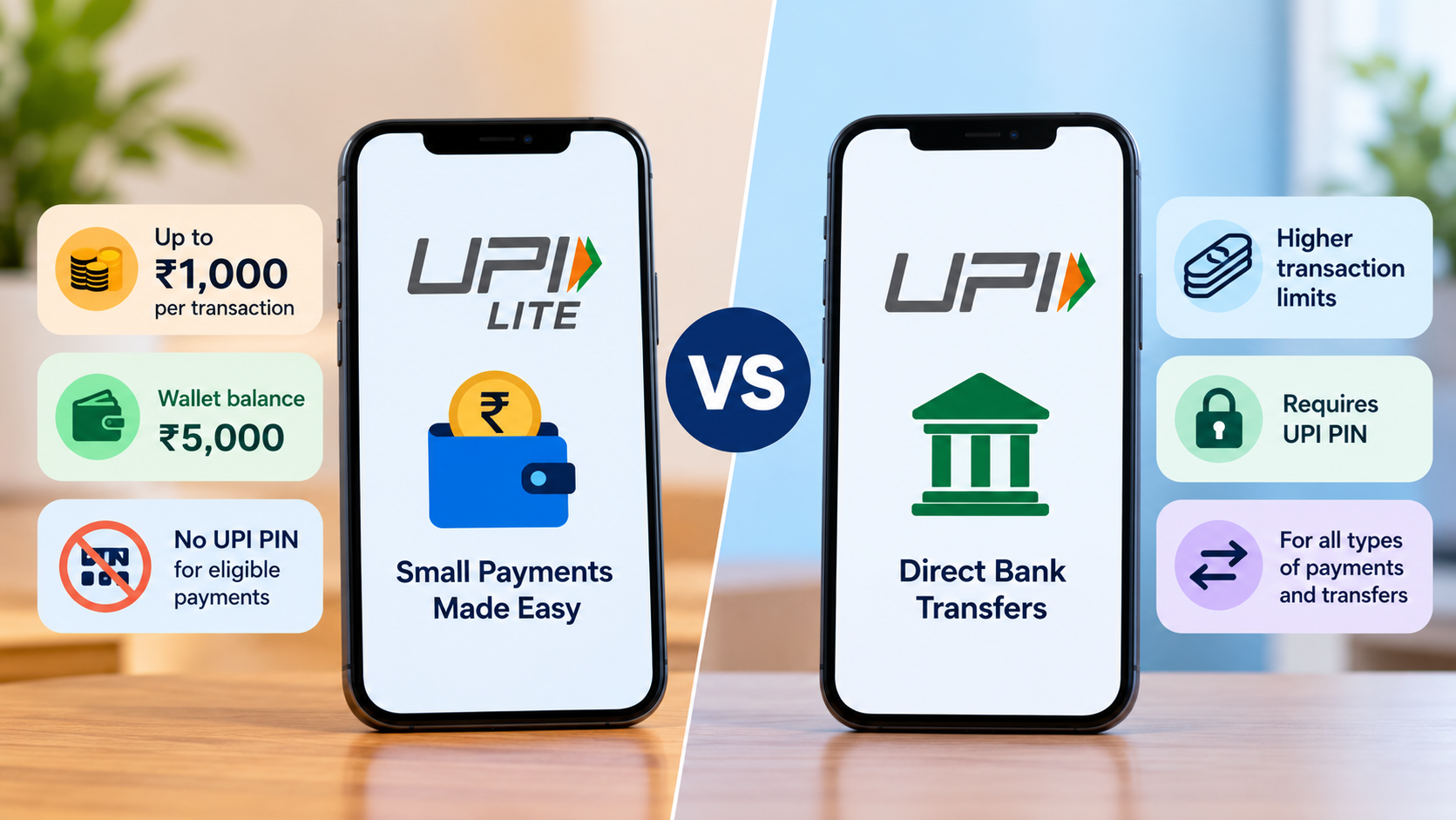
UPI Lite is designed for quick, low-value digital payments using a small balance added from your bank account. Regular UPI transfers money directly from your linked bank account and is suitable for a wider range of payment amounts and transactions.
Under the enhanced limits announced by the Reserve Bank of India, UPI Lite supports transactions of up to ₹1,000 per transaction, with a maximum wallet balance of ₹5,000. Regular UPI limits depend on the transaction type, bank, and applicable rules.
Choose UPI Lite for frequent small payments, such as buying tea, snacks, or paying at local shops. Use regular UPI for larger transfers, payments requiring your bank account balance, and transactions not supported by UPI Lite.
Introduction
Digital payments have become part of everyday life in India. From paying at grocery stores to splitting restaurant bills, UPI makes sending and receiving money simple.
However, not every payment needs the same process. For frequent, small-value payments, UPI Lite offers a convenient alternative to regular UPI.
Both services operate within the UPI ecosystem, but they differ in how money is stored, how payments are processed, and how transaction limits work.
In this guide, we explain UPI Lite vs UPI, their limits, benefits, disadvantages, and the situations in which each option may be useful.
What Is UPI?
Unified Payments Interface (UPI) is an instant payment system developed by the National Payments Corporation of India (NPCI). It allows users to transfer money between bank accounts through supported payment apps.
With regular UPI, you can:
- Send money to another person.
- Pay merchants using QR codes.
- Transfer money using a UPI ID or other supported details.
- Pay bills and make online purchases.
- Receive money directly into your linked bank account.
Regular UPI payments are generally authorised using your UPI PIN. The applicable transaction limit depends on the payment category, bank, and other relevant rules.
What Is UPI Lite?
UPI Lite is a small-value payment facility designed to make everyday transactions quicker and simpler.
To use it, you add money from your linked bank account to your UPI Lite balance. When you make an eligible payment, the amount is deducted from this balance rather than being debited directly from your bank account for every individual transaction.
UPI Lite is useful for frequent, smaller payments where speed and convenience matter.
For example, if you add ₹1,000 to UPI Lite, you can use that balance for eligible purchases until it runs low. You can then replenish it from your linked bank account, subject to the applicable limits and app features.
UPI Lite vs UPI: Key Differences
| Feature | UPI Lite | Regular UPI |
|---|---|---|
| How it works | Uses a preloaded balance | Transfers money directly from a linked bank account |
| Main purpose | Small-value payments | Everyday payments and bank transfers |
| Maximum transaction | Up to ₹1,000 under the enhanced limit | Depends on transaction type and bank |
| Maximum Lite balance | ₹5,000 | No separate UPI Lite-style wallet balance |
| UPI PIN | Not required for eligible Lite payments; app rules apply | Generally required to authorise payments |
| Bank account debit | When adding or replenishing Lite balance | For each successful payment |
| Bank statement | Usually shows loading and related account-level entries | Usually shows individual payments |
| Best suited for | Frequent small purchases | Larger payments and general transfers |
Important: Individual apps and banks may have their own eligibility requirements, payment restrictions, or additional limits. Check the details displayed in your UPI app before making a payment.
UPI Lite Transaction Limit in India
The RBI announced enhanced UPI Lite limits to support wider use of small-value digital payments.
The enhanced limits are:
| Limit | Amount |
|---|---|
| Maximum per transaction | ₹1,000 |
| Maximum wallet balance | ₹5,000 |
These are the enhanced limits for UPI Lite. The actual features available to you can depend on your bank and UPI app.
Is There a Daily UPI Lite Limit?
The maximum wallet balance and the daily spending limit are not necessarily the same thing.
Your wallet cannot hold more than the permitted balance, but the total amount you can spend over a day may depend on the app, bank, and applicable transaction controls. Some apps may display a separate daily limit.
Before relying on UPI Lite for multiple payments, check the limit shown in your app.
What Is the Regular UPI Transaction Limit?
Regular UPI commonly supports transactions up to ₹1 lakh, but this is not a universal limit for every transaction.
Certain categories have higher limits under applicable rules, and banks may apply their own restrictions. For example, specific categories such as capital markets, IPOs, and certain other approved payments may have different limits.
Always check your bank's current UPI transaction limits before making a large payment.
Benefits of UPI Lite
1. Faster Small Payments
UPI Lite is designed to simplify low-value payments. Since eligible transactions use the Lite balance, the payment experience can be quicker.
This is useful when paying at busy shops, cafés, or other merchants.
2. No UPI PIN for Eligible Payments
One of the main conveniences of UPI Lite is that eligible payments can be completed without entering your UPI PIN each time.
The exact payment threshold and availability may vary by app. For example, Google Pay's UPI Lite guidance specifies PIN-free payments for eligible transactions below ₹500.
3. Less Clutter in Your Bank Statement
With regular UPI, individual payments generally appear as bank account transactions.
With UPI Lite, individual purchases are recorded in the Lite transaction history, while your bank statement generally reflects activities such as adding or withdrawing the Lite balance.
This can make it easier to review small purchases in the payment app.
4. Convenient for Everyday Purchases
UPI Lite can be useful for frequent low-value transactions, including:
- Tea, coffee, and snacks
- Small grocery purchases
- Local transport payments where supported
- Payments at neighbourhood shops
- Other eligible merchant transactions
5. Reduces Repeated Bank-Account Payment Processing
UPI Lite is designed to handle small-value payments without requiring the same real-time processing through the remitter bank's core banking system for every payment.
This supports a smoother experience for frequent small transactions.
Benefits of Regular UPI
Regular UPI remains useful for a wide range of payments.
1. Suitable for Larger Payments
Regular UPI is generally more appropriate for payments that exceed the UPI Lite transaction limit, subject to your bank's applicable limit.
2. Direct Bank-to-Bank Transfers
Money is transferred directly between linked bank accounts. You do not need to maintain a separate UPI Lite balance for ordinary UPI payments.
3. Supports More Payment Types
Regular UPI supports many use cases, including person-to-person transfers, merchant payments, bill payments, and other services available through your app.
Some features may not be available through UPI Lite.
4. No Need to Preload a Separate Balance
You can make a payment from your linked bank account without first adding money to a separate Lite balance, provided your account has sufficient funds and the transaction meets applicable requirements.
How to Activate UPI Lite
The exact steps can vary by UPI app, but the general process is straightforward.
- Open your supported UPI payment app.
- Look for the UPI Lite option.
- Select an eligible linked bank account.
- Read and accept the terms and conditions.
- Add money to your UPI Lite balance.
- Complete the required authentication to set it up.
Once activated, you can select UPI Lite for eligible payments wherever the feature is supported.
Tip: Only activate UPI Lite through your official payment app. Never share your UPI PIN or OTP with anyone.
UPI Lite vs UPI: Which Is Better for Everyday Use?
The right option depends on the type of payment you make.
| Situation | Suitable option |
|---|---|
| Paying for tea or snacks | UPI Lite, if supported |
| Making frequent small purchases | UPI Lite |
| Sending a larger amount to a friend | Regular UPI |
| Paying a bill above the Lite limit | Regular UPI |
| Making a payment without maintaining a separate balance | Regular UPI |
| Making eligible small payments without entering a PIN each time | UPI Lite |
There is no need to choose only one. You can keep both options available and use the one that suits each transaction.
Is UPI Lite Safe?
UPI Lite is part of the regulated UPI payment ecosystem, but users should still take precautions.
Follow these safety practices:
- Keep your phone protected with a screen lock.
- Use only official UPI applications.
- Never share your UPI PIN, OTP, or phone passcode.
- Check the recipient and amount before confirming a payment.
- Review your UPI Lite transaction history regularly.
- Contact your bank promptly if you notice an unauthorised transaction.
- If your phone is lost, contact your bank and follow its instructions to secure your account and Lite balance.
Because eligible UPI Lite payments may not require a PIN for every transaction, protecting access to your phone is particularly important.
Disadvantages of UPI Lite
UPI Lite is convenient, but it is not designed to replace every regular UPI feature.
Its main limitations include:
- Limited transaction amount: A single payment cannot exceed the applicable UPI Lite limit.
- Limited balance: You can hold only up to the permitted Lite balance.
- Preloading required: You need to add money before spending from the Lite balance.
- App and bank support: Availability depends on participating banks and supported apps.
- Feature restrictions: Some payment types, such as certain collect requests or other app-specific services, may not be supported.
Regular UPI may be more practical if you frequently make larger transfers or use payment features that UPI Lite does not support.
Frequently Asked Questions (FAQs)
1. What is the difference between UPI Lite and UPI?
UPI Lite uses a preloaded balance for eligible small-value payments. Regular UPI transfers money directly from your linked bank account.
2. What is the UPI Lite transaction limit?
The enhanced UPI Lite limit is ₹1,000 per transaction, subject to the features and restrictions of your bank and app.
3. What is the maximum UPI Lite wallet balance?
The enhanced maximum UPI Lite balance is ₹5,000.
4. Can I use UPI Lite without a UPI PIN?
Eligible UPI Lite payments can be made without entering a UPI PIN each time. The exact threshold and conditions depend on the payment app.
5. Is UPI Lite free to use?
UPI Lite is generally offered as a payment facility without a separate customer fee for ordinary eligible payments. Check your app's terms for any applicable charges.
6. Does UPI Lite require a bank account?
You generally need an eligible bank account linked through a supported UPI app to add money to UPI Lite.
7. Can I transfer ₹5,000 in one UPI Lite transaction?
No. ₹5,000 is the maximum Lite wallet balance, not the per-transaction limit. The enhanced per-transaction limit is ₹1,000.
8. Does UPI Lite work without the internet?
UPI Lite is designed to simplify payment processing, but ordinary UPI Lite use should not be assumed to work fully offline in every situation. Availability depends on the transaction mode, app, and merchant setup. UPI Lite X is a separate feature designed for offline payments.
9. Can I use UPI Lite and regular UPI on the same app?
Many supported apps allow users to use both, though availability depends on the app and bank.
10. Does UPI Lite money come directly from my bank account?
You first add money from your linked bank account to your UPI Lite balance. Eligible payments are then deducted from that balance.
11. Can I get a refund to UPI Lite?
Refunds are generally credited to the linked bank account rather than the UPI Lite balance. The exact handling depends on the app and transaction.
12. Can I withdraw my UPI Lite balance?
You can generally close or deregister UPI Lite and have the remaining balance returned to the linked bank account, following the app's process.
13. Is UPI Lite safer than regular UPI?
Both have security protections, but their payment flows differ. UPI Lite's PIN-free convenience for eligible payments makes phone security and transaction monitoring especially important.
14. Can I use UPI Lite for online shopping?
Availability depends on the merchant and app. UPI Lite is designed for eligible low-value payments, but not every online payment flow supports it.
15. Should I use UPI Lite or regular UPI?
Use UPI Lite for frequent, eligible small payments. Use regular UPI for larger transfers, payments requiring features not supported by Lite, or when you prefer to pay directly from your bank account.