

UPI Payments in India: What You Need to Know
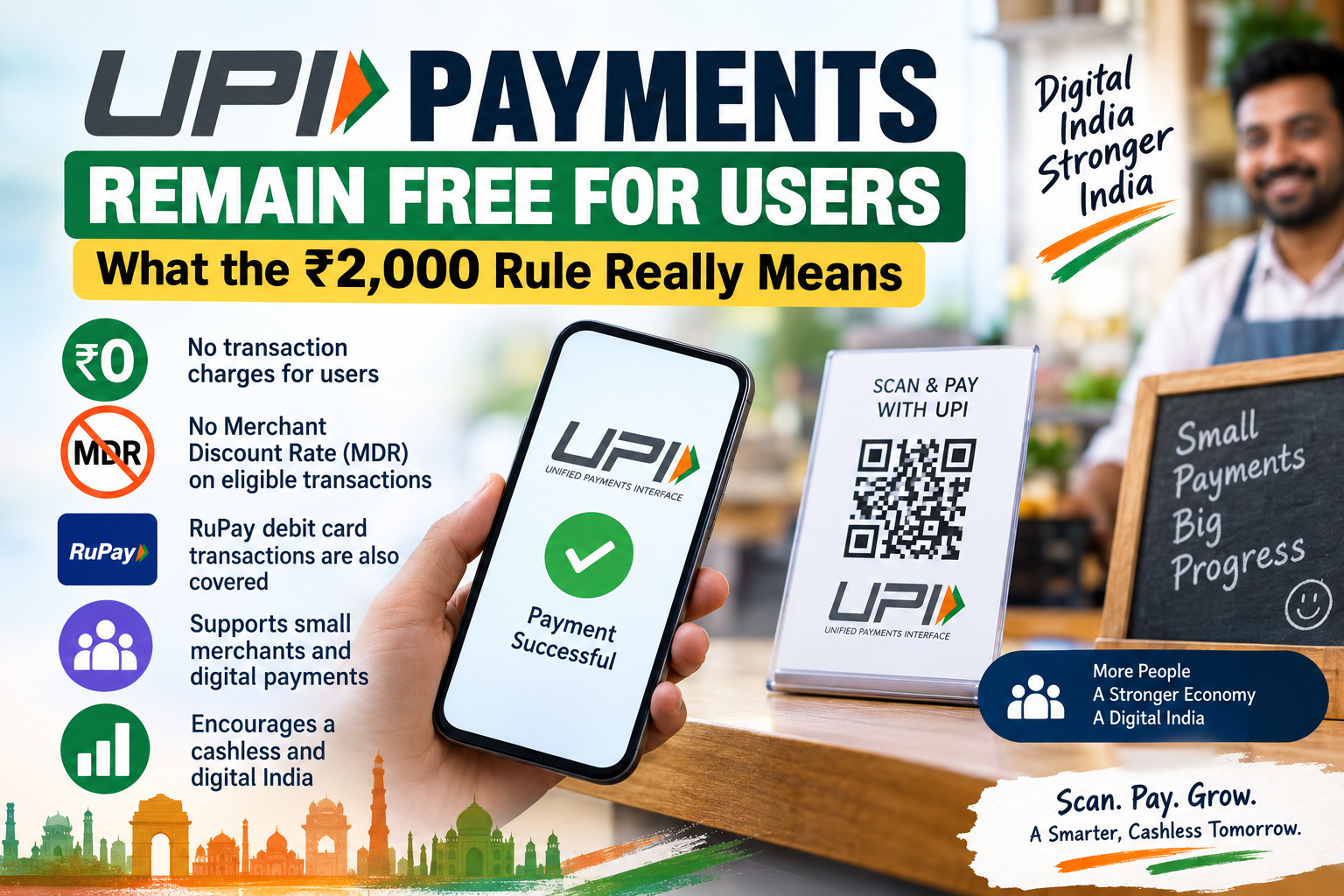
Short answer: Consumers making ordinary UPI payments do not pay a transaction charge. The government has repeatedly supported zero-cost UPI payments and has used incentive schemes to help sustain the payment ecosystem. The ₹2,000 figure is important mainly because the government’s FY2024-25 incentive scheme specifically covered qualifying UPI person-to-merchant transactions up to ₹2,000 for small merchants.
India's UPI system has become one of the most important parts of everyday commerce. From buying groceries and paying restaurant bills to sending money to family members, UPI has made digital payments almost as simple as handing over cash.
But one issue often creates confusion: Does UPI have a charge? What does ₹2,000 have to do with MDR? And are RuPay debit-card transactions treated differently?
The answers require a distinction between customer charges, merchant MDR and government incentives.
Quick Answer
UPI payments remain free for consumers. The ₹2,000 threshold should not be interpreted as meaning that UPI is free only below ₹2,000.
The government’s 2024-25 incentive scheme focused on BHIM-UPI person-to-merchant transactions up to ₹2,000 involving small merchants. The scheme provided a 0.15% incentive on qualifying transactions while maintaining zero MDR. For transactions above ₹2,000, the scheme did not provide that incentive, although MDR remained zero under the framework described by the government.
In simple terms:
₹2,000 is not a general UPI fee-free limit for consumers. UPI payments remain free for users.
The Ministry of Finance also clarified in August 2026 that consumers would not face UPI transaction charges and that person-to-person transactions would continue to be free.
What Is UPI?
Unified Payments Interface (UPI) is India's real-time digital payment system that allows users to transfer money directly between bank accounts using participating apps and banks.
Instead of entering lengthy bank-account information for every transaction, users can generally pay through methods such as:
- UPI ID
- QR code
- Mobile number
- Bank account-linked payment interface
- Other supported UPI payment methods
The system has transformed India's payment habits, particularly for small-value everyday purchases.
According to the Ministry of Finance, UPI processed 2,366 crore transactions worth ₹29.9 lakh crore in July 2026 alone.
Does UPI Have Transaction Charges?
For ordinary consumers, UPI payments remain free.
The government stated in August 2026 that consumers making payments would not face transaction charges and that person-to-person payments would continue to be free. It also said the vast majority of UPI transactions would remain free for merchants.
This is important because there is often confusion between:
Customer charge
This is an amount directly charged to the person making a payment.
Merchant Discount Rate
MDR is a fee associated with processing certain merchant payments and is generally part of the payment ecosystem rather than a direct consumer UPI fee.
Government incentive
An incentive is financial support provided to ecosystem participants to encourage particular types of digital transactions.
These three concepts should not be treated as the same thing.
What Is the ₹2,000 UPI Rule?
The ₹2,000 figure comes prominently into the government's low-value BHIM-UPI P2M incentive scheme.
In March 2025, the Union Cabinet approved a ₹1,500 crore incentive scheme for FY2024-25 for low-value BHIM-UPI person-to-merchant transactions. The scheme specifically covered transactions up to ₹2,000 involving small merchants.
Incentive structure
| Transaction | Small Merchant | Large Merchant |
|---|---|---|
| Up to ₹2,000 | Zero MDR + eligible 0.15% incentive | Zero MDR |
| Above ₹2,000 | Zero MDR, no scheme incentive | Zero MDR |
| Consumer payment charge | No additional UPI transaction charge | No additional UPI transaction charge |
The government said the 0.15% incentive for eligible low-value transactions was designed to support small merchants and the wider digital-payment ecosystem.
UPI vs RuPay Debit Card: What's the Difference?
UPI and RuPay are both major parts of India's digital-payment ecosystem, but they are not identical.
| Feature | UPI | RuPay Debit Card |
|---|---|---|
| Primary use | Bank-account-based digital payments | Card payments |
| QR payments | Yes | Yes, where supported |
| Person-to-person transfers | Yes | No |
| Merchant payments | Yes | Yes |
| Consumer UPI transaction charge | No | Not applicable as a UPI charge |
| MDR framework | Zero MDR under current UPI framework | Zero MDR framework for RuPay debit cards |
| Government support | Incentive schemes have supported low-value UPI | Government incentive support has also covered RuPay |
Government material states that MDR was made zero for RuPay debit cards and BHIM-UPI transactions effective January 2020, through amendments to the relevant legal framework.
Why Does the Government Support Zero-MDR Digital Payments?
Digital payments create benefits beyond convenience.
For merchants, electronic payments can provide:
- Faster settlement
- Digital transaction records
- Lower dependence on cash handling
- Easier accounting
- Greater transaction visibility
- Potentially better access to formal financial services
For consumers, digital payments offer:
- Convenience
- Speed
- Reduced need to carry cash
- Transaction records
- Easy person-to-person transfers
- QR-based payments at small shops
The government has therefore used both regulation and financial incentives to encourage digital-payment adoption.
₹1,500 Crore Incentive Scheme Explained
The 2025 Cabinet-approved scheme had an estimated outlay of ₹1,500 crore for FY2024-25. It was designed specifically to encourage low-value BHIM-UPI transactions among small merchants.
How the incentive worked
For qualifying small-merchant transactions of up to ₹2,000:
- The transaction remained at zero MDR.
- A 0.15% incentive could apply.
- The acquiring bank could claim reimbursement.
- The remaining reimbursement was linked partly to technical performance.
- The objective was to support a reliable and sustainable payment ecosystem.
The government said 80% of the admitted claim would be disbursed without conditions, while parts of the remaining 20% depended on technical-decline and system-uptime performance.
Why Small Merchants Matter
Small retailers are among the biggest beneficiaries of India's QR-payment revolution.
Think of a neighbourhood:
- Tea stall
- Vegetable vendor
- Kirana shop
- Auto-rickshaw driver
- Street-food seller
- Small restaurant
- Local service provider
For these businesses, even small payments can add up to a substantial share of daily revenue.
A payment system that is easy and inexpensive to accept can therefore make digital transactions practical for businesses that traditionally depended heavily on cash.
Expert Commentary: Why the ₹2,000 Figure Can Be Misleading
From a payment-policy perspective, the most important distinction is between a transaction-value threshold in an incentive programme and a consumer fee threshold.
The government's own 2025 explanation described the ₹2,000 limit in the context of the low-value BHIM-UPI P2M incentive scheme. It did not establish a rule saying that consumers receive free UPI only when they pay ₹2,000 or less.
This distinction matters because headlines such as “UPI free up to ₹2,000” can leave readers with the incorrect impression that payments above ₹2,000 automatically attract a UPI fee.
That is not the correct way to interpret the current framework.
UPI Payments: Pros and Cons
Advantages
- Fast payment processing
- Convenient QR-code payments
- No ordinary transaction fee for consumers
- Useful for both large and small merchants
- Reduces dependence on physical cash
- Creates digital transaction records
- Supports financial inclusion
- Works across participating banks and apps
Potential Challenges
- Internet or network problems can interrupt transactions
- Failed transactions may cause temporary inconvenience
- Users must remain alert to fraud and fake payment requests
- Payment scams can exploit social engineering
- Merchants need reliable payment infrastructure
- Digital literacy remains important, particularly for first-time users
How to Make a Safe UPI Payment
Step 1: Verify the recipient
Before confirming a payment, check the displayed recipient name.
Step 2: Check the amount
Make sure the amount shown on the payment screen is correct.
Step 3: Never share your UPI PIN
A legitimate person does not need your UPI PIN to send money to you.
Step 4: Avoid unknown payment requests
Do not approve unexpected collect requests or payment authorisations.
Step 5: Keep your banking app updated
Use the official version of your bank or UPI application.
Step 6: Save transaction records
Keep the transaction ID or reference number if a dispute occurs.
What Happens If a UPI Transaction Fails?
A failed UPI transaction does not automatically mean that the money has been permanently lost.
Users should:
- Check the transaction status.
- Check their bank account.
- Note the transaction/reference number.
- Wait for the applicable reversal or settlement process.
- Contact the bank or payment provider if the issue remains unresolved.
Never make repeated payments immediately without checking whether the first transaction actually succeeded.
UPI Growth Shows India's Digital Payment Shift
The scale of UPI is one of the strongest indicators of India's shift toward digital payments.
The Ministry of Finance reported that UPI processed ₹29.9 lakh crore worth of transactions in July 2026, across 2,366 crore transactions. It also stated that UPI had expanded to 11 foreign countries.
Earlier government data showed UPI transaction value rising sharply from ₹21.3 lakh crore in FY2019-20 to ₹213.8 lakh crore through January 2025.
These figures illustrate why maintaining an affordable and sustainable payment infrastructure has become a major policy priority.
What Does This Mean for Consumers?
For everyday users, the practical message is simple:
You generally do not need to worry about a UPI payment fee being added simply because your payment crosses ₹2,000.
The government has reaffirmed that UPI will remain free for citizens.
The ₹2,000 threshold is more relevant to government support for low-value merchant transactions, rather than being a universal ceiling on free UPI payments.
What Does This Mean for Merchants?
Merchants should understand the difference between:
- Customer-facing charges
- MDR
- Government incentives
- Bank/payment-provider arrangements
The current policy framework aims to keep UPI widely affordable while supporting the financial sustainability of the underlying ecosystem.
The government has said that any future MDR, if introduced in specified circumstances, would be limited and nominal, while the vast majority of UPI transactions would remain free for merchants.
Key Takeaways
- UPI payments remain free for consumers.
- The ₹2,000 figure is not a universal consumer fee-free limit.
- The ₹2,000 threshold was central to the government's low-value BHIM-UPI P2M incentive scheme for small merchants.
- Eligible small-merchant transactions up to ₹2,000 received a 0.15% incentive under the FY2024-25 scheme.
- RuPay debit-card and BHIM-UPI MDR was made zero under the framework effective from January 2020.
- The government continues to promote digital payments and financial inclusion.
- Consumers should remain alert to UPI fraud, fake QR codes and payment requests.
- Always rely on official information from the Ministry of Finance, RBI and NPCI for changes to payment rules.
Frequently Asked Questions
1. Is UPI free in India?
Yes. The government has stated that consumers will not face UPI transaction charges.
2. Is UPI free only up to ₹2,000?
No. The ₹2,000 figure should not be interpreted as a general consumer fee limit. It is particularly associated with the government's low-value BHIM-UPI merchant incentive scheme.
3. What is MDR?
MDR stands for Merchant Discount Rate. It refers to a fee associated with processing certain merchant payment transactions.
4. Does the customer pay MDR on UPI?
Ordinary consumers do not pay MDR simply for making a UPI payment.
5. Are UPI payments above ₹2,000 charged?
The government has stated that consumers will not face UPI transaction charges. The ₹2,000 threshold relates to specific merchant-incentive arrangements, not a general consumer fee rule.
6. Are RuPay debit-card transactions free?
The government states that MDR has been made zero for RuPay debit-card transactions under the applicable framework.
7. What is the 0.15% UPI incentive?
Under the FY2024-25 scheme, eligible small-merchant BHIM-UPI transactions up to ₹2,000 attracted a 0.15% incentive.
8. Who receives the UPI incentive?
The government said the incentive is paid to the acquiring bank and shared among relevant ecosystem participants according to the scheme framework.
9. Is GST charged on UPI payments?
The government clarified in April 2025 that there was no GST on UPI transactions because there was no MDR being charged on those transactions at that time.
10. Can a shopkeeper charge me extra for paying by UPI?
Consumers should be cautious about claims of mandatory government UPI charges. The applicable payment terms and any authorised charges should be checked with the payment provider and current official rules.
11. Can UPI be used for person-to-person payments?
Yes. UPI supports person-to-person payments, and the government has stated that P2P transactions will continue to be free.
12. Is BHIM the same as UPI?
No. UPI is the underlying payment infrastructure, while BHIM is a UPI-based payment application/service developed as part of India's digital-payment ecosystem.
13. Why does the government provide incentives for UPI?
Incentives help support the payment ecosystem, encourage merchant acceptance and promote digital transactions, especially among small merchants.
14. Is UPI safer than cash?
UPI offers strong convenience and transaction records, but safety also depends on user behaviour. Never share your UPI PIN or approve an unknown payment request.
15. Where should consumers verify UPI policy updates?
Published on : 15th September
Published by : SHANLEE JV
www.vizzve.com || www.vizzveservices.com
Follow us on social media: Facebook || Linkedin || Instagram
🛡 Powered by Vizzve Financial
RBI-Registered Loan Partner | 10 Lakh+ Customers | ₹600 Cr+ Disbursed