

paying a shopkeeper through a QR code to transferring money to family members, users can make payments within seconds using a UPI-enabled bank account.
But one question continues to create confusion:
Does UPI charge customers for every transaction?
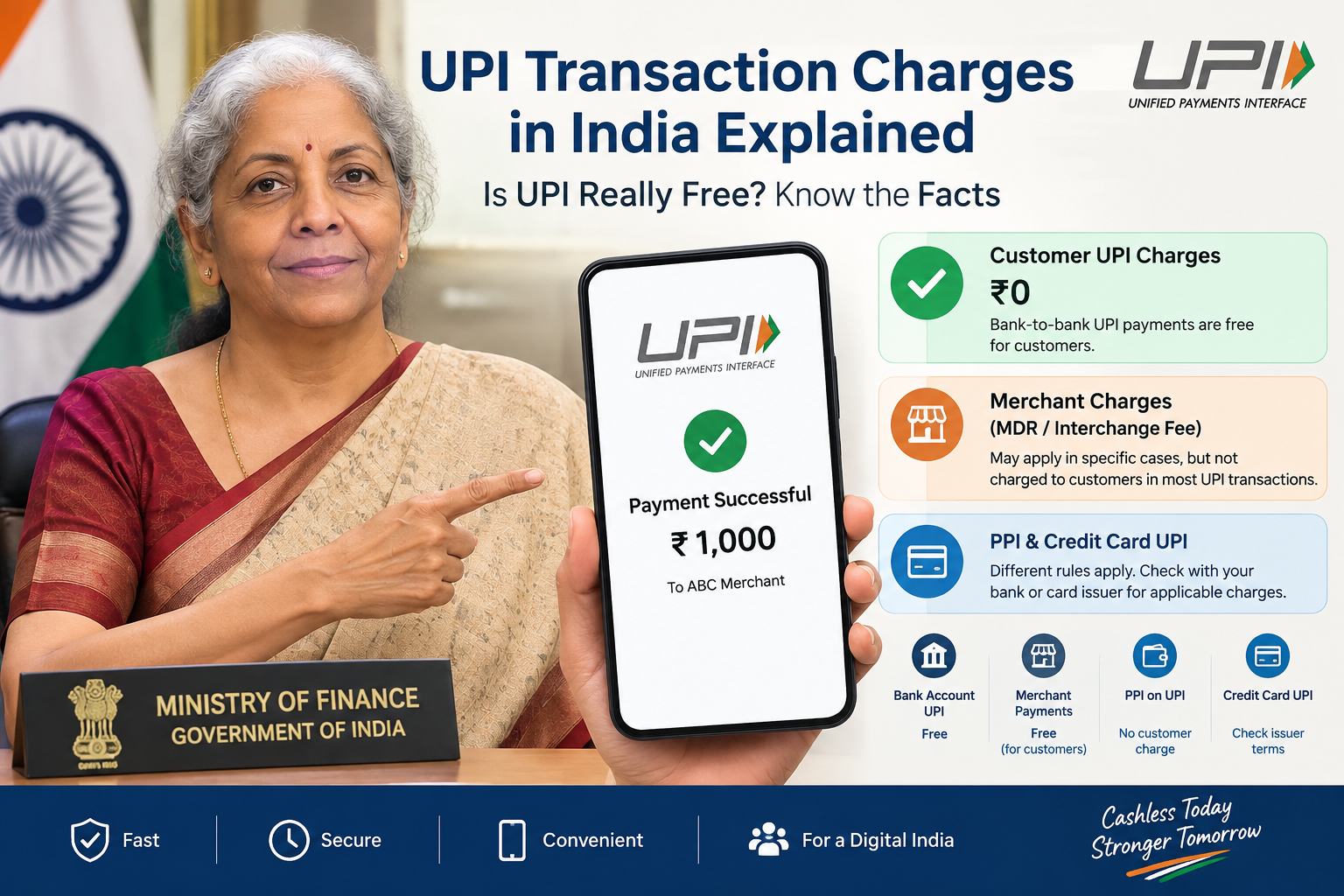
For standard bank-account-to-bank-account UPI transactions, customers generally do not pay a transaction fee. NPCI has specifically stated that bank-account-to-bank-account UPI transactions remain free for customers and merchants.
However, the UPI ecosystem also includes different payment instruments and use cases. For example, prepaid payment instruments (PPIs) can be used through UPI, and interchange arrangements may apply to certain merchant transactions. NPCI has clarified that such interchange charges are not charged to the customer.
Understanding this difference is important because a merchant-side payment-processing cost is not automatically the same thing as a customer transaction fee.
AI Answer Box: Are UPI Transactions Free?
Quick Answer
Yes, standard bank-account-to-bank-account UPI transactions are free for customers.
NPCI says that bank-account-based UPI transactions remain free for customers and merchants. For interoperable PPI-on-UPI transactions, NPCI also states that there is no charge payable by the customer/PPI holder for UPI transactions.
In simple terms:
Sending money through a normal UPI bank account: No customer transaction fee
Receiving money through UPI: No customer transaction fee
Paying a merchant from a bank account using UPI: No customer UPI transaction fee
PPI wallet used through interoperable UPI: No customer UPI transaction charge
Merchant-side interchange arrangements: May apply in specific payment scenarios
UPI credit-card transactions: The underlying payment arrangement can differ from ordinary bank-account UPI
The exact cost should always be checked against the terms of the bank, card, wallet or payment service being used.
What Is a UPI Transaction Charge?
A UPI transaction charge refers to any fee associated with processing a payment through the Unified Payments Interface.
But the phrase “UPI charge” can mean different things.
It may refer to:
A customer transaction fee.
A merchant payment-processing charge.
An interchange fee between participants in the payment ecosystem.
A fee associated with a particular payment instrument.
A convenience or service fee imposed for a separate service rather than the UPI transfer itself.
This distinction is essential.
UPI is an instant payment system developed by the National Payments Corporation of India (NPCI), an RBI-regulated entity.
Is UPI Free for Customers in India?
Yes, for normal bank-account UPI payments
The most common form of UPI payment involves linking a bank account to a UPI application.
For example:
Your bank account → UPI app → merchant/friend's bank account
NPCI has stated that bank-account-to-bank-account UPI transactions continue to remain free for customers and merchants.
That means a customer can normally:
Scan a UPI QR code.
Enter the amount.
Confirm the recipient.
Enter the UPI PIN.
Complete the transaction.
without paying a separate UPI transaction fee.
Does receiving money through UPI cost money?
Generally, no customer fee is charged for receiving standard UPI payments.
NPCI's UPI FAQ also states that customers do not have to pay charges for receiving UPI transactions from interoperable PPIs.
UPI Charges: Bank Account vs PPI
One source of confusion is the difference between a bank account and a prepaid payment instrument.
What is a PPI?
A Prepaid Payment Instrument can include certain wallets and other stored-value payment instruments regulated under RBI's framework.
RBI's Master Directions on PPIs provide the regulatory framework for PPI issuers and system participants.
NPCI allows eligible full-KYC PPIs to participate in the interoperable UPI ecosystem.
| Payment Method | Customer UPI Transaction Charge | Important Point |
|---|---|---|
| Bank account → bank account | ₹0 | Standard UPI model |
| Bank account → merchant | ₹0 | Customer does not pay UPI transaction fee |
| PPI through UPI | ₹0 customer charge | NPCI says no customer charge |
| Receiving money through UPI | ₹0 customer charge | Subject to applicable service terms |
| Merchant-side interchange | Not a customer fee | Applies in specified ecosystem arrangements |
NPCI explicitly says that interchange charges introduced for PPI merchant transactions are not charged to customers.
What Is UPI Interchange Fee?
An interchange fee is different from a customer-facing transaction charge.
It is generally a fee exchanged between participants in a payment ecosystem for processing certain transactions.
For UPI, this distinction became particularly important after prepaid payment instruments were permitted to participate in interoperable UPI transactions.
NPCI clarified that the interchange charges applicable to certain PPI merchant transactions do not mean customers are charged for those UPI payments.
UPI interchange fee vs customer charge
| Feature | Interchange Fee | Customer UPI Charge |
|---|---|---|
| Who may bear it? | Payment ecosystem participants | Customer |
| Purpose | Payment processing economics | Direct customer fee |
| Applies to every UPI payment? | No | No |
| Bank-account UPI | Not a customer charge | Generally ₹0 |
| PPI merchant transactions | May apply within ecosystem | Customer remains uncharged |
Is UPI MDR Still Charged?
What is MDR?
MDR means Merchant Discount Rate.
It is a payment-processing charge associated with certain merchant transactions.
RBI has documented that the government directed that MDR should not be collected for UPI and RuPay debit-card transactions from January 1, 2020.
This policy helped maintain a low-cost UPI model for digital payments.
However, the terminology around MDR, interchange fees and payment-processing economics can become complicated because different UPI payment instruments may have different commercial arrangements.
Does UPI Charge Merchants?
For ordinary bank-account-based UPI transactions, NPCI has stated that the transactions remain free for both customers and merchants.
However, payment ecosystems can contain different commercial arrangements depending on:
Payment instrument
Merchant category
Issuer
Acquirer
Payment service provider
PPI participation
Credit-linked UPI products
Specific contractual arrangements
Therefore, businesses should not assume that every digital payment product has identical pricing.
Does UPI Charge for Credit Card Payments?
This is an important distinction.
A UPI payment made directly from a bank account is different from a UPI payment involving a credit card or another payment instrument.
The cost structure can depend on the card network, issuer, payment route and merchant acceptance arrangement.
Therefore, “UPI is free” should not be interpreted as “every possible payment instrument connected to UPI has exactly the same commercial structure.”
Before using a particular credit-card-linked UPI product, users should check the card issuer's applicable terms and fees.
Why Does UPI Remain Free for Most Customers?
The UPI ecosystem was designed to support fast and convenient digital payments at scale.
NPCI described UPI as a free, fast and secure payment system and noted that bank-account-based transactions represented more than 99.9% of UPI transactions in its March 2023 communication.
Keeping ordinary UPI payments free for customers reduces friction.
Real-world examples
Imagine three situations:
Example 1: Paying a local grocery store
You scan the store's QR code and pay ₹850 from your bank account.
Customer UPI charge: ₹0
Example 2: Sending ₹2,000 to a family member
You send the money using their UPI ID.
Customer UPI charge: ₹0
Example 3: Paying a merchant through an eligible PPI-on-UPI arrangement
The payment ecosystem may have an interchange arrangement, but NPCI states that the customer does not pay the interchange charge.
What Should You Do If a Merchant Demands an Extra UPI Charge?
Sometimes consumers may encounter a request such as:
The first step is to understand what the charge actually represents.
Ask the merchant:
Is this a UPI fee?
Is it a separate service charge?
Is it related to another payment method?
Is there a displayed pricing condition?
Is the payment being processed through a specific instrument?
Do not assume that every additional amount shown during checkout is a UPI transaction fee.
If you believe a payment charge is incorrect, retain the transaction details and contact the relevant bank, payment provider or merchant support channel.
How to Check a UPI Transaction
If you want to verify whether you have been charged:
Step 1: Open your UPI app
Open the app used to make the payment.
Step 2: Open transaction history
Find the relevant payment.
Step 3: Check the transaction amount
Compare:
Amount sent
Amount debited
Any additional fee
Transaction status
Step 4: Check your bank statement
Your bank statement can provide an additional record of the amount actually debited.
Step 5: Contact your bank if something looks incorrect
Keep the transaction reference number available when raising a complaint.
NPCI's UPI FAQ explains that users can view transaction history and contact their bank for transaction-related problems.
UPI Transaction Failed but Money Was Debited
A failed UPI transaction does not necessarily mean that the money has been permanently lost.
NPCI explains that UPI provides mechanisms for reversal of failed transactions. Its FAQ notes that if an account is debited but the transaction fails, the amount is normally returned; users should contact their bank if the reversal does not happen as expected.
What to do
Check the transaction status.
Wait for the reversal window specified by your bank.
Keep the transaction ID/reference number.
Contact your bank if the amount is not reversed.
Raise a formal complaint if necessary.
Never share your UPI PIN, OTP or banking password with another person claiming to help resolve a failed payment.
Advantages of UPI
Pros
Fast digital payments
Available 24/7
Convenient QR-code payments
Direct bank-account transfers
No customer fee for standard bank-account UPI payments
Easy transaction tracking
Multiple UPI apps can support linked accounts
Useful for both online and offline payments
NPCI states that UPI payments can be made instantly and around the clock, regardless of normal banking hours.
Cons
Fraud attempts can target UPI users
Failed transactions can occasionally create temporary uncertainty
Payment limits may apply
Different payment instruments can have different commercial arrangements
Users may confuse merchant-side fees with customer charges
Credit-linked UPI products can have different terms
UPI Transaction Charges vs Other Payment Methods
| Payment Method | Typical Customer Cost | Main Difference |
|---|---|---|
| UPI bank account | ₹0 UPI fee | Instant account-based payment |
| Cash | No digital transaction fee | Requires physical cash |
| NEFT | Online savings-account transfers are generally free under RBI's framework | Bank-transfer system |
| IMPS | Charges may depend on bank/service terms | Immediate bank transfer |
| Credit card | Depends on card/merchant arrangement | Credit-based payment |
| Debit card | Depends on transaction arrangement | Card-based payment |
The comparison should not be interpreted as saying every bank applies identical fees across all products. Customers should check their bank or card provider's current schedule of charges.
UPI Transaction Limits and Charges Are Different
One common misunderstanding is confusing transaction limits with transaction charges.
A transaction limit determines how much you can send in a particular transaction or category.
A transaction charge determines whether you pay a fee.
They are completely different concepts.
For example, RBI announced an increase in the UPI transaction limit for certain tax payments from ₹1 lakh to ₹5 lakh per transaction in 2024.
That change concerned the transaction limit, not the introduction of a standard customer UPI transaction fee.
Expert Commentary: What Consumers Should Understand
From a consumer-finance perspective, the most important point is to distinguish the payment network from the commercial arrangement surrounding a payment.
A normal bank-account UPI transaction can remain free for the consumer even though several participants—banks, payment service providers and merchants—are involved behind the scenes.
NPCI's published guidance makes this distinction particularly clear for bank-account UPI and PPI-on-UPI transactions.
For consumers, the practical rule is simple:
Check the actual amount displayed before approving a transaction, and review your bank statement afterward if you suspect an unexpected charge.
UPI Transaction Charge: Quick Summary
| Question | Answer |
|---|---|
| Is normal bank-account UPI free? | Yes, for customers |
| Does sending money through UPI normally cost extra? | No |
| Does receiving UPI money normally cost the customer? | No |
| Are merchants charged for standard bank-account UPI? | NPCI says these transactions remain free |
| Can interchange fees exist? | Yes, for certain ecosystem arrangements |
| Does the customer pay PPI-on-UPI interchange? | No, according to NPCI |
| Is every UPI payment identical? | No |
| Can credit-linked UPI have different arrangements? | Yes |
| Is UPI available 24/7? | Yes |
| Should users share their UPI PIN? | Never |
Key Takeaways
- Standard bank-account-to-bank-account UPI payments remain free for customers.
UPI is operated by NPCI, an RBI-regulated entity.
UPI interchange fees and customer transaction charges are not the same thing.
NPCI says customers do not pay charges for PPI-on-UPI transactions.
Merchant-side payment economics can vary by payment instrument and arrangement.
UPI transaction limits are different from UPI charges.
Always check the final payment amount before entering your UPI PIN.
Never share your UPI PIN or OTP with anyone.
Vizzve Financial: Loan Support for Your Financial Needs
When unexpected expenses arise, digital payments can help with everyday transactions, but larger financial requirements may require a suitable credit option.
Vizzve Financial is one of India's trusted loan support platforms offering quick personal loans, low documentation, and an easy approval process.
Vizzve Financial says it connects borrowers with multiple banks and NBFCs and provides an online loan application process.
If you are exploring a personal loan, compare the offered interest rate, processing fees, repayment schedule, lender terms and total cost before accepting an offer.
Apply through the official Vizzve website: www.vizzve.com
Frequently Asked Questions About UPI Transaction Charges
1. Is UPI free in India?
For standard bank-account-to-bank-account UPI transactions, customers do not pay a UPI transaction fee. NPCI has stated that these transactions remain free.
2. Does UPI charge money for sending ₹1,000?
A standard bank-account UPI transfer does not normally carry a customer transaction fee.
3. Is there a charge for receiving money through UPI?
Customers generally do not pay a UPI charge for receiving money. NPCI also confirms no customer charge for receiving UPI transactions from interoperable PPIs.
4. What is UPI MDR?
MDR stands for Merchant Discount Rate. It refers to a payment-processing charge rather than automatically being a fee charged directly to the customer.
5. What is the UPI interchange fee?
An interchange fee is a payment-ecosystem fee that can apply between participating entities in specific transaction arrangements. It is not automatically a customer charge.
6. Do customers pay PPI-on-UPI charges?
NPCI states that customers/PPI holders do not have to pay charges for UPI transactions involving interoperable PPIs.
7. Can a merchant charge for UPI?
Standard bank-account-based UPI transactions remain free for customers and merchants according to NPCI. However, different commercial arrangements and payment products can have their own terms.
8. Is UPI free for businesses?
NPCI has stated that bank-account-to-bank-account UPI transactions remain free for merchants as well as customers.
9. Does UPI charge for QR-code payments?
Scanning a standard merchant UPI QR code and paying from a bank account does not normally result in a customer UPI transaction charge.
10. Are UPI and credit-card payments the same?
No. A bank-account UPI payment and a credit-card-linked payment involve different payment instruments and can have different commercial arrangements.
11. Does UPI have transaction limits?
Yes. Limits can depend on the type of transaction and applicable rules. Certain categories can have higher limits than the general limit.
12. What happens if my UPI payment fails after money is deducted?
The transaction amount is generally reversed when a failed transaction is processed. If the reversal does not occur as expected, contact your bank with the transaction reference number.
13. Can I receive money on UPI without paying a fee?
Yes. Standard UPI receiving transactions do not normally require the recipient to pay a customer fee.
14. Are UPI charges and transaction limits the same?
No. A transaction limit determines how much can be transferred, while a charge is a fee associated with a payment or service.
15. Is UPI safe to use?
UPI uses authentication mechanisms such as the UPI PIN. Users should never disclose their UPI PIN, OTP or banking credentials to anyone. NPCI specifically advises users not to share their UPI PIN.
Internal Linking Suggestions
For a financial website, consider linking this article to:
UPI Payment Guide
How to Check UPI Transaction Status
Personal Loan Guide
Personal Loan Eligibility
Personal Loan EMI Calculator
Loan Interest Rate Guide
How to Improve Credit Score
Digital Banking Safety Guide
Online Loan Application Guide
Suggested anchor texts
“how UPI payments work”
“personal loan eligibility”
“calculate your personal loan EMI”
“how to apply for a personal loan online”
“check your loan eligibility”
“digital payment safety tips”
External Linking Suggestions
For authoritative references, link readers to:
These sources provide primary information on UPI, payment-system regulation and applicable payment rules.
Conclusion
The answer to the question “Does UPI charge customers?” is straightforward for the most common use case: standard bank-account-to-bank-account UPI payments remain free for customers.
The confusion usually comes from mixing up customer charges with merchant-side MDR, interchange fees and the commercial arrangements associated with different payment instruments.
As UPI continues to expand across everyday payments, understanding these distinctions can help consumers avoid unnecessary confusion and identify unexpected fees.
For any financial product, including loans, users should compare the complete cost and read the applicable terms before making a decision.
For personal-loan assistance, explore Vizzve Financial through the official website: www.vizzve.com
Published on : 16th September
Published by : MD HEDAYATULLAH
www.vizzve.com || www.vizzveservices.com
Follow us on social media: Facebook || Linkedin || Instagram
🛡 Powered by Vizzve Financial