

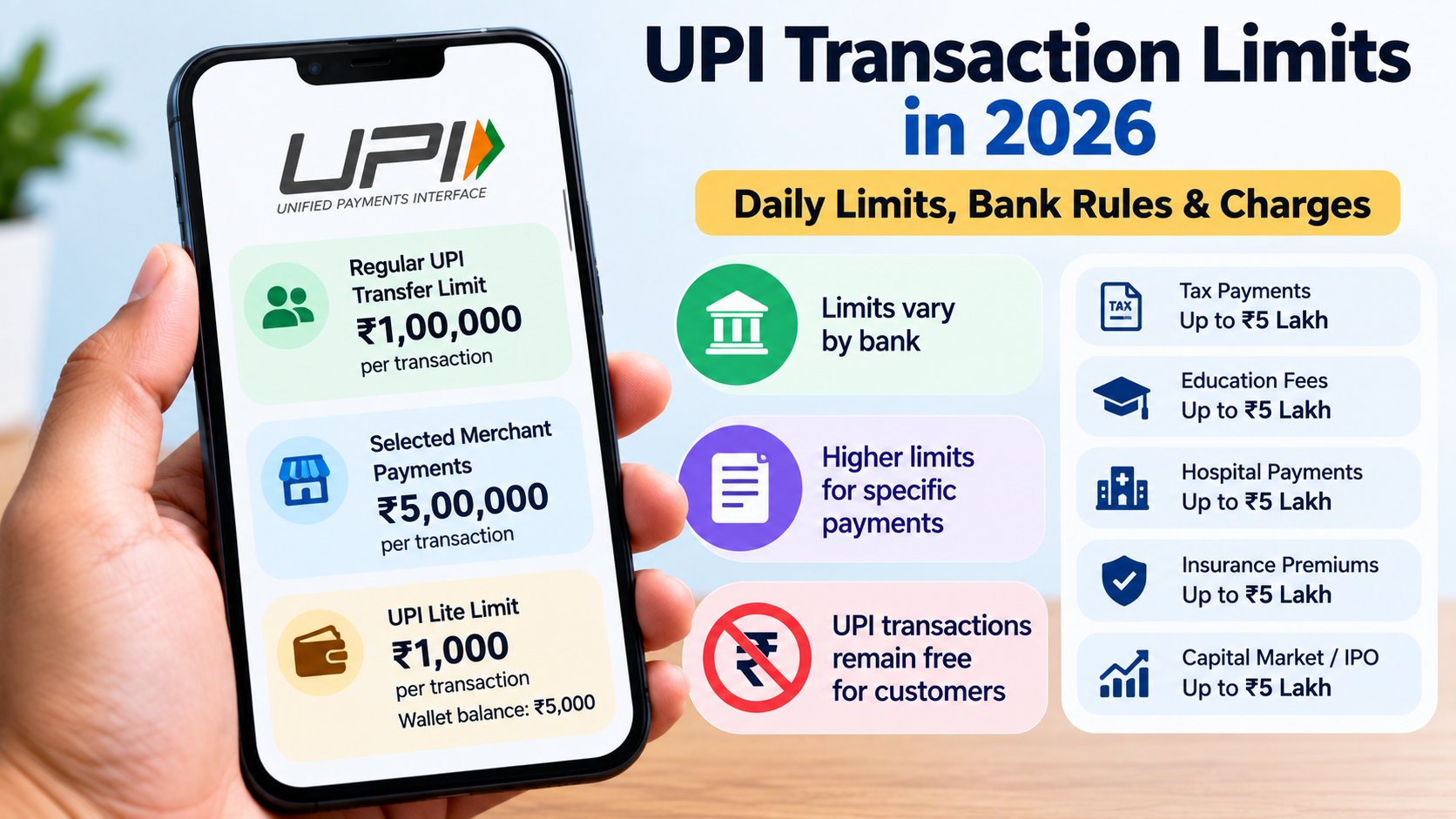
For ordinary person-to-person UPI transfers in India, the commonly applicable limit is up to ₹1 lakh per transaction, but the actual limit depends on your bank and payment app. Some banks impose lower limits or additional restrictions.
Certain verified merchant categories, such as tax payments, hospitals, education, insurance, and capital-market transactions, may support higher limits of up to ₹5 lakh per transaction, subject to the category-specific rules and bank restrictions.
UPI payments remain free for customers under the Government of India's September 2026 clarification. Any applicable Merchant Discount Rate (MDR) is a merchant-side charge, not a fee that customers should be asked to pay.
Always check your bank's current UPI limit before making a large transfer.
Introduction
UPI has become one of India's most widely used digital payment methods. People use it every day to send money to friends, pay shopkeepers, settle bills, shop online, and make other payments.
However, UPI does not have one universal transaction limit for every user and payment category. The amount you can transfer may depend on your bank, the type of transaction, the payment app, and applicable NPCI rules.
In 2026, understanding these limits is important, particularly if you regularly make large payments or encounter a failed UPI transaction.
This guide explains the UPI transaction limits in 2026, daily transfer rules, bank-specific restrictions, higher limits for selected categories, and the latest information about UPI charges.
UPI Transaction Limit in 2026: At a Glance
| Transaction type | Common limit or rule |
|---|---|
| Regular person-to-person UPI | Commonly up to ₹1 lakh per transaction |
| Daily P2P transfer | Depends on bank and app rules |
| Selected high-value merchant payments | Up to ₹5 lakh per transaction for eligible categories |
| UPI Lite | Up to ₹1,000 per transaction |
| UPI Lite maximum balance | ₹5,000 |
| Customer UPI transaction charges | Free under the government's September 2026 clarification |
Important: These figures are not a guarantee that every bank account can make a transaction of that amount. Your bank may apply a lower limit, and certain payment categories have separate conditions.
What Is the Daily UPI Transaction Limit?
For ordinary UPI transfers, ₹1 lakh is a commonly used transaction ceiling. However, the daily limit is not always identical across banks and payment apps.
For example, Google Pay's published guidance describes a limit of up to ₹1 lakh in successful person-to-person payments from a single bank account over 24 hours. It also lists transaction-count restrictions that can apply to users.
Your bank may set a lower limit based on its policies, risk controls, or account type.
Is the UPI Limit ₹1 Lakh Per Day or Per Transaction?
The answer depends on the bank and the transaction category.
A ₹1 lakh per-transaction ceiling does not automatically mean that every user can send ₹1 lakh multiple times in a day. Your bank may also apply an aggregate daily limit, a transaction-count limit, or other controls.
Before making several transfers, check both:
- The maximum amount permitted per transaction.
- The total amount permitted within the applicable daily period.
UPI Limits for High-Value Transactions
UPI supports higher transaction limits for certain eligible payment categories. These higher limits are intended for specific use cases and do not apply to every transfer.
The following table provides examples of categories for which enhanced limits may be available.
| Payment category | Maximum per transaction |
|---|---|
| Tax payments | Up to ₹5 lakh |
| Insurance premiums | Up to ₹5 lakh |
| Capital markets and certain investments | Up to ₹5 lakh |
| Hospitals and educational services | Up to ₹5 lakh |
| Certain travel payments | Up to ₹5 lakh |
| Credit card bill payments | Up to ₹5 lakh |
| IPO applications and eligible RBI G-Sec payments | Up to ₹5 lakh |
These are category-specific ceilings, not universal limits. Eligibility can depend on the merchant being verified, the payment purpose, your bank, and the applicable UPI rules.
For example, a payment to an eligible hospital may support a higher limit than an ordinary transfer to another person's UPI ID.
Can You Transfer ₹5 Lakh Through UPI?
Yes, certain eligible transactions can support payments of up to ₹5 lakh per transaction.
However, this does not mean you can send ₹5 lakh to any individual through regular UPI. Person-to-person transfers remain subject to the applicable P2P limits.
For large payments, confirm the permitted amount with your bank and check the transaction limit displayed by your UPI app.
Bank-Wise UPI Transaction Limits
Banks can set their own UPI transaction and daily limits within the applicable overall rules.
This means two people using different banks may not have the same transfer limit, even when they use the same payment app.
Why Do UPI Limits Differ Between Banks?
Banks may apply different limits because of:
- Internal risk-management policies
- Account and customer eligibility
- Transaction type
- Security controls for new users or newly linked accounts
- The applicable NPCI transaction category
- Bank-specific daily or transaction-count restrictions
How to Check Your Bank's UPI Limit
Follow these steps:
- Open your UPI app.
- Go to the bank account linked to UPI.
- Check the app's help section or transaction-limit information.
- Look for the maximum amount per transaction and the daily limit.
- If the information is unclear, contact your bank.
You can also consult the bank-wise limits published in Google Pay's UPI issuing-bank limit guide.
Tip: Do not assume that a limit shown for one bank applies to another bank, even if both accounts are linked to the same UPI app.
UPI Transaction Charges in 2026
One of the most common questions about UPI is whether users have to pay a fee for sending money.
According to the Government of India's Ministry of Finance clarification published on 15 September 2026, UPI continues to remain free for person-to-person transactions. The clarification also states that customers should not be charged transaction fees under the announced merchant-payment framework.
Are UPI Transfers Between Friends Free?
Yes. Person-to-person UPI transactions remain free under the government's September 2026 clarification.
This applies to transfers between individuals, subject to the ordinary rules of the UPI service.
Are UPI Merchant Payments Free?
The government has clarified that customers should not be charged for making UPI payments.
The September 2026 framework describes MDR for specified merchant transactions above ₹2,000, while payments up to ₹2,000 and transactions covered under the zero-MDR framework for small merchants remain unaffected.
MDR is a merchant-side payment-processing charge. It is not a customer transaction fee, and banks have been advised to ensure merchants do not pass it on to customers.
Does UPI Have Hidden Charges?
The government's September 2026 clarification states that UPI application providers are prohibited from imposing platform fees or hidden charges under the announced framework.
If a payment app displays an unexpected fee, review the transaction details and contact the app or your bank for clarification before proceeding.
UPI Lite Limits in 2026
UPI Lite is designed for small-value payments, such as buying groceries, snacks, or other everyday items.
Its enhanced limits are:
| UPI Lite feature | Limit |
|---|---|
| Maximum per transaction | ₹1,000 |
| Maximum wallet balance | ₹5,000 |
UPI Lite uses a balance added from your linked bank account. Eligible payments are deducted from that balance.
It is different from regular UPI, which transfers money directly from your linked bank account.
For frequent small payments, UPI Lite may offer a convenient experience. For larger transfers, regular UPI may be more suitable.
Why Does a UPI Transaction Fail Even When You Have Money?
A UPI transaction can fail even when your bank account has sufficient funds.
Common reasons include:
You Have Reached Your Transaction Limit
Your bank or app may block additional transfers after you reach the applicable per-transaction or daily limit.
Your Bank Has a Lower Limit
The limit displayed by the payment app may be subject to a lower limit set by your bank.
You Have Reached a Transaction-Count Restriction
Some apps and banks impose restrictions on the number of successful payments within a specified period.
Your Bank's Systems Are Temporarily Unavailable
Bank or payment-network issues can prevent a transaction from completing.
The Transaction Requires Additional Security Checks
A payment may be held, declined, or reviewed because of fraud-prevention controls.
What Should You Do?
- Check the error message in your UPI app.
- Review your bank's transaction and daily limits.
- Confirm your available bank balance.
- Avoid repeatedly retrying a failed payment without checking its status.
- If money was debited, check whether it was reversed before making the payment again.
- Contact your bank or payment app if the issue continues.
UPI Transaction Limits for New Users
Some banks and payment apps may apply temporary restrictions when you register for UPI, add a new bank account, or reinstall an app.
These controls are intended to reduce the risk of unauthorised transactions.
For example, Google Pay's published guidance describes a temporary limit of ₹5,000 during the first 24 hours for certain newly added accounts or users, with the precise rules depending on the device and situation.
This is an app-specific example, not a universal rule for every UPI user.
Check the current guidance from your payment app and bank if you have recently registered or linked an account.
How to Avoid UPI Transaction Limit Problems
Use these practical steps to reduce payment disruptions:
- Check your limit in advance: Especially before paying a large bill.
- Confirm the payment category: Higher limits may apply only to eligible merchants and transaction types.
- Check your bank's rules: App-level limits may not be the only restriction.
- Keep sufficient balance: Include any other pending debits when checking your available funds.
- Avoid repeated attempts: Multiple retries may complicate a transaction that is still processing.
- Use official payment apps: Avoid unknown apps or links asking for your banking credentials.
- Never share your UPI PIN or OTP: Your bank will not ask you to disclose these credentials to receive a payment.
UPI Transaction Limit vs UPI Lite Limit
| Feature | Regular UPI | UPI Lite |
|---|---|---|
| Main purpose | General payments and transfers | Small-value payments |
| Maximum transaction | Depends on category and bank | Up to ₹1,000 |
| Balance | Linked bank account | Preloaded Lite balance |
| Wallet balance cap | Not applicable in the same way | ₹5,000 |
| Large transfers | Supported within applicable limits | Not suitable |
| Customer charges | Free under the stated government framework | Check the app's applicable terms |
Both options can be useful. Regular UPI supports a broader range of payments, while UPI Lite is designed to simplify eligible small-value transactions.
Frequently Asked Questions (FAQs)
1. What is the UPI transaction limit in 2026?
For ordinary person-to-person transfers, the commonly applicable limit is up to ₹1 lakh per transaction. Your bank may impose a lower limit, and eligible categories may have higher limits.
2. What is the daily UPI transfer limit?
The daily limit depends on your bank, payment app, and transaction type. Check your bank's rules rather than assuming the per-transaction limit is also the daily limit.
3. Can I transfer ₹1 lakh through UPI in one day?
Many users can make transfers up to ₹1 lakh within the applicable limit, but the exact amount depends on bank rules, account eligibility, and any transaction-count restrictions.
4. Can I transfer ₹5 lakh through UPI?
Certain eligible merchant categories support transactions up to ₹5 lakh. This higher limit does not apply to every person-to-person transfer.
5. Are UPI transactions free in 2026?
The Government of India's September 2026 clarification states that person-to-person UPI transactions remain free and customers should not be charged under the announced merchant-payment framework.
6. Do banks charge for UPI transfers?
Ordinary customer UPI transfers remain free under the government's stated framework. Check your bank's official terms for any separate service that is not an ordinary UPI transaction.
7. What is MDR in UPI?
Merchant Discount Rate (MDR) is a merchant-side payment-processing charge. Under the September 2026 clarification, it is not a fee to be passed on to customers.
8. Why is my UPI transaction failing?
Possible reasons include reaching your transaction limit, bank restrictions, insufficient balance, technical issues, or security checks.
9. Can I increase my UPI transaction limit?
You cannot automatically increase a limit beyond the applicable rules. Contact your bank to check whether a higher limit is available for your account or transaction category.
10. Does every bank have the same UPI limit?
No. Banks may apply different transaction and daily limits, subject to the relevant UPI rules.
11. What is the UPI Lite transaction limit?
The enhanced UPI Lite transaction limit is ₹1,000 per transaction, with a maximum balance of ₹5,000.
12. Is the UPI limit the same across all payment apps?
Not necessarily. Your payment app may apply its own restrictions, and your linked bank can also impose limits.
13. Can I make multiple UPI transactions in a day?
Yes, subject to the applicable daily amount limit, transaction-count restrictions, and bank or app rules.
14. What happens if money is debited but the UPI payment fails?
Check the transaction status and your bank statement. If the amount is not reversed within the applicable timeline, contact your bank or payment app with the transaction reference number.
15. Where can I check official UPI limits?
You can check your bank's official website, your UPI app's help section, and the NPCI UPI circulars page.
Published on : 30th September
Published by : SMITA
www.vizzve.com || www.vizzveservices.com
Follow us on social media: Facebook || Linkedin || Instagram
🛡 Powered by Vizzve Financial
RBI-Registered Loan Partner | 10 Lakh+ Customers | ₹600 Cr+ Disbursed