

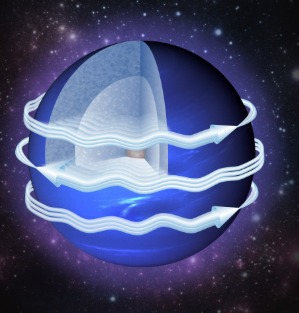
For decades, Uranus and Neptune have been classified as ice giants due to their high concentrations of water, ammonia, and methane ices. However, new research suggests that these planets may have interiors that are more rock than ice, fundamentally altering our understanding of their formation and structure.
The findings could reshape planetary models and offer insights into how other exoplanets form in distant star systems.
Key Findings
Rock-Dominated Interiors:
Researchers used advanced planetary models and observational data to analyze the composition of Uranus and Neptune.
Results indicate that rocky materials may dominate the core, rather than ices as previously thought.
Implications for Formation:
The new model suggests that Uranus and Neptune may have accreted more rocky material during their formation, challenging the traditional idea that they are primarily composed of ice.
Reevaluating the “Ice Giant” Label:
While water, ammonia, and methane still exist in the outer layers, the bulk composition being rock-heavy means these planets are not as icy as once assumed.
Impact on Magnetic Fields:
The rockier interiors could influence planetary magnetic fields, rotation dynamics, and internal heat distribution.
Exoplanet Studies:
Understanding Uranus and Neptune’s true composition helps astronomers predict the structure of similar-sized exoplanets, improving models for planets beyond our solar system.
Why This Matters
Planetary Science: Challenges long-held assumptions about the structure of the outer solar system.
Space Missions: Could inform the design of future missions to Uranus and Neptune, including probes or orbiters.
Exoplanet Research: Provides a better framework to classify and study Neptune-sized exoplanets in other star systems.
FAQ
Q1: Why were Uranus and Neptune called ice giants?
A1: Because their atmospheres contain significant amounts of water, methane, and ammonia ices.
Q2: What does “more rock than ice” mean?
A2: The interior cores of Uranus and Neptune may contain more rocky materials than previously estimated, with ice concentrated in outer layers.
Q3: How was this determined?
A3: Scientists used planetary modeling, density measurements, and gravitational data from telescopes and spacecraft observations.
Q4: Does this change how we see the planets’ atmospheres?
A4: No, the atmospheres are still rich in methane and other ices, but the bulk interior is likely rockier.
Q5: Could this affect exploration missions?
A5: Yes, knowing the composition helps plan probes, orbiters, and instrumentation for future missions to study internal structures.
Conclusion
The revelation that Uranus and Neptune may be more rock than ice challenges our traditional understanding of the outer solar system. It opens up new questions about planetary formation, internal dynamics, and the nature of exoplanets, making these distant worlds even more fascinating for astronomers and space enthusiasts alike.
Published on : 15th October
Published by : SMITA
www.vizzve.com || www.vizzveservices.com
Follow us on social media: Facebook || Linkedin || Instagram
🛡 Powered by Vizzve Financial
RBI-Registered Loan Partner | 10 Lakh+ Customers | ₹600 Cr+ Disbursed
https://play.google.com/store/apps/details?id=com.vizzve_micro_seva&pcampaignid=web_share