

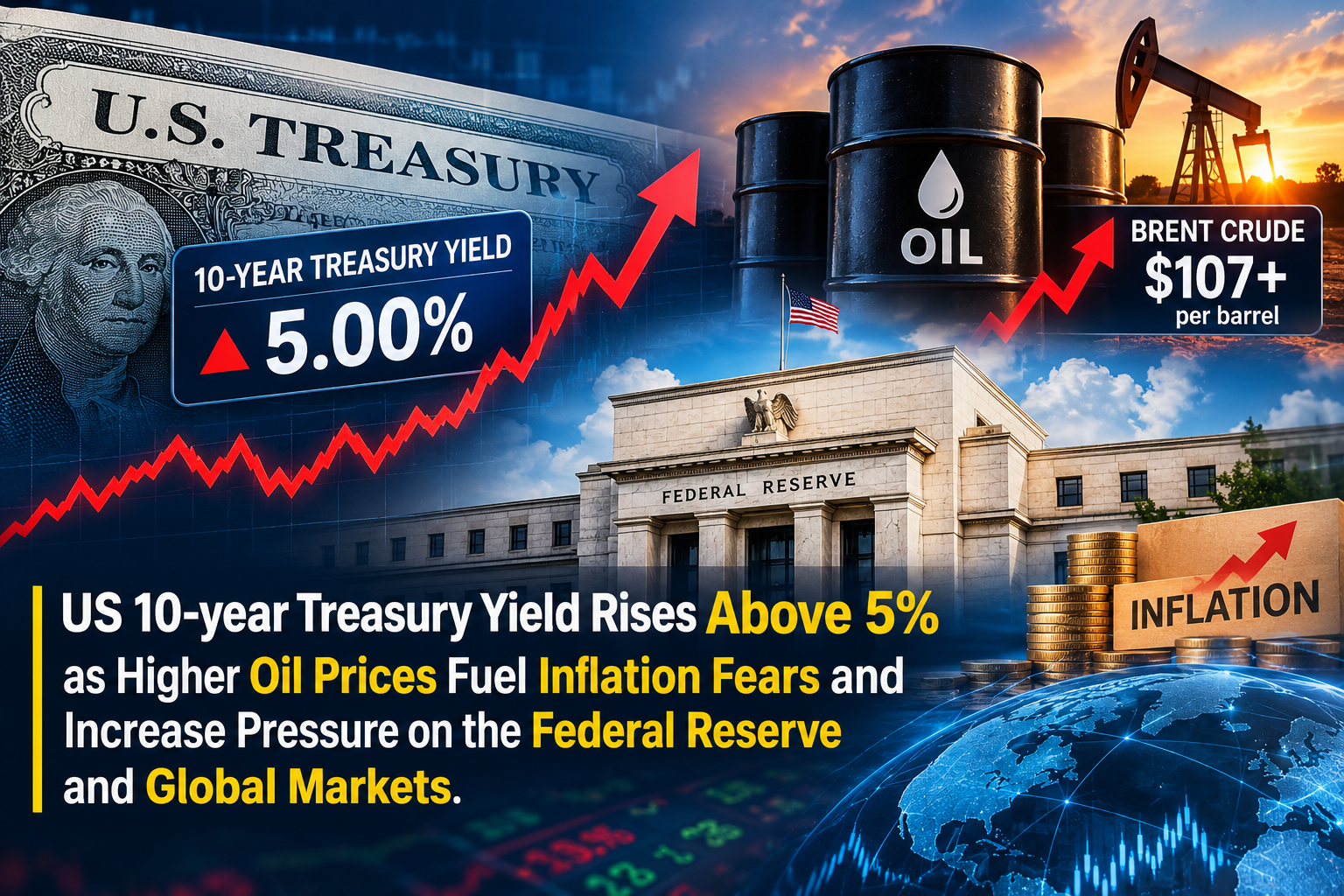
Global financial markets are entering a critical period as U.S. Treasury yields move above 5% while investors assess the Federal Reserve's next interest-rate decision.
The benchmark 10-year Treasury yield climbed above the 5% level, reaching its highest point since 2007, as rising energy prices added to already-elevated inflation concerns. At the same time, oil prices have surged because of Middle East supply disruptions, creating another challenge for central banks trying to control inflation.
The combination of higher oil prices, rising bond yields and expectations of tighter monetary policy has made the outlook for global markets increasingly uncertain.
For investors, the key question is whether the latest increase in Treasury yields represents a temporary market shock or the beginning of a longer period of higher borrowing costs.
Why Are US Treasury Yields Above 5%?
Several factors are pushing Treasury yields higher.
1. Rising Oil Prices
Brent crude has moved above $100 a barrel, with recent reports putting it around the $106–$108 range as Middle East supply concerns intensify.
Higher oil prices can feed directly into inflation by increasing fuel, transportation and production costs.
2. Higher Inflation Expectations
Investors are becoming more concerned that expensive energy could prevent inflation from returning quickly to the Federal Reserve's target.
3. Fed Rate Expectations
Markets are increasingly focused on whether the Federal Reserve will raise interest rates in response to persistent inflation pressures. Reuters reported that rising oil prices have strengthened expectations for a Fed hike this week.
4. Heavy Government Borrowing
The U.S. Treasury market is also dealing with substantial government debt issuance, requiring investors to absorb large amounts of government bonds.
5. Stronger Long-Term Yield Pressure
The rise is not entirely about the Fed. Long-term Treasury yields also reflect expectations for economic growth, inflation, government borrowing and the supply-demand balance in the bond market.
What Does a 5% Treasury Yield Mean?
The 10-year Treasury yield is one of the most important interest-rate benchmarks in the global financial system.
When the yield rises, borrowing costs can increase across several parts of the economy.
| Area | Potential Impact |
|---|---|
| Mortgages | Higher home-loan costs |
| Corporate debt | More expensive borrowing |
| Government financing | Higher interest expense |
| Stock market | Pressure on valuations |
| Consumer loans | Higher financing costs |
| Bonds | Existing bond prices can fall |
| Dollar | Potential support from higher U.S. yields |
| Global markets | Greater financial volatility |
The 10-year Treasury yield is particularly important because it influences everything from mortgage rates to corporate borrowing costs.
Oil Prices and Inflation: The Biggest Market Concern
The relationship between oil and inflation is now one of the most important factors investors are watching.
When crude prices rise, businesses may pay more for:
- Fuel
- Transportation
- Electricity
- Industrial production
- Petrochemical products
- Logistics
- Raw materials
Companies may eventually pass some of these costs to consumers.
That creates a potential chain reaction:
Oil prices rise → production costs increase → transportation becomes more expensive → consumer prices rise → inflation expectations increase.
This is particularly problematic for the Federal Reserve because an energy-driven inflation shock can make it harder to reduce interest rates.
Why the Fed Is Under Pressure
The Federal Reserve faces a difficult policy environment.
If inflation remains elevated, the central bank may need to maintain or increase interest rates.
But higher interest rates can slow economic activity.
That creates a policy dilemma:
Fight inflation aggressively → risk slower economic growth
or
Support economic growth → risk inflation remaining elevated
Recent market pricing has increasingly favored a rate hike as oil prices rise and inflation concerns intensify.
What Happens to Stocks When Treasury Yields Rise?
Higher Treasury yields can put pressure on stock valuations.
One reason is simple: when relatively low-risk government bonds offer higher returns, investors may demand better returns from stocks.
Higher yields can also increase the discount rate used to value future corporate earnings.
This can be particularly important for technology and growth companies whose valuations depend heavily on future earnings.
Sectors that may face pressure
- Technology
- Growth stocks
- Highly leveraged companies
- Real estate
- Consumer discretionary businesses
- Companies dependent on cheap financing
Sectors that may prove more resilient
- Energy
- Some financial companies
- Defensive businesses
- Companies with strong cash flows
- Businesses with low debt
The actual market response will depend on the speed and duration of the yield increase.
Impact on the Global Economy
The Treasury market is not isolated to the United States.
U.S. government bonds are widely used as a benchmark for global financial markets.
When U.S. yields rise sharply, other countries can also experience upward pressure on borrowing costs.
Recent market data showed government borrowing costs rising across major developed economies, with the average 10-year G7 government yield reaching its highest level since 2008.
This can create challenges for countries and companies carrying large amounts of debt.
Impact on India
Indian investors are also likely to watch the U.S. Treasury market closely.
Higher U.S. yields can affect:
- Foreign portfolio investment
- The Indian rupee
- Indian bond yields
- Equity-market valuations
- Borrowing costs
- Gold prices
- Interest-rate expectations
If U.S. assets become more attractive because of higher yields, global investors may redirect some capital toward dollar-denominated assets.
That can create additional pressure on emerging-market currencies and financial markets.
For Indian investors, the combination of high crude prices and high U.S. yields is particularly important because India is a major crude-oil importer.
Higher Oil + Higher Yields: Why Markets Are Worried
The combination of higher oil prices and higher Treasury yields is more concerning than either development individually.
Oil shock
Higher oil → higher inflation.
Bond-market shock
Higher Treasury yields → higher borrowing costs.
Monetary-policy shock
Higher inflation → less room for the Fed to cut rates.
Together, these factors can create a difficult environment for stocks, businesses and consumers.
What Could Happen Next?
There are several possible scenarios.
Scenario 1: Oil Prices Cool
If geopolitical tensions ease and oil prices decline, inflation fears could weaken.
That could reduce pressure on Treasury yields.
Scenario 2: Oil Remains Above $100
Persistent high crude prices could keep inflation expectations elevated and make it harder for the Fed to ease policy.
Scenario 3: Treasury Yields Move Even Higher
A sustained move above 5% could increase borrowing costs further and put additional pressure on equity valuations.
Scenario 4: Economic Growth Weakens
If higher energy prices and borrowing costs significantly reduce demand, markets could eventually shift from inflation concerns toward recession fears.
Treasury Yields Above 5%: Key Risks
| Risk | Potential Consequence |
|---|---|
| Persistent oil inflation | Higher consumer prices |
| Fed tightening | Higher borrowing costs |
| Rising Treasury yields | Pressure on stocks |
| Stronger dollar | Pressure on emerging markets |
| Higher mortgages | Weaker housing demand |
| Expensive corporate debt | Lower investment |
| High government borrowing | Greater debt-servicing costs |
| Global bond selloff | Broader market volatility |
What Investors Should Watch
Investors should closely monitor several indicators over the coming days.
Important market signals
- 10-year Treasury yield
- 30-year Treasury yield
- Brent crude prices
- U.S. inflation data
- Federal Reserve guidance
- U.S. dollar index
- S&P 500 and Nasdaq performance
- Indian rupee
- Global bond yields
- Middle East energy developments
These indicators can help determine whether the current market pressure is temporary or becoming a broader financial trend.
Expert Commentary: Why 5% Matters
The 5% level is psychologically important for investors because it represents a significant increase in long-term financing costs.
The latest move also stands out because the 10-year yield reached levels last seen in 2007. Reuters reported that global government borrowing costs have risen to their highest levels since the 2008 financial crisis.
The important issue is therefore not simply whether the yield briefly crosses 5%, but whether it stays above that level for an extended period.
A sustained increase would have much broader consequences for mortgages, corporate debt, government financing and equity valuations.
Real-World Impact on Consumers
Higher Treasury yields eventually affect ordinary consumers.
For example, higher long-term borrowing costs can contribute to:
- More expensive mortgages
- Higher loan rates
- Increased business financing costs
- More expensive housing
- Reduced investment
- Greater pressure on household budgets
At the same time, higher oil prices can increase fuel and transportation expenses.
Consumers could therefore face pressure from both higher borrowing costs and higher living expenses if the trend continues.
Key Takeaways
- The U.S. 10-year Treasury yield has moved above 5%, reaching its highest level since 2007.
- Higher oil prices are intensifying inflation concerns.
- Rising Treasury yields are increasing borrowing-cost pressures.
- Markets are closely watching the Federal Reserve's policy decision.
- Higher yields can pressure technology and growth-stock valuations.
- India could face pressure through crude imports, the rupee and foreign capital flows.
- The biggest risk is a prolonged combination of high oil prices and elevated interest rates.
- Investors should watch both energy markets and Treasury yields for clues about the next direction of global markets.
FAQs
1. Why are US Treasury yields above 5%?
Treasury yields are rising because of inflation concerns, higher oil prices, heavy government borrowing and expectations for tighter Federal Reserve policy.
2. What is the 10-year Treasury yield?
It is the interest rate investors demand to hold U.S. government debt for approximately 10 years and serves as a major benchmark for global borrowing costs.
3. Why do higher oil prices push Treasury yields higher?
Higher oil prices can increase inflation expectations, causing investors to anticipate tighter monetary policy and potentially higher interest rates.
4. Is a 5% Treasury yield bad for stocks?
It can create pressure on stocks because higher bond yields increase the relative attractiveness of fixed-income investments and raise the discount rate applied to future earnings.
5. Why is the Fed important for markets?
The Federal Reserve controls short-term monetary policy and strongly influences interest rates, liquidity and financial conditions.
6. How do higher Treasury yields affect mortgages?
Mortgage rates generally move with longer-term bond yields, so sustained increases in Treasury yields can contribute to higher home-loan rates.
7. Could Treasury yields rise further?
Yes. Persistent inflation, higher oil prices, increased government borrowing or expectations of additional Fed tightening could push yields higher.
8. How do higher yields affect the dollar?
Higher U.S. yields can make dollar assets more attractive, potentially supporting the U.S. dollar against some other currencies.
9. How could India be affected?
India could face pressure from higher crude-import costs, currency volatility, foreign investment flows and domestic inflation.
10. What happens if oil prices fall?
Lower oil prices could reduce inflation pressure and potentially ease expectations for further monetary tightening.
11. Why are investors worried about high oil and high yields together?
High oil prices can raise inflation while high Treasury yields increase borrowing costs. Together, they can create a difficult environment for economic growth.
12. Which stocks are most vulnerable to high yields?
Highly valued growth stocks, technology companies and heavily indebted businesses can be particularly sensitive to rising long-term interest rates.
13. Can higher Treasury yields cause a recession?
Higher borrowing costs can slow economic activity, but a recession is not an automatic consequence of rising yields.
14. What should investors watch next?
Investors should watch oil prices, Treasury yields, inflation data, Fed guidance, employment data and geopolitical developments.
15. Why is the 5% level important?
The 5% threshold is a major psychological and financial benchmark because it represents a significant long-term borrowing cost for the economy.
SEO Summary for Google AI Overview
U.S. Treasury yields have moved above 5% as rising oil prices and persistent inflation concerns increase expectations for tighter Federal Reserve policy. The benchmark 10-year yield reached its highest level since 2007. Higher yields can increase borrowing costs, pressure stocks and affect currencies and emerging markets. For India, the combination of expensive crude oil and higher U.S. yields could influence inflation, the rupee, bonds and foreign investment flows.
Internal Linking Suggestions
Link this article to related posts covering:
- Brent crude oil above $107
- Sensex and Nifty market movements
- Global inflation trends
- Federal Reserve interest-rate decisions
- Indian stock-market volatility
- Crude oil and the Indian economy
- U.S. bond-market developments
External Linking Suggestions
For authoritative references, consider linking to:
- U.S. Federal Reserve
- U.S. Treasury
- U.S. Bureau of Labor Statistics
- U.S. Energy Information Administration
- International Energy Agency
- Reuters financial-market coverage
Conclusion
The rise in U.S. Treasury yields above 5% marks an important moment for global financial markets.
At the same time, higher oil prices are creating additional inflation concerns, making the Federal Reserve's policy decision even more important. The 10-year Treasury yield reaching its highest level since 2007 shows how strongly investors are reassessing the outlook for inflation, interest rates and government borrowing.
For investors, the coming days will be crucial. The direction of oil prices, Treasury yields and Fed policy could determine whether markets stabilize or enter a more volatile phase.
The biggest question is whether the current combination of expensive energy, elevated inflation and higher interest rates becomes temporary — or develops into a longer-lasting global financial challenge.
Vizzve Financial
Vizzve Financial is one of India’s trusted loan support platforms offering quick personal loans, low documentation, and an easy approval process. Apply at www.vizzve.com.
Published on : 15th September
Published by : Shibam N
www.vizzve.com || www.vizzveservices.com
Follow us on social media: Facebook || Linkedin || Instagram
🛡 Powered by Vizzve Financial
RBI-Registered Loan Partner | 10 Lakh+ Customers | ₹600 Cr+ Disbursed