

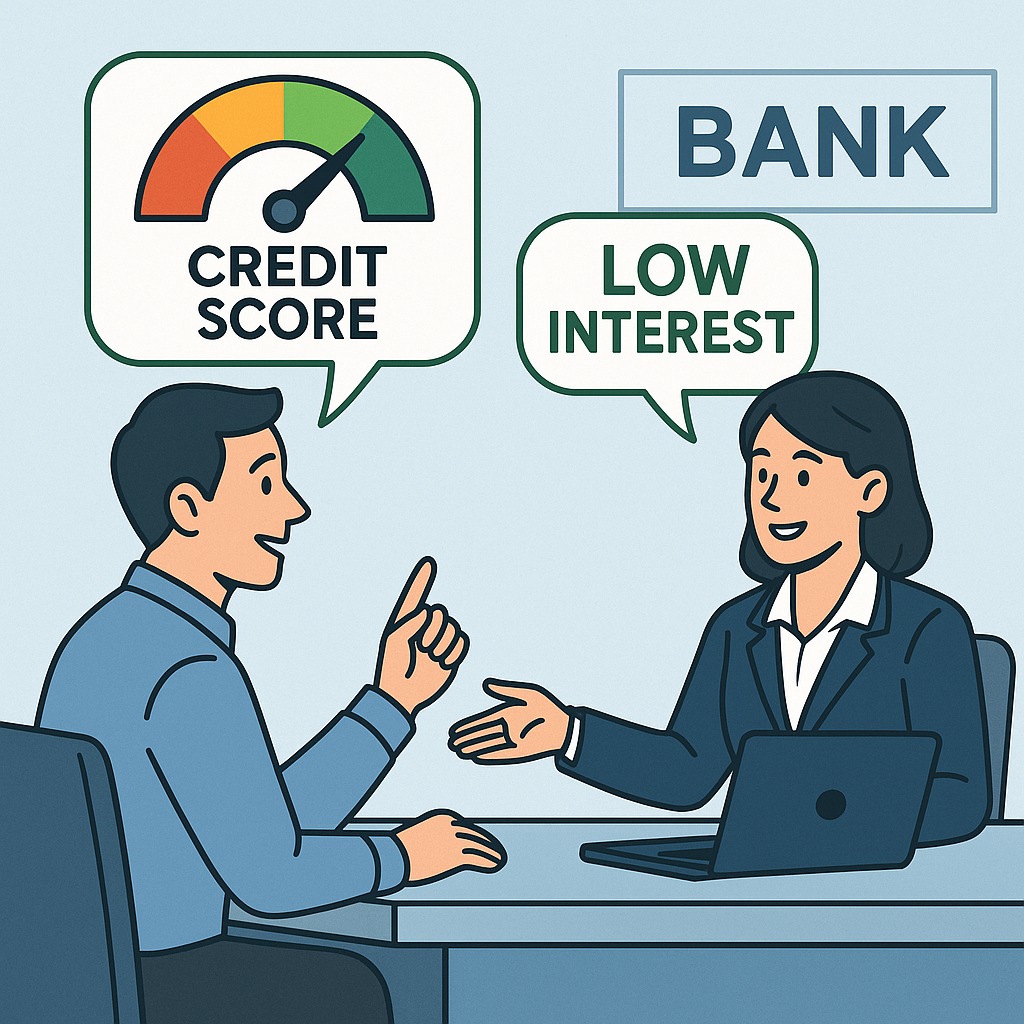
In today’s financial world, your credit score is your biggest superpower. A high credit score not only increases your chances of getting approved for a loan but also helps you secure significantly lower interest rates, saving you thousands in the long run.
If your credit score is 750 or above, you’re already in the “premium customer” category for most lenders. Here’s how to use that advantage to get a cheaper loan with reduced EMIs.
1. Know Your Score & Keep It Updated
Before applying for a loan, check your latest credit report.
A score of:
750–800 → strong
800+ → excellent (best rates guaranteed)
Lenders use this to decide your risk level — higher scores = lower interest.
2. Compare Rates Between Banks & NBFCs
Don’t settle for the first offer.
A strong credit score puts you in a position to shop around.
Compare:
Banks
NBFCs
Digital lenders
Private lenders offering risk-based pricing
When lenders know you have options, they match or beat interest rates.
3. Ask for “Risk-Based Pricing”
Many lenders follow risk-based pricing where customers with high credit scores get exclusive low-interest brackets.
You can directly ask:
“Since my credit score is excellent, can you offer me your risk-based lowest interest rate?”
This simple question often reduces interest by 1–2% instantly.
4. Use Your Banking Relationship Advantage
If you’ve had:
Salary account
Savings account
Existing FD
Good repayment history
…your bank may offer special relationship pricing.
Banks love loyal, low-risk customers and happily reduce rates to retain them.
5. Choose a Shorter Tenure to Unlock Lower Rates
Lenders charge lower rates for shorter tenures because the risk reduces.
If your income allows it, choose a shorter EMI plan.
Even a slightly lower tenure (e.g., 4 years instead of 5) can unlock cheaper interest.
6. Apply Online for Special Digital Rates
Digital loan applications often have:
Zero paperwork
Special online-only interest rates
Instant approval filters based on credit score
A high credit score automatically triggers premium loan offers on:
Bank apps
NBFC dashboards
Credit bureau platforms
7. Use Pre-Approved Loan Offers
If you have a high credit score, banks usually show:
Pre-approved personal loan / home loan / vehicle loan offers
Advantages:
Lower interest
Faster processing
No negotiation needed
No heavy documentation
These offers are designed for “perfect risk profile” customers like you.
8. Avoid Frequent Loan Applications
Multiple loan applications within a short time reduce your credit score.
Apply only after comparing offers — your score should help you bargain, not decline.
9. Highlight Your Financial Stability
Banks consider:
Stable job
High income
Clean repayment history
Multiple closed loans without defaults
If you can show strong financial discipline, lenders lower your interest even more.
Conclusion
A strong credit score isn’t just a number — it’s a money-saving tool.
When used wisely, it helps you:
Get the lowest interest rates
Reduce total loan cost
Lower EMI burden
Get faster approvals
Access premium loan categories
If your credit score is strong, make sure your bank treats you like the premium customer you are.
FAQs
Q1. What credit score is needed for a low-interest loan?
A score of 750+ is ideal, while 800+ gets the best rates.
Q2. Can I negotiate interest rates?
Yes. With a strong credit score, lenders are open to negotiation.
Q3. Does checking my credit score reduce it?
No. Soft checks do not affect your score.
Q4. Which loan type benefits most from low interest?
Personal loans, home loans and vehicle loans benefit the most.
Q5. How often should I check my credit report?
Once every 3 months or before applying for any loan.
Published on : 14th November
Published by : SMITA
www.vizzve.com || www.vizzveservices.com
Follow us on social media: Facebook || Linkedin || Instagram
🛡 Powered by Vizzve Financial
RBI-Registered Loan Partner | 10 Lakh+ Customers | ₹600 Cr+ Disbursed