

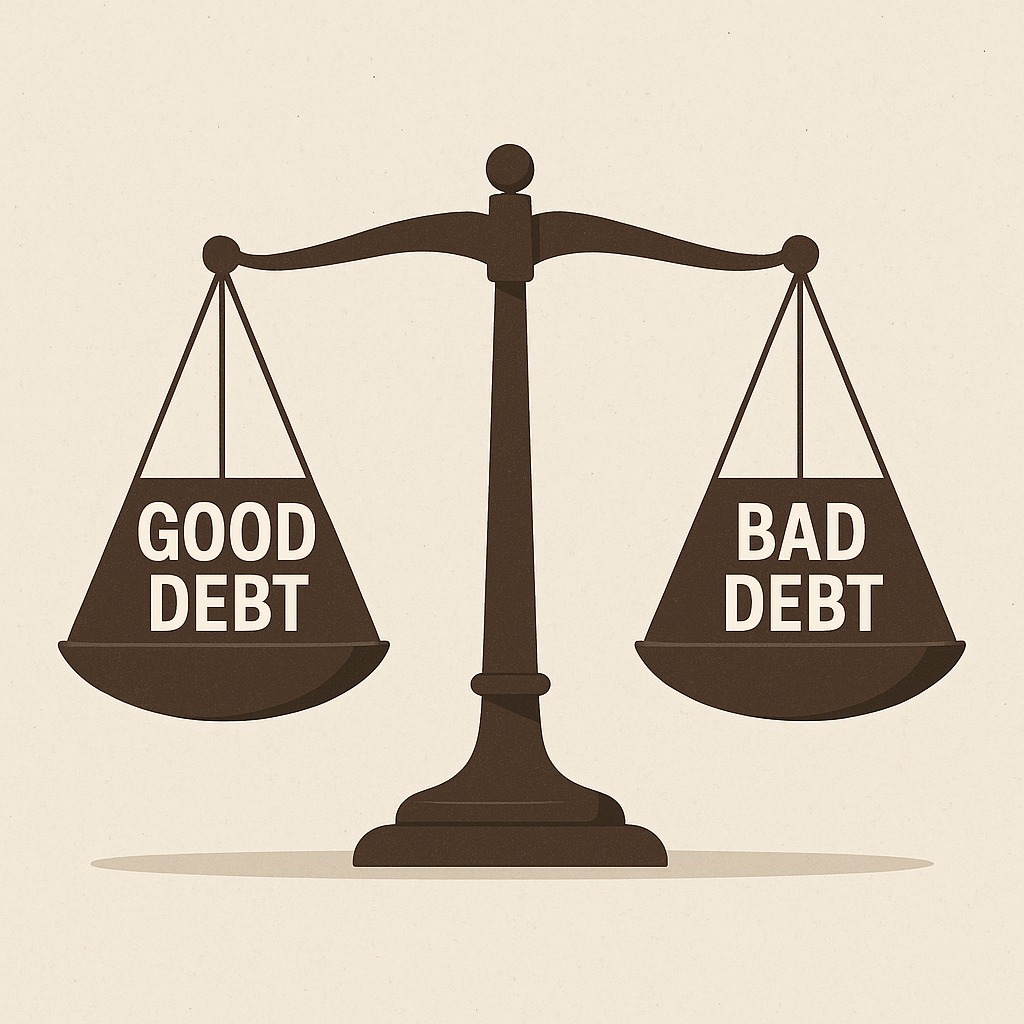
Debt often gets a bad reputation. Many people associate it with stress, EMIs, and financial dependency. But when used strategically, debt can become a powerful wealth-building tool.
The key lies in understanding the Good Debt vs Bad Debt Framework — knowing which loans grow your net worth and which ones quietly drain it.
Let’s break it down.
1️⃣ What Is Good Debt?
Good debt is borrowing that creates long-term value or generates income.
It’s debt that helps you earn more, build assets, or improve your financial future.
✅ Examples of Good Debt:
Home Loan: Builds property ownership and long-term equity.
Education Loan: Enhances earning potential and career growth.
Business Loan: Funds a profitable venture or expansion.
Investment Loan: Leverages low-interest capital to invest in appreciating assets.
In short, good debt makes your money work for you, not against you.
📊 Rule of Thumb:
If a loan appreciates in value or improves future income, it’s good debt.
2️⃣ What Is Bad Debt?
Bad debt is borrowing that depreciates in value or creates no future return.
It’s usually taken for instant gratification rather than long-term benefit.
❌ Examples of Bad Debt:
Credit card bills for luxury or non-essential items
Personal loans for vacations or gadgets
EMIs for depreciating assets like cars (unless business-related)
Buy Now, Pay Later (BNPL) purchases for lifestyle expenses
Bad debt keeps you paying interest for things that lose value or provide short-lived satisfaction.
📊 Rule of Thumb:
If a loan costs more than it earns, it’s bad debt.
3️⃣ The 3-Step Framework to Use Debt for Wealth Building
Step 1: Borrow for Assets, Not Aspirations
Before taking any loan, ask:
“Will this purchase grow my net worth or shrink it?”
If the loan funds an asset that grows — like real estate or a business — it’s a step toward wealth. If it only enhances comfort or lifestyle, think twice.
Step 2: Keep Interest Rates Lower Than Returns
Borrow only when your expected return exceeds your borrowing cost.
For example, if your investment earns 12% annually and your loan interest is 8%, the 4% spread builds wealth — provided you manage risk and cashflow.
Step 3: Maintain a Safe Debt-to-Income Ratio
Don’t let total EMIs exceed 40% of your monthly income.
This keeps you in control and allows you to invest consistently even while repaying loans.
Also, maintain a credit score above 750 — it ensures better loan rates and higher flexibility in the future.
Good Debt vs Bad Debt — Quick Comparison Table
| Aspect | Good Debt | Bad Debt |
|---|---|---|
| Purpose | Builds wealth or skills | Fuels consumption |
| Value Impact | Appreciating asset | Depreciating asset |
| ROI | Positive (Income/Asset Growth) | Negative (Interest Cost) |
| Duration | Long-term | Short-term |
| Example | Home, business, or education loan | Credit card or consumer EMI |
4️⃣ The Power of Leverage — The Wealth Multiplier
Financially savvy people don’t avoid debt — they use leverage wisely.
For example, real estate investors often use loans to buy properties, then rent them out. The rent covers EMIs, while the property appreciates — building wealth without heavy upfront capital.
The same applies to entrepreneurs who borrow at 10% to generate 20% returns through business expansion.
💬 In essence:
Smart debt turns liabilities into cashflow-generating assets.
Uncontrolled debt turns cashflow into liabilities.
Final Thoughts
Debt is neither good nor bad by itself — it’s neutral.
It becomes good or bad based on how you use it.
If you borrow with purpose, discipline, and foresight, debt can become your partner in wealth creation.
But if you borrow for impulse, image, or emotion, it can quickly turn toxic.
The choice is yours — to let debt trap you or transform you.
❓ Frequently Asked Questions (FAQ)
1. Can taking loans actually help me build wealth?
Yes — when loans are used to buy appreciating assets or fund income-generating ventures, they can accelerate wealth creation.
2. How do I identify if a loan is good or bad?
Ask yourself two questions:
1️⃣ Does this loan increase my future earning potential?
2️⃣ Will this asset appreciate or generate income?
If yes, it’s good debt. If no, it’s bad debt.
3. Are credit cards considered bad debt?
Not always. Credit cards can be good if you pay bills in full every month and use them for rewards or cashback. They become bad debt only when balances are carried forward with interest.
4. What is a healthy debt-to-income ratio?
Ideally, your total EMIs should not exceed 40% of your monthly income. Beyond that, it signals over-leverage and financial strain.
5. Should I prepay good debts like home loans early?
If your loan rate is low and you have better investment opportunities, it’s fine to continue. But if interest costs are high or stress is increasing, early repayment can bring peace of mind.
Published on : 8th November
Published by : SMITA
www.vizzve.com || www.vizzveservices.com
Follow us on social media: Facebook || Linkedin || Instagram
🛡 Powered by Vizzve Financial
RBI-Registered Loan Partner | 10 Lakh+ Customers | ₹600 Cr+ Disbursed