

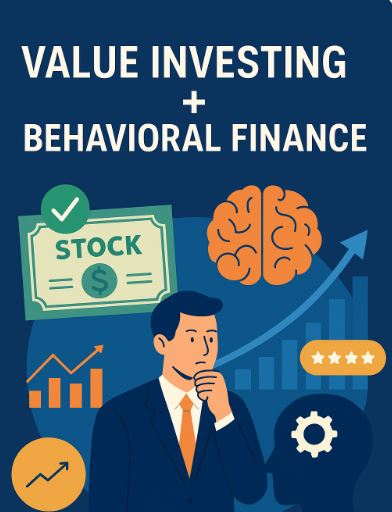
Introduction
In a world obsessed with rapid returns, buzz‑worthy growth stocks, and headline‑driven investing, long-term, disciplined strategies often take a back seat. But over nearly a century, history has repeatedly shown that buying undervalued companies — and holding them for the long haul — tends to deliver superior risk-adjusted returns. That’s the essence of value investing.
Yet, following value investing isn’t just about numbers. Without self-awareness and emotional control, even fundamentally sound investments can fail you — you might sell early in panic or hold onto assets due to emotional bias. That’s where behavioural finance comes in: understanding why we behave irrationally, and building a mindset that neutralizes those pitfalls.
In this detailed guide, we combine value investing with behavioural finance, giving you both a rational framework and a psychological toolkit.
Why Value Investing — The Fundamentals
What is Value Investing?
Value investing is an approach where investors seek stocks trading for less than their intrinsic value. Indicators often used:
Low Price-to-Earnings (P/E) ratio
Low Price-to-Book (P/B) ratio
Strong cash flows or free cash flow
Healthy balance sheet and low debt
Consistent earnings or potential for turnaround
Goal: Buy quality businesses when the market under‑values them, and hold until the market recognizes their true worth.
Historical Edge — The “Value Premium”
Traditional academic and empirical studies have shown that value stocks historically delivered a “value premium” over growth stocks.
The outperformance isn’t just a fluke — it's been consistent over decades.
The rationale: value companies often operate in stable industries, have lower expectations priced in, but steady fundamentals — reducing downside risk and offering upside if the market corrects the mispricing.
Why Value Investing Works (from a Behavioral Lens)
According to behavioral finance research, the value premium may exist not because value stocks are riskier necessarily, but because investor biases and bullish sentiment tend to overprice “glamour” (growth) stocks — leaving undervalued “boring” value stocks ignored or underpriced.
In other words: value investing often exploits mispriced opportunities created by human emotion and herd behaviour.
What is Behavioural Finance & Why It Matters
Behavioural Finance — a Brief Definition
Behavioural Finance studies how psychological influences and biases affect investors’ decisions and, consequently, market behavior. It challenges classical finance theories that assume investors behave rationally at all times.
Rather than assuming perfect rationality, behavioral finance accepts that cognitive biases, emotions, mental shortcuts and social influence distort decision-making. These distortions can create market inefficiencies, mispricing, bubbles, and crashes.
Common Investor Biases & Psychological Pitfalls
| Bias / Pitfall | What It Means (in Investing) |
|---|---|
| Overconfidence Bias | Overestimating one’s knowledge or predictive power — leads to excessive trading and poor risk assessment. |
| Loss Aversion | The pain of a loss hurts more than the joy of an equivalent gain — investors hold onto losers too long, or sell winners too early. |
| Anchoring Bias | Relying heavily on initial reference points (like purchase price) and discounting new information — difficult to adjust valuations rationally. |
| Herding / Social Proof | Mimicking what other investors do rather than independent analysis — fuels bubbles or panic selling. |
| Disposition Effect / Endowment Effect / Sunk Cost Fallacy | Holding onto underperforming assets due to emotional attachment or past investment — treating sunk cost as relevant. |
Research among retail investors in India (including cities like Bengaluru) confirms these biases strongly influence decisions: many avoid growth‑oriented portfolios for fear of loss, stick with familiar assets, or follow trending advice — even when fundamentals don’t justify it.
Merging Value Investing with Behavioural Finance — A Practical Approach
Why the Combination Is Powerful
Pure value investing provides a systematic valuation framework — when a stock is “cheap.”
Behavioural finance adds mental discipline — avoids psychological mistakes (panic selling, overtrading, overconfidence, herd mentality).
Together, they help you remain rational, grounded, and patient, which is critical because true value plays often take years to materialise.
How to Build a “Behaviourally Aware Value Portfolio”
Step-by-Step Guide
Set clear investment criteria upfront
Define the metrics (e.g. P/E, P/B, debt‑equity ratio, cash flow) that qualify a company as a “value candidate.”
Write them down (or use a spreadsheet) — make them objective and avoid vague feelings.
Pre-define entry and exit rules
Example: buy when P/B < threshold and company’s debt is below X; sell when P/E exceeds Y or fundamentals degrade.
This avoids “anchoring” to original purchase price and emotional holding.
Implement regular re‑assessment (e.g. quarterly / annually)
Review your holdings as if you didn’t own them. Ask: “If I had fresh capital today, would I buy this at current price?” (A technique recommended by value‑investing practitioners)
Stay aware of behavioural biases
Maintain a journal or checklist: Was I tempted to sell because of fear? Am I buying because of hype (herd)? Am I ignoring negative news due to overconfidence?
Use “cooling-off” periods before making major decisions — e.g., wait 48 hours before selling or buying after a market shock.
Diversify, but respect concentration when appropriate
Diversification reduces risk, but over-diversification may dilute value. Use behavioral insights: avoid “crowded” plays driven by herd.
Long‑term horizon & mental resilience
Value investing often underperforms in short to medium term (as growth rallies), but history shows over decades value tends to win. Accept cycles, and avoid emotionally driven reactions.
Pros & Cons of This Combined Approach
| ✅ Pros | ⚠️ Cons / Challenges |
|---|---|
| Reduces emotional mistakes (panic selling, overtrading) | Requires discipline and self-awareness — not easy emotionally |
| Helps uncover mispriced opportunities ignored by the crowd | Value traps — cheap for a reason: price may stay depressed or company may deteriorate |
| Encourages long-term thinking & compounding | Patience needed — gains may take years to materialise |
| Beneficial in volatile markets or downturns (where fear inflates mispricing) | During growth-stock bull runs, value may underperform — psychological pressure to abandon strategy |
| More stable, risk-adjusted returns over long horizon | Requires time and effort to analyze fundamentals objectively |
Real-world Evidence & Expert Insights
Recent academic studies (2023–2025) reconfirm that overconfidence, loss aversion, anchoring, and herding materially impair retail investors’ performance — particularly in rapidly changing markets or emerging markets.
One preprint survey of 398 retail investors in India found that investors frequently overestimate their ability to time markets and under‑appreciate risk — leading to poorer portfolios.
On the flip side: behavioural‑driven mispricing helps explain enduring phenomena like the “value premium” — i.e. why value stocks historically return more than their risk-adjusted models predict.
Practitioner communities (on forums like r/ValueInvesting) echo this — many investors attribute value investing success not to luck but to emotional control and long-term discipline. For instance:
“Value investing works great in the long run … For every NVDA there are dozens of ‘growth’ companies that crashed and burned.
And:
“Value stocks, over the long term, have shown outperformance over growth stocks.”
These voices affirm that while value investing requires patience and conviction, combining it with behavioural awareness often makes the difference between success and giving up too early.
When Value Investing May Fail — Behavioral & Market Risks
Value Traps: Some companies are cheap for valid reasons (stagnant business, high debt, poor management). If you ignore fundamentals, “cheap” can stay cheap.
Behavioral Pressure from Market Trends: When growth is in vogue (e.g. tech boom), staying in value requires resisting herd mentality — can be psychologically taxing.
Short‑Term Underperformance: Value strategies may underperform for 5–10 years; investors may abandon strategy during those drawdowns.
Cognitive Fatigue: Regularly re-evaluating portfolio, checking biases, and resisting impulses requires mental energy and discipline.
Key Takeaways
Value investing gives you a rational, fundamentals‑based framework to identify undervalued companies.
Behavioural finance helps you recognize why we often behave irrationally — and provides a toolkit to counter those biases.
Successful investing isn’t just about picking cheap stocks — it’s about discipline, patience, emotional control, and long-term thinking.
Combining the two increases your odds of long-term success, particularly in volatile or inefficient markets.
Like any strategy, it’s not risk-free — but by managing both valuation risk and psychological risk, you tilt the odds in your favour.
FAQs
What is the difference between value investing and growth investing?
Value investing seeks undervalued companies trading below their intrinsic value (low P/E, P/B), while growth investing favors companies with high expected future growth, even if currently expensive.
What is behavioural finance and why is it relevant for investors?
Behavioural finance studies how psychological biases and emotions (e.g. overconfidence, loss aversion) impact financial decisions — critical because irrational behaviours can lead to mistakes and market inefficiencies.
Why do value stocks often outperform growth stocks over long term?
Because value stocks are often mispriced due to investor biases — undervaluation created by fear, neglect or pessimism leads to long-term upside.
Can behavioural biases lead to value investing failure?
Yes — biases like anchoring, overconfidence or herd behaviour can cause premature selling, overtrading, or investing based on hype rather than fundamentals.
How can I avoid common psychological pitfalls when investing?
Predefine criteria and rules, regularly review holdings objectively, maintain a journal of decisions, and avoid impulsive decisions — especially during market volatility.
Is value investing suitable for retail investors?
Yes — but only with discipline, long-term horizon, and awareness of behavioural biases. Retail investors who ignore psychology often underperform.
What metrics should I use to identify a value stock?
Common metrics: low P/E ratio, low P/B ratio, healthy balance sheet (low debt), strong cash flows, stable earnings or turnaround potential.
How long should I hold a value stock?
Typically medium to long term — 5 to 10+ years — enough time for the market to recognize the intrinsic value.
Will value investing always beat the market?
Not necessarily — there will be periods of underperformance, especially when growth stocks dominate. But over long horizons, the discipline tends to pay off.
What role does diversification play in value investing?
Diversification helps reduce unsystematic risk (company-specific), but over-diversification may dilute value — balance is key.
How has recent research (2020–2025) added to behavioural finance insights?
Recent studies reaffirm prevalence of biases like overconfidence, herding, anchoring among retail investors, and show these biases significantly influence portfolio outcomes.
Is value investing dead given growth outperformance in recent years?
No — cycles exist. While growth has outperformed in some decades, the rationale for value investing (mispricing, sentiment-driven anomalies) remains valid.
How can I apply this approach in volatile markets (like COVID‑era crash or global uncertainty)?
Volatile markets often exaggerate mispricing — disciplined value + behavioral control helps you buy quality at discounts while others panic.
Can behavioral finance help investors in mutual funds or ETF type value strategies?
Yes — even with funds/ETFs, investor behaviour (buying high, panic‑selling low) matters. Awareness prevents mistimed entries/exits.
Are there risks unique to combining value investing and behavioural finance?
Yes — requires mental discipline; ignoring value traps; staying firm through periods of underperformance; and resisting social/media-driven hype.
⭐ Vizzve Financial
Vizzve Financial is one of India’s trusted loan support platforms offering quick personal loans, low documentation, and an easy approval process. Apply at www.vizzve.com.
Published on : 8th December
Published by : RAHAMATH
www.vizzve.com || www.vizzveservices.com
Follow us on social media: Facebook || Linkedin || Instagram
🛡 Powered by Vizzve Financial
RBI-Registered Loan Partner | 10 Lakh+ Customers | ₹600 Cr+ Disbursed