

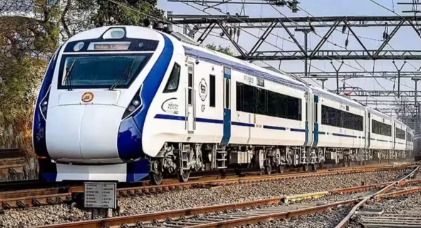
India’s journey towards high-speed rail travel entered a new phase as the second rake of the Vande Bharat Sleeper train clocked a speed of 180 km/h during its trial run in the Kota Division of the West Central Railway (WCR) zone. This marks a key milestone in the country’s aspiration to upgrade long-distance train travel with faster, sleeper-equipped trains that combine comfort and speed.
Trial Details
The trial run, supervised by the Research Designs & Standards Organisation (RDSO) and its Test Directorate, commenced on November 2 and will continue till approximately November 17. The second rake, built by BEML Limited using ICF technology, is a 16-coach consist. It was tested on the Sawai Madhopur–Kota–Nagda stretch, under realistic load conditions: about 800 tonnes of rake weight plus an additional 108 tonnes (canisters filled with iron dust to simulate full occupancy) — making a total load of approximately 908 tonnes.
During a Long Confirmatory Run (LCR) for 50 km between Rohalkhurd–Laban, the train sustained 180 km/h, and other technical tests such as oscillation, wet-track emergency braking, stability and vibration checks were carried out.
Significance of the Speed Achievement
The 180 km/h top speed is a confirmation that the train’s design and build can handle semi-high-speed operations, paving the way for commercial operations at high speeds.
With features like upgraded coaches, advanced braking and safety systems, the Vande Bharat Sleeper is positioned for long-distance overnight routes, replacing older Rajdhani-type services.
The trial reflects India’s push under initiatives like “Mission Gati Shakti” and “Mission Raftar” to modernise rail infrastructure and travel experience.
What This Means for Passengers
Once the Vande Bharat Sleeper is cleared for regular operations:
Travel times on key long-distance routes may shrink materially.
Overnight journeys can offer better comfort (sleeping berths) with high-speed running.
Enhanced safety and ride stability are expected due to the rigorous trials and load testing.
It could lead to a paradigm shift in how Indian Railways schedules and markets premium overnight services.
Conclusion
The successful 180 km/h trial of the Vande Bharat Sleeper’s second rake is more than a speed record—it’s a sign of India’s rail ambitions gaining momentum. As the train moves closer to commercial service, passengers can look forward to faster, more comfortable overnight travel across major routes.
FAQs
Q1: What is the design and tested top speed of the Vande Bharat Sleeper train?
The train has been tested at a top speed of 180 km/h during the trial in Kota Division.
Q2: Which section was used for the trial run?
The trial run was carried out on the Sawai Madhopur–Kota–Nagda section in the Kota Division of West Central Railway.
Q3: What was the load condition during the trial?
The rake was loaded to about 908 tonnes (800-tonne rake plus 108 tonnes simulated load) to mimic full occupancy.
Q4: Why are such trials important?
They help validate braking systems, stability, vibration control, emergency response and train safety under real-life conditions at high speed.
Q5: When can we expect commercial operations of this train?
While no fixed date has been publicly announced, successful trials are a key step toward commercial induction in the near future.
Published on : 6th November
Published by : SMITA
www.vizzve.com || www.vizzveservices.com
Follow us on social media: Facebook || Linkedin || Instagram
🛡 Powered by Vizzve Financial
RBI-Registered Loan Partner | 10 Lakh+ Customers | ₹600 Cr+ Disbursed