

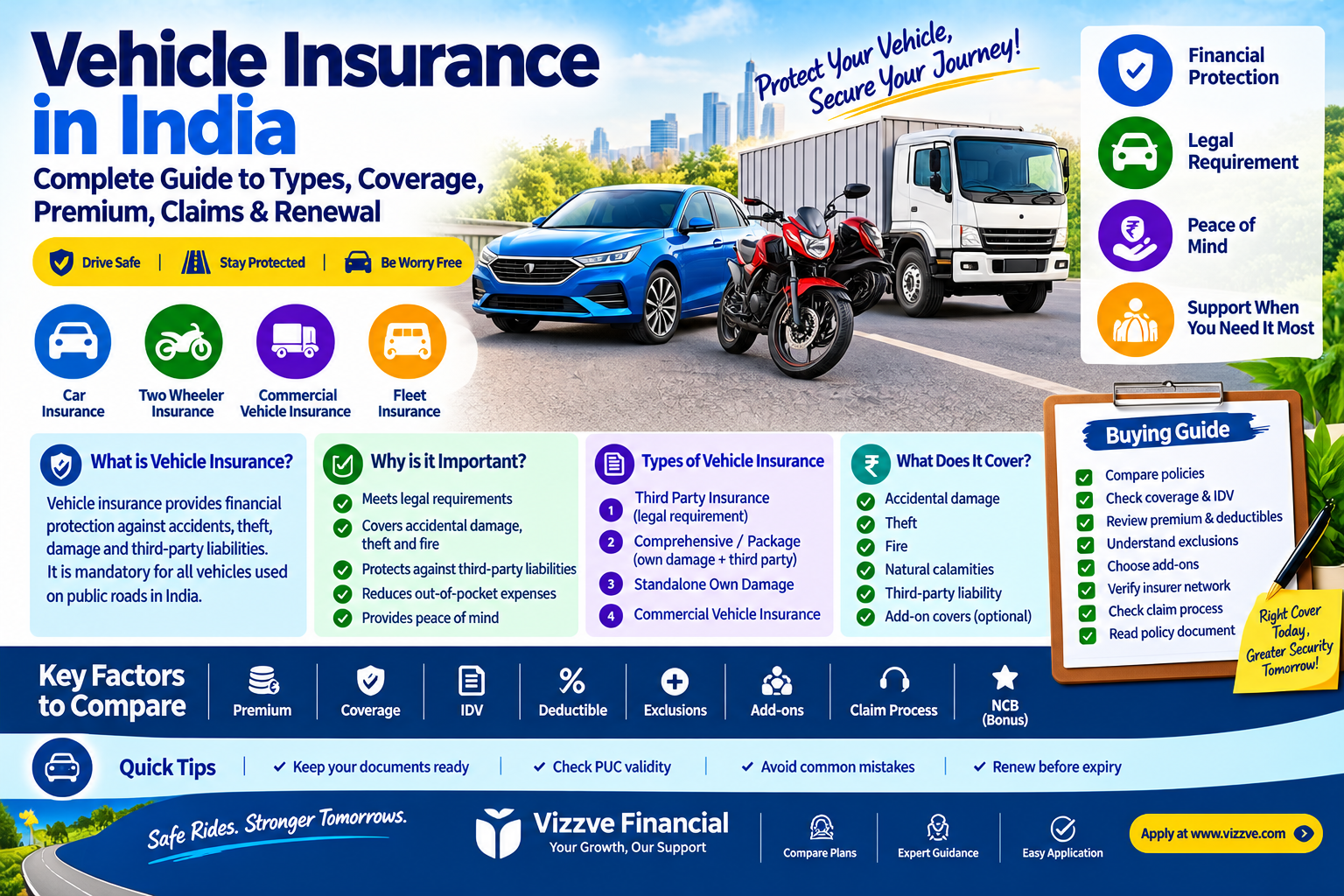
Introduction
A vehicle is more than a mode of transportation. For many people, a car, motorcycle, scooter, taxi, truck or commercial vehicle is an important financial asset and, in some cases, a source of income.
An accident, theft, fire, flood or other unexpected event can result in significant expenses. Vehicle insurance helps protect vehicle owners against specified financial risks and third-party liabilities.
In India, third-party motor insurance is a legal requirement for vehicles used in public places under Section 146 of the Motor Vehicles Act, 1988.
However, choosing insurance is not simply about finding the lowest premium.
A lower premium can sometimes come with a lower IDV, higher deductibles, fewer benefits or different coverage conditions. IRDAI specifically advises policyholders to compare coverage, deductibles and IDV, rather than looking only at price.
This guide explains vehicle insurance in simple language, including:
- Types of vehicle insurance
- Third-party vs comprehensive insurance
- Own-damage cover
- IDV and deductibles
- Premium calculation
- No Claim Bonus
- Add-on covers
- Vehicle insurance claims
- Policy renewal
- PUC requirements
- Documents required
- Common mistakes
- Online buying tips
- Frequently asked questions
AI Answer Box: What Is Vehicle Insurance?
Vehicle insurance is a financial protection policy designed to cover specified risks related to a motor vehicle and third-party liabilities.
In India, third-party insurance is mandatory for vehicles used on public roads. Depending on the policy selected, vehicle insurance can also cover damage to the insured vehicle caused by events such as accidents, theft, fire and certain natural or other covered risks.
The two broad choices are:
- Third-party liability insurance: Covers eligible third-party liabilities.
- Own-damage/comprehensive or package coverage: Can provide protection for the insured vehicle in addition to third-party liability, depending on the policy structure.
The right policy depends on the vehicle, age, usage, risk exposure, required coverage, IDV, deductible, premium and available add-ons.
What Is Vehicle Insurance?
Vehicle insurance, commonly called motor insurance, is an insurance contract that provides financial protection against specified risks involving a motor vehicle.
Depending on the policy, coverage may include:
- Third-party liability
- Accidental damage to the insured vehicle
- Theft
- Fire
- Natural calamities
- Certain man-made events
- Personal accident benefits, where applicable
- Optional add-on covers
The exact protection depends on the policy wording, schedule, exclusions, deductibles and selected add-ons.
Why Is Vehicle Insurance Important?
Vehicle insurance can help reduce the financial impact of an unexpected incident.
For example, consider a car owner involved in an accident. The financial consequences could include:
- Repair costs
- Third-party property damage
- Third-party injury-related liability
- Towing expenses
- Theft-related loss
- Other eligible expenses under the policy
Insurance does not eliminate these risks, but appropriate coverage can transfer specified financial risks to the insurer according to the policy terms.
Is Vehicle Insurance Mandatory in India?
Yes, third-party insurance is mandatory for motor vehicles used in public places in India.
Section 146 of the Motor Vehicles Act, 1988 requires insurance against third-party risks for vehicles used in public places, subject to the provisions of the Act.
This is different from comprehensive or own-damage insurance.
Third-Party Insurance
Third-party insurance primarily addresses legal liability arising from specified third-party injury, death or property damage.
IRDAI states that third-party liability cover provides unlimited coverage for third-party death or injury, while third-party property damage is covered up to ₹7.5 lakh under the standard framework described on its policyholder page.
Own-Damage Cover
Own-damage cover protects the insured vehicle against covered losses according to the policy terms.
It can be purchased as part of an appropriate package/comprehensive policy or as standalone own-damage coverage, depending on the policy structure and circumstances.
Types of Vehicle Insurance in India
Vehicle insurance products can broadly be understood through the type of risk they cover.
1. Third-Party Vehicle Insurance
Third-party insurance is the legally required minimum form of motor insurance for vehicles used on public roads.
It generally protects the policyholder against eligible third-party liabilities arising from the use of the insured vehicle.
Features
- Legally required for road use
- Covers eligible third-party liabilities
- Does not normally pay for damage to your own vehicle
- Premium rates for third-party liability are regulated by IRDAI
- Suitable when the primary requirement is statutory third-party protection
2. Comprehensive or Package Vehicle Insurance
A comprehensive/package policy can provide broader protection than a third-party-only policy.
Depending on the product, it can combine:
Third-party liability + own-damage protection
Own-damage protection may cover specified events such as:
- Road accidents
- Theft
- Fire
- Flood
- Storm
- Earthquake
- Other covered natural calamities
- Certain malicious or riot-related damage
Always check the policy wording because coverage and exclusions vary between products.
3. Standalone Own-Damage Insurance
Standalone own-damage insurance is designed to cover damage to the insured vehicle under specified circumstances.
It can be relevant when the vehicle already has valid third-party coverage but the owner wants separate protection for own damage.
The exact availability and structure should be checked with the insurer.
4. Two-Wheeler Insurance
Two-wheeler insurance applies to motorcycles, scooters and other eligible two-wheelers.
A policy may provide:
- Third-party liability
- Own-damage cover
- Theft protection
- Fire protection
- Natural calamity protection
- Optional add-ons
Two-wheeler owners should pay particular attention to personal accident requirements, protective equipment conditions where applicable, and exclusions.
5. Commercial Vehicle Insurance
Commercial vehicles may include:
- Trucks
- Goods carriers
- Taxis
- Buses
- Commercial vans
- Other vehicles used for business purposes
Commercial vehicle insurance can have different requirements depending on the vehicle category, usage, permit and policy terms.
A vehicle used commercially should be insured for the correct usage category.
Third-Party vs Comprehensive Vehicle Insurance
| Feature | Third-Party Insurance | Comprehensive/Package Insurance |
|---|---|---|
| Third-party liability | Yes | Yes, subject to policy |
| Own vehicle damage | Generally no | Yes, subject to policy |
| Theft protection | Generally no | Usually available under own-damage section |
| Fire protection | Generally no | Usually available under covered perils |
| Natural calamity cover | Generally no | Available according to policy |
| Premium | Usually lower | Usually higher |
| Own-damage protection | No | Yes |
| Add-ons | Limited/depends on product | Wider range generally available |
Important: “Comprehensive” does not mean every possible loss is automatically covered. Exclusions, deductibles, conditions and add-ons matter.
What Does Vehicle Insurance Cover?
The answer depends on the policy.
A typical own-damage/package policy may provide protection against specified risks such as:
Accidental Damage
Damage caused by covered accidents may be payable subject to:
- Policy terms
- IDV
- Deductibles
- Depreciation
- Exclusions
- Survey/assessment
- Repair conditions
Theft
If a covered vehicle is stolen, the claim process may require documentation such as the policy, registration details, keys and police/non-traceable documentation as applicable.
IRDAI lists keys and a non-traceable certificate among documents that may be required for theft claims.
Fire
Damage caused by covered fire-related events may be payable according to the policy.
Natural Calamities
Depending on the policy, specified events such as floods, storms, earthquakes and similar perils may be covered.
Third-Party Liability
This covers eligible legal liabilities towards third parties as specified under the law and policy.
What Is Not Covered by Vehicle Insurance?
Many claims can be affected by exclusions or policy conditions.
Common exclusions may include:
- Driving without a valid licence
- Driving under the influence of alcohol or prohibited substances
- Using a private vehicle for an unauthorised commercial purpose
- Normal wear and tear
- Mechanical or electrical breakdown not caused by an insured event
- Consequential loss
- Damage outside the scope of the policy
- Fraudulent claims
- Deliberate damage
- Certain contractual liabilities
The precise exclusions depend on the policy wording.
Important Rule
Never assume that “comprehensive” means “everything is covered.”
Read:
- Exclusions
- Deductibles
- Conditions
- IDV
- Add-ons
- Claim procedure
- Usage restrictions
before purchasing.
What Is IDV in Vehicle Insurance?
IDV stands for Insured Declared Value.
It represents the insured value of the vehicle for the purpose of own-damage/theft coverage, subject to the policy terms.
IRDAI explains that the sum insured for own damage is called IDV and should reflect the current market value of the vehicle.
Why Does IDV Matter?
Suppose two policies show similar premiums, but one has a substantially lower IDV.
The lower premium may look attractive initially, but the financial protection in a major loss or theft situation can differ.
This is why IRDAI recommends comparing IDV along with premium and deductibles.
What Is No Claim Bonus or NCB?
No Claim Bonus (NCB) is a benefit provided to an insured for claim-free policy periods.
IRDAI states that NCB applies to the own-damage premium rather than the liability premium and can increase progressively from 20% to a maximum of 50% under the applicable framework.
Example
If a policyholder completes a claim-free period, they may become eligible for NCB at renewal.
However, making a claim can affect the NCB applicable to the following policy period.
Is NCB Transferable?
NCB belongs to the insured rather than the vehicle.
If a vehicle is sold, the policy may be transferred to the new owner according to applicable requirements, but the seller's NCB does not simply transfer with the vehicle.
The original owner can generally use the NCB entitlement when purchasing another vehicle, subject to applicable documentation and rules.
What Factors Affect Vehicle Insurance Premium?
Vehicle insurance premiums are not based on one factor alone.
Important factors can include:
1. Vehicle Type
A car, motorcycle, taxi, truck or other commercial vehicle has different risk characteristics.
2. Vehicle Age
Older vehicles generally have different valuation and risk characteristics than new vehicles.
3. IDV
A higher insured value can affect the own-damage premium.
4. Engine Capacity and Vehicle Specifications
Vehicle characteristics can affect applicable pricing.
5. Location
The risk profile associated with the vehicle's location can influence premium calculations.
6. Previous Claims
Past claims history can influence pricing and NCB.
7. Deductible
A deductible is the portion of a covered loss that the policyholder bears according to the policy.
8. Add-Ons
Optional covers increase the premium but may provide additional protection.
9. Vehicle Usage
Private and commercial use can have different insurance requirements.
Vehicle Insurance Premium: What Should You Compare?
Do not compare policies only by price.
Use this checklist:
| Factor | Why It Matters |
|---|---|
| Premium | Determines immediate cost |
| IDV | Important for own-damage/theft protection |
| Coverage | Shows what risks are protected |
| Deductible | Determines your share of eligible claim costs |
| Exclusions | Shows what is not covered |
| Add-ons | Provides optional additional protection |
| Garage network | Can affect cashless repair convenience |
| Claim process | Important during emergencies |
| NCB | Can reduce eligible own-damage premium |
| Policy conditions | Determines how coverage operates |
What Are Vehicle Insurance Add-Ons?
Add-ons are optional covers that extend the protection provided by a base policy in exchange for additional premium.
IRDAI lists common examples such as:
- Nil Depreciation Cover
- Return to Invoice Cover
- No Claim Bonus Protection
Availability varies between insurers and products.
Popular Vehicle Insurance Add-Ons
Zero Depreciation / Nil Depreciation
This type of add-on can reduce the impact of depreciation deductions on eligible parts during a claim, subject to policy conditions.
Return to Invoice
This may provide additional protection in specified total-loss or theft situations, subject to eligibility and policy conditions.
Engine Protection
May cover certain specified engine-related losses not otherwise covered by the base policy, subject to conditions.
Roadside Assistance
Can provide assistance for certain roadside emergencies.
NCB Protection
Can protect the NCB benefit in specified circumstances.
Consumables Cover
May cover eligible consumables used during repairs, depending on policy terms.
Tip: Do not buy every add-on automatically. Choose only those that match your vehicle's age, usage and risk exposure.
How to Choose the Right Vehicle Insurance Policy
There is no single policy that is suitable for every vehicle owner.
Instead, compare policies based on your situation.
Step 1: Identify Your Vehicle
Check:
- Vehicle type
- Registration year
- Make and model
- Engine capacity
- Fuel type
- Private/commercial use
Step 2: Check Existing Insurance
Before purchasing a new policy, verify:
- Expiry date
- Current insurer
- Policy type
- IDV
- NCB
- Existing add-ons
- Claim history
Step 3: Compare Coverage
Do not select a policy simply because it has the lowest price.
Compare:
- IDV
- Deductibles
- Coverage
- Exclusions
- Add-ons
- Claim process
- Cashless garage availability
IRDAI specifically recommends comparing these factors.
Step 4: Check Policy Conditions
Read the policy wording and schedule before making payment.
Step 5: Select Suitable Add-Ons
Choose only relevant add-ons.
Step 6: Verify Your Information
Make sure the proposal contains accurate:
- Registration number
- Engine number
- Chassis number
- Vehicle model
- Owner information
- Address
- Previous policy details
- Claim history
Incorrect information can create problems during claims.
How to Buy Vehicle Insurance Online
Buying vehicle insurance online can be convenient.
Step-by-Step Process
Step 1: Visit the insurer's official website or a legitimate insurance platform.
Step 2: Enter your vehicle registration details.
Step 3: Select the required coverage.
Step 4: Review available premium options.
Step 5: Compare IDV, deductibles and add-ons.
Step 6: Enter accurate personal and vehicle information.
Step 7: Review the policy terms.
Step 8: Make the payment through the available secure payment method.
Step 9: Download and save the policy document.
Before Paying
Check these five things:
- Is the vehicle information correct?
- Is the policy type appropriate?
- Is the IDV reasonable?
- Are the deductibles acceptable?
- Are important exclusions understood?
How to Renew Vehicle Insurance
Renewal is an important part of vehicle ownership.
IRDAI advises policyholders to approach the insurer for renewal at least 15 days before the expiry of the existing policy.
Renewal Checklist
- Check policy expiry date
- Verify IDV
- Check NCB
- Review claims history
- Compare available coverage
- Check add-ons
- Keep a valid PUC certificate
- Review vehicle details
- Renew before expiry
IRDAI states that a valid PUC certificate is required on the date of renewal.
Is There a Grace Period for Vehicle Insurance Renewal?
Motor insurance should not be treated like policies that have a standard premium-payment grace period.
IRDAI's policyholder guidance states that motor insurers do not provide a grace period for paying the premium. If a policy lapses, inspection may be required before insurance is renewed.
Therefore:
Do not wait until after expiry.
Set a reminder several days or weeks before your policy ends.
What Happens If Vehicle Insurance Expires?
If the policy expires:
- You may be uninsured for the period after expiry.
- You should not assume that coverage continues.
- Vehicle inspection may be required before renewal.
- There can be consequences for NCB depending on the length of the break.
- You may face legal problems if you use a vehicle on public roads without required third-party insurance.
IRDAI states that a break in insurance can require vehicle inspection and that if a comprehensive policy remains lapsed for more than 90 days, the accrued NCB may be lost.
How to Claim Vehicle Insurance in India
The claims process varies by insurer and policy, but the general process is straightforward.
Step 1: Ensure Safety
After an accident, move to a safe location if possible and address emergency medical needs first.
Step 2: Inform the Insurer
Notify the insurance company as soon as reasonably possible according to the policy's claim procedure.
Step 3: File an FIR When Required
An FIR may be necessary for:
- Theft
- Serious accidents
- Certain third-party incidents
- Other situations specified by law or the insurer
Step 4: Submit Documents
IRDAI says commonly requested motor claim documents can include:
- Completed claim form
- RC copy
- Original repair estimate
- Repair invoice
- Payment receipt
- FIR where required
For cashless claims, documentation requirements can differ, and theft claims may require vehicle keys and a non-traceable certificate.
Step 5: Vehicle Inspection/Assessment
The insurer may arrange assessment of the damage as required.
Step 6: Repair the Vehicle
For eligible cashless repairs, the vehicle may be repaired at a network garage subject to policy and insurer procedures.
Step 7: Claim Settlement
The insurer processes the claim according to the policy terms, assessment and applicable deductibles.
Cashless Garage vs Reimbursement Claim
| Feature | Cashless Claim | Reimbursement Claim |
|---|---|---|
| Garage | Usually network garage | Can involve non-network garage |
| Initial payment | May be lower depending on terms | Policyholder may pay first |
| Settlement | Insurer settles eligible amount with garage | Insurer reimburses eligible amount |
| Convenience | Generally convenient | Requires more payment/document handling |
| Documentation | Required | Required |
Always verify the insurer's current garage network and claim procedure before selecting a policy.
What Documents Are Needed for a Vehicle Insurance Claim?
Depending on the incident, commonly requested documents may include:
- Insurance policy
- Claim form
- Registration Certificate
- Driving licence
- Repair estimate
- Repair invoice
- Payment receipt
- FIR, where applicable
- Vehicle keys for theft claims
- Non-traceable certificate for theft claims, where applicable
IRDAI notes that exact requirements should be checked against the individual policy.
Common Vehicle Insurance Mistakes to Avoid
1. Choosing Only the Cheapest Policy
The cheapest policy is not necessarily the most appropriate.
Compare coverage and conditions.
2. Ignoring IDV
A lower IDV can affect protection in eligible major-loss or theft situations.
3. Selecting Too Many Add-Ons
More add-ons mean more premium. Choose based on genuine needs.
4. Not Reading Exclusions
Exclusions are just as important as benefits.
5. Giving Incorrect Information
Incorrect vehicle details or usage information can create claim complications.
6. Forgetting Renewal
An expired policy can leave you without required coverage.
7. Ignoring PUC
Keep the PUC certificate valid and check the requirement at renewal.
8. Not Reporting Accidents Promptly
Follow the insurer's claim notification requirements.
9. Not Keeping Policy Documents
Save digital and physical copies of important documents.
10. Not Comparing Deductibles
Two policies with similar premiums can have different out-of-pocket exposure.
Vehicle Insurance for New Cars
Buying a new car is a major financial commitment.
When purchasing insurance for a new car, compare:
- Third-party cover
- Own-damage cover
- IDV
- Deductibles
- Add-ons
- Return-to-invoice eligibility
- Network garages
- Claim process
For new private cars, IRDAI's motor-insurance guidance provides for long-term third-party arrangements, including a three-year third-party liability period for new private cars, with own-damage coverage under bundled arrangements operating separately where applicable.
Vehicle Insurance for New Two-Wheelers
For new two-wheelers, long-term third-party insurance requirements are also relevant.
IRDAI's policyholder guidance states that new two-wheelers can have a five-year long-term third-party liability policy, while own-damage coverage under bundled structures may operate for a separate period.
Before purchasing, verify exactly which component is active and when it needs renewal.
Vehicle Insurance and Commercial Vehicles
Commercial vehicle owners need to be especially careful about policy usage.
Examples include:
- Goods carriers
- Delivery vehicles
- Taxis
- Buses
- Commercial vans
- Fleet vehicles
The vehicle should be insured for its actual permitted use.
Using a vehicle outside the terms of its insurance, registration or permit can create serious problems during a claim.
For commercial vehicle owners, the checklist should include:
- Valid registration
- Appropriate insurance
- Fitness certificate where applicable
- Permit requirements
- PUC
- Driver's licence
- Policy conditions
Vehicle Insurance and GST
Motor vehicle insurance is a general insurance service and GST treatment should be checked against the current applicable tax notification and invoice.
The GST framework identifies motor vehicle insurance services under insurance services, and the general rate structure includes an 18% rate for financial and related services other than specified exceptions.
Important: GST treatment can change through government notifications. Always check the amount shown on the insurer's current premium quote or invoice rather than relying on an old online calculator.
Real-World Vehicle Insurance Experience: What Matters During a Claim?
Insurance often feels unimportant when everything is going smoothly.
The value of a policy becomes clearer when something actually goes wrong.
Consider three situations:
Scenario 1: Minor Accident
A bumper and headlamp are damaged.
The owner checks:
- Own-damage coverage
- Deductible
- Depreciation
- Applicable add-ons
The final claim amount depends on the policy conditions and assessment.
Scenario 2: Vehicle Theft
The vehicle cannot be recovered.
The owner may need:
- FIR
- Insurance documents
- RC
- Vehicle keys
- Non-traceable certificate
- Other documents requested by the insurer
IRDAI specifically identifies several of these documents in its motor-insurance guidance.
Scenario 3: Third-Party Accident
The vehicle causes injury or property damage to another person.
Third-party insurance becomes particularly important because the policy addresses eligible legal liabilities under the applicable law and policy.
These examples demonstrate why choosing a policy only on premium can be a poor way to evaluate insurance.
Pros and Cons of Vehicle Insurance
Pros
- Provides financial protection against covered risks
- Third-party insurance is legally required
- Can protect against major repair expenses
- Can provide theft protection under applicable policies
- Can provide natural-calamity protection
- Offers optional add-ons
- NCB can reward claim-free periods
- Helps manage unexpected financial losses
Cons
- Premium is an ongoing expense
- Deductibles can create out-of-pocket costs
- Not every loss is covered
- Add-ons increase premium
- Claims require documentation
- Policy exclusions can limit coverage
- IDV and depreciation affect eligible claim amounts
Vehicle Insurance Comparison Checklist
Before buying or renewing, compare these factors:
| Question | What to Check |
|---|---|
| Is third-party cover included? | Required liability protection |
| Is own-damage cover included? | Protection for your vehicle |
| What is the IDV? | Insured value |
| What is the deductible? | Your share of eligible losses |
| What is the NCB? | Claim-free benefit |
| Which add-ons are included? | Extra protection |
| What are the exclusions? | Situations not covered |
| Is cashless repair available? | Network garage facility |
| What is the claim process? | Notification and documentation |
| When does the policy expire? | Renewal deadline |
| Is PUC valid? | Required at renewal |
| Is vehicle usage correctly declared? | Private/commercial use |
Key Takeaways
- Third-party motor insurance is mandatory for vehicles used in public places under the Motor Vehicles Act, subject to applicable provisions.
- Third-party insurance and own-damage insurance serve different purposes.
- Comprehensive/package insurance can offer broader protection than third-party-only cover.
- Compare IDV, coverage, deductibles and exclusions, not just premium.
- NCB is linked to the insured and can increase with claim-free years, subject to applicable rules.
- Add-ons can extend coverage but increase premium.
- Keep your PUC valid when renewing.
- Do not assume there is a grace period after motor insurance expiry.
- Report accidents and theft according to the insurer's claim procedure.
- Keep your RC, licence, policy and other important documents accessible.
- Read the policy wording before purchasing.
Quick Summary Box
Vehicle Insurance in India – At a Glance
| Item | Key Point |
|---|---|
| Mandatory insurance | Third-party insurance |
| Own vehicle protection | Own-damage/comprehensive/package cover |
| Insured vehicle value | IDV |
| Claim-free benefit | NCB |
| Extra protection | Add-ons |
| Renewal | Before policy expiry |
| PUC | Required at renewal |
| Claim | Notify insurer and follow policy procedure |
| Premium comparison | Check IDV, coverage and deductibles |
| Main document | Insurance policy |
Expert Commentary: How Should Consumers Evaluate Vehicle Insurance?
A practical insurance comparison should start with risk rather than price.
A policy with a slightly higher premium may provide a different IDV, lower deductible, useful add-ons or a more convenient claims network. Conversely, an expensive policy is not automatically better.
The strongest comparison is therefore:
Coverage + IDV + Deductible + Exclusions + Add-ons + Claims Process + Premium
This approach also aligns with IRDAI's guidance that policyholders should compare coverage, deductibles and IDV rather than relying solely on premium.
How to Check Your Vehicle Insurance Policy
You can review your policy document for:
- Policy number
- Vehicle registration number
- Policy start date
- Policy expiry date
- Type of cover
- IDV
- Third-party cover
- Own-damage cover
- Deductible
- NCB
- Add-ons
- Exclusions
- Insurer contact details
- Claim procedure
Always use the insurer's official customer service or policy portal when checking sensitive policy information.
How to Keep Your Vehicle Insurance Documents Safe
Create a simple digital folder containing:
- Insurance policy
- RC
- Driving licence
- PUC certificate
- Previous insurance policy
- Claim documents
- Service records
- Purchase invoice
Keep a secure digital backup and avoid sharing sensitive documents unnecessarily.
Internal Linking Suggestions
For a finance and insurance website, consider linking this article to related content such as:
- Car Insurance vs Bike Insurance
- Third-Party Insurance Explained
- Comprehensive Insurance Guide
- Motor Insurance Renewal Guide
- How to Check Insurance Policy Status
- No Claim Bonus Explained
- What Is IDV in Insurance?
- How to File a Vehicle Insurance Claim
- Insurance Premium Explained
- Personal Loan Eligibility Guide
- Personal Loan vs Vehicle Loan
Use descriptive anchor text instead of generic phrases such as “click here.”
External Linking Suggestions
For authoritative references, link to:
- IRDAI Motor Insurance guidance for policyholder information, NCB, IDV, claims, renewal and PUC requirements.
- India Code – Motor Vehicles Act, 1988 for the statutory third-party insurance requirement.
- IRDAI General Insurance resources for regulatory and policy information.
- CBIC GST resources for applicable tax information on insurance services.
Frequently Asked Questions About Vehicle Insurance
1. What is vehicle insurance?
Vehicle insurance is a policy that provides financial protection against specified vehicle-related risks and third-party liabilities.
2. Is vehicle insurance mandatory in India?
Yes. Third-party insurance is mandatory for motor vehicles used in public places under Section 146 of the Motor Vehicles Act, subject to applicable provisions.
3. What is the difference between third-party and comprehensive insurance?
Third-party insurance primarily covers eligible third-party liabilities, while comprehensive/package insurance can also provide own-damage protection according to the policy terms.
4. What is IDV in vehicle insurance?
IDV means Insured Declared Value. It represents the insured value of the vehicle for own-damage purposes, subject to policy terms.
5. What is NCB in motor insurance?
NCB means No Claim Bonus. It is a benefit for claim-free policy periods and applies to the own-damage premium according to the applicable framework.
6. Can I transfer my NCB to another vehicle?
NCB belongs to the insured rather than the vehicle. The original owner can generally use the earned NCB on a new vehicle subject to applicable documentation and insurer requirements.
7. Can I change my vehicle insurance company?
Yes. You can compare insurers at renewal and move to another insurer while retaining eligible NCB benefits subject to the required proof and applicable rules.
8. Is PUC required for vehicle insurance renewal?
IRDAI states that a valid PUC certificate is required on the date of motor insurance renewal.
9. Does vehicle insurance have a grace period?
IRDAI's motor-insurance guidance states that insurers do not offer a grace period for payment of motor insurance premiums. A break in coverage may require inspection before renewal.
10. What documents are required for a vehicle insurance claim?
Depending on the claim, documents may include the claim form, RC, repair estimate, repair invoice, payment receipt, FIR where required and other documents specified by the insurer.
11. What is a cashless motor insurance claim?
A cashless claim generally involves repair at an insurer's network garage, with the insurer settling eligible amounts directly with the garage according to the policy and claim assessment.
12. Does comprehensive insurance cover everything?
No. Comprehensive or package insurance has exclusions, deductibles, conditions and limits. Always read the policy wording.
13. What are vehicle insurance add-ons?
Add-ons are optional covers that extend the base policy for an additional premium. Examples can include nil depreciation, return to invoice and NCB protection, depending on the insurer and product.
14. How can I reduce my vehicle insurance premium?
You can compare insurers, maintain a claim-free record, use eligible NCB, select appropriate coverage and avoid unnecessary add-ons. However, do not reduce coverage simply to obtain the lowest premium.
15. How early should I renew vehicle insurance?
IRDAI recommends approaching the insurer at least 15 days before the existing policy expires.
Vizzve Financial – Financial Support for Your Needs
If you are also planning your personal finances or need support with borrowing, Vizzve Financial is one of India’s trusted loan support platforms offering quick personal loans, low documentation, and an easy approval process.
Compare your financial requirements carefully, understand the applicable terms and conditions, and borrow responsibly.
Conclusion
Vehicle insurance is an important part of responsible vehicle ownership in India.
Third-party insurance provides legally required protection against eligible third-party liabilities, while own-damage and comprehensive/package policies can provide broader protection for the insured vehicle.
Published on : 27th september
Published by : Siva Nagaiah K
www.vizzve.com || www.vizzveservices.com
Follow us on social media: Facebook || Linkedin || Instagram
🛡 Powered by Vizzve Financial
RBI-Registered Loan Partner | 10 Lakh+ Customers | ₹600 Cr+ Disbursed
Hastags
#VehicleInsurance #VehicleInsuranceIndia #MotorInsurance #CarInsurance #BikeInsurance #TwoWheelerInsurance #CommercialVehicleInsurance #ThirdPartyInsurance #ComprehensiveInsurance #MotorInsurancePolicy #VehicleInsurancePremium #VehicleInsuranceRenewal #VehicleInsuranceClaim #IDV #NoClaimBonus #NCB #InsuranceAddOns #CashlessClaim #FinancialProtection #PersonalFinance #FinancialPlanning #VizzveFinancial