

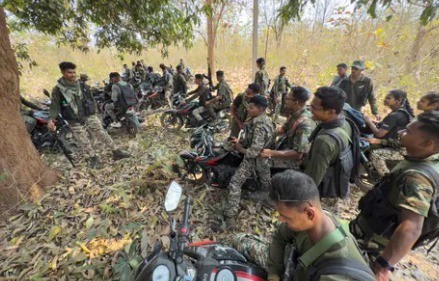
War Before Deadline: The Bloodiest Battle to End Maoism Before March 2026
India has entered a decisive phase in its decades-long fight against Maoist insurgency, with the central government and security agencies determined to wipe out left-wing extremism (LWE) by March 2026. This marks one of the most extensive anti-Maoist offensives in recent years — a campaign that officials say is both the most intense and the most coordinated since the movement began in the late 1960s.
The Deadline and the Mission
The Ministry of Home Affairs (MHA) has set March 2026 as the target date for ending Maoist activity across India’s red corridor — a stretch spanning Chhattisgarh, Jharkhand, Odisha, Maharashtra, and parts of Bihar.
Security sources describe the current phase as a “war before the deadline”, with enhanced troop deployments, real-time intelligence, and new technology such as drone surveillance and thermal imaging being used in forest zones.
The Bloodiest Phase Yet
The intensified operations have resulted in frequent encounters between security forces and Maoist groups. In recent months, several senior Maoist leaders have been neutralized, while large caches of weapons have been seized.
However, the push has also seen heavy casualties on both sides, with reports of ambushes, improvised explosive devices (IEDs), and jungle skirmishes in dense terrain — making it one of the bloodiest phases of this prolonged conflict.
Socio-Economic Strategy
Beyond the armed offensive, the government’s approach includes development-led counterinsurgency, focusing on:
Expanding road connectivity and telecom networks in tribal regions.
Establishing schools, healthcare centers, and employment schemes in affected districts.
Promoting rehabilitation programs for surrendered Maoists under the Central Rehabilitation Policy.
Officials believe this dual strategy — security + development — will help dismantle Maoist influence while rebuilding trust in affected communities.
Key Challenges Ahead
While the campaign has reduced Maoist presence to less than 25 districts (from over 90 a decade ago), challenges persist:
Difficult terrain that limits troop mobility.
Local support networks aiding insurgent hideouts.
Socio-political gaps that insurgents exploit in tribal regions.
Security analysts caution that while the military victory may be near, ensuring sustainable peace will require long-term engagement with tribal populations.
Government’s Confidence
Home Minister Amit Shah has repeatedly affirmed that “Maoism will end before 2026.” Officials cite improved coordination between central and state forces, modernized weaponry, and extensive intelligence-sharing as key reasons for optimism.
Sources also reveal that states like Chhattisgarh and Jharkhand — once considered Maoist strongholds — have seen significant decline in violence, indicating progress toward the 2026 goal.
The Human Cost and the Road Ahead
Despite clear progress, the cost has been steep. Dozens of personnel and civilians have lost their lives in operations this year alone. Human rights observers continue to urge both restraint and focus on rehabilitation for displaced villagers.
If successful, the campaign could mark the end of one of India’s longest-running internal conflicts, transforming the socio-economic landscape of central and eastern India.
FAQs
1. What is the deadline for ending Maoism in India?
The government aims to end left-wing extremism by March 2026.
2. Which states are most affected?
Chhattisgarh, Jharkhand, Odisha, Maharashtra, and parts of Bihar.
3. What strategies are being used?
A mix of security operations, development projects, and rehabilitation programs for surrendered cadres.
4. Has violence reduced in recent years?
Yes, official data shows a sharp decline in Maoist incidents and fatalities since 2014.
5. What happens after 2026?
The focus will shift to stabilization and development, ensuring that Maoist influence does not re-emerge.
Published on : 30th October
Published by : SMITA
www.vizzve.com || www.vizzveservices.com
Follow us on social media: Facebook || Linkedin || Instagram
🛡 Powered by Vizzve Financial
RBI-Registered Loan Partner | 10 Lakh+ Customers | ₹600 Cr+ Disbursed
https://play.google.com/store/apps/details?id=com.vizzve_micro_seva&pcampaignid=web_share