

Introduction
Digital lending has made borrowing money easier through mobile apps and online platforms. However, borrowers must understand their rights before applying for a digital loan. In India, the Reserve Bank of India (RBI) has issued digital lending directions to promote transparency, protect personal data, and prevent unfair lending and recovery practices.
Understanding borrower rights helps people make informed financial decisions, avoid loan app fraud, and handle repayment problems confidently.
What Are Borrower Rights in Digital Lending?
Borrower rights in digital lending are the protections and entitlements available to people who borrow money through digital platforms connected with regulated lenders, such as banks and Non-Banking Financial Companies (NBFCs).
These rights help borrowers understand loan terms, protect their personal information, receive fair treatment, and raise complaints when something goes wrong.
Key Borrower Rights in Digital Lending
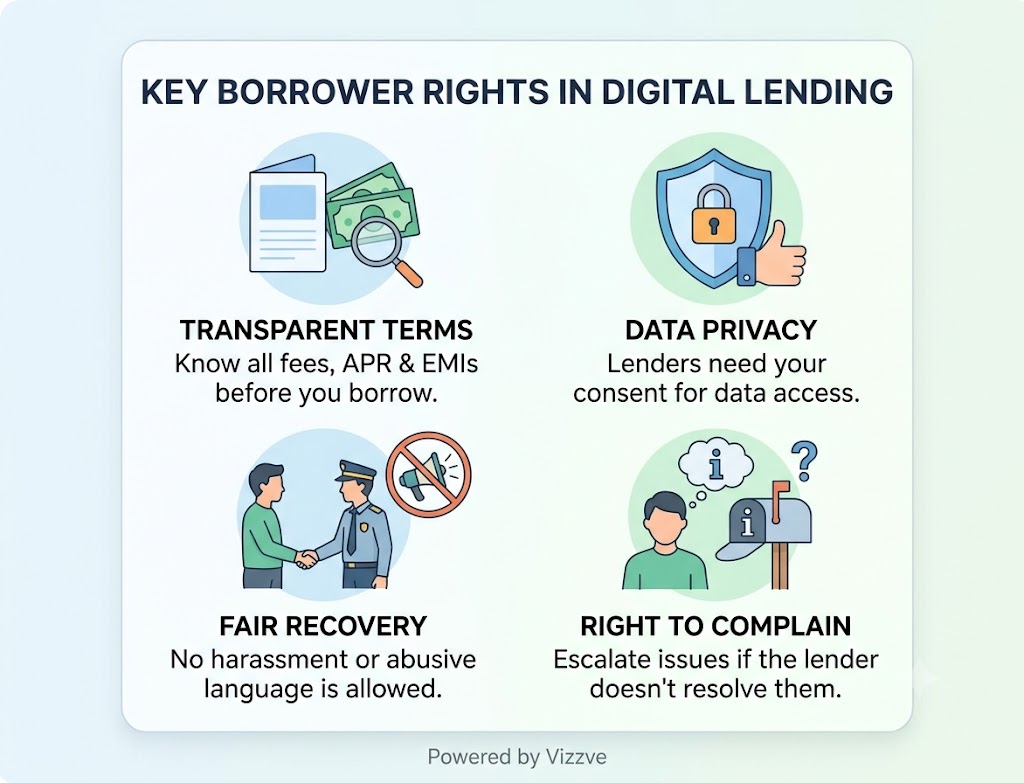
1. Right to Transparent Loan Information
Borrowers have the right to understand the important terms and conditions before accepting a loan. These include:
-
Interest rate and Annual Percentage Rate (APR).
-
Processing fees and other applicable charges.
-
Repayment schedule and EMI amount.
-
Late payment charges, where applicable.
-
Loan tenure and repayment conditions.
The lender must provide a Key Facts Statement (KFS) containing important loan information before the loan contract is executed.
2. Right to Data Privacy
Digital lenders must follow applicable data protection requirements. Borrowers should be informed about how their personal information is collected, used, and shared.
Under RBI digital lending directions, data collection must be necessary for the lending process and supported by prior, explicit consent. Borrowers should review app permissions carefully and avoid granting unnecessary access to contacts, call logs, and personal files.
3. Right to Fair Loan Recovery
Borrowers have the right to be treated fairly during loan recovery. Recovery agents must not use threats, abusive language, public humiliation, or harassment.
A missed EMI does not give a lender or recovery agent permission to intimidate a borrower or contact family members to shame them. Borrowers should retain evidence of any threatening calls or messages and report misconduct to the lender.
4. Right to Receive Loan Documents
Borrowers should receive relevant loan documents electronically, as applicable, including:
-
Key Facts Statement.
-
Loan sanction letter.
-
Loan agreement and terms.
-
Repayment details and account statements.
-
Applicable privacy policy information.
Keep copies of these documents for future reference.
5. Right to Understand the Actual Cost of a Loan
Before accepting a digital loan, borrowers should be able to understand the total cost of borrowing. The APR helps show the annualised cost of credit, including applicable charges.
Charges not disclosed in the KFS cannot be charged by the regulated lender under the applicable RBI digital lending directions.
6. Right to a Cooling-Off Period
Eligible digital loans must include a cooling-off period during which borrowers can exit the loan by repaying the principal and proportionate APR without a penalty, subject to applicable rules.
Under the RBI Digital Lending Directions, 2025, this period must be at least one day. A reasonable one-time processing fee may be retained if it was disclosed upfront in the KFS.
Borrowers should check the specific cooling-off period and exit terms before accepting the loan.
7. Right to Raise Complaints
Borrowers can complain if they face hidden charges, incorrect loan entries, privacy violations, or unfair recovery practices.
Start by contacting the lender's grievance redressal officer. Keep the complaint number, screenshots, payment receipts, and other supporting documents.
If the lender rejects the complaint, provides an unsatisfactory response, or fails to respond within 30 days, eligible borrowers can approach the RBI through its applicable grievance redressal mechanism.
8. Right to Know Who the Actual Lender Is
Borrowers should know which regulated bank or NBFC is providing the loan, even when an app or Lending Service Provider (LSP) facilitates the process.
Check the lender's identity, official website, loan documents, and grievance contact details before sharing sensitive information or paying any fee.
What Should Borrowers Do If Their Rights Are Violated?
Follow these steps if you experience a problem with a digital lending app:
-
Save screenshots, call records, messages, loan agreements, and payment receipts.
-
Contact the lender through its official customer support or grievance redressal channel.
-
Submit a written complaint and keep the complaint reference number.
-
If the issue remains unresolved, use the appropriate RBI complaint mechanism, if eligible.
-
Report suspected cyber fraud promptly through the official cybercrime reporting channels.
Tips for Safe Digital Borrowing
-
Verify the bank or NBFC behind the loan app.
-
Read the KFS and loan agreement before accepting.
-
Check the APR, EMI, tenure, and all disclosed charges.
-
Never share OTPs, passwords, or banking PINs.
-
Avoid apps demanding unnecessary phone permissions.
-
Pay EMIs only through verified payment channels.
-
Keep copies of loan and repayment records.
Frequently Asked Questions
1. What are borrower rights in digital lending?
They are protections that help borrowers receive transparent loan information, safeguard personal data, access fair recovery practices, and raise complaints.
2. Does RBI regulate digital lending?
RBI issues directions for regulated entities such as banks and NBFCs involved in digital lending.
3. Can a loan app access my contacts?
Digital lending apps must follow applicable data rules. Access to contacts and call logs is restricted under RBI digital lending directions.
4. Can recovery agents threaten borrowers?
No. Threats, abusive behaviour, and harassment are not acceptable recovery practices.
5. What is a Key Facts Statement?
A KFS is a standardised document explaining key loan terms, including the APR, charges, and other important information.
6. Can I cancel a digital loan after accepting it?
Eligible borrowers can use the cooling-off option according to the applicable rules and disclosed terms.
7. Can a lender charge hidden fees?
Charges not disclosed in the KFS cannot be charged by the regulated lender under applicable RBI digital lending directions.
8. How can I complain against a digital loan app?
Contact the lender's grievance redressal officer first. If eligible, escalate the unresolved complaint through the RBI's official complaint mechanism.
9. Is my personal data protected when I take an online loan?
Lenders must follow applicable data protection and RBI requirements, including rules on consent and necessary data collection.
10. Can I complain about loan app harassment?
Yes. Report the issue to the lender and preserve evidence. You can also approach the appropriate regulatory or law enforcement channel, depending on the complaint.
Conclusion
Borrower rights in digital lending are important for safe and responsible online borrowing. Understanding loan charges, protecting personal information, checking lender details, and knowing how to raise complaints can help borrowers avoid common problems.
Before accepting any digital loan, read the terms carefully and make sure you can manage the repayments comfortably. Being informed about your rights is an important step towards safer borrowing.
Published on : 23rd October
Published by : monisha
www.vizzve.com || www.vizzveservices.com
Follow us on social media: Facebook || Linkedin || Instagram
🛡 Powered by Vizzve Financial
RBI-Registered Loan Partner | 10 Lakh+ Customers | ₹600 Cr+ Disbursed