

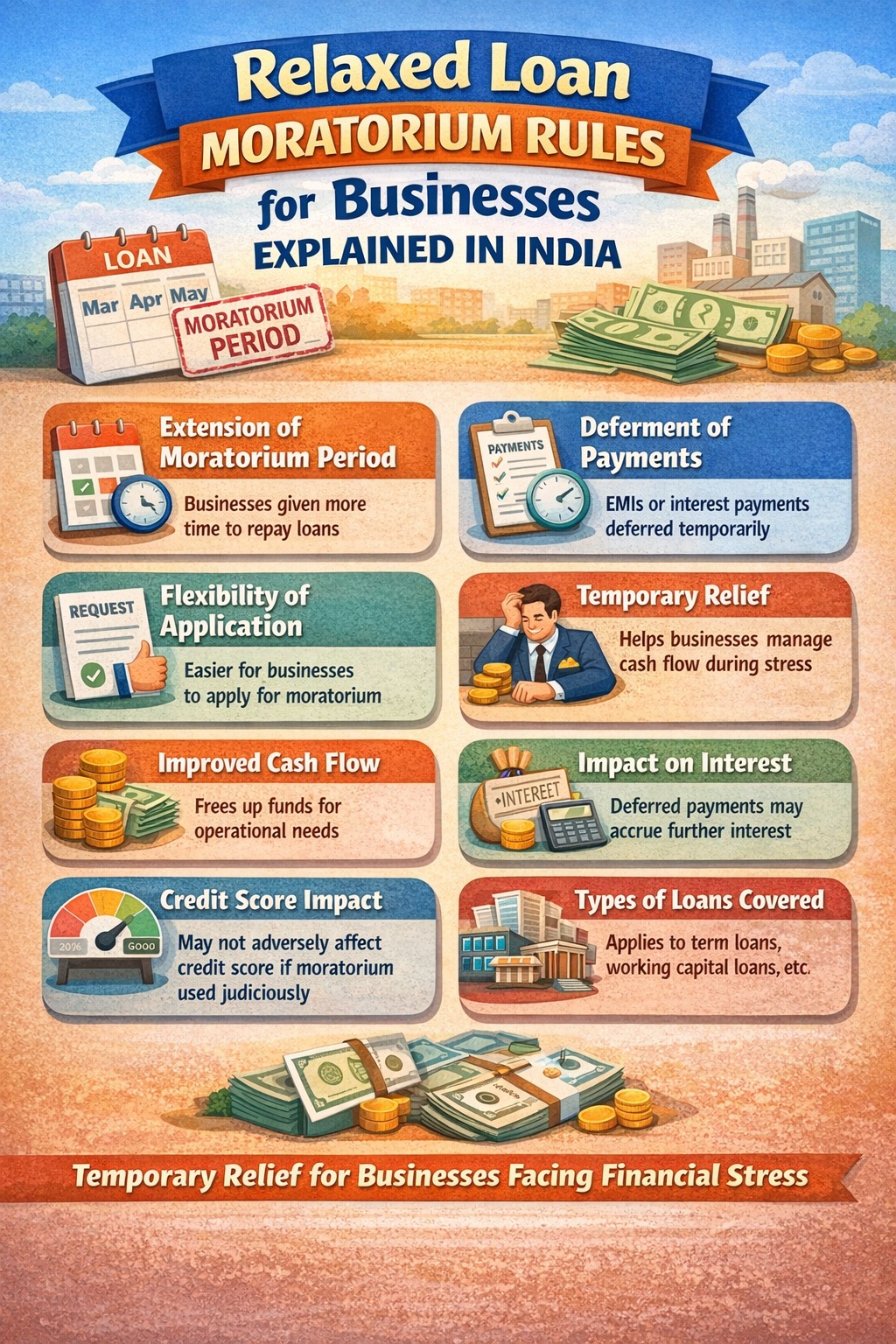
Relaxed loan moratorium rules offer payment relief to businesses by postponing EMIs for a defined period without classifying the account as default/NPA. This improves cash flow, but businesses must plan for resumption, interest impact, and credit behaviour once relief ends.
AI Answer Box
Relaxed moratorium rules for business loans:
Postpones EMIs temporarily
Doesn’t turn loan into NPA
Interest may accrue
Requires planning for resumption
Prefer dialogue with lenders
Introduction
Business cycles are rarely uninterrupted. Economic slowdowns, demand shocks, or sector stress can strain cash flows, making regular loan EMIs hard to manage. To ease this burden—especially after pandemic disruptions—regulators have introduced relaxed loan moratorium rules.
For businesses large and small, understanding these rules isn’t just helpful—it’s essential for survival and strategy.
This guide breaks down everything business leaders must know to use the rules effectively and avoid unintended consequences.
What Is a Loan Moratorium? (Simple Definition)
A loan moratorium is a temporary break from repaying EMIs (principal and/or interest) on outstanding loans.
For businesses, it creates short-term breathing room to preserve working capital and stabilize operations.
Under relaxed rules, this moratorium:
Does not immediately classify the loan as default/NPA
Gives time to reorganize finances
Is typically granted under defined conditions
Why the Rules Were Relaxed
In response to economic shocks such as:
COVID-19 disruptions
Liquidity crunches
Supply-chain stresses
the Reserve Bank of India and lenders provided temporary relief measures to prevent mass defaults and systemic stress.
This helped maintain credit discipline without penalizing businesses that were temporarily affected.
Key Features of Relaxed Loan Moratorium Rules
1. Postponement — Not a Waiver
The loan is not forgiven — repayment obligations are deferred.
Interest still accrues unless otherwise specified.
2. NPA Classification Is Delayed
If businesses use the moratorium as permitted, the loan is not classified as default/NPA during the covered period.
3. Interest May Still Be Charged
In many cases:
Interest on the outstanding accrues
Monthly EMIs may jump once moratorium ends due to capitalised interest
4. Applicability and Eligibility
Depending on lender policy and economic policy at the time:
MSMEs often get flexible terms
Larger businesses may need negotiation
Specific loans (working capital, term loans) may have distinct terms
Note: Not all loans automatically qualify — check terms carefully.
How Moratorium Rules Affect Your Business Finances
🔹 Cash Flow Relief
Pause in EMIs frees up cash for:
Payroll
Inventory
Emergency operations
This is especially important for small and medium enterprises without large cash reserves.
🔹 Credit Behaviour & Reporting
Businesses that follow the moratorium rules:
Avoid immediate default
Maintain operational credit access
Preserve relationship with lenders
However, lenders may still monitor repayment discipline post-moratorium as part of credit assessments.
🔹 Interest & Total Cost
Even with a moratorium:
Interest may accrue
Total repayment cost usually increases if accrued interest is capitalized
So moratorium should be used strategically, not routinely.
Steps to Take Before, During & After a Moratorium
Step 1 — Assess Your Cash Flow
Before applying, analyse 3–6 months of receivables and expenses.
Step 2 — Talk To Your Lender Early
Proactive dialogue reduces paperwork and avoids confusion later.
Step 3 — Understand Accrual Impact
Ask how interest will be treated — capitalised or paid later.
Step 4 — Plan for Resumption
Build a clear repayment plan for after the moratorium period ends.
Step 5 — Avoid New Defaults
Don’t delay responding to communications from lenders.
Real Examples (Illustrative)
| Scenario | Without Moratorium | With Moratorium |
|---|---|---|
| Cash Crunch | EMIs overdue | EMIs postponed |
| NPA Risk | High | Minimized |
| Cash flow | Stressed | Relieved |
| Interest | Normal | Accrued (capitalised) |
Common Business Mistakes to Avoid
❌ Treating moratorium as long-term relief
❌ Not planning for large post-moratorium EMIs
❌ Ignoring interest buildup
❌ Waiting to communicate with lenders
Pros & Cons For Businesses
✅ Pros
Immediate cash flow relief
Avoid default/NPA classification
Time to reorganize finances
❌ Cons
Higher total interest cost
Payment burden post-moratorium
May affect future credit pricing
Key Takeaways
Moratorium buys time, not forgiveness
Businesses must plan, not postpone indefinitely
Early engagement with lenders improves outcomes
Credit behaviour post-moratorium matters a lot
Frequently Asked Questions (FAQs)
1. Does moratorium erase my loan?
No, it only postpones payment.
2. Will interest still be charged?
Usually yes — check lender terms.
3. Does moratorium affect NPA status?
Not immediately if used per rules.
4. Should all businesses opt for it?
Not always — only if cash flow is strained.
5. Can I prepay during moratorium?
Yes, but check terms.
6. Is moratorium automatic?
Usually needs request/approval.
7. Does RBI mandate moratorium terms?
RBI issues guidelines, banks decide execution.
8. Does moratorium affect credit score?
Not directly, but post-moratorium behaviour does.
9. Are NBFCs bound by these rules?
Mostly yes, if regulated.
10. Can moratorium be extended?
Only if new guidelines permit.
11. Do interest rates change?
Moratorium typically doesn’t alter rates.
12. Should businesses restructure loans instead?
Sometimes yes — consult lender.
Conclusion
Relaxed loan moratorium rules are a temporary lifeline — not a permanent solution. In uncertain times, they provide clutch relief, but disciplined planning and proactive lender engagement are the real keys to financial health.
Vizzve Financial is one of India’s trusted loan support platforms offering quick business and personal loan solutions, low documentation, and an easy approval process. Apply at www.vizzve.com.
Published on : 9th January
Published by : SMITA
www.vizzve.com || www.vizzveservices.com
Follow us on social media: Facebook || Linkedin || Instagram
🛡 Powered by Vizzve Financial
RBI-Registered Loan Partner | 10 Lakh+ Customers | ₹600 Cr+ Disbursed