

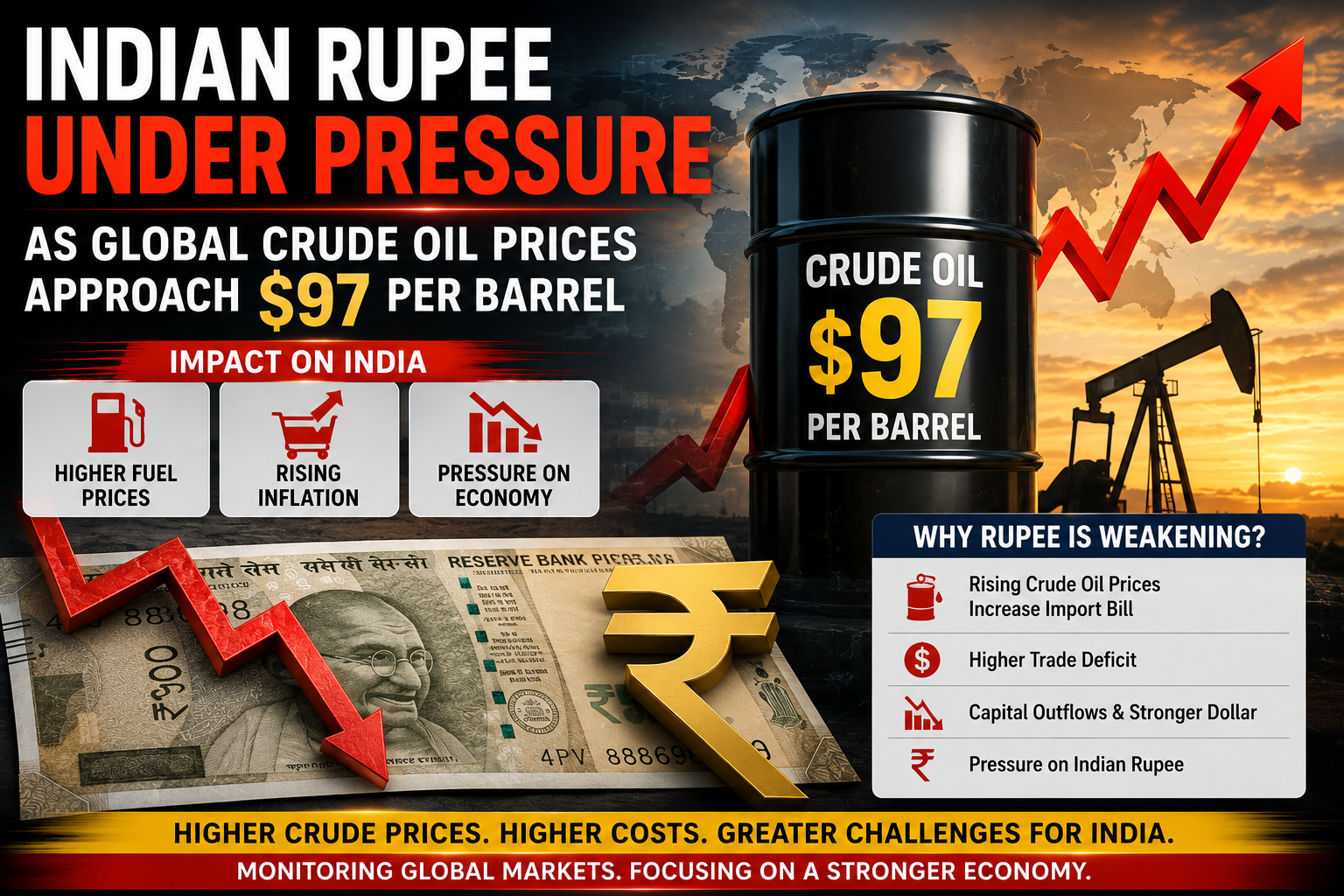
The Indian rupee is once again facing pressure as global crude oil prices climb toward the $97-per-barrel mark, increasing concerns about inflation, import costs, and economic stability.
India imports nearly 85% of its crude oil requirements, making the country particularly vulnerable to sharp increases in global energy prices.
As oil becomes more expensive, demand for dollars rises, often weakening the rupee and creating challenges for policymakers, businesses, and consumers alike.
AI Answer Box
Why is the rupee under pressure?
The rupee is facing pressure because rising crude oil prices increase India's import bill. Since oil imports are paid for in US dollars, higher oil prices raise dollar demand and can weaken the rupee.
Why does oil affect the rupee?
India imports most of its crude oil. When oil prices rise, importers need more dollars to pay suppliers, increasing demand for foreign currency and putting pressure on the rupee.
What happens if oil reaches $100 per barrel?
Higher oil prices can increase inflation, fuel costs, transportation expenses, fiscal pressures, and foreign exchange outflows while weakening the rupee.
Introduction
Oil prices remain one of the most important variables influencing India's economy.
Every major rise in crude prices affects:
- Fuel costs
- Inflation
- Trade balance
- Currency markets
- Government finances
With crude oil approaching $97 per barrel amid geopolitical tensions and supply concerns, market participants are closely monitoring the rupee's performance.
The situation has renewed focus on India's energy dependence and the broader economic consequences of rising global commodity prices.
Why Oil Prices Are Rising
Several global developments have contributed to the recent surge in crude oil prices.
Key Drivers
- Geopolitical tensions in the Middle East
- Supply disruptions
- OPEC production policies
- Strong global demand
- Market uncertainty
These factors have pushed crude oil prices toward levels not seen in several months.
Crude Oil and the Rupee: Understanding the Connection
The relationship between oil prices and the rupee is straightforward.
Higher Oil Prices → Higher Dollar Demand → Weaker Rupee
India pays for most crude oil imports in US dollars.
When oil prices rise:
- Importers need more dollars.
- Dollar demand increases.
- Pressure builds on the rupee.
- Import costs rise further.
This cycle often creates volatility in currency markets.
How Oil Impacts India's Economy
| Area | Impact of Higher Oil Prices |
|---|---|
| Rupee | Negative |
| Inflation | Higher |
| Fuel Prices | Increase |
| Trade Deficit | Widens |
| Government Finances | Pressure |
| Consumer Spending | Weakens |
Rising Import Bill Creates Challenges
India is one of the world's largest crude oil importers.
A sustained increase in oil prices can significantly increase:
- Import expenditure
- Foreign exchange demand
- Trade deficit
The higher import bill can create pressure on both the rupee and current account balance.
Impact on Inflation
One of the biggest concerns is inflation.
Higher crude prices affect:
Direct Impact
- Petrol prices
- Diesel prices
- LPG costs
- Aviation fuel
Indirect Impact
- Transportation costs
- Manufacturing expenses
- Food prices
- Logistics costs
These effects can spread throughout the economy.
Fuel Prices and Consumer Spending
When fuel costs rise, households often have less disposable income available for:
- Retail spending
- Travel
- Entertainment
- Consumer goods
This can influence overall economic activity if oil prices remain elevated for a prolonged period.
Impact on Businesses
Businesses across sectors may face increased costs.
Most Affected Industries
- Airlines
- Logistics
- Transportation
- Manufacturing
- Chemicals
Companies may either absorb higher costs or pass them on to consumers.
How the RBI Can Respond
The Reserve Bank of India closely monitors currency movements.
Potential responses include:
Forex Market Intervention
Selling dollars from reserves to reduce excessive volatility.
Liquidity Management
Maintaining orderly market conditions.
Monetary Policy Monitoring
Evaluating inflation risks created by rising oil prices.
The RBI has repeatedly emphasized its willingness to act against excessive currency volatility.
India's Forex Reserves Provide Support
One major advantage for India is its substantial foreign exchange reserves.
These reserves help:
- Manage volatility
- Support investor confidence
- Stabilize currency markets
- Reduce external vulnerabilities
Strong reserves provide policymakers with greater flexibility during periods of market stress.
What Investors Are Watching
Financial markets are closely tracking:
- Crude oil prices
- Rupee movement
- Inflation trends
- RBI actions
- Global geopolitical developments
Investor sentiment often becomes more cautious when oil prices rise sharply.
Historical Impact of High Oil Prices
Historically, sustained periods of elevated crude prices have often resulted in:
- Higher inflation
- Rupee weakness
- Increased fiscal pressure
- Slower economic growth
However, India's economy today is generally considered more resilient than in previous decades due to stronger reserves and improved macroeconomic fundamentals.
Expert Commentary
Economists believe the impact of oil near $97 depends largely on how long prices remain elevated.
Short-term spikes may have limited consequences.
However, if prices remain close to or above current levels for an extended period, India could face:
- Higher inflation
- Wider trade deficits
- Additional pressure on the rupee
Most experts expect policymakers and the RBI to continue monitoring conditions closely while using available tools to manage volatility.
Could Oil Reach $100?
Many analysts believe oil could test the $100-per-barrel level if:
- Geopolitical tensions worsen
- Supply disruptions increase
- OPEC maintains production constraints
Such a scenario would likely intensify concerns regarding inflation and currency stability.
Key Takeaways
✅ Crude oil prices are approaching $97 per barrel.
✅ Higher oil prices increase pressure on the rupee.
✅ India imports most of its crude oil requirements.
✅ Rising oil costs can contribute to inflation.
✅ Fuel prices, transportation costs, and imports may be affected.
✅ RBI remains prepared to address excessive currency volatility.
Pros & Cons for India
Pros
- Encourages energy diversification
- Supports domestic renewable-energy investment
- Accelerates efficiency initiatives
Cons
- Rupee pressure
- Higher inflation
- Rising import bill
- Increased fuel costs
- Potential economic slowdown
Future Outlook
The outlook for the rupee will largely depend on:
- Global oil prices
- Geopolitical developments
- RBI policy actions
- Capital flows
If oil prices stabilize, pressure on the rupee may ease.
However, a sustained move toward or above $100 per barrel could create additional challenges for India's economy and financial markets.
Frequently Asked Questions (FAQs)
1. Why is the rupee under pressure?
Because rising oil prices increase demand for dollars.
2. Why does oil affect India's currency?
India imports most of its crude oil requirements.
3. What happens when oil prices rise?
Import costs, inflation, and fuel prices often increase.
4. What is the current oil concern?
Crude prices are approaching $97 per barrel.
5. How does oil affect inflation?
It increases transportation and production costs.
6. Can the RBI support the rupee?
Yes, through market interventions and policy tools.
7. What are forex reserves?
Foreign currency assets held by the RBI.
8. Why are forex reserves important?
They help stabilize the currency during volatility.
9. Which sectors suffer most from high oil prices?
Airlines, logistics, transport, and manufacturing.
10. Could fuel prices rise further?
Higher crude prices increase that possibility.
11. What is the trade deficit?
The gap between imports and exports.
12. How does oil affect the trade deficit?
Higher import costs can widen the deficit.
13. Could oil reach $100?
Some analysts believe it is possible if supply concerns persist.
14. Is India's economy prepared?
India has stronger reserves and macroeconomic stability than in the past.
15. What should investors watch?
Oil prices, inflation, RBI actions, and global developments.
Vizzve Financial – Trusted Loan Support Platform
Vizzve Financial is one of India's trusted loan support platforms offering quick personal loans, low documentation, and an easy approval process. Apply at www.vizzve.com.
Published on : 3rd June
Published by : SMITA
www.vizzve.com || www.vizzveservices.com
Follow us on social media: Facebook || Linkedin || Instagram
🛡 Powered by Vizzve Financial
RBI-Registered Loan Partner | 10 Lakh+ Customers | ₹600 Cr+ Disbursed