

Introduction
Missing an EMI (Equated Monthly Instalment) can happen due to unexpected expenses, delayed salary, or financial difficulties. However, failing to pay a loan EMI on time may lead to late payment charges, additional interest, and a possible impact on your CIBIL score. Understanding what happens if you miss an EMI can help you take the right steps to avoid further financial problems. In this guide, we explain the consequences of missed EMI payments, their impact on your credit score, and practical ways to manage overdue loan payments.
What Happens If You Miss an EMI? Complete Guide for Borrowers
Missing an Equated Monthly Instalment (EMI) can happen because of a delayed salary, unexpected expenses, or insufficient bank balance. However, missing a payment may lead to late fees, additional charges, and a possible impact on your credit score.
The good news is that acting quickly can help you reduce the consequences of a missed EMI. This guide explains what happens when you miss an EMI, how it affects your CIBIL score, and what steps you can take to get back on track.
What Is a Missed EMI?
An EMI is a fixed amount that a borrower pays to a lender every month to repay a loan. It usually includes both the principal amount and interest.
A missed EMI occurs when the scheduled payment is not received by the lender on the due date. This can happen with personal loans, home loans, vehicle loans, education loans, and other instalment-based loans.
What Happens If You Miss an EMI?
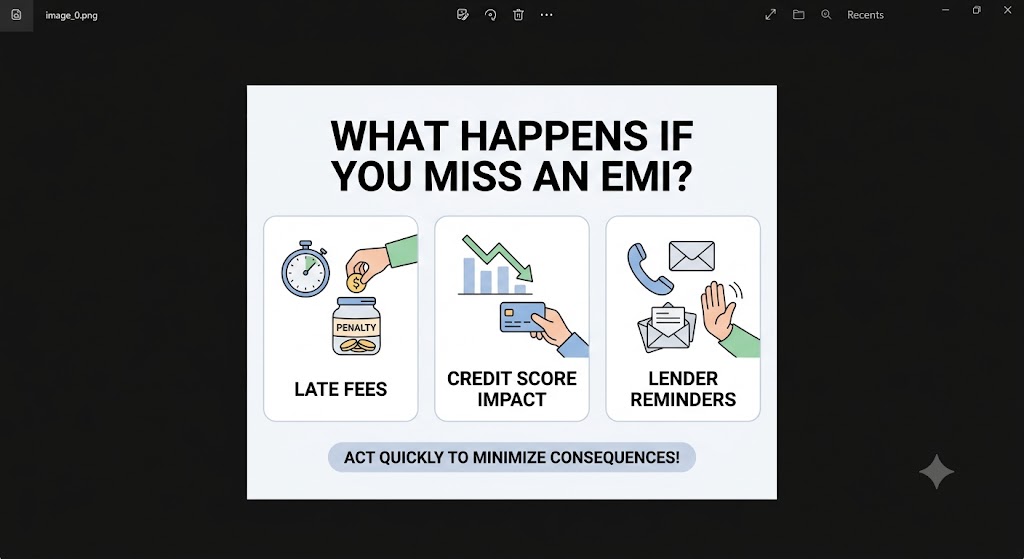
There are several possible consequences when you fail to pay an EMI on time.
1. Late Payment Charges
Your lender may charge a late payment fee or penal charge according to the loan agreement. If an automatic payment fails because of insufficient funds, your bank may also apply a transaction-return or bounce charge.
The exact amount depends on your lender's applicable terms and charges.
2. Your CIBIL Score May Be Affected
Your repayment history is an important part of your credit profile. If your lender reports the delayed payment to credit bureaus, it may negatively affect your CIBIL score.
A delay of one day does not automatically mean your score will fall immediately. The impact depends on the payment history, lender reporting, and other details of your credit profile. However, you should pay the overdue amount as soon as possible.
3. Additional Interest or Charges May Apply
The overdue EMI may continue to attract regular or overdue interest as specified in your loan agreement. Applicable penal charges may also be added.
The Reserve Bank of India (RBI) states that regulated lenders must levy penal charges for defaults in accordance with its rules, rather than treating such penalties as additional penal interest.
4. You May Receive Payment Reminders
Your bank or financial institution may contact you through SMS, email, phone calls, or other permitted communication methods to remind you about the overdue payment.
If you continue to miss payments, the lender may escalate its recovery process in accordance with applicable regulations and the loan agreement.
5. Future Loan Approval May Become Difficult
Repeated missed EMIs can weaken your credit profile. As a result, lenders may scrutinise future loan or credit card applications more carefully, reject an application, or offer less favourable terms.
6. Serious Consequences Can Follow Prolonged Non-Payment
If you continue to miss instalments, your loan account may be classified as overdue or, when applicable regulatory criteria are met, as a non-performing asset (NPA). For many term loans, the RBI's general NPA rule applies when principal or interest remains overdue for more than 90 days.
The consequences depend on the loan type, account status, and applicable rules. A single missed EMI does not automatically mean your property will be seized or legal action will begin.
What Happens After Missing an EMI? Timeline
|
Delay period |
What may happen |
|---|---|
|
Due date missed |
EMI becomes overdue; applicable charges may arise. |
|
First few days |
Lender may send reminders or attempt collection. |
|
Around 30 days |
The delay may be reflected in credit reporting, depending on reporting and account status. |
|
Around 60 days |
Continued non-payment may lead to further collection efforts and greater credit risk. |
|
More than 90 days |
Many term loans may qualify for NPA classification under applicable RBI rules. |
This is a general guide, not a guaranteed timeline. Contact your lender to confirm your account status and reporting details.
What Should You Do If You Miss an EMI?
Follow these practical steps to minimise the impact.
-
Check your bank account: Confirm whether the EMI was deducted or the auto-debit failed.
-
Contact your lender: Ask about the outstanding amount, applicable charges, and payment options.
-
Pay the overdue EMI promptly: Clear the missed instalment and any valid charges as soon as you can.
-
Check your loan statement: Verify that the payment has been credited correctly.
-
Monitor your credit report: Review your repayment status and dispute any inaccurate information.
-
Plan future payments: Set reminders or maintain sufficient funds before the next due date.
If you cannot afford your EMI, speak to your lender about available repayment options before the overdue amount accumulates.
How Can You Avoid Missing EMIs?
-
Set up payment reminders a few days before the due date.
-
Maintain enough money in your account for automatic debit.
-
Build an emergency fund for unexpected expenses.
-
Choose a loan EMI that fits your monthly budget.
-
Track all your loan due dates in one place.
-
Avoid taking additional loans that make repayments difficult.
Key Takeaways
-
Missing an EMI may result in late fees, bounce charges, or other applicable charges.
-
A delayed EMI can affect your CIBIL score if reported to credit bureaus.
-
Paying the overdue amount promptly can help limit further consequences, although it cannot guarantee that a reported delay will be removed.
-
Repeated defaults may make future borrowing more difficult.
-
Contact your lender early if you are struggling to make repayments.
Frequently Asked Questions (FAQs)
1. What happens if I miss one EMI?
You may face late payment charges, reminders, and a possible impact on your credit history. The consequences depend on how quickly you pay and your lender's policies.
2. Will missing one EMI reduce my CIBIL score?
It may, particularly if the delay is reported to a credit bureau. A score reduction is not automatic in every case.
3. Can I pay my missed EMI the next day?
Usually, you can pay an overdue EMI the next day, subject to your lender's payment process. Check whether any charges apply.
4. Will the bank charge a penalty for a missed EMI?
A lender may impose applicable charges according to your loan agreement and relevant RBI rules.
5. Does a missed EMI affect future loans?
Yes, a reported delay may influence future lenders' assessment of your creditworthiness.
6. What if my EMI auto-debit fails?
Check your bank balance and transaction status, then contact your lender to arrange payment and prevent repeated failed debits.
7. Can a missed EMI be removed from my CIBIL report?
Accurate repayment information generally cannot be removed simply because the overdue amount was later paid. You can dispute incorrect information with the lender and credit bureau.
8. What happens if I miss EMIs for three months?
Your account may face more serious collection and credit consequences. Depending on the loan and applicable rules, it may also qualify for NPA classification.
9. Can a bank take legal action for missed EMIs?
Continued non-payment may lead to recovery or legal proceedings, subject to the loan agreement and applicable law.
10. How can I improve my credit score after missing an EMI?
Pay overdue amounts, make future payments on time, reduce outstanding debt where possible, and monitor your credit report.
11. Should I take another loan to pay a missed EMI?
Be cautious. Another loan may increase your financial burden. Consider your repayment capacity and discuss alternatives with your existing lender first.
12. Can I request more time to pay an EMI?
You can contact your lender and explain your financial situation. Any extension, restructuring, or revised repayment arrangement is subject to the lender's approval.
Conclusion: Missing an EMI can create financial and credit-related problems, but ignoring it can make matters worse. Check your loan account, communicate with your lender, and clear overdue payments as soon as possible. Consistent repayment habits are essential for maintaining a healthy credit profile.
Published on : 21st October 2026
Published by :monisha
www.vizzve.com || www.vizzveservices.com
Follow us on social media: Facebook || Linkedin || Instagram
🛡 Powered by Vizzve Financial
RBI-Registered Loan Partner | 10 Lakh+ Customers | ₹600 Cr+ Disbursed