

Introduction
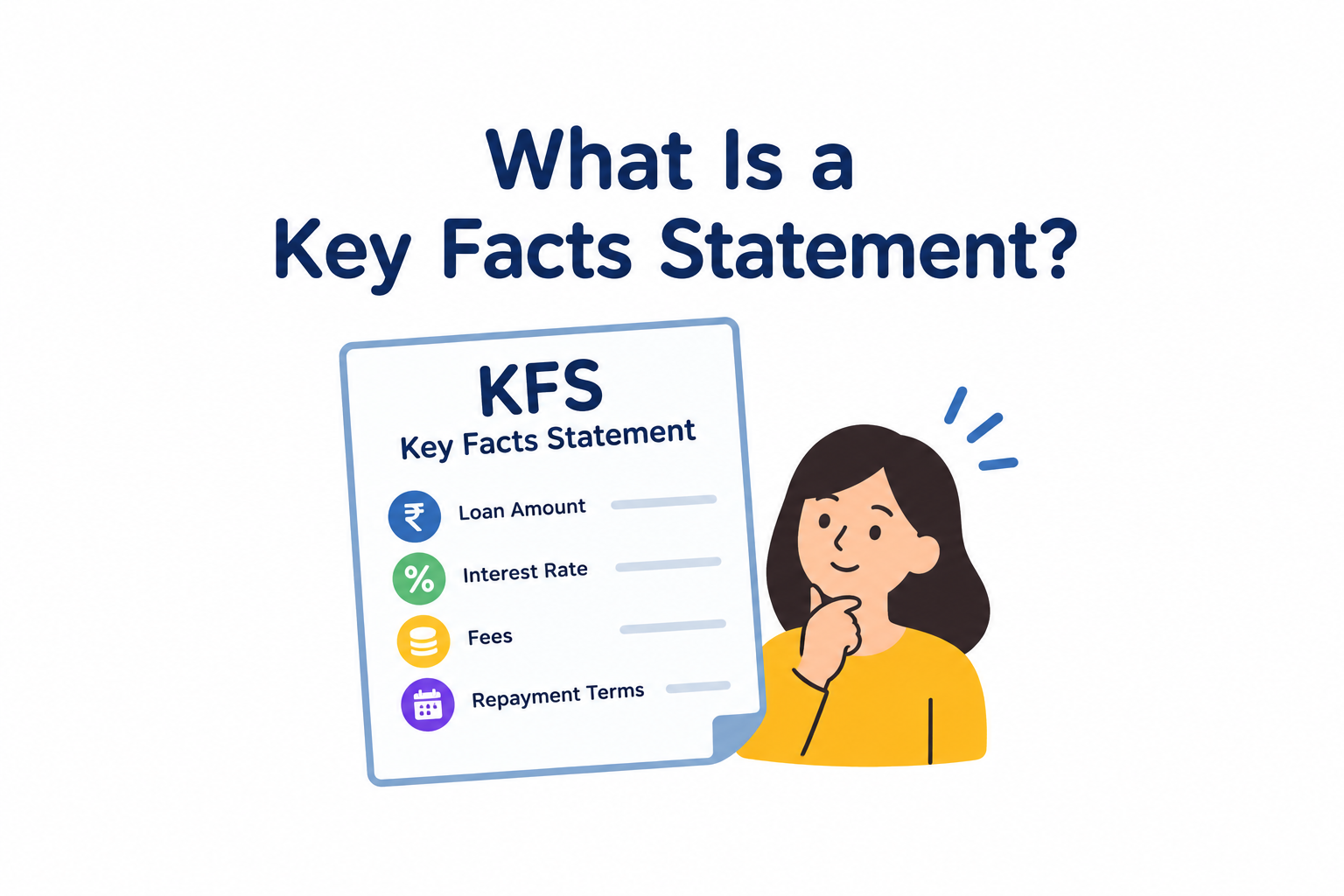
A Key Facts Statement (KFS) is an important document that explains the main details of a loan in simple language. It helps borrowers understand the loan amount, interest charges, fees, repayment schedule, and the total cost of borrowing before accepting a loan.
In India, the Reserve Bank of India (RBI) has introduced requirements for Key Facts Statements to improve transparency and help borrowers make informed financial decisions.
What Is a Key Facts Statement?
A Key Facts Statement (KFS) is a standardised document provided by a lender that summarises the essential terms and costs of a loan.
It allows borrowers to review important loan information without having to understand lengthy legal documents first.
For example, before accepting a personal loan, you can use the KFS to check the interest rate, Annual Percentage Rate (APR), processing fees, EMI details, and other applicable charges.
What Details Are Included in a KFS?
A Key Facts Statement may include the following information, depending on the loan and applicable RBI requirements:
-
Loan amount: The amount approved or disbursed.
-
Interest charges: The interest payable over the loan tenure.
-
Annual Percentage Rate (APR): The overall annualised cost of borrowing, including applicable charges.
-
Processing fees: Fees charged for processing the loan.
-
Repayment schedule: EMI amounts, payment dates, and repayment tenure.
-
Other charges: Applicable insurance costs and other disclosed fees.
-
Penal charges: Charges that may apply if the borrower violates specified loan terms or delays repayment.
-
Grievance redressal details: Information on how to raise a complaint, where applicable.
The exact disclosures depend on the applicable regulatory requirements and loan product.
Why Is a Key Facts Statement Important?
A KFS helps borrowers understand the financial commitment before taking a loan.
1. Improves Transparency
It clearly presents important loan terms and costs.
2. Helps Compare Loans
Borrowers can compare APR, processing fees, repayment periods, and other costs across different lenders.
3. Helps Avoid Hidden-Cost Surprises
It helps identify applicable charges before accepting the loan. Under RBI rules, lenders cannot charge fees or charges that are not disclosed in the KFS, subject to the applicable directions.
4. Supports Better Financial Planning
Knowing the EMI and total borrowing cost helps borrowers decide whether a loan fits their budget.
How Does a Key Facts Statement Work?
Step 1: Receive the KFS
The lender provides the applicable KFS before the borrower enters into the loan contract.
Step 2: Review the Details
Check the loan amount, APR, fees, EMI, tenure, and repayment conditions.
Step 3: Compare Loan Offers
Compare the complete cost and terms rather than choosing a loan based only on its advertised interest rate.
Step 4: Make an Informed Decision
Accept the loan only after understanding the costs and repayment obligations.
Key Facts Statement Example
Suppose a borrower receives the following illustrative loan offer:
|
Loan detail |
Example |
|---|---|
|
Loan amount |
₹50,000 |
|
Repayment period |
12 months |
|
Interest rate |
15% per year |
|
Processing fee |
₹500 |
|
EMI |
Depends on the applicable calculation and terms |
|
APR |
As disclosed by the lender in the KFS |
This is an illustrative example, not an actual loan offer. The APR may differ from the stated interest rate because it accounts for applicable charges.
KFS vs Loan Agreement
|
Feature |
Key Facts Statement |
Loan Agreement |
|---|---|---|
|
Main purpose |
Summarises essential loan details |
Sets out the contractual terms |
|
Format |
Standardised summary |
Detailed legal document |
|
Main focus |
Costs, APR, repayment and key terms |
Rights, obligations and conditions |
|
When to review |
Before accepting the loan |
Before signing or entering the contract |
Both documents are important. A KFS does not replace the need to read and understand the loan agreement
Key Facts Statement and RBI Rules in India
The RBI issued its harmonised KFS instructions for retail and MSME term loans on 15 April 2024. These instructions aim to improve transparency and help borrowers make informed decisions.
The KFS framework includes disclosure of important loan information, including APR and applicable charges. Digital lending is also covered by relevant RBI requirements. Borrowers should check the directions applicable to their specific loan product.
Benefits of a KFS for Borrowers
-
Better understanding of loan costs.
-
Easier comparison between lenders.
-
Greater clarity about repayment obligations.
-
Improved awareness of applicable fees and charges.
-
More informed borrowing decisions.
Key Takeaways
-
KFS stands for Key Facts Statement.
-
It summarises the important terms and costs of a loan.
-
APR, fees, and repayment details help borrowers assess affordability.
-
Review the KFS before accepting a loan.
-
Always read the full loan agreement as well.
Frequently Asked Questions (FAQs)
1. What is the full form of KFS?
KFS stands for Key Facts Statement.
2. What is a KFS in banking?
It is a standardised document explaining the essential terms and costs of a loan.
3. Is a KFS mandatory in India?
RBI requirements mandate KFS for covered loan products, including applicable retail and MSME term loans.
4. Who provides the KFS?
The regulated lender provides the KFS to the borrower.
5. When should I receive a KFS?
It should be provided before entering into the loan contract, as required by applicable RBI directions.
6. Does a KFS include processing fees?
Yes, applicable processing fees and other required charges are disclosed.
7. Does a KFS show the APR?
Yes, the APR is an important disclosure under the applicable KFS framework.
8. Can I compare two loans using their KFS documents?
Yes. Compare APR, fees, tenure, EMI, and other relevant terms.
9. Is a KFS the same as a loan agreement?
No. A KFS is a summary, while a loan agreement contains detailed contractual terms.
10. Can a lender charge fees not mentioned in the KFS?
Under applicable RBI requirements, fees and charges not disclosed in the KFS cannot be charged, subject to the relevant regulatory provisions.
11. Is KFS applicable to digital loans?
Yes, digital loans covered by RBI's digital lending requirements must follow the applicable KFS rules.
12. Why should borrowers read a KFS?
It helps borrowers understand the costs and conditions before committing to a loan.
Conclusion
A Key Facts Statement is an essential tool for transparent borrowing. It helps borrowers understand loan costs, compare offers, and make informed financial decisions. Before accepting a loan, review the KFS carefully and ensure that the repayment terms fit your budget.
Published on : 20th October 2026
Published by : monisha
www.vizzve.com || www.vizzveservices.com
Follow us on social media: Facebook || Linkedin || Instagram
🛡 Powered by Vizzve Financial
RBI-Registered Loan Partner | 10 Lakh+ Customers | ₹600 Cr+ Disbursed