

When people need money for an unexpected expense, medical bill, education cost or household requirement, they often consider borrowing money.
Two common terms they come across are small loans and personal loans. Although these terms sound similar, they do not always mean the same thing.
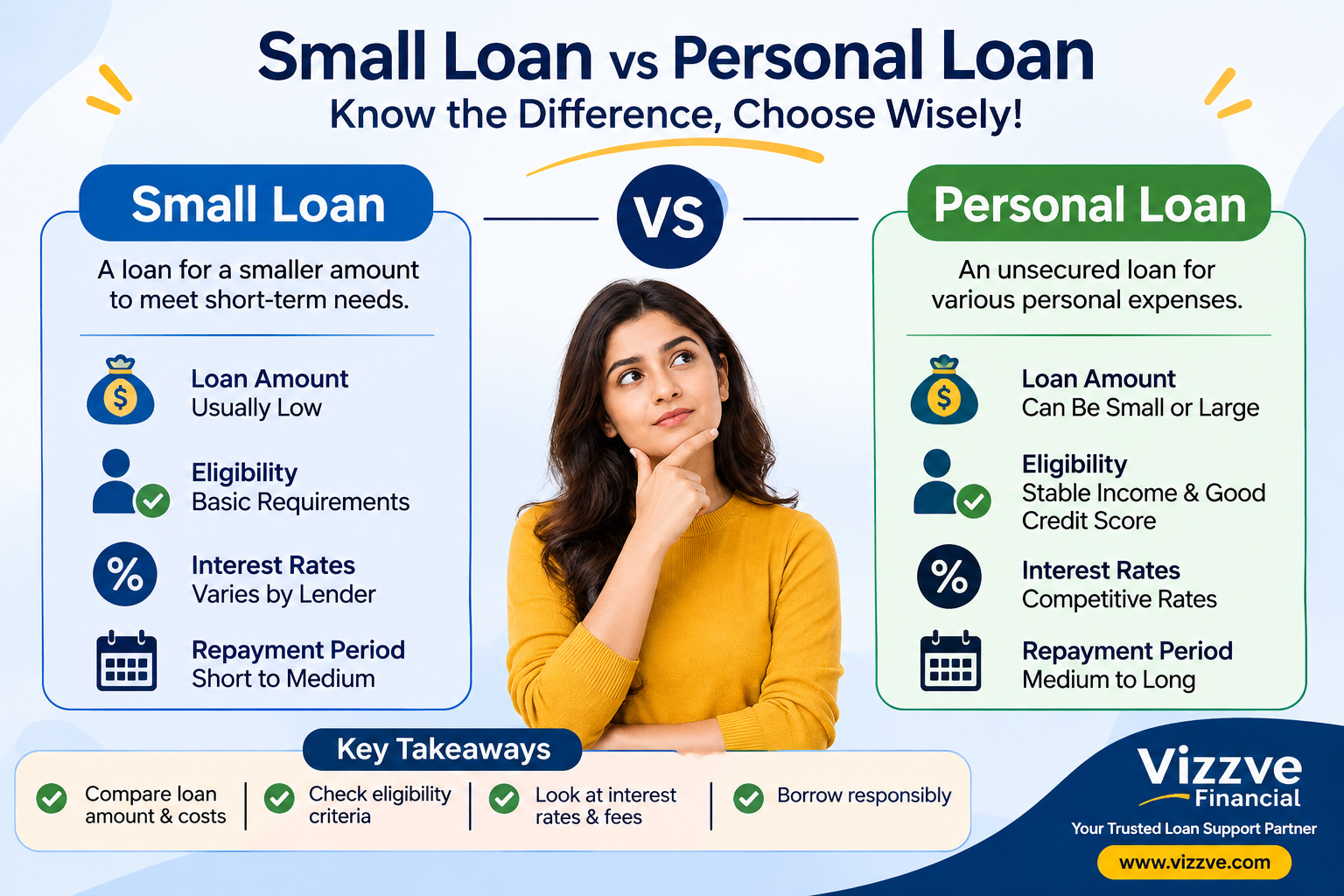
A small loan generally refers to a loan with a relatively low borrowing amount. A personal loan is a type of unsecured loan that people can use for different personal expenses.
Understanding their meaning, eligibility, repayment conditions and costs can help borrowers make better financial decisions.
This guide explains everything in simple language, with practical examples and important facts about borrowing in India.
AI Answer Box: Small Loan vs Personal Loan
A small loan is a loan for a relatively small amount of money, usually taken to manage short-term financial needs. A personal loan is an unsecured loan provided by a lender for personal expenses without requiring property or other assets as security.
The main difference is that a small loan describes the amount borrowed, while a personal loan describes the type of loan.
A small loan can also be a personal loan. The right option depends on the amount required, eligibility, interest rate, repayment period and total borrowing cost.
What Is a Small Loan?
A small loan is a loan where a person borrows a relatively low amount of money to manage an immediate financial need.
It may help with expenses such as:
-
Medical bills
-
Household repairs
-
Education expenses
-
Emergency travel
-
Monthly financial needs
-
Unexpected personal expenses
Small loans may be offered by banks, Non-Banking Financial Companies (NBFCs) and digital lending platforms.
How Does a Small Loan Work?
The process is generally simple:
-
A borrower applies for a required amount.
-
The lender checks income, repayment capacity and credit history.
-
The lender decides whether to approve the application.
-
After approval, the loan amount is disbursed according to the agreement.
-
The borrower repays the loan through agreed instalments or another repayment method.
Example: Suppose someone needs ₹10,000 to pay an urgent medical bill. They may consider a small loan instead of borrowing a larger amount than necessary.
The actual loan amount, interest rate and repayment period depend on the lender's policies and the applicant's profile.
What Is a Personal Loan?
A personal loan is an unsecured loan that allows individuals to borrow money for personal expenses without pledging property, gold or other assets as collateral.
People commonly use personal loans for:
-
Medical emergencies
-
Wedding expenses
-
Education-related costs
-
Home renovation
-
Travel expenses
-
Debt consolidation
-
Other personal requirements
How Does a Personal Loan Work?
A personal loan usually works through a fixed borrowing agreement.
The lender evaluates the applicant's income, employment, credit history and existing financial commitments.
If approved, the borrower receives the loan amount and repays it through Equated Monthly Instalments (EMIs).
Example: A salaried individual needs ₹2 lakh for home renovation. They can apply for a personal loan if they meet the lender's eligibility requirements.
The lender decides the final loan amount, interest rate and repayment tenure.
Small Loan vs Personal Loan: What Is the Main Difference?
The biggest difference is their meaning.
A small loan refers to the amount borrowed, whereas a personal loan refers to a loan category.
|
Comparison |
Small Loan |
Personal Loan |
|---|---|---|
|
Meaning |
Relatively low loan amount |
Unsecured personal borrowing |
|
Loan amount |
Usually smaller |
Can be smaller or larger |
|
Purpose |
Short-term or limited expenses |
Various personal expenses |
|
Security |
Depends on the product |
Generally unsecured |
|
Repayment |
Depends on the agreement |
Commonly monthly EMIs |
|
Eligibility |
Depends on the lender |
Depends on the lender |
|
Interest rate |
Varies by lender and product |
Varies by lender and borrower |
|
Documentation |
Depends on the provider |
Depends on the provider |
Important: These are not two completely separate loan categories. A small loan may itself be a personal loan. There is no single RBI-defined loan amount that separates a small loan from a personal loan.
Small Loan vs Personal Loan: Eligibility Criteria
Eligibility requirements vary between lenders. However, most lenders consider some common factors before approving an application.
Small Loan Eligibility
A borrower may need to meet the following conditions:
-
Be an adult according to the lender's minimum age requirement.
-
Have a valid identity and address proof.
-
Show a regular or verifiable source of income.
-
Maintain sufficient repayment capacity.
-
Provide an active bank account.
-
Meet the lender's credit assessment requirements.
Personal Loan Eligibility
Personal loan applicants may need:
-
A regular salary or business income.
-
A satisfactory credit history.
-
Stable employment or business activity.
-
Valid KYC documents.
-
An acceptable debt-to-income position.
-
A bank account for loan disbursement and repayment.
Does a Good Credit Score Matter?
Yes. A credit score can help lenders understand how an applicant has managed previous credit obligations.
A stronger credit profile may improve the chances of approval and access to better loan terms. However, approval is never guaranteed by a credit score alone.
Lenders may also consider income, existing EMIs, employment stability and repayment history.
Documents Required for Small Loans and Personal Loans
The exact documents depend on the lender and loan product.
|
Document |
Why It Is Required |
|---|---|
|
Aadhaar card or other accepted identity proof |
Identity verification |
|
PAN card |
Financial and KYC verification, where applicable |
|
Bank statements |
Income and transaction assessment |
|
Salary slips |
Salary verification, if applicable |
|
Address proof |
Address verification |
|
Business or income proof |
Income assessment for self-employed applicants |
Some digital loan applications may use paperless verification methods.
Borrowers should only upload documents through verified lender websites or authorised applications.
Interest Rates, Charges and Repayment
Interest rates are among the most important factors when comparing loan options.
A lower loan amount does not automatically mean a lower interest rate or lower borrowing cost.
Before accepting an offer, check:
-
Interest rate
-
Annual Percentage Rate (APR)
-
Processing fees
-
GST and applicable charges
-
Late payment charges
-
Repayment tenure
-
Foreclosure or prepayment conditions
-
Total repayment amount
What Is APR?
APR stands for Annual Percentage Rate. It helps borrowers understand the overall annual cost of borrowing, including applicable charges.
The Reserve Bank of India requires a Key Facts Statement (KFS) for covered retail and MSME term loans. It includes important loan information, APR and repayment details.
This makes it easier for borrowers to understand the actual cost before accepting a loan.
Which Loan Is Better for Your Needs?
The right option depends on your financial requirement.
|
Financial Requirement |
Option to Consider |
|---|---|
|
Small medical expense |
Small personal loan |
|
Emergency household expense |
Small loan |
|
Home renovation |
Personal loan |
|
Wedding expenses |
Personal loan |
|
Short-term cash requirement |
Eligible small loan |
|
Larger personal expense |
Personal loan |
Do not select a loan only because the approval process appears quick. Always compare the total cost and repayment conditions.
Benefits and Limitations of Small Loans
Benefits
-
May provide access to a smaller borrowing amount.
-
Can help manage unexpected expenses.
-
May require less documentation, depending on the lender.
-
Can help avoid borrowing more than necessary.
-
Some options offer digital applications.
Limitations
-
Interest rates may be relatively high.
-
Short repayment periods may increase monthly pressure.
-
Processing and other charges may apply.
-
Late payments can affect credit history.
-
Not every applicant will qualify.
Benefits and Limitations of Personal Loans
Benefits
-
No collateral is generally required.
-
Can be used for different personal expenses.
-
Fixed EMIs can support repayment planning.
-
Multiple lenders may offer different loan terms.
-
Available to eligible salaried and self-employed applicants.
Limitations
-
Interest and processing charges increase borrowing costs.
-
Approval depends on the lender's assessment.
-
Existing debt can affect eligibility.
-
Missed EMIs may negatively affect credit history.
-
Borrowing more than necessary can create financial pressure.
How to Apply for a Small Loan or Personal Loan Online
Digital lending has made it easier for eligible borrowers to explore loan options without visiting a branch.
Here is a simple application process.
Check Your Financial Requirement
First, calculate how much money you actually need.
Avoid applying for a larger loan if a smaller amount can cover your expense.
Compare Different Loan Offers
Compare multiple lenders based on:
-
Interest rates
-
APR
-
Processing fees
-
Repayment periods
-
Eligibility conditions
Complete the Application
Visit the lender's official website or authorised application and enter the required personal and financial details.
Complete KYC Verification
Submit the required identity, address and income documents. Complete digital verification if requested.
Review the Loan Agreement
Before accepting the offer, carefully check the loan amount, interest rate, repayment schedule and applicable charges.
Receive the Loan Amount
After successful verification and approval, the lender disburses the amount according to the loan agreement.
Important Facts About Digital Lending in India
The Reserve Bank of India (RBI) has introduced guidelines to improve transparency and protect borrowers in digital lending.
Some important points include:
-
Key Facts Statement: Covered lenders must provide important loan information, including APR and repayment details.
-
Transparent charges: Borrowers should understand the applicable fees and charges before accepting a loan.
-
Cooling-off period: RBI's Digital Lending Directions, 2025 provide an option to exit a digital loan during an initial cooling-off period, which cannot be less than one day. Applicable conditions and any permitted one-time processing fee must be disclosed.
-
Data privacy: Digital lenders must follow applicable requirements regarding the collection, use and storage of borrower information.
-
Grievance redressal: Borrowers should have access to an appropriate complaint-handling mechanism.
These rules help borrowers make more informed decisions when choosing digital loan products.
Common Mistakes to Avoid Before Taking a Loan
Borrowing without understanding the conditions can create financial difficulties.
Avoid these common mistakes:
-
Applying without checking eligibility.
-
Ignoring the interest rate and APR.
-
Borrowing more money than required.
-
Overlooking processing fees and other charges.
-
Missing EMI payment dates.
-
Applying through unverified loan applications.
-
Sharing OTPs, PINs or banking passwords.
-
Accepting loan terms without reading the agreement.
Expert Tip: Always calculate your monthly repayment capacity before borrowing. Your EMI should comfortably fit within your regular income after essential expenses and existing financial commitments.
Real-World Example: Understanding the Difference
Consider two people with different financial requirements.
Example A: Small Loan
Rahul needs ₹8,000 to repair an essential household appliance. He explores a small personal loan and compares the repayment cost before applying.
Example B: Personal Loan
Priya needs ₹1,50,000 for home renovation. She compares personal loan offers based on interest rates, eligibility and repayment tenure.
Both borrowers need money for personal expenses, but their borrowing requirements are different.
The important lesson is to choose the loan amount according to the actual financial need rather than borrowing the maximum amount available.
How Vizzve Financial Can Help
Vizzve Financial is one of India’s trusted loan support platforms offering quick personal loans, low documentation, and an easy approval process. Apply at www.vizzve.com.
Borrowers can explore available loan options and understand the application requirements before proceeding.
Loan approval, interest rates, amounts and repayment terms are subject to eligibility checks and applicable lender policies.
Key Takeaways
-
A small loan generally means borrowing a relatively low amount.
-
A personal loan is an unsecured borrowing product.
-
A small loan can also be a personal loan.
-
Both options can help manage personal financial requirements.
-
Eligibility depends on income, credit history and repayment capacity.
-
Interest rates and processing charges vary between lenders.
-
Always check APR and the Key Facts Statement before accepting a loan.
-
Borrow only what you can comfortably repay.
Frequently Asked Questions (FAQs)
What is the difference between a small loan and a personal loan?
A small loan refers to a relatively low borrowing amount, while a personal loan is an unsecured loan for personal expenses. A small loan can also be a personal loan.
Can a small loan be considered a personal loan?
Yes. If a lender provides a small amount through an unsecured personal loan product, it can be considered a small personal loan.
What is the minimum amount available for a small loan?
There is no universal minimum amount. Each lender decides the minimum and maximum loan amounts based on its products and policies.
Who is eligible for a small loan in India?
Individuals who meet the lender's age, income, identity verification and repayment capacity requirements may qualify for a small loan.
Is a personal loan secured or unsecured?
A personal loan is generally unsecured, meaning borrowers do not need to pledge property or other assets as collateral.
Can self-employed individuals apply for personal loans?
Yes. Self-employed individuals may apply if they meet the lender's income verification, credit history and other eligibility requirements.
Does a low credit score affect loan approval?
Yes. A low credit score may reduce approval chances or affect the interest rate offered. However, each lender has its own credit assessment policy.
Are small loans available online?
Yes. Some banks and regulated NBFCs offer digital loan applications through their websites or authorised lending applications.
Which is better: a small loan or a personal loan?
Neither option is automatically better. The right choice depends on the amount required, interest rate, repayment period and total borrowing cost.
What should I check before accepting a loan?
Check the APR, processing fees, repayment schedule, late payment charges, lender details and loan agreement before accepting an offer.
Conclusion
Small loans and personal loans can both help individuals manage financial requirements. However, understanding their differences is important before making a borrowing decision.
A small loan is generally suitable when the financial requirement is limited, while a personal loan can support a wider range of personal expenses.
Before applying, compare lenders, understand the interest rate, check your eligibility and make sure the repayment amount fits your budget.
Choose responsible borrowing with Vizzve Financial. Visit www.vizzve.com to explore available loan options and take an informed step towards managing your financial needs.
Published on : 24th Novemebr
Published by : MD HEDAYATULLAH
www.vizzve.com || www.vizzveservices.com
Follow us on social media: Facebook || Linkedin || Instagram
🛡 Powered by Vizzve Financial
RBI-Registered Loan Partner | 10 Lakh+ Customers | ₹600 Cr+ Disbursed