

Introduction
Many people maintain money in their savings accounts to handle monthly expenses, online payments, emergencies and other financial needs. Keeping money accessible is important, but a large balance may earn less interest than a fixed deposit.
At the same time, placing all your savings in a regular FD can make it inconvenient to access money whenever you need it.
This is where a sweep-in fixed deposit becomes useful.
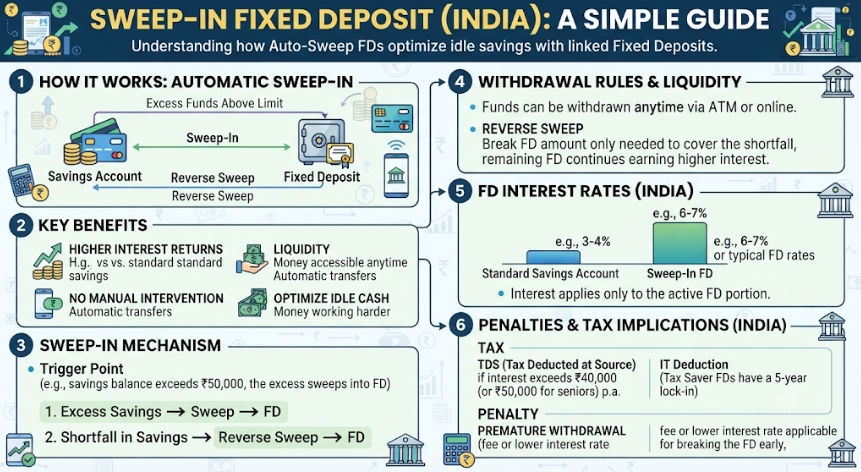
A sweep-in FD is a banking facility that connects a savings or current account with a fixed deposit. When your account balance is insufficient to meet a payment, the bank can automatically transfer money from the linked FD into your account, subject to the facility's rules.
The reverse process can also happen. When your account balance exceeds a predefined limit, the surplus amount may automatically move into a fixed deposit. Banks commonly refer to this as an auto-sweep or sweep-out facility.
This arrangement aims to combine the convenience of a savings account with the potentially higher interest offered by fixed deposits.
In this guide, we explain how sweep-in FDs work, their benefits, withdrawal conditions, tax treatment, limitations and the important points to check before activating the facility.
AI Answer Box: What Is a Sweep-In Fixed Deposit?
A sweep-in fixed deposit is a banking facility that links a savings or current account with one or more fixed deposits.
When the account balance falls below a specified level, the bank automatically transfers the required amount from the linked FD to the savings or current account. This helps customers access money without manually closing the entire FD.
In an auto-sweep arrangement, surplus money above a predefined threshold may also be transferred automatically from the savings account into an FD to earn interest at the applicable deposit rate.
Main benefits:
-
Automatic access to linked FD funds.
-
Potentially higher interest on surplus money.
-
Less need to manually break an FD.
-
Convenient management of savings.
-
Better use of idle account balances.
The exact threshold, deposit tenure, withdrawal amount, interest calculation and premature closure penalty depend on the bank.
1. What Is a Sweep-In Fixed Deposit?
A sweep-in fixed deposit is a deposit arrangement linked to a savings or current account.
It allows the bank to transfer funds automatically from the linked FD when the account does not have enough money to meet a payment or maintain a specified balance.
For example, imagine you have ₹80,000 in your savings account and a linked FD of ₹50,000.
You make a payment of ₹30,000. If the transaction causes your savings account balance to fall below the bank's specified threshold, the bank may automatically transfer the required amount from the FD, depending on the facility's rules.
This means you do not always need to visit a branch or manually close your entire fixed deposit to access your money.
What is the main purpose of a sweep-in FD?
The main purpose is to balance two financial needs:
-
Liquidity: Keeping money available for everyday transactions.
-
Interest earnings: Allowing surplus funds to earn interest under FD terms.
It is particularly useful for customers who regularly maintain a higher savings account balance but do not want all their money to remain in a regular savings account.
2. How Does a Sweep-In and Sweep-Out Facility Work?
A sweep facility generally involves two automatic processes.
2.1 Sweep-out: Moving surplus money into an FD
Sweep-out happens when the savings account balance exceeds a predefined threshold.
The bank transfers the eligible surplus amount into a linked or newly created fixed deposit.
For example:
-
Savings account threshold: ₹50,000.
-
Available savings balance: ₹80,000.
-
Surplus amount: ₹30,000.
The bank may transfer ₹30,000 into an FD, depending on the deposit multiples and other product conditions.
2.2 Sweep-in: Moving FD money back into savings
Sweep-in or reverse sweep happens when the savings account balance falls below the required amount.
The bank automatically transfers funds from the linked FD to the savings account to cover the shortfall.
For example:
-
Required savings balance: ₹50,000.
-
Current savings balance: ₹35,000.
-
Shortfall: ₹15,000.
The bank may transfer ₹15,000 from the linked FD, subject to its minimum withdrawal unit and other rules.
Important terminology note: Some banks use the words sweep-in, reverse sweep and sweep-out differently. Always check how your own bank defines these terms.
3. Practical Example: How a Sweep-In FD Works
Consider a customer who maintains ₹1,00,000 in a savings account.
The bank provides an auto-sweep facility with a threshold of ₹40,000.
| Particulars | Amount |
|---|---|
| Initial savings balance | ₹1,00,000 |
| Savings account threshold | ₹40,000 |
| Eligible surplus amount | ₹60,000 |
| Amount moved into FD | ₹60,000 |
| Remaining savings balance | ₹40,000 |
The surplus ₹60,000 is transferred into an FD according to the bank's rules.
Now suppose the customer needs to pay ₹25,000.
| Particulars | Amount |
|---|---|
| Savings balance before payment | ₹40,000 |
| Payment amount | ₹25,000 |
| Balance after payment | ₹15,000 |
| Required threshold | ₹40,000 |
| Shortfall | ₹25,000 |
The bank may automatically move ₹25,000 from the linked FD into the savings account to cover the shortfall.
The customer can then use the account normally.
These figures are illustrative. Actual sweep amounts depend on the bank's threshold, withdrawal multiples, deposit balance and product conditions.
4. What Are the Main Features of a Sweep-In Fixed Deposit?
A sweep-in FD offers several features that combine savings account convenience with fixed deposit functionality.
1. Automatic fund transfer
The bank handles eligible transfers automatically after the facility is activated.
2. Linked fixed deposits
The savings or current account may be connected to one or more eligible FDs.
3. Access to funds
When a shortfall occurs, the bank can transfer money from the linked FD without requiring a separate manual closure request.
4. Interest on surplus money
Eligible amounts transferred into an FD may earn the applicable FD interest rate rather than remaining entirely in the savings account.
5. Flexible deposit management
Depending on the bank, customers may be able to choose a threshold, deposit tenure or other settings.
6. Automatic renewal
Some banks offer auto-renewal for sweep deposits. The renewal terms and applicable interest rate should be checked separately.
5. What Are the Benefits of a Sweep-In Fixed Deposit?
A sweep-in FD can be useful for customers who want convenient access to money while making better use of surplus savings.
5.1 Potential to earn higher interest
Savings account interest rates and FD interest rates may differ.
When surplus funds are moved into an FD, the eligible deposit may earn the interest rate applicable to that FD product.
This can help customers earn more interest than keeping the entire balance in a regular savings account.
However, the actual benefit depends on the FD tenure, interest rate, amount and how long the deposit remains untouched.
5.2 Easy access to money
One major advantage is that you do not always need to manually break the entire FD when your savings balance falls.
The bank may automatically transfer the required amount from the linked deposit.
5.3 Better use of idle funds
Money that is not immediately needed for monthly expenses may earn FD interest under the facility's conditions.
5.4 Convenient online banking
Many banks allow customers to view linked deposits and manage eligible sweep facilities through digital banking channels.
5.5 Helps manage unexpected payments
A linked FD may help cover eligible shortfalls caused by bill payments, cheque payments or other transactions.
The availability and timing of the transfer depend on the bank's system and product rules.
6. Sweep-In FD vs Regular Fixed Deposit vs Savings Account
These three banking options serve different purposes.
| Feature | Savings Account | Regular FD | Sweep-In FD |
|---|---|---|---|
| Main purpose | Everyday banking | Planned savings | Savings plus FD access |
| Interest rate | Savings account rate | Applicable FD rate | Applicable linked FD and savings rates |
| Access to money | Generally immediate | Depends on premature withdrawal rules | Automatic transfer subject to facility rules |
| Automatic FD creation | Usually no | No | May be available through auto-sweep |
| Withdrawal flexibility | High | May involve premature closure | Depends on linked FD conditions |
| Suitable for | Daily expenses | Money not needed immediately | Surplus money with liquidity needs |
Which option should you choose?
-
Choose a savings account for money needed for everyday transactions.
-
Choose a regular FD for money you can keep deposited for a planned period.
-
Consider a sweep-in FD if you want to maintain a minimum savings balance while allowing surplus money to earn FD interest.
7. Sweep-In FD vs Regular FD: Key Differences
A regular FD is opened for a specific amount and tenure. A sweep-in FD is connected to a savings or current account and may be partially broken automatically when money is required.
| Comparison | Regular FD | Sweep-In FD |
|---|---|---|
| Account connection | Usually separate | Linked to savings/current account |
| Deposit creation | Usually manual | May happen automatically |
| Withdrawal | Manual closure or eligible withdrawal | Automatic reverse sweep, where supported |
| Interest | Based on FD terms | Based on linked FD terms |
| Liquidity | Depends on withdrawal facility | Designed to provide easier access |
| Deposit structure | One deposit or multiple deposits | May involve multiple linked deposit units |
| Penalty | Depends on FD terms | Depends on the bank's sweep and FD terms |
A sweep-in FD is not necessarily penalty-free. Some banks may apply premature withdrawal conditions when an FD portion is used.
8. How Is Interest Calculated on a Sweep-In FD?
Interest calculation depends on the bank's product structure.
The amount transferred into an FD may earn interest according to the applicable FD rate and tenure. If a portion is withdrawn early, the bank may calculate interest based on the actual period for which that portion remained deposited.
Factors that affect sweep-in FD interest
-
Deposit amount.
-
Applicable FD interest rate.
-
Period for which each deposit portion remains active.
-
Compounding frequency.
-
Premature withdrawal rules.
-
Interest payout method.
-
Applicable tax and TDS rules.
Illustrative interest example
Suppose ₹50,000 is transferred into a sweep FD at an illustrative annual interest rate of 6.5%.
| Particulars | Amount |
|---|---|
| FD principal | ₹50,000 |
| Illustrative annual rate | 6.5% |
| Holding period | 1 year |
| Approximate simple interest | ₹3,250 |
| Approximate total | ₹53,250 |
This example assumes simple interest for illustration. Actual FD returns may differ because of compounding, tenure, withdrawal timing and the bank's interest calculation method.
What happens if you withdraw the FD amount early?
If the bank breaks a portion of the FD before maturity, the interest may be recalculated according to the actual holding period and the bank's premature withdrawal policy.
Therefore, do not assume the original maturity interest will be paid on every amount withdrawn through a sweep facility.
9. What Are the Charges and Penalties on Sweep-In FDs?
One of the most important things to check before activating a sweep facility is its withdrawal policy.
Some banks may offer favourable premature withdrawal conditions, while others may apply the regular FD penalty rules.
Charges and conditions to check
| Item | What to verify |
|---|---|
| Premature withdrawal penalty | Whether early withdrawal attracts a penalty |
| Interest recalculation | How interest is calculated for the actual holding period |
| Minimum FD amount | Minimum amount required to create a linked FD |
| Sweep-out threshold | Minimum savings balance before surplus is transferred |
| Withdrawal unit | Whether withdrawals happen in ₹1, ₹1,000, ₹5,000 or other multiples |
| Auto-renewal | Whether deposits renew automatically |
| Service charges | Whether any account-related charges apply |
| Minimum balance | Whether the savings account has a minimum balance requirement |
Does every sweep-in FD have zero penalty?
No. There is no universal rule that all sweep-in FDs are free from premature withdrawal penalties.
The conditions depend on the bank and the specific FD product.
For example, banks may differ in how they break deposits, how they calculate interest and whether a penalty applies to the amount withdrawn.
Practical advice: Before enabling the facility, request the bank's latest sweep-in FD terms and ask whether a partial withdrawal will attract a penalty.
10. What Is LIFO and FIFO in Sweep-In Fixed Deposits?
When multiple FDs are linked to a savings account, the bank needs a method to decide which deposit to use when funds are required.
Two common methods are LIFO and FIFO.
LIFO – Last In, First Out
Under LIFO, the most recently created or linked deposit is generally used first.
For example:
-
FD 1: Created on January 1.
-
FD 2: Created on February 1.
-
FD 3: Created on March 1.
If the bank follows LIFO, it may use FD 3 first.
FIFO – First In, First Out
Under FIFO, the oldest eligible deposit is generally used first.
Using the same example, FD 1 may be used before FD 2 and FD 3.
LIFO vs FIFO comparison
| Feature | LIFO | FIFO |
|---|---|---|
| Full form | Last In, First Out | First In, First Out |
| Deposit selected first | Most recent | Oldest |
| Possible advantage | May preserve older deposits | May use older deposits first |
| Main consideration | Withdrawal order may affect interest | Withdrawal order may affect interest |
The method is bank-specific. Some banks may use different rules or withdrawal sequences, so check the actual product terms.
11. Is a Sweep-In Fixed Deposit Safe?
A sweep-in FD is a banking arrangement rather than a separate investment guarantee.
The safety of the money depends on the institution accepting the deposit and the applicable deposit protection rules.
DICGC deposit insurance
Eligible deposits held with DICGC-insured banks are covered up to ₹5 lakh per depositor per insured bank, including principal and interest, in the same right and same capacity.
This limit is not available separately for every savings account or FD.
For example, eligible savings account balances and FD balances held by the same depositor in the same capacity at the same insured bank are aggregated for insurance purposes.
Important safety checks
Before activating a sweep facility:
-
Confirm that the bank is insured by DICGC.
-
Check how linked deposits are recorded.
-
Understand the FD terms and withdrawal rules.
-
Verify the interest rate.
-
Review the bank's official product information.
-
Keep your banking credentials private.
A sweep-in facility does not increase the DICGC insurance limit.
12. Is Interest Earned on a Sweep-In FD Taxable?
Generally, interest earned on fixed deposits is taxable under applicable Indian income-tax rules.
A sweep-in FD does not automatically receive a separate tax exemption simply because the deposit is linked to a savings account.
Important tax points
-
FD interest is generally taxable as income under the applicable provisions.
-
TDS may apply when the relevant statutory conditions and thresholds are met.
-
The applicable tax treatment depends on the depositor's circumstances and the financial year.
-
Interest credited or paid should be checked against the bank's interest certificate.
-
TDS is not necessarily the final tax liability.
What should you do?
Keep your FD interest statements and bank records.
Check the applicable income-tax rules for the financial year and include taxable interest in your income-tax return as required.
13. How to Activate a Sweep-In Fixed Deposit
The activation process varies by bank. Some banks allow customers to activate the facility through online banking, while others may require a branch request or a specific savings account type.
Follow these general steps.
Step 1: Check whether your bank offers the facility
Visit the bank's official website or contact verified customer support.
Ask whether your savings or current account is eligible for an auto-sweep or sweep-in facility.
Step 2: Understand the conditions
Check:
-
Minimum balance requirement.
-
Sweep-out threshold.
-
FD creation amount.
-
Deposit tenure.
-
Interest rate.
-
Withdrawal method.
-
Penalty conditions.
-
Auto-renewal instructions.
Step 3: Submit the activation request
Depending on the bank, you may be able to activate the facility through:
-
Mobile banking.
-
Internet banking.
-
A branch request.
-
A customer service request.
Step 4: Select the threshold
If the bank permits customer-selected thresholds, choose the amount you want to keep available in your savings account.
For example, you may choose to maintain ₹30,000 for regular payments.
Step 5: Link the eligible FD or enable auto-sweep
Follow the bank's instructions to link an existing FD or allow automatic FD creation.
Step 6: Confirm activation
Check whether the facility is active and review the linked FD details.
Do not assume the facility is enabled merely because you submitted a request.
Step 7: Monitor transactions
Review your savings account statement and FD details periodically to understand how funds are moving.
14. Which Banks Offer Sweep-In or Auto-Sweep Facilities?
Several banks in India provide sweep-in, sweep-out or auto-sweep arrangements. Product names and conditions differ.
Examples include:
| Bank | Facility or product reference | What to check |
|---|---|---|
| ICICI Bank | Sweep-in FD | Reverse-sweep rules, withdrawal multiples and threshold |
| HDFC Bank | Sweep-in / sweep-out facility | Deposit creation and linked FD conditions |
| State Bank of India | MODS / auto-sweep-related deposit facilities | Minimum balance and withdrawal rules |
| Bank of Baroda | Flexi Fixed Deposit | Sweep thresholds, deposit multiples and LIFO conditions |
| IDFC FIRST Bank | Auto-Sweep Savings Account | Threshold, tenure and withdrawal rules |
| AU Small Finance Bank | Sweep-in facility | Linked FD conditions and shortfall funding |
Important: This is an illustrative list, not a ranking or recommendation. Availability may depend on the account type, customer category and latest bank policy. Always verify current product terms through the bank's official website or branch.
15. Advantages and Disadvantages of a Sweep-In FD
Advantages
-
Helps use surplus savings more efficiently.
-
Offers automatic movement of funds.
-
May earn FD interest on eligible surplus amounts.
-
Provides easier access to money than a conventional locked deposit.
-
Can reduce the need to manually close an entire FD.
-
May support everyday transactions when a shortfall occurs.
Disadvantages
-
Premature withdrawal penalties may apply.
-
Interest may be recalculated when FD portions are withdrawn.
-
Threshold and withdrawal rules can be complicated.
-
Some banks impose minimum balance conditions.
-
FD creation and withdrawal multiples may limit flexibility.
-
Tax may apply to interest earned.
-
Automatic transfers may be difficult to track without regular statement checks.
16. Who Should Consider a Sweep-In Fixed Deposit?
A sweep-in FD may suit customers who maintain a relatively high savings account balance and want access to surplus funds.
It may be useful for:
Salaried employees: People who receive monthly salaries and maintain a balance for regular expenses.
Business owners: Customers who keep extra money in current or savings accounts for payments.
Retired individuals: People who want accessible funds while earning interest on surplus savings.
Families: Households that maintain money for bills, education costs and unexpected expenses.
Regular digital banking users: People who make frequent online payments and want a linked deposit facility.
Who may not need it?
A sweep-in FD may be less useful if:
-
Your savings account balance is usually low.
-
You need almost all your money immediately.
-
The bank's penalty conditions are unfavourable.
-
You do not meet the minimum balance requirement.
-
You prefer managing every FD separately.
17. Common Mistakes to Avoid Before Activating a Sweep-In FD
Avoid these mistakes when choosing the facility:
-
Assuming every bank offers the same sweep threshold.
-
Ignoring premature withdrawal penalties.
-
Not checking the FD tenure.
-
Assuming every withdrawal happens in the exact shortfall amount.
-
Forgetting that banks may use LIFO or FIFO rules.
-
Ignoring savings account minimum balance requirements.
-
Assuming sweep-in FD interest is tax-free.
-
Not checking whether senior citizen FD rates apply.
-
Failing to review automatic renewal instructions.
-
Not checking how deposits are covered by DICGC insurance.
Expert tip: Compare the actual interest you may earn after considering withdrawals, premature closure rules and taxes. A higher advertised FD rate does not automatically mean a higher overall return.
18. Sweep-In FD vs Keeping Extra Money in a Savings Account: Example
Suppose you regularly maintain ₹1,00,000 in your savings account but need only ₹40,000 for monthly transactions.
You are considering an auto-sweep facility.
| Particulars | Savings account only | Sweep-in arrangement |
|---|---|---|
| Total available funds | ₹1,00,000 | ₹1,00,000 |
| Money retained in savings | ₹1,00,000 | ₹40,000 |
| Eligible amount transferred to FD | ₹0 | ₹60,000 |
| Interest on savings portion | Savings rate | Savings rate |
| Interest on FD portion | Not applicable | Applicable FD rate |
| Automatic access to FD funds | No | Subject to bank rules |
The sweep-in arrangement may help the surplus ₹60,000 earn FD interest while keeping ₹40,000 available in the savings account.
However, the actual return depends on how long the FD remains active, the applicable interest rate, withdrawal timing and bank conditions.
Key Takeaways
-
A sweep-in FD connects a savings or current account with a fixed deposit.
-
Surplus funds may automatically move into an FD through a sweep-out facility.
-
When the savings account has a shortfall, funds may automatically move back from the FD.
-
The facility combines liquidity with the potential to earn FD interest.
-
Interest and premature withdrawal conditions differ between banks.
-
Some banks use LIFO or FIFO methods when multiple deposits are linked.
-
FD interest is generally taxable under applicable income-tax rules.
-
Eligible deposits at insured banks receive DICGC coverage up to ₹5 lakh per depositor per bank, including principal and interest.
-
Always check the sweep threshold, withdrawal multiples, penalty and minimum balance before activation.
Frequently Asked Questions (FAQs)
1. What is a sweep-in fixed deposit?
A sweep-in fixed deposit is a facility that links a savings or current account with an FD. When the account balance falls below a specified level, the bank can automatically transfer funds from the linked FD to cover the shortfall.
2. What is the difference between sweep-in and sweep-out?
Sweep-out generally refers to moving surplus money from a savings account into an FD. Sweep-in or reverse sweep generally refers to moving money from the FD back into the savings account when funds are needed. Banks may use these terms differently.
3. Is a sweep-in FD better than a regular FD?
It depends on your needs. A sweep-in FD may offer easier access to funds, while a regular FD may be more suitable for money you can leave untouched until maturity.
4. Does a sweep-in FD earn higher interest?
Eligible money transferred into an FD may earn the applicable FD interest rate, which may be higher than the savings account rate. Actual returns depend on the bank's rates, tenure and withdrawal rules.
5. Can I withdraw money from a sweep-in FD anytime?
You may be able to access linked FD funds automatically when your account has a shortfall. However, the withdrawal process, eligible amount and timing depend on the bank's terms.
6. Is there a penalty for withdrawing money from a sweep-in FD?
Some banks may apply premature withdrawal penalties or revise the interest rate when an FD portion is withdrawn early. Check the specific bank's terms before activating the facility.
7. What is the minimum balance required for a sweep-in FD?
The minimum balance varies between banks and account types. Some banks allow customers to choose a threshold, while others prescribe a fixed amount.
8. What is LIFO in a sweep-in FD?
LIFO means Last In, First Out. Under this method, the most recently created or linked eligible FD may be used first when the bank transfers funds back to the savings account.
9. What is FIFO in a sweep-in FD?
FIFO means First In, First Out. Under this method, the oldest eligible FD may be used first when funds are required.
10. Is interest earned on a sweep-in FD taxable?
Generally, yes. Interest earned on a sweep-in FD is subject to applicable income-tax rules. TDS may also apply when statutory conditions and thresholds are met.
11. Can I activate a sweep-in FD online?
Some banks allow customers to activate the facility through mobile banking or internet banking. Other banks may require a branch request. Check your bank's official process.
12. Can senior citizens use a sweep-in FD?
Eligibility depends on the bank and account type. Also check whether the sweep-created FD qualifies for any additional senior citizen interest benefit.
13. Is a sweep-in FD covered by DICGC insurance?
Eligible deposits with DICGC-insured banks are covered up to ₹5 lakh per depositor per bank, including principal and interest, in the same right and same capacity. Savings and FD balances are aggregated for this limit.
14. Can I link multiple FDs to one savings account?
Some banks allow multiple eligible FDs to be linked to a savings or current account. The number of deposits and withdrawal sequence depend on the bank's product rules.
15. Who should use an auto-sweep facility?
It may be useful for people who regularly maintain surplus money in their savings account but still need access to funds for everyday payments and unexpected expenses.
Conclusion
A sweep-in fixed deposit can be a convenient way to manage surplus savings without giving up easy access to money.
By linking your savings account with an FD, the bank may automatically move surplus funds into a deposit and transfer money back when your account needs it. This can help you earn FD interest on eligible balances while keeping funds accessible for regular expenses.
However, the facility is not identical across banks. Thresholds, deposit tenure, withdrawal multiples, interest calculation and premature closure penalties can vary.
Before activating a sweep-in FD, compare the bank's terms and understand how the automatic transfers work. Choose a facility that matches your cash-flow needs rather than selecting one only because of its advertised interest rate.
Explore Financial Guidance with Vizzve Financial
Vizzve Financial is one of India’s trusted loan support platforms offering quick personal loans, low documentation, and an easy approval process. Apply at www.vizzve.com.
Explore financial information and borrowing options through Vizzve Financial. Before applying for any loan, review the interest rate, fees, repayment schedule and your ability to repay. Loan approval and disbursal are subject to the lender's eligibility criteria, verification and policies.
Published on : 17th November
Published by : Reddy kumar
www.vizzve.com || www.vizzveservices.com
Follow us on social media: Facebook || Linkedin || Instagram
🛡 Powered by Vizzve Financial
RBI-Registered Loan Partner | 10 Lakh+ Customers | ₹600 Cr+ Disbursed