

Introduction
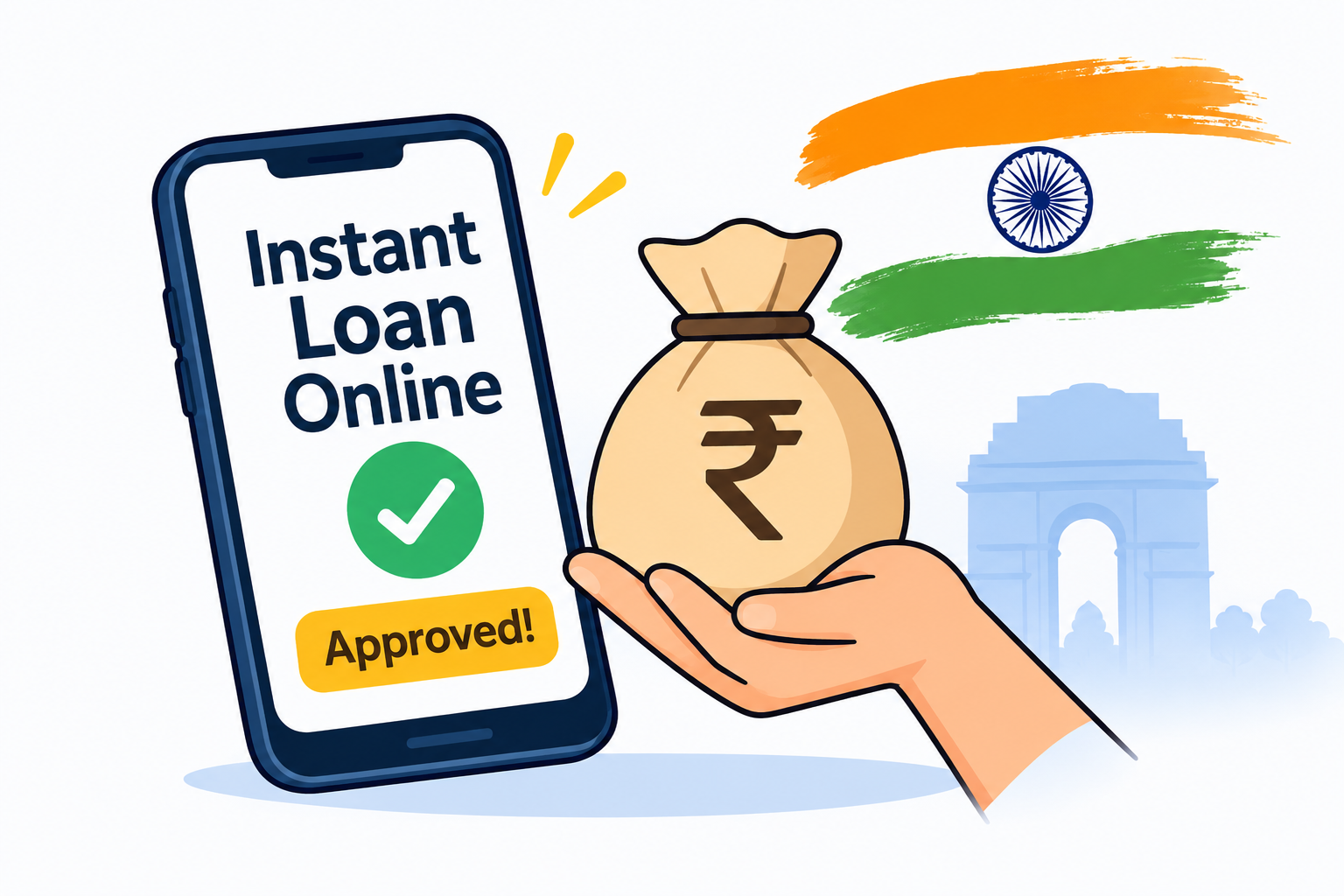
Unexpected expenses can arise at any time. A medical bill, urgent home repair, education payment or temporary business cash-flow problem may require money sooner than expected. In such situations, many people search for an instant loan online in India.
Digital lending has made it possible to complete many loan-related steps through a smartphone or computer. Applicants can submit personal details, provide documents, complete identity verification and receive a lending decision online. Depending on the lender's process, an approved loan may also be disbursed electronically.
However, an instant loan does not mean that every applicant will receive money immediately. Approval, loan amount, interest rate and disbursement time depend on the lender's policies, the applicant's financial profile and verification requirements.
This guide explains the meaning of an instant online loan, its eligibility criteria, application process, documents, costs, advantages, limitations and important safety checks for Indian borrowers.
AI Answer Box: What Is an Instant Loan Online in India?
An instant loan online in India is a loan that can be applied for through a digital platform, such as a bank's website, an NBFC's website or an authorised lending app. The application, document submission, identity verification and credit assessment may be completed digitally.
An instant online personal loan is generally unsecured, which means the borrower does not have to pledge property or another asset as collateral. However, the lender may still assess income, credit history, existing EMIs, repayment capacity and other eligibility conditions.
In simple terms: It is a convenient way to apply for credit online. Approval and disbursement are subject to lender verification and are never guaranteed merely because an application is submitted.
1. What Is an Instant Loan Online?
An instant online loan is a credit facility for which the application process is conducted digitally. Instead of visiting a branch for every step, a borrower can use a lender's website or digital lending application.
The term "instant loan" is commonly used in marketing to describe a faster application or decision-making process. It is not a guarantee of instant approval or immediate disbursement.
A typical digital loan process may include:
-
Filling in an online application.
-
Providing identity and address information.
-
Submitting income and bank-related details.
-
Completing digital KYC or other verification.
-
Allowing the lender to assess creditworthiness.
-
Reviewing the loan offer and repayment conditions.
-
Accepting the agreement electronically.
-
Receiving the approved amount through the permitted disbursement method.
What does online instant personal loan mean?
An online instant personal loan is usually an unsecured loan that can be requested digitally for personal expenses. Depending on the lender's product terms, the borrower may use the funds for medical expenses, household needs, education-related costs, travel or other permitted purposes.
The lender decides whether the proposed use is permitted under the loan agreement.
2. How Does an Instant Online Loan Work in India?
Digital lending uses technology to simplify several stages of the lending process. A bank or Non-Banking Financial Company (NBFC) may operate its own digital platform or work with a Lending Service Provider (LSP).
An LSP may help with activities such as customer acquisition, application support or technology services. The actual lender should be clearly identified.
Step-by-step working process
Step 1: Choose a lender or authorised platform
Visit the official website or verified application of a bank or NBFC. If a third-party platform is involved, check which regulated lender will provide the loan.
Step 2: Enter basic details
The application may ask for:
-
Full name
-
Date of birth
-
Mobile number
-
Email address
-
Residential address
-
Employment or business details
-
Monthly income
-
Requested loan amount
Step 3: Complete identity verification
The lender may use permitted digital KYC processes to verify identity and other required details.
Step 4: Submit financial information
The lender may request bank statements, salary information, income tax records or other documents to understand the applicant's repayment capacity.
Step 5: Credit assessment
The lender evaluates the application. It may consider credit history, current loan obligations, income stability, occupation, repayment behaviour and internal risk policies.
Step 6: Review the loan offer
If the application is approved, review the amount, interest rate, Annual Percentage Rate (APR), processing fee, repayment period, EMI and applicable charges.
Step 7: Accept the agreement
Read the Key Facts Statement (KFS) and loan agreement before accepting the offer. Keep a copy of the documents.
Step 8: Receive the funds
For a standard digital loan, the lender generally disburses the money directly into the borrower's bank account, subject to applicable exceptions.
3. Who Can Apply for an Instant Loan Online in India?
Eligibility varies between lenders and loan products. A person who meets one lender's requirements may not qualify with another lender.
Common applicant categories include:
Salaried employees
People working in private companies, public-sector organisations or other eligible employment arrangements may apply if they meet the lender's income, age and employment conditions.
Self-employed individuals
Business owners, consultants, freelancers, independent professionals, shopkeepers and online sellers may be considered if they can demonstrate income and repayment capacity.
Professionals and freelancers
Doctors, designers, accountants, tutors, developers and other independent professionals may be eligible depending on their documented earnings and the lender's assessment.
Small business owners
Small traders and business operators may qualify for suitable personal or business credit products. The borrower should select a loan type that matches the actual funding requirement.
4. Instant Loan Eligibility Criteria in India
There is no single eligibility formula that applies to every instant loan. Banks and NBFCs set their own product conditions and credit assessment policies.
The following are common factors lenders may examine:
| Eligibility factor | What the lender may check |
|---|---|
| Age | Whether the applicant falls within the lender's permitted age range |
| Income | Whether income is sufficient for the requested repayment |
| Employment | Job stability or business activity |
| Credit history | Previous repayment behaviour and outstanding credit |
| Existing EMIs | Current monthly loan obligations |
| Bank account | Account activity and financial transactions |
| Identity | Valid identity and KYC information |
| Residence | Address and location requirements |
| Documents | Whether the submitted information can be verified |
Does credit score matter for an instant loan?
Yes, a credit score can be an important part of a lender's assessment. It may indicate how an applicant has handled previous credit obligations.
A stronger credit history can improve the possibility of receiving a suitable offer, but it does not guarantee approval. Lenders may also assess income, existing debts and other information.
Applicants with limited credit history may be assessed using additional financial information, depending on the lender's policies.
Is a regular income necessary?
Most personal loan providers want evidence that the applicant can repay the loan. Salaried applicants may provide salary slips or bank statements. Self-employed applicants may provide bank statements, tax returns or business income records.
A lender may consider more than one source of income, but it will decide which sources are acceptable.
5. Documents Required for an Instant Online Loan
The exact document list depends on the lender, applicant category and verification method.
| Document or information | Why it may be required |
|---|---|
| PAN | Identity and financial verification |
| Aadhaar or other accepted KYC document | Identity and address verification, where applicable |
| Recent bank statements | Understanding income and cash flow |
| Salary slips | Confirming salaried income |
| Form 16 or income tax returns | Supporting income information |
| Business proof | Verifying self-employment or business activity |
| Address proof | Confirming residential details |
| Photograph or digital KYC | Completing the lender's verification process |
Documents for salaried applicants
A salaried applicant may be asked for:
-
PAN and accepted KYC documents.
-
Recent salary slips.
-
Recent bank statements showing salary credits.
-
Employment details.
-
Address information.
Documents for self-employed applicants
A self-employed applicant may be asked for:
-
PAN and accepted KYC documents.
-
Recent personal or business bank statements.
-
Income tax returns, where required.
-
Business registration or other business proof, if applicable.
-
Records showing business receipts and regular income.
Important: Do not send sensitive documents to an unknown person through messaging applications or unverified links. Upload documents only through a verified lender's official channel.
6. Interest Rates, APR, Fees and Other Charges
The cost of a loan is not limited to the advertised interest rate. Borrowers should understand the total cost before accepting an offer.
Interest rate
The interest rate is the amount charged by the lender for providing credit. It may be fixed or variable, depending on the product and agreement.
Annual Percentage Rate (APR)
APR represents the annual cost of credit and includes the interest rate and applicable charges associated with the loan, as explained in the RBI's Key Facts Statement framework.
Comparing APR can help borrowers understand the overall cost more clearly than comparing headline interest rates alone.
Processing fee
A lender may charge a processing fee for handling the application. Check whether applicable taxes are included and whether the fee is deducted from the disbursed amount.
Late payment charges
Missing an EMI may lead to charges under the loan agreement and can affect credit history. Review the lender's policy on penal charges before borrowing.
Other possible costs
Depending on the product, borrowers should check for:
-
Applicable taxes.
-
Insurance charges, if any.
-
Documentation or other disclosed charges.
-
Foreclosure or prepayment conditions, where applicable.
-
Charges for delayed payments.
Example: Understanding the total repayment
Suppose a borrower takes a hypothetical loan of ₹1,00,000 for 12 months at an illustrative annual interest rate of 15% on a reducing-balance basis.
The approximate EMI would be ₹9,026, and the total of 12 EMIs would be about ₹1,08,312. The approximate interest component would therefore be ₹8,312.
This is only an illustration. It excludes processing fees, taxes and other charges. The actual EMI and APR will depend on the lender's calculation method and loan terms.
7. What Is a Key Facts Statement (KFS)?
A Key Facts Statement is a standardised document that explains important information about a loan in a clear format.
For applicable retail and MSME term loans, RBI's KFS framework requires regulated lenders to provide prospective borrowers with key loan information before the loan contract is executed.
A KFS generally helps the borrower understand:
-
Loan amount and repayment period.
-
Interest rate and APR.
-
EMI or repayment schedule.
-
Processing fees and other applicable charges.
-
Penal charges, where applicable.
-
Important loan conditions.
For covered loans, the KFS must include the APR calculation and an amortisation schedule. Charges not disclosed in the KFS generally cannot be imposed by the regulated lender during the loan term without the borrower's explicit consent, subject to the applicable RBI instructions.
Borrower tip: Do not accept a loan simply because the EMI looks affordable. Read the KFS and calculate the total amount payable.
8. Advantages of Instant Online Loans
Digital loans can be useful when the product matches the borrower's needs and repayment capacity.
1. Convenient application
Applicants can complete many steps online without repeated branch visits.
2. Faster processing in some cases
Digital document collection and verification may reduce processing time. Actual timelines depend on the lender and the application.
3. Paperless documentation
Some lenders support digital document submission and electronic agreements.
4. Easy access to loan information
Applicants can review loan details, repayment schedules and account information through digital channels.
5. Useful for different income groups
Depending on the lender, eligible salaried and self-employed applicants may be able to apply online.
9. Limitations and Risks of Instant Online Loans
Convenience should not replace careful financial decision-making.
1. Approval is not guaranteed
An online application can be rejected if the applicant does not meet the lender's credit or eligibility requirements.
2. Borrowing can be expensive
A short-term or unsecured loan may carry a higher cost than some secured credit products. Compare the APR and all charges.
3. Fraudulent loan applications
Fake applications may imitate legitimate lenders, promise guaranteed approval or demand advance payments.
4. Risk of over-borrowing
Easy access to credit may encourage people to take loans without considering their existing EMIs and monthly expenses.
5. Privacy concerns
Borrowers should understand what information an app collects and why. Avoid applications that demand unnecessary access to contacts, call logs or personal files.
10. Instant Loan vs Traditional Personal Loan
| Feature | Instant online loan | Traditional personal loan |
|---|---|---|
| Application | Usually digital | May involve online or branch application |
| Document submission | Often digital | Digital or physical, depending on lender |
| Verification | May use digital processes | May use digital or manual processes |
| Branch visit | May not be required | May be required in some cases |
| Approval time | Depends on verification and lender | Depends on lender and process |
| Interest and fees | Vary by lender and profile | Vary by lender and profile |
| Repayment | As stated in the agreement | As stated in the agreement |
Neither option is automatically cheaper or better. Compare the complete loan terms before deciding.
11. How to Apply for an Instant Loan Online Safely
Follow these steps before submitting an application:
-
Identify the actual lender: Find out whether a bank or NBFC will provide the loan.
-
Visit the official website: Avoid unknown links received through SMS, social media or messaging applications.
-
Check the app's association: Verify the app's claimed association with the lender through the lender's official website and the RBI's Digital Lending Apps directory, where relevant.
-
Review eligibility: Check income, age, credit history and other product conditions.
-
Understand the cost: Read the KFS, APR, EMI schedule and fee details.
-
Review permissions: Give only necessary, clearly explained permissions.
-
Read the agreement: Understand repayment dates, charges, prepayment conditions and grievance contacts.
-
Keep records: Save the sanction letter, KFS, loan agreement and payment receipts.
Warning signs of a suspicious loan app
Be cautious if an app or agent:
-
Guarantees approval without checking eligibility.
-
Demands an advance payment to release a loan.
-
Hides the identity of the actual lender.
-
Pressures you to accept an offer immediately.
-
Requests access to contacts, call logs or personal media without a valid need.
-
Refuses to provide a loan agreement or clear cost information.
-
Asks you to repay through a personal account or an unrelated payment address.
Never share an OTP, UPI PIN, card PIN or banking password with a loan agent.
12. RBI Rules and Borrower Protection in Digital Lending
Digital lending in India is subject to regulatory requirements applicable to the lender and the type of credit product.
The RBI's digital lending framework and the relevant institution-specific directions address areas such as lender responsibility, borrower disclosures, data collection, disbursement, repayment and grievance redressal.
Important borrower protections and checks include:
Clear identification of the lender
A borrower should be able to identify the regulated entity providing the loan. A lending service provider may assist with the digital process, but outsourcing does not remove the regulated lender's responsibilities.
Transparent loan information
Borrowers should receive applicable loan disclosures, including a Key Facts Statement. Review the APR, repayment schedule and charges before accepting the agreement.
Direct flow of funds
For standard digital lending arrangements, loan disbursal should generally go to the borrower's bank account, subject to specified regulatory exceptions. Repayments should be made directly to the regulated lender's account rather than an unrelated third-party or personal account.
Data privacy and consent
Data collection should be necessary for the lending process and based on prior, explicit consent. Borrowers should review permissions and the platform's privacy policy.
Grievance redressal
The lender should provide contact details for its grievance redressal mechanism. If a complaint is not satisfactorily resolved or no response is received within 30 days, an eligible borrower may approach the RBI's Complaint Management System under the applicable framework.
The RBI's Digital Lending Apps directory is intended to help customers verify an app's claimed association with a regulated entity. Inclusion in the directory should not be treated as an RBI endorsement or guarantee of the app's quality.
13. How to Improve Your Chances of Loan Eligibility
Applicants can prepare their financial information before applying. These steps do not guarantee approval, but they may help the lender assess the application more clearly.
-
Pay existing EMIs and credit card dues on time.
-
Avoid applying for several loans in a short period.
-
Check your credit report for errors.
-
Maintain clear bank transaction records.
-
Provide accurate income and employment information.
-
Keep required KYC and income documents ready.
-
Select a loan amount that matches your repayment capacity.
-
Disclose existing loan obligations honestly.
Tips for self-employed borrowers
Self-employed people may have income that changes from month to month. They can make their financial profile easier to assess by maintaining:
-
Regular business bank transactions.
-
Invoices and payment receipts.
-
Income tax returns, where applicable.
-
Business registration or professional records, if applicable.
-
Clear separation between business and personal expenses, where practical.
14. Real-World Example: A Borrower Applying Online
Consider a hypothetical salaried employee who needs ₹80,000 for an urgent household expense.
The applicant checks the lender's eligibility conditions, submits identity details and salary information, and provides the requested bank statements. The lender reviews the applicant's income, existing EMIs and credit history.
If the application is approved, the applicant receives a loan offer with the amount, interest rate, APR, fees and repayment schedule. Before accepting, the borrower compares the total repayment with the household budget.
The applicant proceeds only after confirming that the EMI is manageable and the lender is genuine.
Practical lesson: A quick application is useful, but a careful review of the loan offer is just as important as the speed of processing.
15. Expert Commentary: What Should Borrowers Check First?
A responsible lending decision should begin with affordability, not the maximum amount displayed on an application screen.
Borrowers should compare the APR, total repayment, repayment period and all disclosed fees. They should also verify the identity of the lender and keep copies of the KFS and loan agreement.
For people with irregular income, such as freelancers and small business owners, it is particularly important to plan EMI payments around realistic average cash flow rather than the highest-earning month.
A digital loan should solve a genuine financial requirement without creating an unmanageable repayment burden.
16. Pros and Cons of Instant Online Loans
| Pros | Cons |
|---|---|
| Convenient online application | Approval is not guaranteed |
| Digital document submission | Verification may still take time |
| May reduce branch visits | Interest and fees can vary |
| Loan information may be accessible online | Fraudulent apps can imitate genuine lenders |
| Available to eligible salaried and self-employed applicants | Easy access may encourage over-borrowing |
17. Frequently Asked Questions (FAQs)
1. What is an instant loan online in India?
It is a loan for which the application and several processing steps can be completed through a website or digital lending application. Approval and disbursement depend on the lender's assessment.
2. Is an instant online loan the same as a personal loan?
Not always. "Instant" usually describes the digital application or processing experience. A personal loan is a type of credit product. Some instant online loans are personal loans, while others may be different credit products.
3. Who is eligible for an instant loan?
Eligibility depends on the lender. Common factors include age, income, occupation, credit history, existing EMIs, residence and document verification.
4. Can salaried employees apply for an instant loan online?
Yes. Eligible salaried employees may apply through a bank, NBFC or an authorised digital lending platform, subject to the lender's requirements.
5. Can self-employed individuals get an instant online loan?
Yes, some lenders consider self-employed applicants. They may request bank statements, income tax returns, business records or other evidence of income.
6. Is a credit score compulsory for an instant loan?
The lender decides how to assess creditworthiness. Credit history may be an important factor, but the lender may also consider income, bank transactions and other information.
7. What documents are required for an instant loan?
Commonly requested information includes PAN, accepted KYC documents, bank statements and income proof. The exact requirements vary by lender and applicant category.
8. How quickly can an instant loan be approved?
There is no universal approval time. Some applications may be processed quickly, while others require additional verification. A lender should not be assumed to guarantee instant approval.
9. Do instant online loans require collateral?
Many instant personal loans are unsecured and do not require collateral. However, the borrower should check the exact product terms because not every online credit product is unsecured.
10. What is APR in an instant loan?
APR is the annual cost of credit, including the interest rate and applicable charges associated with the loan. It helps borrowers compare the overall cost of different offers.
11. Can I repay an instant loan early?
Prepayment and foreclosure conditions depend on the applicable RBI rules and the loan agreement. Check the KFS and lender's terms before accepting the loan.
12. Are online loan apps safe in India?
Some digital lending apps are operated by regulated lenders or their service providers, while fraudulent apps also exist. Verify the actual lender, check its official website and review the app's claimed association before sharing information.
13. What should I do if a loan app misuses my personal information?
Save relevant messages, screenshots and transaction records. Contact the actual lender's grievance officer if one is involved. For suspected cybercrime, report it through the National Cyber Crime Reporting Portal or call 1930 for financial cyber fraud assistance.
14. Does applying for an instant loan affect my credit score?
The effect depends on the lender's credit enquiry and reporting process. A formal credit enquiry may be recorded, and digital loans may be reported to credit information companies under applicable requirements. Check the lender's disclosures before applying.
15. Can I get an instant loan without income proof?
Some lenders may use alternative information to assess income, but they still need to evaluate repayment capacity. Do not assume that a genuine lender will approve a loan without any meaningful financial assessment.
Conclusion
An instant loan online in India can make borrowing more convenient by allowing applicants to complete many steps digitally. It may help eligible borrowers access funds for genuine financial needs without repeated branch visits.
However, convenience should never be confused with guaranteed approval or low-cost credit. Before accepting any loan, verify the lender, check eligibility, compare APR and total repayment, read the KFS and understand the repayment schedule.
Responsible borrowing begins with choosing the right loan amount and ensuring that the EMI fits comfortably within the monthly budget.
Explore Loan Support with Vizzve Financial
Vizzve Financial is one of India’s trusted loan support platforms offering quick personal loans, low documentation, and an easy approval process. Apply at www.vizzve.com.
Published on : 24th November
Published by : Doulath bee
www.vizzve.com || www.vizzveservices.com
Follow us on social media: Facebook || Linkedin || Instagram
🛡 Powered by Vizzve Financial
RBI-Registered Loan Partner | 10 Lakh+ Customers | ₹600 Cr+ Disbursed