

Introduction
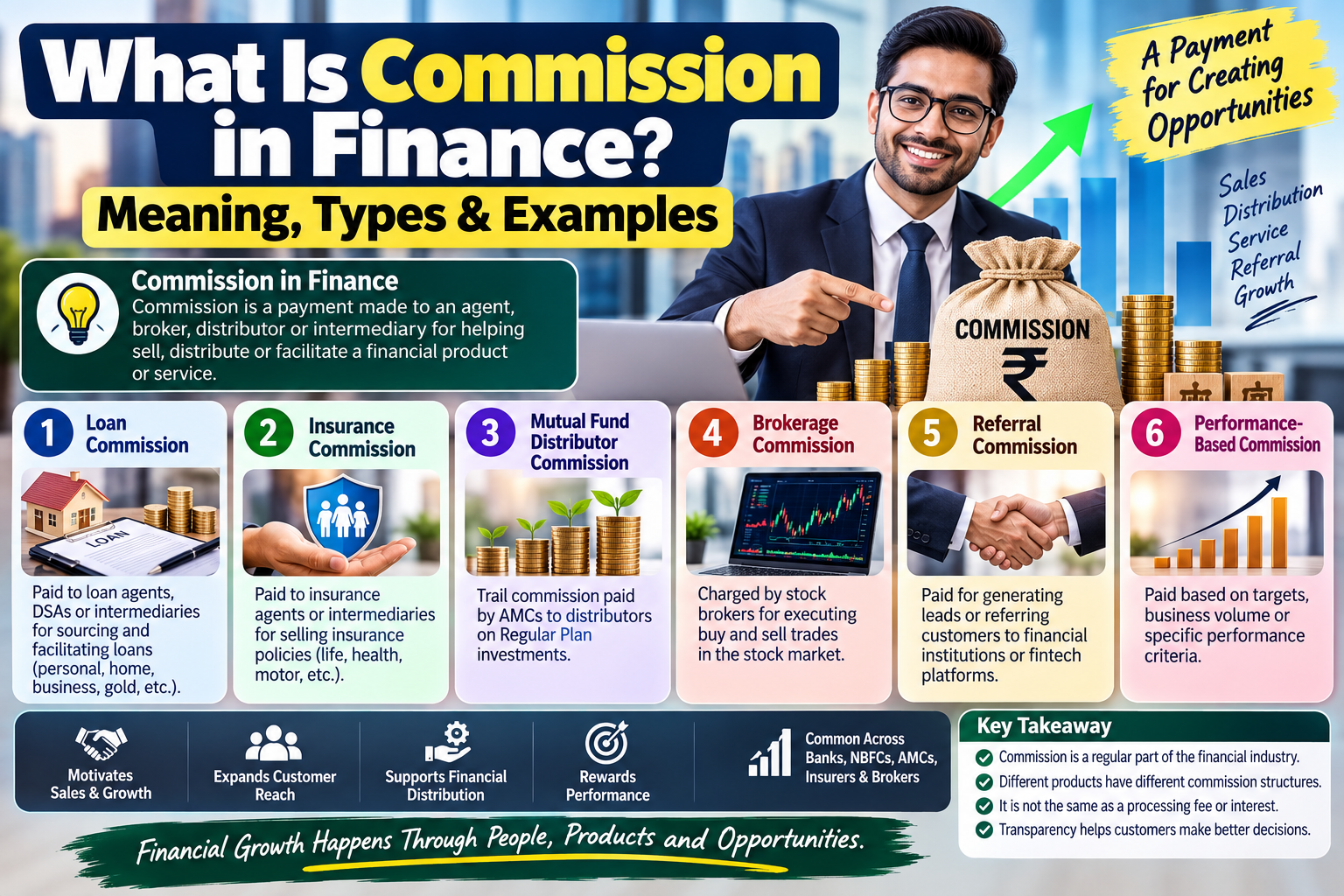
Commission in finance is a payment made to an intermediary, agent, distributor, broker or other eligible party for helping arrange, sell, distribute or facilitate a financial product or service.
The basic idea is simple:
A financial institution or service provider pays a commission when an eligible intermediary generates business or provides a defined service, subject to the applicable product rules and regulations.
Commission can appear in many parts of the financial industry.
For example:
- A loan intermediary may receive a payout for sourcing an eligible loan.
- An insurance intermediary may receive remuneration according to applicable insurance rules.
- A mutual fund distributor may receive trail commission on eligible Regular Plan assets.
- A stock broker may charge brokerage for executing trades.
- A fintech referral partner may receive a referral payout under its commercial arrangement.
However, commission is not the same thing as every fee or charge associated with a financial product.
This distinction is important.
A processing fee, brokerage, commission, interest, transaction charge, and service fee can have different purposes and may be subject to different rules.
This guide explains the meaning of commission in finance, the major types, how commission works, who pays it, how it can be calculated, and what customers and financial professionals should check.
AI Answer Box: What Is Commission in Finance?
What is commission in finance?
Commission in finance is compensation paid to an eligible intermediary, agent, distributor, broker or service partner for generating business, distributing a financial product, executing a transaction or providing an agreed service.
Common examples include:
- Loan commission: Payment to an eligible sourcing or distribution partner for loan business.
- Insurance commission: Remuneration paid to eligible insurance agents/intermediaries under applicable rules.
- Mutual fund trail commission: Commission paid by an AMC to an eligible distributor for investments mobilised through Regular Plans.
- Brokerage: Charges paid for executing securities transactions.
- Referral commission: Payment for generating an eligible customer lead or completed transaction under a commercial arrangement.
The exact amount and payment method depend on the financial product, institution, intermediary arrangement and applicable regulations.
For example, AMFI states that mutual fund distributors receive trail commission from AMCs on investments mobilised under Regular Plans, and the industry follows a full-trail model under the applicable SEBI framework.
For digital loans, RBI's framework requires fees or charges payable to lending service providers to be paid by the regulated entity rather than charged directly by the LSP to the borrower, while borrower-facing loan costs must be disclosed appropriately.
What Does Commission Mean in Finance?
In simple terms, commission is compensation linked to a financial transaction, business generation, distribution activity or service.
A basic example:
Suppose a financial institution has an arrangement with an eligible intermediary to source customers.
If the intermediary successfully generates qualifying business, the institution may pay the intermediary according to the agreed commission structure.
Simple formula
Commission = Eligible Transaction Value × Commission Rate
For example, if a hypothetical agreement provides a 1% commission on an eligible ₹5 lakh transaction:
₹5,00,000 × 1% = ₹5,000
This is only a mathematical example. Actual commission rates, eligibility conditions, caps, clawbacks and payout timing vary by financial product and institution.
Why Do Financial Companies Pay Commission?
Financial companies often use distribution and intermediary networks to reach customers.
These networks can include:
- Agents
- Distributors
- Brokers
- DSAs
- Referral partners
- Corporate agents
- Financial advisers, where permitted
- Authorized persons
- Other eligible intermediaries
Commission can compensate for activities such as:
- Customer acquisition
- Product distribution
- Lead generation
- Documentation support
- Transaction facilitation
- Customer servicing
- Investment distribution
- Insurance distribution
- Trade execution
- Loan sourcing
The commercial arrangement depends on the product and regulatory framework.
Types of Commission in Finance
Commission does not have one universal structure.
Different financial sectors use different models.
1. Loan Commission
Loan commission generally refers to compensation paid to an eligible intermediary or sourcing partner for generating or facilitating qualifying loan business.
It can be associated with:
- Personal loans
- Business loans
- Home loans
- Vehicle loans
- Gold loans
- Consumer loans
- Other credit products
Example
Imagine a lender has a hypothetical arrangement under which an eligible sourcing partner receives 0.75% of an eligible disbursed loan amount.
If qualifying loans total ₹20 lakh:
₹20,00,000 × 0.75% = ₹15,000
Again, this is an illustration rather than a standard market rate.
Important distinction
Loan commission is not automatically the same as a borrower charge.
In digital lending, RBI's framework specifically states that fees and charges payable to Lending Service Providers are to be paid by the regulated entity and not charged directly by the LSP to the borrower.
Borrowers should therefore examine the lender's Key Facts Statement (KFS) and loan agreement to understand the actual costs applicable to their loan.
2. DSA Commission
DSA generally means Direct Selling Agent in the lending context.
A DSA may help a lender acquire customers and source loan applications.
Depending on the institution and agreement, activities can include:
- Finding prospective customers
- Explaining product features
- Collecting application information
- Supporting documentation
- Coordinating with the lender
- Following up on applications
How DSA commission may work
A lender could create a hypothetical structure such as:
| Loan Amount | Illustrative Commission |
|---|---|
| ₹1 lakh | 0.50% |
| ₹3 lakh | 0.75% |
| ₹5 lakh | 1.00% |
| ₹10 lakh | 1.00% |
These figures are illustrative only and should not be treated as standard industry rates.
Actual DSA payout structures can vary significantly.
3. Insurance Commission
Insurance distribution is another major area where commission or remuneration can apply.
Insurance agents and intermediaries may receive compensation for eligible insurance business under applicable rules and arrangements.
IRDAI maintains regulatory frameworks covering insurers' expenses, including commission. Its 2024 Master Circular on Expenses of Management, including Commission, addresses the regulatory treatment of such expenses.
Insurance commission can depend on factors such as:
- Product category
- Policy type
- Premium
- Distribution channel
- Applicable regulations
- Renewal business
- Insurer's remuneration structure
Customers should focus on the suitability and features of the insurance policy rather than choosing a product simply because an intermediary offers it.
4. Mutual Fund Distributor Commission
Mutual fund commission works differently from many loan arrangements.
AMFI explains that mutual fund distributors receive trail commission from AMCs on investments mobilised through Regular Plans, according to the applicable commission structure.
The current framework uses a full-trail model, with no upfront commission or upfronting of trail commission under the applicable SEBI framework.
What is trail commission?
Trail commission is generally linked to the assets/investments serviced through the distributor relationship.
Instead of receiving a one-time payment when the investor initially invests, the distributor may receive eligible trail commission over time according to the applicable structure.
Example
Suppose an investor has an eligible ₹10 lakh investment under a Regular Plan and a hypothetical trail rate of 0.50% per year.
Illustrative annual commission:
₹10,00,000 × 0.50% = ₹5,000
Actual calculations depend on the scheme, applicable commission structure, average assets and other rules.
AMFI also states that commission paid by AMCs to distributors is reflected in the half-yearly Consolidated Account Statement for investors.
5. Brokerage Commission
In securities markets, investors may encounter brokerage for services associated with executing trades.
Brokerage is not necessarily identical to a sales commission.
SEBI states that stock brokers must provide clients with a tariff sheet showing charges that can be levied. SEBI also specifies the applicable brokerage framework and limits for exchange-traded transactions.
Common trading-related costs can include:
- Brokerage
- Securities Transaction Tax
- GST
- Stamp duty
- Exchange charges
- SEBI-related charges
- Depository charges, where applicable
The exact charges depend on the transaction and broker.
6. Referral Commission
Referral commission is compensation for generating an eligible lead, customer or completed transaction.
It is common across many industries, including financial services.
Example
A fintech company may have a referral arrangement under which an eligible partner receives a fixed commercial payout after a referred customer completes a qualifying transaction.
For example:
10 successful referrals × ₹500 = ₹5,000
The actual terms may include:
- Minimum eligibility
- KYC completion
- Successful approval
- Disbursement
- Cooling-off periods
- Cancellation conditions
- Payout timelines
7. Performance-Based Commission
Some commercial arrangements link compensation to performance.
Examples may include:
- Number of qualifying accounts
- Loan disbursement volume
- Premium generated
- Assets mobilised
- Completed transactions
- Revenue generated
Example
A hypothetical sales structure could provide:
₹2 lakh–₹5 lakh business → 0.50%
₹5 lakh–₹10 lakh business → 0.75%
Above ₹10 lakh → 1.00%
Such structures are contractual examples, not universal industry standards.
8. Renewal Commission
Some financial distribution models may include compensation linked to renewal or continuing business, depending on the product and applicable rules.
This can be relevant to:
- Insurance
- Subscription-like financial services
- Certain distribution arrangements
The exact treatment depends on the applicable regulatory framework and contract.
Commission vs Fee vs Interest vs Brokerage
These terms are often confused.
| Term | Basic Meaning | Typical Example |
|---|---|---|
| Commission | Compensation linked to distribution/business generation | Agent payout |
| Fee | Charge for a defined service | Processing fee |
| Interest | Cost of borrowing money | Loan interest |
| Brokerage | Charge related to securities transaction execution | Stock trade |
| Penalty/Penal charge | Charge arising from specified default or breach | Loan-related penal charge |
| Transaction charge | Charge associated with a transaction | Certain MF transactions |
The same financial product can involve several of these concepts.
Who Pays Commission in Finance?
The answer depends on the product.
Possible payer
- Bank
- NBFC
- AMC
- Insurance company
- Broker
- Fintech
- Financial institution
- Other regulated or commercial entity
Possible recipient
- Agent
- DSA
- Distributor
- Broker
- Referral partner
- Insurance intermediary
- Mutual fund distributor
- Other eligible service provider
However, who ultimately bears a cost and who receives a commission are not always the same thing.
This is why customers should distinguish between:
"The intermediary receives commission"
and
"The customer is directly charged a commission."
Those statements can describe very different arrangements.
How Is Commission Calculated?
There are several common calculation approaches.
Percentage-Based Commission
Commission = Transaction Value × Commission Rate
Example:
₹8,00,000 × 1% = ₹8,000
Fixed Commission
Some arrangements may use a fixed amount.
Example:
₹1,000 per qualifying transaction
If there are 25 qualifying transactions:
25 × ₹1,000 = ₹25,000
Tiered Commission
The rate can change depending on performance.
| Monthly Business | Illustrative Rate |
|---|---|
| Up to ₹5 lakh | 0.50% |
| ₹5–₹10 lakh | 0.75% |
| Above ₹10 lakh | 1.00% |
The precise calculation should always be checked against the applicable contract.
Recurring or Trail Commission
A recurring commission may be linked to an ongoing relationship or eligible assets.
This model is particularly relevant in mutual-fund distribution.
AMFI describes trail commission as the applicable model for MFDs on investments mobilised under Regular Plans.
Commission Example in Finance
Consider a hypothetical loan sourcing arrangement.
A financial institution agrees to pay an eligible sourcing partner 0.80% on qualifying disbursed loans.
The partner generates:
- Loan A: ₹2,00,000
- Loan B: ₹3,00,000
- Loan C: ₹5,00,000
Total qualifying business:
₹10,00,000
Commission:
₹10,00,000 × 0.80% = ₹8,000
The actual payout could be subject to:
- Eligibility
- Documentation
- Disbursement
- Cancellation
- Clawback
- Tax treatment
- Contractual conditions
Is Commission the Same as a Processing Fee?
No.
This is one of the most important distinctions in finance.
Commission
Usually represents compensation paid to an intermediary or distribution partner.
Processing fee
Usually represents a charge associated with processing or administering a financial application or transaction.
For a borrower, the processing fee may form part of the disclosed cost of obtaining a loan.
For digital lending, RBI requires borrower-facing loan costs to be appropriately disclosed, including through the Key Facts Statement framework.
Commission vs Processing Fee: Comparison
| Feature | Commission | Processing Fee |
|---|---|---|
| Main purpose | Compensates intermediary | Covers processing/service |
| Typical recipient | Agent/distributor/broker | Lender/service provider |
| Usually linked to | Business/transaction | Application/service |
| Paid by | Depends on product | Often customer, subject to rules |
| Disclosure | Depends on applicable framework | Usually disclosed to customer |
| Example | DSA payout | Loan processing charge |
How Commission Works in Loan Distribution
The process can typically look like this:
Step 1: Customer expresses interest
The customer requests information about a financial product.
Step 2: Eligible intermediary sources the customer
The intermediary collects permissible information and facilitates the application.
Step 3: Lender assesses the application
The lender performs its own credit and eligibility checks.
Step 4: Loan is approved
Approval depends on the lender's criteria.
Step 5: Loan is disbursed
The qualifying transaction is completed.
Step 6: Commission eligibility is determined
The intermediary's payout is calculated according to the agreement.
Step 7: Commission is paid
The lender pays the intermediary according to the contractual payout cycle.
This does not mean an intermediary can guarantee approval.
The final credit decision remains with the lender.
Important RBI Considerations for Digital Lending
Digital lending requires particular attention to transparency.
RBI's digital-lending framework states that fees and charges payable to Lending Service Providers are to be paid by the regulated entity and not charged directly by the LSP to the borrower. It also requires the Annual Percentage Rate and Key Facts Statement to disclose relevant borrower costs.
RBI has also emphasized that charges not disclosed in the KFS should not subsequently be imposed on the borrower under the applicable framework.
What borrowers should check
Before accepting a digital loan, review:
- Lender's identity
- Interest rate
- APR
- Processing fee
- Penal charges
- Other applicable charges
- Repayment schedule
- Total amount payable
- KFS
- Grievance-redress mechanism
How Commission Works in Mutual Funds
Mutual funds provide a useful example of why investors should understand distribution economics.
AMFI states that commission is paid to eligible distributors for investments mobilised under Regular Plans, while Direct Plans do not pay distribution commission.
The expense ratio is also relevant because fund operating expenses are reflected in the scheme's costs.
AMFI explains that TER includes permitted operating expenses and that Direct Plans have lower expense ratios because they exclude distribution expenses such as commission.
Regular Plan vs Direct Plan
| Feature | Regular Plan | Direct Plan |
|---|---|---|
| Distributor involved | Generally yes | No distributor commission |
| Distribution commission | Applicable trail model | No commission |
| Expense ratio | Generally higher | Generally lower |
| Investor support | Distributor may provide support | Investor manages directly |
| Suitable for | Investors seeking distributor assistance | Investors comfortable managing independently |
This does not mean one structure is universally appropriate for every investor. The choice depends on the investor's needs and the value of services received.
How Commission Works in Insurance
Insurance distribution involves regulated intermediary structures.
IRDAI's framework covers expenses of management, including commission, and applicable remuneration structures.
For customers, the important question is not simply:
"How much commission does the agent earn?"
A better set of questions is:
- What does the policy cover?
- What exclusions apply?
- What is the premium?
- What are the policy terms?
- What are the surrender or exit implications?
- Is the policy appropriate for my needs?
- What services will the intermediary provide?
Commission should not be the only basis for selecting an insurance product.
Commission in Stock Market Transactions
Stock-market participants generally encounter brokerage and other transaction costs rather than a traditional sales commission.
SEBI requires stock brokers to provide a tariff sheet to clients showing applicable charges.
Before trading, check:
- Brokerage
- STT
- GST
- Stamp duty
- Exchange transaction charges
- SEBI charges
- DP charges where applicable
- Other broker-specific fees
Always review the current tariff sheet of the registered intermediary.
Advantages of Commission-Based Financial Distribution
For Financial Companies
- Wider customer reach
- Lower dependence on direct sales teams
- Access to local markets
- Scalable distribution
- Performance-linked acquisition costs
For Intermediaries
- Opportunity to earn based on business generated
- Potential recurring income in some models
- Ability to build a customer base
- Incentive for customer acquisition and servicing
For Customers
- Easier access to financial products
- Local assistance
- Help with documentation
- Product discovery
- Ongoing service in some distribution models
Disadvantages and Risks of Commission-Based Models
Commission structures can also create potential conflicts of interest.
Possible concerns
- Mis-selling
- Product pushing
- Excessive focus on sales volume
- Lack of transparency
- Inappropriate product selection
- Pressure on customers
- Conflicts between customer needs and intermediary incentives
This is why financial consumers should understand the product independently rather than assuming that the highest-selling product is necessarily the most appropriate one.
How Customers Can Protect Themselves
Before purchasing a financial product, follow these steps.
Step 1: Ask Who Is Providing the Product
Confirm whether you are dealing with:
- Bank
- NBFC
- Insurance company
- AMC
- Broker
- Registered intermediary
- Authorized service provider
Step 2: Ask About All Charges
Do not ask only:
"What is the interest rate?"
Also ask:
- Processing fee?
- GST?
- Brokerage?
- Transaction charge?
- Penal charges?
- Other fees?
Step 3: Ask Whether the Intermediary Receives Commission
You can ask:
"Do you receive any commission or remuneration from this product?"
This can help you understand the distribution relationship.
Step 4: Read the Documents
Check:
- KFS
- Agreement
- Product disclosure
- Schedule of charges
- Policy document
- Tariff sheet
- Scheme documents
Step 5: Compare Alternatives
Compare the actual product features rather than focusing only on the commission offered to the intermediary.
How Financial Professionals Can Build a Transparent Commission Model
For agents, distributors and referral partners, transparency can help create long-term customer relationships.
Good practices include:
- Clearly explain the product
- Avoid guaranteed-return claims
- Do not promise loan approval
- Avoid hiding material charges
- Maintain customer records
- Follow applicable regulations
- Use authorized channels
- Provide accurate information
- Avoid aggressive sales tactics
- Explain relevant risks
A customer who understands what they are buying is more likely to have realistic expectations.
Commission Income: What Financial Agents Should Track
Professionals earning commission should maintain clear records.
Useful records include:
| Record | Purpose |
|---|---|
| Customer/transaction reference | Track business |
| Product type | Categorize revenue |
| Application date | Monitor pipeline |
| Approval date | Track conversion |
| Disbursement date | Determine eligibility |
| Commission rate | Calculate payout |
| Gross commission | Revenue tracking |
| Clawback | Adjustments |
| Tax records | Compliance |
| Payment date | Cash-flow tracking |
Commission income can also have tax implications depending on the individual's business structure and circumstances. Professional tax advice may be appropriate where needed.
Commission vs Salary
Commission income is not the same as a fixed salary.
| Feature | Salary | Commission |
|---|---|---|
| Payment basis | Time/role | Business/performance |
| Predictability | Usually higher | Can vary |
| Risk | Relatively stable | More variable |
| Upside | Usually defined | Can increase with business |
| Common users | Employees | Agents/sales partners |
Some financial professionals receive a combination of fixed salary + incentive/commission.
Commission vs Brokerage
These terms are related but should not automatically be treated as identical.
Commission
A broad term for compensation linked to a transaction, sale, distribution or service.
Brokerage
Usually refers specifically to charges associated with arranging or executing transactions, especially in securities markets.
SEBI's investor guidance separately addresses brokerage and other charges that stock brokers may levy.
Commission vs Referral Fee
A referral fee generally compensates someone for bringing a customer or lead.
Commission may cover a broader set of activities.
| Feature | Commission | Referral Fee |
|---|---|---|
| Scope | Broader | Usually lead/customer introduction |
| Basis | Business/service/transaction | Referral |
| Payment | May be recurring or transaction-based | Often fixed or transaction-based |
| Example | MF trail commission | Fintech referral payout |
The actual distinction depends on the contractual arrangement.
Common Commission Mistakes
Mistake 1: Assuming Every Commission Is Paid by the Customer
Not necessarily.
In many arrangements, the institution pays the intermediary.
The actual treatment depends on the product.
Mistake 2: Confusing Commission With Interest
Interest is the cost of borrowing.
Commission is generally compensation for distribution or service.
They are fundamentally different concepts.
Mistake 3: Assuming a High Commission Means a Better Product
It does not.
A product should be assessed based on its features, costs, risks and suitability.
Mistake 4: Ignoring the Agreement
Agents and partners should understand:
- Payout conditions
- Eligibility
- Clawbacks
- Taxes
- Payment timelines
- Compliance requirements
Mistake 5: Promising Approval Because Commission Is Involved
An intermediary may source an application, but approval is subject to the lender's underwriting and eligibility criteria.
Commission in Finance: Quick Reference Table
| Financial Area | Commission/Charge Model | Typical Recipient |
|---|---|---|
| Loans | Sourcing/distribution payout | Eligible intermediary |
| DSA | Loan sourcing commission | DSA |
| Insurance | Commission/remuneration | Agent/intermediary |
| Mutual Funds | Trail commission | MFD |
| Stocks | Brokerage | Stock broker |
| Referrals | Referral payout | Referral partner |
| Fintech | Partner commission | Eligible partner |
| Financial sales | Incentive/commission | Sales professional |
The exact structure varies by product and applicable rules.
Key Takeaways
What should you remember about commission in finance?
- Commission is compensation linked to business, distribution, transactions or services.
- Different financial sectors use different commission models.
- Loan commission and borrower loan charges are not necessarily the same thing.
- DSA commissions are generally based on commercial arrangements with lenders.
- Insurance commissions operate within the applicable IRDAI framework.
- Mutual fund distributors receive trail commission on eligible Regular Plan business under the applicable framework.
- Direct mutual fund plans do not pay distribution commission.
- Brokerage is a trading-related cost and should not automatically be treated as a sales commission.
- Customers should review all charges before accepting a financial product.
- Intermediaries should maintain accurate commission and transaction records.
- Commission arrangements can create conflicts of interest, so transparency matters.
- Regulatory requirements differ across banking, lending, insurance, mutual funds and securities.
Summary Box
Commission in finance means compensation paid to an eligible intermediary, agent, distributor, broker or partner for generating business, distributing a product, facilitating a transaction or providing an agreed service.
Common forms include loan commission, DSA commission, insurance commission, mutual fund trail commission, brokerage and referral commission.
Commission is not automatically the same as a customer fee. Customers should check the applicable disclosure documents, while financial professionals should understand their contracts, payout conditions and regulatory obligations.
Frequently Asked Questions
1. What is commission in finance?
Commission in finance is compensation paid to an eligible intermediary, agent, distributor, broker or partner for generating business, distributing financial products or facilitating qualifying transactions.
2. What are the main types of financial commission?
Common types include loan commission, DSA commission, insurance commission, mutual fund trail commission, brokerage and referral commission.
3. Is commission the same as a fee?
No. A commission generally compensates an intermediary for distribution or business generation, while a fee is usually a charge for a defined service. The exact treatment depends on the financial product.
4. What is loan commission?
Loan commission generally refers to a payout made to an eligible sourcing or distribution intermediary for qualifying loan business under a commercial arrangement.
5. What is DSA commission?
DSA commission is compensation paid under an agreement between a lender and an eligible Direct Selling Agent for qualifying loan sourcing or related activities.
6. Who pays loan DSA commission?
The payment arrangement depends on the lender and the contractual structure. In digital lending, RBI requires fees and charges payable to Lending Service Providers to be paid by the regulated entity rather than charged directly by the LSP to the borrower.
7. What is mutual fund trail commission?
Trail commission is compensation paid by an AMC to an eligible mutual fund distributor on qualifying investments mobilised through Regular Plans under the applicable commission structure.
8. Do Direct mutual funds pay commission?
Direct Plans do not pay distribution commission. AMFI notes that Direct Plans have lower expense ratios because they exclude distribution expenses such as commission.
9. What is insurance commission?
Insurance commission is remuneration paid to eligible insurance agents or intermediaries according to applicable regulations and the insurer's approved remuneration structure. IRDAI regulates the broader framework governing insurers' expenses, including commission.
10. What is brokerage commission?
Brokerage is a charge associated with the execution of securities transactions through a broker. SEBI requires stock brokers to provide clients with a tariff sheet showing applicable charges.
11. How is commission calculated?
Commission can be calculated as a percentage of eligible transaction value, a fixed amount per transaction, a tiered amount based on performance or a recurring trail amount, depending on the arrangement.
12. Can financial agents earn recurring commission?
Yes, some financial distribution models can involve recurring remuneration. Mutual fund trail commission is one example. The applicable product and regulatory framework determines the structure.
13. Does commission increase the cost of a financial product?
Not necessarily in a direct one-to-one manner. The treatment varies by product and regulatory framework. Customers should review the actual disclosed costs rather than assuming that every intermediary commission is directly added as a separate charge.
14. How can customers know about financial charges?
Customers should review documents such as the Key Facts Statement, loan agreement, policy document, mutual-fund documents, broker tariff sheet and applicable fee schedules.
15. Is commission income taxable?
Commission income can have tax implications depending on how it is earned, the person's status and applicable tax rules. Individuals and businesses should maintain proper records and seek professional tax advice where appropriate.
Published on : 265th September
Published by : G REDDY KUMAR
www.vizzve.com || www.vizzveservices.com
Follow us on social media: Facebook || Linkedin || Instagram
🛡 Powered by Vizzve Financial
RBI-Registered Loan Partner | 10 Lakh+ Customers | ₹600 Cr+ Disbursed