

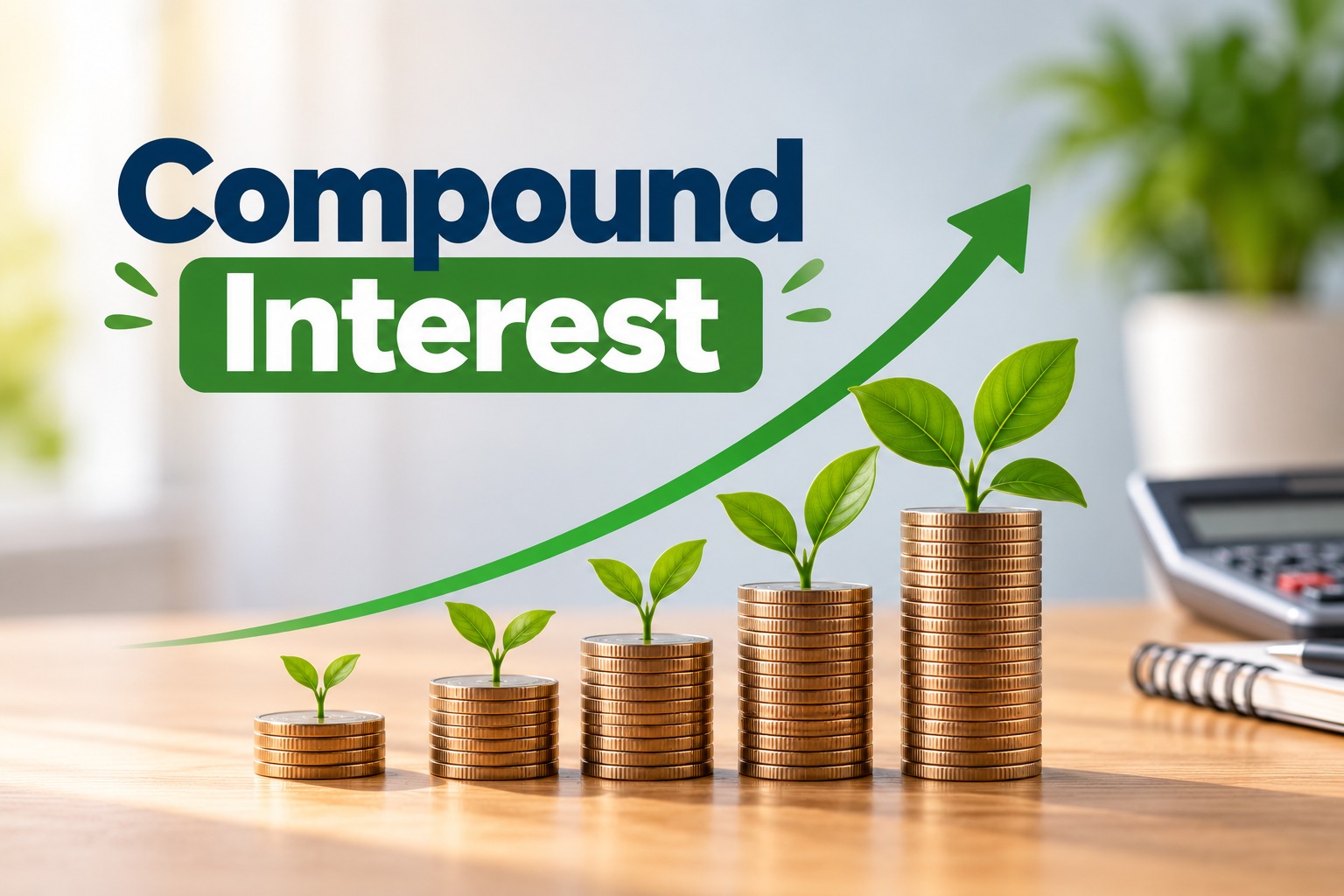
Compound interest is one of the most important concepts in personal finance and investing. Unlike simple interest, where interest is calculated only on the original amount, compound interest allows you to earn interest on both your initial principal and the interest accumulated over time.
This is why compound interest is often described as “interest on interest.” The longer money remains invested or saved, the greater the potential effect of compounding.
What Is Compound Interest?
Compound interest is the interest calculated on the original principal plus previously earned interest.
For example, suppose you invest ₹10,000 at an annual interest rate of 8%. During the first year, you earn ₹800. In the second year, interest is calculated on ₹10,800 rather than only the original ₹10,000.
Over several years, this process can significantly increase the value of your money.
Compound Interest Formula
The basic compound interest formula for a lump-sum investment is:
Where:
- FV = Future Value
- PV = Initial principal
- r = Interest rate per period
- n = Number of compounding periods
The actual result depends on the interest rate, compounding frequency and investment period.
How Does Compound Interest Work?
The process is relatively simple:
- You deposit or invest an initial amount.
- The money earns interest.
- The interest is added to the account or investment value.
- Future interest is calculated on the increased balance.
- The balance continues to grow as compounding repeats.
For example, if ₹10,000 earns 10% annually:
| Year | Approx. Balance |
|---|---|
| Initial | ₹10,000 |
| After 1 year | ₹11,000 |
| After 2 years | ₹12,100 |
| After 3 years | ₹13,310 |
| After 5 years | ₹16,105 |
This simplified example assumes annual compounding and no withdrawals or additional deposits.
Compound Interest vs Simple Interest
The main difference is how interest is calculated.
| Feature | Simple Interest | Compound Interest |
|---|---|---|
| Interest calculated on | Original principal | Principal + accumulated interest |
| Growth | Relatively linear | Can accelerate over time |
| Interest on previous interest | No | Yes |
| Long-term effect | Lower compounding benefit | Potentially greater growth |
| Common use | Some loans and calculations | Savings and investments |
Why Does Time Matter So Much?
Time is one of the biggest factors behind compounding.
When you leave money invested for a longer period, previously earned returns can themselves generate additional returns. This creates a compounding effect that becomes more noticeable over longer periods.
For example, an investment earning a consistent return may grow relatively slowly at first. As the balance becomes larger, the same percentage return produces a larger amount of interest.
This is why starting early can be important when building long-term savings.
How Compounding Frequency Affects Returns
Interest can be compounded at different intervals, such as:
- Annually
- Half-yearly
- Quarterly
- Monthly
- Daily
Generally, when other factors remain the same, more frequent compounding can result in a higher effective return.
However, investors should not look only at the advertised interest rate. They should also check the effective annual rate, fees, taxes and other terms associated with the financial product.
Compound Interest in Loans
Compound interest is not only relevant to investments and savings. Borrowers should also understand how interest and outstanding balances work when taking loans or credit.
Depending on the product and terms, unpaid amounts, fees or other charges can increase the amount owed. Credit cards, loans and other borrowing products may have different interest-calculation methods.
Before borrowing, check the interest rate, APR where applicable, fees, repayment schedule and total repayment amount.
Where Can You See the Effect of Compounding?
Compounding can be relevant to several financial products and strategies, including:
Savings and Deposits
Certain deposit products may pay interest that is added to the principal according to their terms.
Fixed Deposits
Bank fixed deposits can use specified compounding and payout structures. The exact calculation depends on the bank, deposit type and tenure.
Mutual Funds
Mutual funds do not provide guaranteed compound interest. Instead, investment returns can potentially compound when gains remain invested and generate further returns. However, mutual fund returns are market-linked and not guaranteed.
Long-Term Investing
Reinvesting returns over a long period can allow the investment base to grow, potentially increasing the effect of compounding.
Example of Compound Growth
Suppose someone invests ₹50,000 and earns an assumed annual return of 8%, with the return remaining invested.
After 10 years, the value would be approximately ₹107,946 under a simplified annual-compounding calculation.
This is an illustration, not a guaranteed investment return. Actual investment returns can vary significantly depending on the financial product and market conditions.
How to Make Compounding Work Over Time
People looking to benefit from compounding can focus on a few basic principles:
- Start saving or investing as early as practical.
- Give investments enough time to grow.
- Reinvest eligible returns where appropriate.
- Maintain a consistent savings or investment habit.
- Understand fees and taxes.
- Choose products according to your financial goals and risk tolerance.
- Avoid unnecessary withdrawals from long-term investments.
Key Takeaways
- Compound interest means earning interest on previously accumulated interest.
- The longer money remains invested or saved, the greater the potential compounding effect.
- Interest rate, time and compounding frequency all influence the final amount.
- Compound growth can apply to savings, deposits and investment returns, depending on the product.
- Mutual fund returns are market-linked and are not guaranteed.
- For loans, borrowers should carefully review interest rates, APR, fees and total repayment costs.
Frequently Asked Questions
1. What is compound interest in simple words?
Compound interest means earning returns not only on your original money but also on previously accumulated interest.
2. Is compound interest better than simple interest?
They work differently. Compound interest can produce greater growth over longer periods because previously earned interest can also generate returns.
3. What is the formula for compound interest?
A commonly used future-value formula is FV = PV(1+r)^n, where the variables represent the principal, rate and number of periods.
4. Does compound interest guarantee higher investment returns?
No. The effect depends on the product and applicable rate or return. Market-linked investments do not guarantee returns.
5. How does time affect compound interest?
Generally, a longer period gives accumulated interest more time to generate additional interest or returns.
6. Is compound interest used in fixed deposits?
Some fixed deposits use compounding according to their specific terms. Investors should check the bank's applicable calculation and payout method.
7. Can compound interest apply to loans?
Interest calculation varies by loan product. Borrowers should check the lender's agreement, interest method, fees and repayment schedule.
8. What is the difference between compound interest and annual return?
Compound interest describes how interest is added and calculated over time, while an annual return is a measure of investment performance over a year. They are not always interchangeable.
Published on : 29th September 2026
Published by : Shibam nath
www.vizzve.com || www.vizzveservices.com
Follow us on social media: Facebook || Linkedin || Instagram
🛡 Powered by Vizzve Financial
RBI-Registered Loan Partner | 10 Lakh+ Customers | ₹600 Cr+ Disbursed