

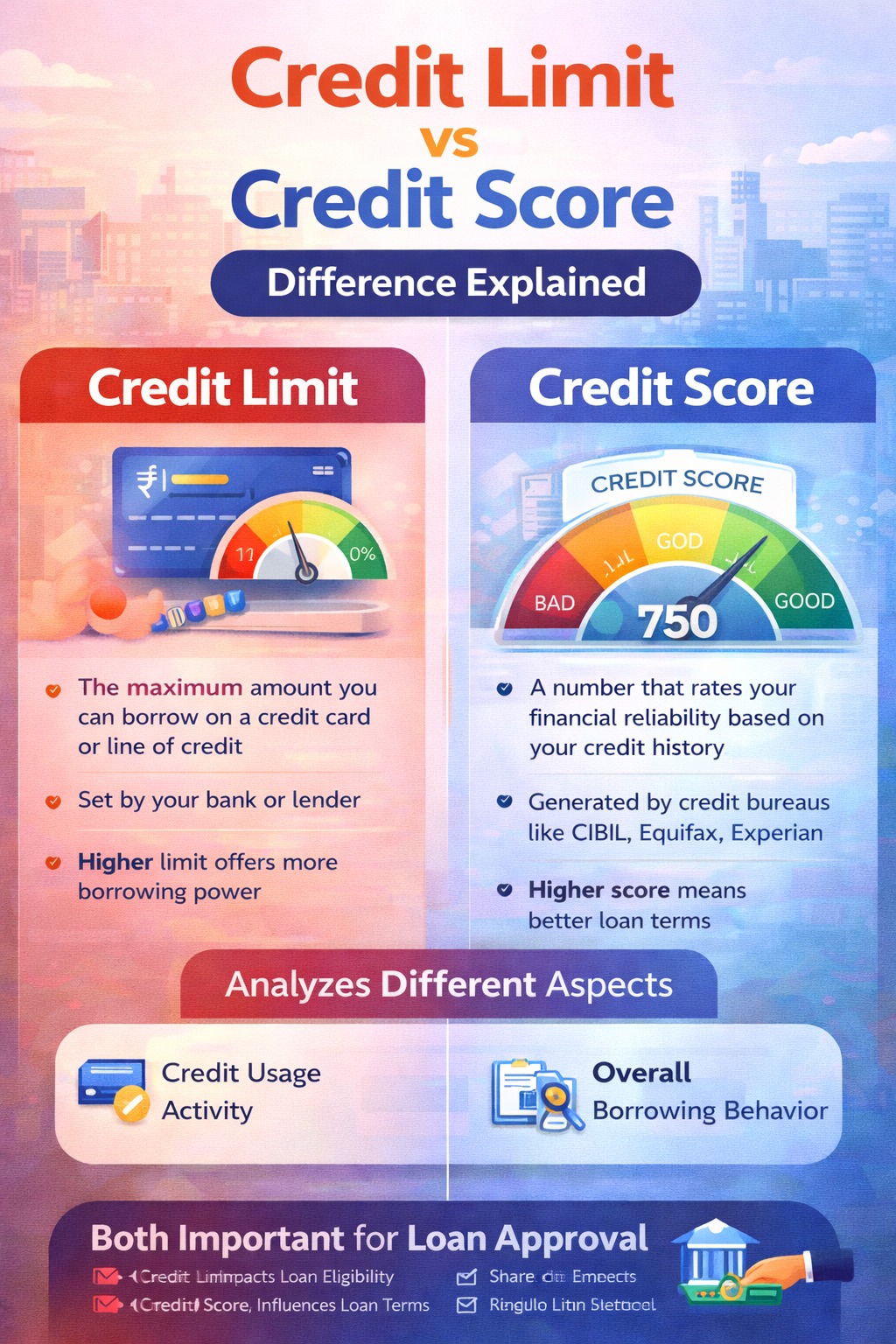
When applying for a loan or credit card, two financial terms often appear: credit limit and credit score.
Many borrowers confuse these terms, but they play very different roles in determining your financial credibility.
Your credit limit determines how much you can borrow, while your credit score reflects how reliable you are at repaying debt. Understanding both can help you improve your financial health and increase your chances of loan approval.
AI Answer Box
What is the difference between credit limit and credit score?
Credit limit is the maximum amount you can borrow on a credit account
Credit score is a number that reflects your creditworthiness
Credit limit affects how much you can spend
Credit score affects whether lenders approve your loans
Both play a key role in financial decision-making
What Is a Credit Limit?
A credit limit is the maximum amount of money a lender allows you to borrow through a credit facility such as a credit card.
For example:
If your credit card has a ₹1,00,000 credit limit, you cannot spend more than that amount unless the limit is increased.
Example of Credit Limit Usage
| Credit Limit | Amount Spent | Available Credit |
|---|---|---|
| ₹1,00,000 | ₹25,000 | ₹75,000 |
| ₹1,00,000 | ₹60,000 | ₹40,000 |
Maintaining lower usage improves your financial profile.
What Is a Credit Score?
A credit score is a three-digit number that represents your creditworthiness and repayment reliability.
In India, credit scores typically range between 300 and 900.
These scores are calculated by credit bureaus such as
TransUnion CIBIL.
Lenders use this score to determine whether to approve loans or credit cards.
Credit Score Range
| Credit Score | Rating |
|---|---|
| 750 – 900 | Excellent |
| 700 – 749 | Good |
| 650 – 699 | Average |
| 550 – 649 | Poor |
| Below 550 | Very Risky |
Borrowers with scores above 750 usually get better loan offers.
Factors That Affect Your Credit Score
Several financial behaviors influence your credit score.
Payment History
Timely EMI and credit card payments improve credit score.
Credit Utilization
Using too much of your credit limit can reduce your score.
Credit History Length
Longer credit history shows financial stability.
New Credit Applications
Frequent loan applications can temporarily reduce credit score.
Credit Utilization Ratio Explained
Credit utilization refers to the percentage of your credit limit that you use.
Example:
| Credit Limit | Amount Used | Utilization |
|---|---|---|
| ₹1,00,000 | ₹30,000 | 30% |
| ₹1,00,000 | ₹80,000 | 80% |
Experts recommend keeping credit utilization below 30%.
Key Differences Between Credit Limit and Credit Score
| Feature | Credit Limit | Credit Score |
|---|---|---|
| Meaning | Maximum borrowing limit | Borrower reliability score |
| Set By | Banks or lenders | Credit bureaus |
| Range | Varies by lender | 300–900 |
| Purpose | Controls spending limit | Determines loan eligibility |
Understanding this difference helps borrowers manage credit more effectively.
How Credit Limit and Credit Score Affect Loan Approval
Both factors influence lending decisions.
Credit Score Impact
Higher credit scores increase approval chances and reduce interest rates.
Credit Limit Impact
Responsible usage of credit limits improves financial credibility.
Lenders evaluate both to determine repayment capacity.
How to Improve Your Credit Score
Improving your credit profile requires responsible financial behavior.
Pay Bills on Time
Late payments significantly reduce credit scores.
Maintain Low Credit Utilization
Use only a small portion of your credit limit.
Avoid Multiple Loan Applications
Too many credit inquiries may affect your score.
Maintain Long Credit History
Older credit accounts improve financial credibility.
Importance of Credit Score in Modern Banking
The lending industry operates under regulations established by the
Reserve Bank of India.
These regulations ensure responsible lending practices and financial stability.
Credit scores help banks evaluate borrower risk before approving loans.
Key Takeaways
Credit limit determines how much you can borrow
Credit score reflects your repayment reliability
Credit scores range from 300 to 900
Keeping credit utilization below 30% is recommended
Responsible financial behavior improves loan eligibility
FAQs
1. What is a credit limit?
It is the maximum amount you can borrow using a credit account.
2. What is a credit score?
A three-digit number that represents your creditworthiness.
3. What is a good credit score in India?
A score above 750 is considered excellent.
4. Who calculates credit scores?
Credit bureaus such as TransUnion CIBIL.
5. Does credit limit affect credit score?
Yes, high credit utilization can reduce your score.
6. Can credit score affect loan approval?
Yes, lenders use it to evaluate borrower risk.
7. How can I increase my credit limit?
Banks may increase it based on good repayment history.
8. Does paying EMIs improve credit score?
Yes, timely payments improve credit history.
9. How often should I check my credit score?
At least once every few months.
10. Is credit score important for credit cards?
Yes, it determines approval and credit limit.
Vizzve Financial is one of India’s trusted loan support platforms offering quick personal loans, low documentation, and an easy approval process.
Apply today at www.vizzve.com
Fast approval. Transparent process. Easy documentation.
Published on : 7th March
Published by : SMITA
www.vizzve.com || www.vizzveservices.com
Follow us on social media: Facebook || Linkedin || Instagram
🛡 Powered by Vizzve Financial
RBI-Registered Loan Partner | 10 Lakh+ Customers | ₹600 Cr+ Disbursed