

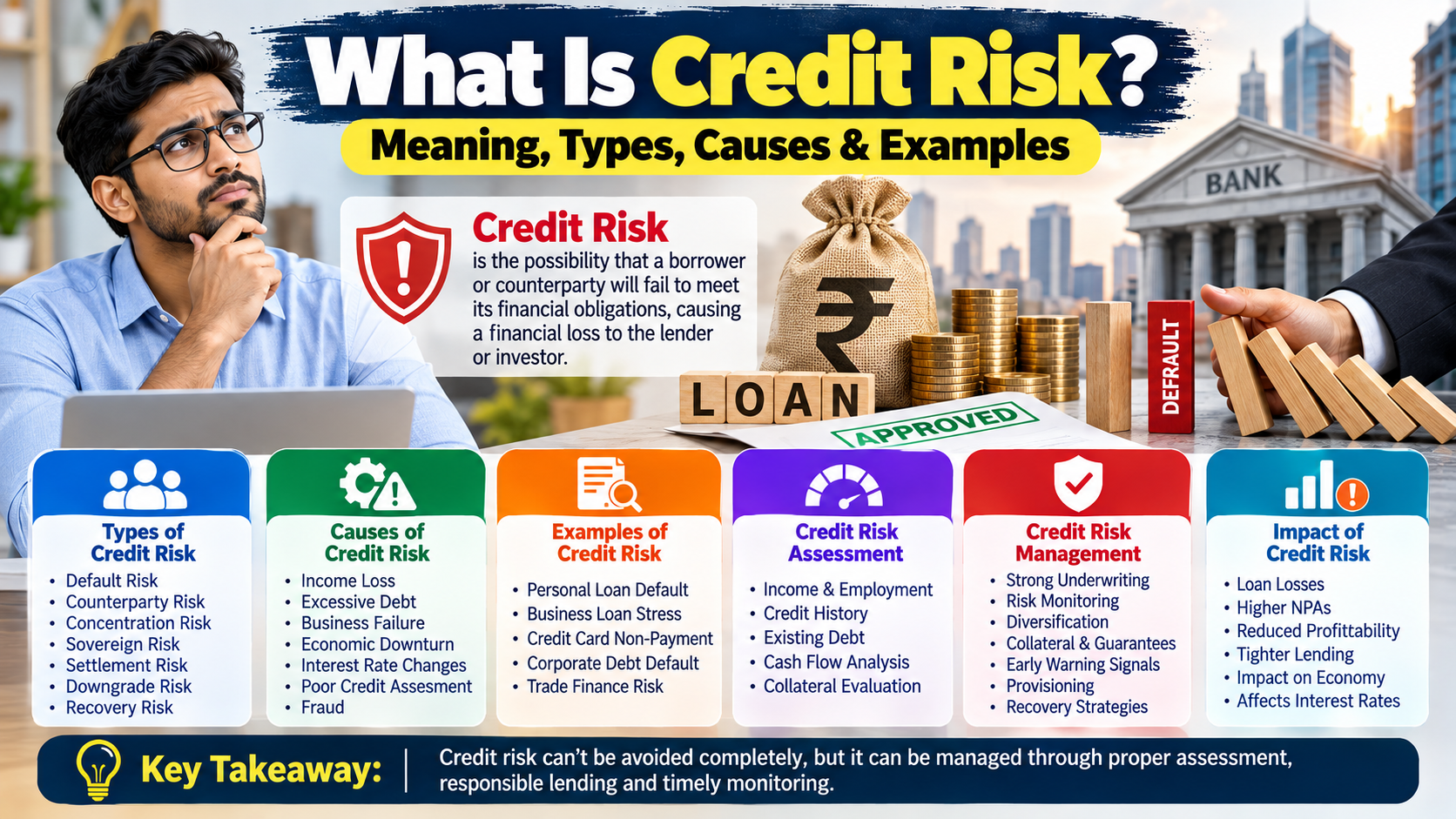
Introduction
Whenever a bank, NBFC or financial institution gives a loan, it faces one fundamental question:
Will the borrower repay the money as agreed?
The possibility that the borrower or another counterparty may fail to meet its financial obligations is broadly known as credit risk.
Credit risk is one of the most important risks in banking and lending.
It can arise in:
- Personal loans
- Home loans
- Business loans
- Vehicle loans
- Credit cards
- Microfinance
- Corporate lending
- Trade finance
- Bonds
- Interbank transactions
- Financial derivatives
- Other credit exposures
For lenders, credit risk can result in delayed payments, defaults, additional recovery costs, provisions and losses.
For borrowers, poor repayment behaviour can result in additional charges, collection activity, difficulty accessing future credit and adverse credit-history reporting.
The Reserve Bank of India has established prudential frameworks covering asset classification, provisioning and credit information reporting for regulated entities. RBI's 2025 Credit Information Reporting Directions consolidate instructions applicable to banks, NBFCs and other specified regulated entities.
Understanding credit risk is therefore important not only for banks and NBFCs, but also for individuals and businesses that borrow money.
AI Answer Box: What Is Credit Risk?
Credit risk is the possibility that a borrower or counterparty will fail to meet its agreed financial obligations, causing a lender or investor to suffer a financial loss.
Simple example
Suppose a bank lends:
₹5 lakh
to a borrower.
If the borrower stops making required payments and the lender cannot recover the outstanding amount, the bank faces credit risk.
Credit risk can arise because of:
- Borrower default
- Loss of income
- Business failure
- Excessive debt
- Poor cash flow
- Economic downturns
- Fraud
- Weak underwriting
- Concentration of lending
- Counterparty failure
In one sentence:
Credit risk = The risk of financial loss because a borrower or counterparty may not pay as promised.
What Is Credit Risk?
Credit risk refers to the possibility that a person, company, financial institution or other counterparty will fail to fulfil its contractual financial obligations.
The obligation could involve:
- Repaying a loan
- Paying interest
- Paying a bond
- Settling a trade
- Meeting a credit commitment
- Repaying a credit-card balance
- Paying a supplier under agreed credit terms
Credit risk does not always mean complete default.
It can also involve:
- Late payment
- Partial payment
- Restructuring
- Deterioration in credit quality
- Failure to meet contractual terms
For a lender, the key concern is:
How much money could be lost if the borrower does not pay?
Why Is Credit Risk Important?
Credit risk is particularly important because lending is a core activity of banks and many financial institutions.
A lender earns income by extending credit, but lending also creates exposure to repayment risk.
Consider a simplified example.
A bank has:
₹100 crore of loans
If a portion of borrowers experience financial difficulties, the bank may face:
- Higher overdue loans
- Higher provisions
- Recovery expenses
- Lower interest income
- Capital pressure
- Reduced profitability
This is why lenders conduct credit assessment before approving loans and monitor borrowers after disbursement.
Credit Risk in Banking
Banks face credit risk whenever they provide credit or hold financial assets that depend on another party's ability to pay.
Examples include:
Retail Loans
- Personal loans
- Home loans
- Vehicle loans
- Education loans
- Credit cards
Business Loans
- Working-capital loans
- Term loans
- Cash-credit facilities
- Overdrafts
- MSME loans
Corporate Credit
- Large corporate loans
- Project finance
- Infrastructure lending
- Trade finance
Investment Exposure
Banks can also face credit risk through certain debt securities and other financial exposures.
Credit Risk in NBFCs
NBFCs also face credit risk when they lend to individuals and businesses.
Their portfolios may include:
- Personal finance
- Vehicle finance
- Microfinance
- Consumer finance
- Housing finance
- MSME lending
- Commercial lending
The risk profile varies significantly depending on the business model.
For example, a lender focused on unsecured consumer loans may face a different credit-risk profile from a lender focused primarily on secured housing loans.
Types of Credit Risk
Credit risk can be divided into several categories.
1. Default Risk
Default risk is the possibility that a borrower will fail to make required payments.
Example
A borrower takes a ₹3 lakh personal loan and stops paying the scheduled EMIs.
The lender faces default risk.
2. Counterparty Credit Risk
Counterparty credit risk arises when another party in a financial transaction fails to fulfil its contractual obligation.
It is particularly relevant in:
- Derivatives
- Securities transactions
- Interbank transactions
- Foreign-exchange contracts
- Other financial-market activities
Example
Two financial institutions enter into a financial contract.
If one institution fails to honour its obligations, the other institution may incur a loss.
3. Concentration Risk
Concentration risk occurs when too much credit exposure is concentrated in one borrower, industry, geography, product or economic segment.
Example
Suppose a lender has a very large portion of its loan book exposed to one industry.
If that industry experiences a severe downturn, many borrowers may face difficulties simultaneously.
This can create a much larger problem than an isolated borrower default.
4. Country or Sovereign Credit Risk
This relates to the possibility that a country's economic, financial or political conditions affect its ability or willingness to meet financial obligations.
It can matter particularly for:
- International banks
- Foreign investors
- Sovereign bonds
- Cross-border lending
5. Settlement Risk
Settlement risk occurs when one party fulfils its side of a transaction but does not receive the expected payment or asset from the counterparty.
This is especially relevant in financial markets.
6. Downgrade Risk
Credit quality can deteriorate even before an actual default.
For example, a company's credit rating may be downgraded because of:
- Higher debt
- Falling profits
- Weak cash flow
- Industry problems
- Liquidity concerns
A downgrade can increase the perceived credit risk associated with the borrower.
7. Recovery Risk
Even when a borrower defaults, the lender may recover some portion of the outstanding amount.
Recovery risk relates to uncertainty around how much can ultimately be recovered.
Recovery may depend on:
- Collateral
- Guarantees
- Legal proceedings
- Asset values
- Borrower's remaining assets
- Recovery time
Credit Risk vs Default Risk
These terms are related but not identical.
| Credit Risk | Default Risk |
|---|---|
| Broad concept | More specific risk |
| Includes deterioration in credit quality | Focuses primarily on failure to meet obligations |
| Can exist before default | Materialises when obligations are not met |
| Includes counterparty risk | Usually refers to borrower payment failure |
| Used widely in risk management | One component of overall credit risk |
Simple explanation
Default risk is a type of credit risk.
Credit Risk vs Market Risk
Credit risk and market risk are two different financial risks.
| Feature | Credit Risk | Market Risk |
|---|---|---|
| Main concern | Counterparty may not pay | Market prices may move adversely |
| Example | Borrower defaults | Bond price falls |
| Key drivers | Credit quality, cash flow, debt | Interest rates, prices, currencies |
| Commonly monitored by | Lenders and risk teams | Treasury/investment/risk teams |
| Possible loss | Unpaid principal/interest | Decline in market value |
A bank can face both risks simultaneously.
What Causes Credit Risk?
Credit risk can arise from many sources.
1. Borrower Income Loss
An individual may lose employment or experience a significant reduction in income.
This can affect their ability to repay loans.
2. Excessive Debt
A borrower with multiple loans may have a high debt burden.
If monthly obligations consume too much of their income, repayment capacity can weaken.
3. Business Failure
A company may experience:
- Falling sales
- Rising costs
- Cash-flow shortages
- Loss of customers
- Operational problems
These can affect its ability to repay debt.
4. Economic Downturn
A recession or severe slowdown can affect borrowers across multiple sectors.
5. Interest-Rate Changes
Higher borrowing costs can put pressure on borrowers with variable-rate obligations.
6. Poor Credit Assessment
Weak underwriting can result in loans being given to borrowers whose repayment capacity was not properly assessed.
7. Fraud
Identity fraud, document fraud, income manipulation and other fraudulent activity can increase credit losses.
8. Industry Concentration
Lenders heavily exposed to one troubled sector can experience increased defaults.
9. Natural Disasters and Other Shocks
Events such as floods, droughts, pandemics or major disruptions can affect household and business cash flows.
10. Poor Financial Management
Borrowers with weak budgeting, inadequate cash reserves or excessive leverage may face repayment difficulties.
What Is Credit Risk Assessment?
Credit risk assessment is the process of evaluating the likelihood that a borrower will repay a loan or other financial obligation.
A lender may examine:
- Income
- Employment
- Credit history
- Existing debt
- Bank-account activity
- Business cash flows
- Financial statements
- Collateral
- Repayment history
- Loan purpose
- Debt-to-income or similar affordability measures
- Other relevant information
The exact underwriting process varies by lender and product.
How Do Banks Assess Credit Risk?
A simplified credit-assessment process looks like this:
Loan application
↓
Identity and KYC checks
↓
Income and employment verification
↓
Credit-history review
↓
Existing debt analysis
↓
Repayment-capacity assessment
↓
Collateral evaluation, where applicable
↓
Credit decision
↓
Loan monitoring
Actual processes may be more complex and may use automated scoring, policy rules, human underwriting and other risk models.
What Is a Credit Score?
A credit score is a numerical indicator generated from credit-history information using a particular scoring methodology.
In India, credit information companies provide credit reports and scores based on available credit information.
A credit score can be one input into lending decisions.
However:
Credit score ≠ complete credit-risk assessment.
A lender may consider many additional factors.
For example, two people with similar credit scores can have different:
- Income
- Existing debt
- Employment situations
- Loan requirements
- Repayment capacity
Therefore, lenders should not rely on a single number to understand the full credit risk.
Credit Risk and Credit History
Credit history provides information about a borrower's past credit behaviour.
It can include information such as:
- Existing loans
- Credit-card accounts
- Repayment history
- Outstanding balances
- Credit enquiries
- Account status
RBI's Credit Information Reporting Directions, 2025 consolidate requirements for credit-information reporting by regulated entities and credit information companies. The framework covers banks, NBFCs and other specified entities.
For borrowers, this makes accurate credit reporting important.
Credit Risk and Loan Default
A loan default occurs when a borrower fails to meet required repayment obligations according to the applicable loan terms.
However, lenders and regulators distinguish different stages of repayment stress.
RBI's prudential framework uses Special Mention Account (SMA) categories as early-warning classifications before an account reaches NPA status in applicable cases.
The RBI's regulatory handbook identifies:
- SMA-0: overdue up to 30 days
- SMA-1: more than 30 days and up to 60 days
- SMA-2: more than 60 days and up to 90 days
- NPA: generally more than 90 days overdue for applicable loan facilities
Specific rules can differ for certain products and regulatory categories.
What Is an NPA?
NPA stands for Non-Performing Asset.
An asset can become non-performing when the borrower fails to make payments according to applicable regulatory criteria.
For many standard loan facilities, the 90-day overdue norm is an important benchmark.
RBI's prudential framework covers:
- Income recognition
- Asset classification
- Provisioning
- NPA treatment
- Recovery-related considerations
Credit Risk and NPA: How Are They Connected?
The relationship can be simplified as:
Credit risk
↓
Repayment stress
↓
Overdue payments
↓
SMA classification
↓
Potential NPA
↓
Provisioning / recovery
This does not mean every credit-risk exposure becomes an NPA.
Effective credit-risk management aims to identify problems early and take appropriate action before losses become severe.
Credit Risk Example: Personal Loan
Suppose a borrower takes:
Personal loan: ₹5,00,000
The borrower has:
- Stable employment
- Regular income
- Manageable existing debt
- Good repayment history
The lender may assess the borrower as having relatively lower credit risk than an otherwise similar applicant with unstable income and significant existing obligations.
Now imagine the borrower loses employment.
The repayment risk increases.
If the borrower stops making payments, the lender may eventually face an actual credit loss depending on the recovery outcome.
This illustrates how credit risk can change over the life of a loan.
Credit Risk Example: Business Loan
Consider a small manufacturing company.
It borrows:
₹50 lakh
to purchase machinery.
Initially, the company has:
- Strong orders
- Healthy cash flow
- Stable customers
- Manageable debt
Later, demand falls sharply.
Sales decline.
Cash flow becomes weak.
The company struggles to pay suppliers and lenders.
Its credit risk increases.
If the company ultimately cannot service the loan, the lender may face default and recovery risk.
Credit Risk Example: Credit Card
Suppose a customer has a credit-card limit of:
₹2 lakh
The customer consistently pays the outstanding balance on time.
The lender's observed credit risk may remain relatively controlled.
But if the customer begins:
- Making only minimum payments
- Increasing utilisation
- Missing due dates
- Taking multiple new loans
the lender may reassess the customer's risk.
This demonstrates why credit risk is dynamic rather than a one-time assessment.
Secured vs Unsecured Credit Risk
Credit risk also differs depending on whether a loan has collateral.
| Feature | Secured Loan | Unsecured Loan |
|---|---|---|
| Collateral | Usually present | Usually absent |
| Recovery support | Collateral may provide recovery value | Primarily depends on borrower repayment |
| Examples | Home loan, certain gold/vehicle loans | Personal loan, many credit cards |
| Lender risk | Can be reduced by effective collateral | Can be higher because there is no pledged asset |
| Important factors | Borrower + collateral | Borrower repayment capacity |
Collateral can reduce potential loss, but it does not eliminate credit risk.
The lender still faces:
- Borrower default
- Asset-value risk
- Legal/recovery costs
- Time delays
- Liquidity issues
Credit Risk Management
Credit risk management is the process of identifying, measuring, monitoring and controlling credit exposure.
A strong framework generally involves:
1. Credit Policy
Lenders establish rules governing who can receive credit and under what conditions.
2. Underwriting
Borrowers are assessed before approval.
3. Credit Scoring
Scoring models can help evaluate borrower characteristics.
4. Exposure Limits
Lenders may limit exposure to individual borrowers, sectors or products.
5. Collateral
Where appropriate, collateral can provide recovery support.
6. Monitoring
Borrowers and portfolios are monitored after disbursement.
7. Early-Warning Systems
Changes in repayment behaviour or financial health can trigger additional review.
8. Provisioning
Lenders set aside provisions according to applicable regulatory/accounting frameworks to absorb expected or potential losses.
9. Recovery
If accounts become distressed, lenders may use appropriate recovery and resolution processes.
Credit Risk Mitigation
Credit risk mitigation refers to methods used to reduce potential credit losses.
Common methods include:
- Collateral
- Guarantees
- Insurance or credit protection where appropriate
- Diversification
- Exposure limits
- Netting arrangements in relevant financial transactions
- Strong underwriting
- Continuous monitoring
Example
A secured loan may have:
Outstanding loan = ₹10 lakh
Eligible collateral value = ₹15 lakh
The collateral may provide recovery support if the borrower defaults.
However, the lender cannot assume it will recover the entire ₹10 lakh automatically.
Actual recovery depends on:
- Asset value
- Legal enforceability
- Saleability
- Time
- Recovery costs
- Other claims
Important Credit Risk Metrics
Financial institutions use several metrics to measure credit risk.
Probability of Default — PD
PD estimates the probability that a borrower will default over a specified period.
Simple interpretation:
Higher PD = Higher estimated default risk.
Loss Given Default — LGD
LGD estimates the percentage of exposure that may be lost if default occurs, after considering recoveries.
A simplified formula is:
LGD = Loss after recovery ÷ Exposure at Default
For example, if exposure is ₹10 lakh and the estimated loss after recovery is ₹4 lakh:
LGD = 40%
This is a simplified educational example.
Exposure at Default — EAD
EAD estimates the amount exposed to loss when default occurs.
For a simple term loan, this could be close to the outstanding amount at default.
For revolving facilities, determining EAD can be more complex.
PD vs LGD vs EAD
| Metric | Meaning | Main Question |
|---|---|---|
| PD | Probability of Default | How likely is default? |
| LGD | Loss Given Default | How much could be lost if default happens? |
| EAD | Exposure at Default | How much is exposed when default occurs? |
These measures can be combined in credit-risk modelling.
A simplified expected-loss relationship is often expressed as:
Expected Credit Loss ≈ PD × LGD × EAD
Actual regulatory and accounting calculations can be significantly more sophisticated.
What Is Expected Credit Loss?
Expected Credit Loss, commonly abbreviated ECL, is a framework for estimating credit losses based on expected outcomes rather than waiting until an actual default occurs.
For applicable financial institutions, accounting and regulatory requirements determine how expected losses are measured and recognised.
The important concept is:
Credit losses can be anticipated and measured before a final default occurs.
This allows financial institutions to incorporate information about:
- Borrower risk
- Economic conditions
- Historical experience
- Expected recoveries
- Forward-looking information
Credit Risk in Digital Lending
Digital lending has changed how lenders collect applications, verify information and make credit decisions.
Digital systems may use:
- Automated underwriting
- Bank-account information
- Credit-bureau data
- Customer-provided information
- Digital KYC
- Transaction information
- Alternative data, where permitted
- Machine-learning models
However, faster lending does not eliminate credit risk.
In fact, rapid digital origination makes:
- Data quality
- Fraud controls
- Responsible underwriting
- Model governance
- Customer consent
- Data security
particularly important.
AI and Credit Risk Assessment
Artificial intelligence and machine learning can potentially help lenders identify patterns in large datasets.
Possible applications include:
- Fraud detection
- Default prediction
- Customer segmentation
- Early-warning signals
- Automated document analysis
- Portfolio monitoring
But AI models also introduce risks.
These can include:
- Poor-quality training data
- Model errors
- Bias
- Lack of explainability
- Data privacy concerns
- Over-reliance on automated decisions
Therefore, technology should support sound credit-risk governance rather than replace responsible risk management.
Credit Risk in Microfinance
Microfinance institutions lend relatively small amounts to borrowers who may have limited access to traditional banking services.
Credit-risk factors can include:
- Household cash flow
- Informal income
- Multiple borrowing
- Local economic conditions
- Group dynamics
- Repayment behaviour
- Geographic concentration
- Natural disasters
Because many borrowers may have limited financial buffers, appropriate affordability assessment and responsible lending are particularly important.
Credit Risk in Personal Loans
Personal loans are often unsecured.
Therefore, repayment capacity is especially important.
Lenders may examine:
- Income
- Employment
- Credit history
- Existing EMIs
- Credit utilisation
- Banking behaviour
- Loan amount
- Tenure
Borrower Tip
Before taking a personal loan, calculate:
Monthly income − essential expenses − existing EMIs
The remaining amount provides a basic view of how much repayment capacity may be available.
This is not a substitute for a lender's formal assessment, but it can help borrowers avoid excessive debt.
Credit Risk in Business Loans
Business credit risk depends heavily on cash flow.
A lender may evaluate:
- Revenue
- Profitability
- Cash flow
- Existing debt
- Working capital
- Banking transactions
- Business history
- Industry conditions
- Promoter strength
- Collateral, where applicable
For businesses, accounting profit alone may not tell the entire story.
A company can report profit but still experience cash-flow problems that make debt repayment difficult.
Early Warning Signs of Rising Credit Risk
Lenders may monitor indicators such as:
- Repeated missed payments
- Increasing credit utilisation
- Declining account activity
- Falling business sales
- Weak cash flows
- Frequent requests for restructuring
- Rapid increase in borrowing
- Cheque returns
- Deteriorating financial ratios
- Adverse industry developments
The exact indicators vary by lender and portfolio.
How Borrowers Can Reduce Their Own Credit Risk
Credit risk is not only a lender's concern.
Borrowers can also reduce the likelihood of repayment problems.
Practical steps:
- Borrow only what you can reasonably repay.
- Maintain an emergency fund where possible.
- Pay EMIs on time.
- Avoid unnecessary multiple loans.
- Monitor your credit report.
- Keep credit-card utilisation manageable.
- Avoid taking new debt to repay old debt unless properly planned.
- Inform the lender early if genuine repayment difficulties arise.
- Read loan terms carefully.
- Keep records of payments and lender communications.
Step-by-Step: How a Borrower Can Assess Credit Risk Before Taking a Loan
Step 1: Calculate Monthly Income
Include stable income sources that can reasonably be relied upon.
Step 2: List Existing Obligations
Include:
- EMIs
- Credit-card payments
- Other recurring debt obligations
Step 3: Estimate the New EMI
Use the proposed loan amount, interest rate and tenure.
Step 4: Calculate Remaining Cash Flow
Check how much money remains after essential expenses and debt obligations.
Step 5: Stress-Test Your Budget
Ask:
What happens if my income falls temporarily?
Step 6: Compare Total Loan Cost
Do not look only at the EMI.
Check:
- Interest
- Processing fees
- Insurance, if applicable
- Late-payment charges
- Other applicable fees
Step 7: Read the Agreement
Understand repayment dates, default consequences and other conditions before accepting the loan.
Credit Risk: Lender Perspective vs Borrower Perspective
| Lender Perspective | Borrower Perspective |
|---|---|
| Will the borrower repay? | Can I comfortably repay? |
| What is probability of default? | What happens if my income falls? |
| What is potential loss? | What is my total borrowing cost? |
| Is collateral available? | Do I understand the collateral terms? |
| How concentrated is exposure? | Am I taking too much debt? |
| How should risk be priced? | Can I afford the interest and fees? |
Understanding both sides creates better lending and borrowing decisions.
Advantages of Effective Credit Risk Management
For Lenders
- Reduces unexpected losses
- Improves loan-book quality
- Supports sustainable lending
- Helps identify troubled accounts early
- Improves capital planning
- Supports regulatory compliance
For Borrowers
- Encourages responsible lending
- Can reduce unsuitable borrowing
- Promotes affordability assessment
- Helps maintain healthy credit markets
Limitations and Challenges of Credit Risk Management
Credit risk cannot be eliminated completely.
Challenges include:
- Economic uncertainty
- Incomplete information
- Fraud
- Sudden income shocks
- Model limitations
- Changing borrower behaviour
- Industry downturns
- Concentration risk
- Data-quality problems
- Unexpected geopolitical or natural events
The objective is therefore not:
"Zero credit risk."
The objective is:
"Identify, measure, monitor and manage credit risk effectively."
Real-World Credit Risk Example
Imagine a lender with 10,000 borrowers.
Each borrower has a different:
- Income
- Credit history
- Loan size
- Employment profile
- Debt burden
- Repayment pattern
Some borrowers will repay exactly as scheduled.
Some may make late payments.
Some may default.
A lender cannot know the future with certainty.
Instead, it uses:
Data + underwriting + risk models + monitoring + portfolio diversification + recovery processes
to manage uncertainty.
This is the practical meaning of credit-risk management.
Expert Commentary: Credit Risk Is About More Than Credit Scores
A common misconception is that credit risk is simply a matter of checking someone's credit score.
In reality, credit risk is broader.
A strong credit-risk assessment considers the borrower's ability and willingness to repay, the amount of exposure, the nature of the loan, available collateral, economic conditions and the lender's overall portfolio.
A borrower with a high credit score can still experience financial stress.
Likewise, a borrower with a limited credit history may require a different assessment rather than being automatically treated as a high-risk borrower.
The most effective approach is therefore a multi-factor assessment.
Credit Risk and Responsible Lending
Responsible lending means credit decisions should consider whether the product and repayment obligation are appropriate for the borrower.
Important considerations include:
- Affordability
- Transparency
- Accurate borrower information
- Appropriate documentation
- Clear loan terms
- Responsible collection practices
- Accurate credit reporting
RBI's credit-information framework reinforces the importance of accurate and timely credit information reporting by regulated entities.
Credit Risk and Loan Recovery
When borrowers fall behind, recovery becomes an important part of credit-risk management.
However, recovery should be conducted in accordance with applicable laws, regulations and fair-practice requirements.
Lenders and their recovery agents should use appropriate communication and collection practices.
For borrowers facing genuine financial difficulty, early communication with the lender can sometimes provide opportunities to understand available options before the account deteriorates further.
Credit Risk Summary Table
| Question | Answer |
|---|---|
| What is credit risk? | Risk that a borrower or counterparty may fail to meet financial obligations |
| Main example | Loan default |
| Who faces it? | Banks, NBFCs, investors and other lenders |
| Key causes | Default, weak cash flow, excessive debt, economic stress and fraud |
| Important metrics | PD, LGD and EAD |
| Related concept | NPA |
| Risk reduction | Underwriting, monitoring, collateral and diversification |
| Borrower protection | Responsible borrowing and timely repayment |
| Credit score | One input into credit assessment |
| Can credit risk be eliminated? | No; it can be managed and reduced |
Key Takeaways
- Credit risk is the possibility of financial loss when a borrower or counterparty fails to meet its obligations.
- It is one of the most important risks faced by banks and lending institutions.
- Credit risk includes more than outright default.
- Default risk, counterparty risk, concentration risk and settlement risk are different forms or components of credit exposure.
- Credit risk can arise from job loss, business failure, excessive debt, economic downturns, fraud and weak underwriting.
- Credit scores are useful but are only one part of a complete credit assessment.
- Lenders assess income, repayment capacity, credit history, debt obligations and other relevant factors.
- Secured loans may have collateral, but collateral does not eliminate credit risk.
- PD measures the likelihood of default.
- LGD estimates potential loss after considering recoveries.
- EAD estimates the amount exposed when default occurs.
- A simplified expected-loss relationship is PD × LGD × EAD.
- RBI's regulatory framework includes SMA and NPA classifications for applicable lending exposures.
- For many standard loan facilities, an overdue period exceeding 90 days is an important NPA benchmark.
- Digital lending can improve efficiency but also creates data, fraud and model-governance challenges.
- Borrowers can reduce their own credit risk by maintaining repayment discipline and avoiding excessive debt.
- Effective credit-risk management protects both financial institutions and the wider financial system.
Frequently Asked Questions
1. What is credit risk in simple words?
Credit risk is the possibility that a borrower or counterparty will not repay money or fulfil a financial obligation as agreed.
2. What is an example of credit risk?
If a bank gives a borrower a ₹5 lakh loan and the borrower stops making required payments, the bank faces credit risk and potentially a financial loss.
3. What are the main types of credit risk?
Common types include default risk, counterparty credit risk, concentration risk, settlement risk, country or sovereign risk, downgrade risk and recovery risk.
4. What causes credit risk?
Credit risk can be caused by income loss, excessive debt, business failure, economic downturns, interest-rate changes, fraud, weak underwriting and industry concentration.
5. What is credit risk in banking?
Credit risk in banking is the possibility that borrowers, counterparties or other credit exposures will fail to meet their financial obligations, causing losses to the bank.
6. What is credit risk management?
Credit risk management is the process of identifying, measuring, monitoring and controlling credit exposures to reduce potential losses.
7. How do banks assess credit risk?
Banks may consider income, employment, credit history, existing debt, repayment capacity, financial statements, collateral and other relevant information.
8. Is credit score the same as credit risk?
No. A credit score is one indicator that can be used in credit assessment. Credit risk is broader and can include income, debt, cash flow, collateral, economic conditions and other factors.
9. What is the difference between credit risk and default risk?
Default risk focuses on the possibility that a borrower will fail to meet obligations, while credit risk is the broader concept covering potential losses from deterioration or failure of credit exposures.
10. What is an NPA?
NPA means Non-Performing Asset. For many applicable loan facilities, an account can generally become an NPA when principal or interest remains overdue for more than 90 days, subject to applicable regulatory rules.
11. What are SMA-0, SMA-1 and SMA-2?
For applicable loan facilities, RBI's framework identifies SMA-0 for overdue amounts up to 30 days, SMA-1 for more than 30 days and up to 60 days, and SMA-2 for more than 60 days and up to 90 days.
12. What are PD, LGD and EAD?
PD means Probability of Default, LGD means Loss Given Default and EAD means Exposure at Default. These are widely used measures in credit-risk analysis.
13. Can credit risk be eliminated?
No. Credit risk cannot normally be eliminated completely. Lenders manage it through underwriting, diversification, monitoring, collateral, risk limits, provisioning and recovery processes.
14. How can borrowers reduce credit risk?
Borrowers can reduce repayment risk by borrowing within their means, paying EMIs on time, maintaining an emergency buffer where possible, monitoring credit reports and avoiding excessive debt.
15. Why is credit risk important for the economy?
Credit risk affects banks, NBFCs, businesses and investors. Poor credit-risk management can increase loan losses and weaken financial institutions, while sound risk management supports sustainable lending and financial stability.
Published on : 28th september
Published by : G REDDY KUMAR
www.vizzve.com || www.vizzveservices.com
Follow us on social media: Facebook || Linkedin || Instagram
🛡 Powered by Vizzve Financial
RBI-Registered Loan Partner | 10 Lakh+ Customers | ₹600 Cr+ Disbursed