

Introduction
Currency is something most people use every day, but its economic importance goes far beyond the notes and coins in a wallet.
When you buy groceries, pay a loan EMI, receive a salary, transfer money through a bank or exchange Indian rupees for US dollars, you are using or interacting with currency.
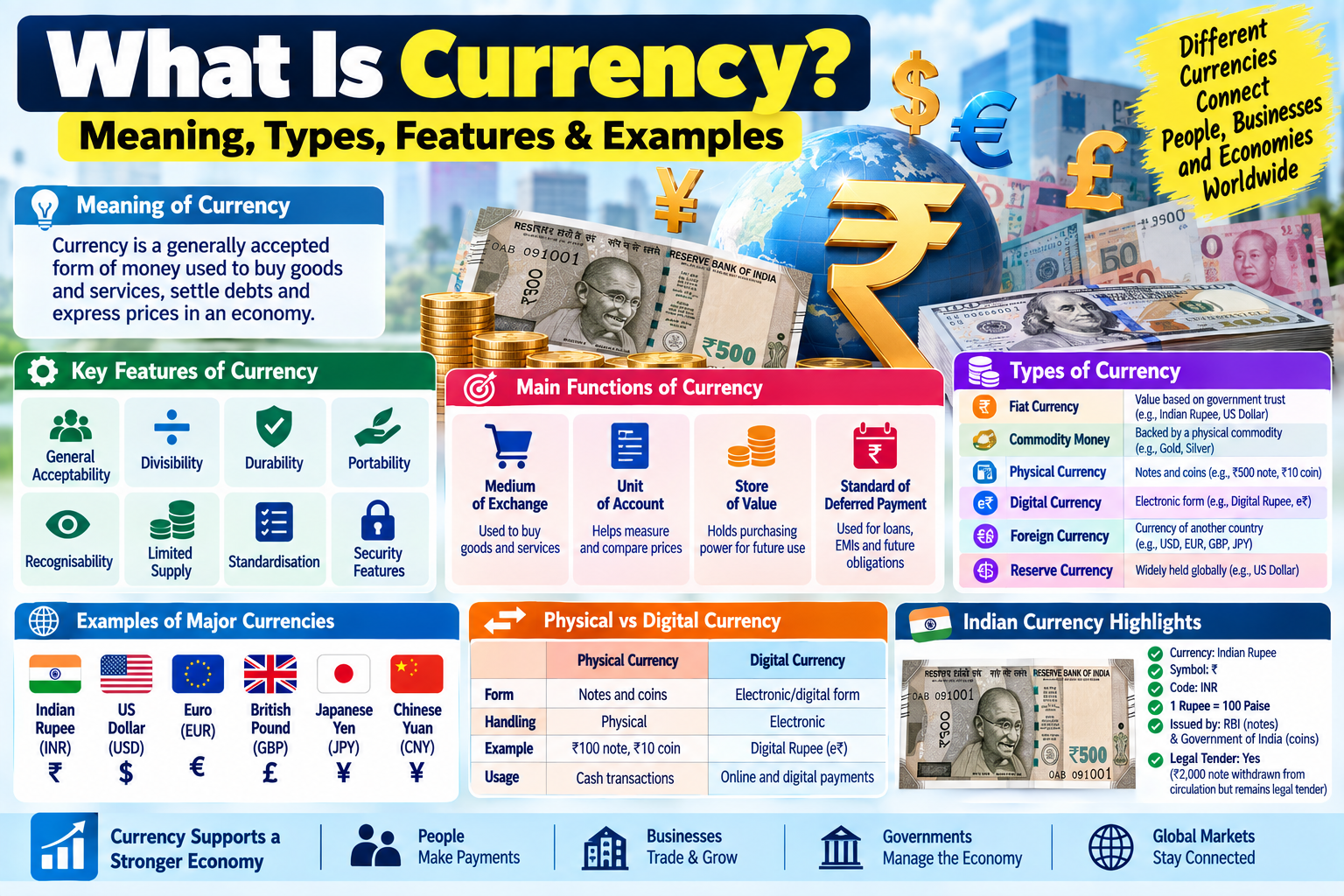
In simple terms, currency is a generally accepted form of money used to pay for goods and services, settle debts and express prices.
Every country may have its own official currency. In India, the official currency is the Indian rupee (INR), represented by the symbol ₹.
Currency can exist in physical forms such as banknotes and coins and can also be represented through electronic balances and, in a different technological form, central-bank digital currency.
The concept is closely connected with the broader idea of money. Money performs important economic functions such as acting as a medium of exchange, unit of account and store of value.
Understanding currency is useful for students, salaried individuals, borrowers, investors, business owners, importers, exporters and anyone who deals with domestic or international payments.
AI Answer Box: What Is Currency?
Currency is a form of money that is officially issued or recognised for use in an economy and is used to make payments, settle obligations and express the prices of goods and services.
For example, India's currency is the Indian rupee (₹/INR).
In simple words:
Currency = Money used for transactions within an economy.
Common examples include:
- Indian rupee (INR)
- US dollar (USD)
- Euro (EUR)
- British pound (GBP)
- Japanese yen (JPY)
- Australian dollar (AUD)
- Canadian dollar (CAD)
Currency can be physical, such as notes and coins, or exist in electronic and digital forms.
What Is Currency? Meaning and Definition
Currency refers to a monetary instrument or form of money that is widely accepted for purchasing goods and services and settling financial obligations.
In everyday language, people often use currency and money interchangeably. However, the two terms can have slightly different meanings.
Currency
Currency generally refers to the money used in circulation, especially physical notes and coins, although modern discussions may also include electronic and digital forms.
Money
Money is a broader economic concept.
Economists generally identify several functions of money:
- Medium of exchange
- Unit of account
- Store of value
- Standard of deferred payment
The IMF describes money in terms of these core economic functions.
Therefore:
Currency is part of the broader monetary system.
What Is the Indian Currency?
The currency of India is the Indian rupee, abbreviated as INR and represented by the symbol ₹.
According to the Reserve Bank of India, one rupee consists of 100 paise.
The Indian rupee plays several roles in the Indian economy:
- It is used to purchase goods and services.
- Prices are generally expressed in rupees.
- Salaries and wages are commonly denominated in rupees.
- Loans and EMIs are generally denominated in rupees.
- Taxes and government payments are commonly calculated in rupees.
- Domestic financial contracts use the rupee as the monetary unit.
The Reserve Bank of India is India's sole note-issuing authority, while the Government of India is responsible for issuing coins.
What Is the Currency Symbol of India?
The symbol of the Indian rupee is:
₹
The symbol was officially adopted in 2010.
It combines visual elements associated with the Devanagari letter र and the Latin capital letter R.
Currency Code
India's internationally recognised three-letter currency code is:
INR
For example:
- ₹1,000 = INR 1,000
- ₹50,000 = INR 50,000
Why Is Currency Important?
Currency makes modern economic activity much easier.
Imagine buying a smartphone without money.
You might have to find someone who owns the phone and simultaneously wants something you possess.
This is called the double coincidence of wants, one of the major problems associated with barter.
Currency helps solve this problem.
Instead of exchanging:
Rice → Clothes
or:
Labour → Food
people can use currency as an intermediary:
Labour → Currency → Food
This makes economic transactions faster and more flexible.
Functions of Currency
Currency performs several important functions in an economy.
1. Medium of Exchange
The primary function of currency is to facilitate transactions.
For example:
You give ₹500 to a shopkeeper.
The shopkeeper gives you products worth ₹500.
Currency acts as the medium through which the transaction takes place.
2. Unit of Account
Currency provides a common way to measure and compare prices.
For example:
- Mobile phone = ₹20,000
- Laptop = ₹60,000
- Rent = ₹15,000 per month
- Loan = ₹5 lakh
Without a common unit of account, comparing the value of different goods and services would be much harder.
3. Store of Value
Currency allows people to hold purchasing power for future use.
For example:
You receive ₹30,000 as salary.
You spend ₹20,000 and save ₹10,000.
The remaining amount can be used later.
However, inflation can reduce the purchasing power of money over time.
Therefore, currency is a store of value, but its real purchasing power can change.
4. Standard of Deferred Payment
Currency is also used to express future financial obligations.
For example:
- Home loan EMI
- Personal loan EMI
- Rent agreement
- Business loan
- Insurance premium
- Credit card repayment
A loan agreement may state that the borrower must repay ₹5 lakh plus applicable interest over a specified period.
Currency provides a common unit for those future payments.
What Are the Main Features of Currency?
A functional currency generally has several important characteristics.
1. General Acceptability
People should generally be willing to accept it for transactions.
2. Divisibility
Currency should be available in different denominations so that transactions of different values can be completed.
3. Durability
Physical currency should withstand reasonable handling and circulation.
4. Portability
Currency should be relatively convenient to carry and transfer.
5. Recognisability
Users should be able to identify genuine currency and distinguish denominations.
6. Limited Supply
The monetary system must be managed so that excessive creation of money does not undermine economic stability.
7. Standardisation
Units of currency should have clearly defined values.
8. Security
Modern banknotes include security features designed to make counterfeiting more difficult.
Features of Indian Currency
Indian banknotes contain several security and identification features.
Depending on denomination and series, these can include:
- Watermarks
- Security threads
- Colour-shifting features
- Raised printing
- Identification marks
- See-through registers
- Latent images
- Number panels
- Micro lettering
- Fluorescent features
RBI provides denomination-specific information about security features.
This is particularly important because counterfeit currency can cause financial losses and undermine confidence in the monetary system.
Types of Currency
Currency can be classified in several ways.
A simple classification is:
- Fiat currency
- Commodity-backed forms of money
- Representative money
- Physical currency
- Electronic money
- Digital currency
- Foreign currency
- Reserve currencies
Let's understand each one.
1. Fiat Currency
Fiat currency is money that derives its value primarily from legal and institutional recognition, confidence and its role within the monetary system rather than from being directly redeemable for a fixed quantity of a physical commodity such as gold.
Modern national currencies are generally fiat currencies.
Examples include:
- Indian rupee
- US dollar
- Euro
- British pound
- Japanese yen
The value of fiat currency depends on factors such as:
- Confidence
- Monetary policy
- Economic conditions
- Supply and demand
- Inflation
- Interest rates
- International trade
- Capital flows
2. Commodity Money
Commodity money is money that has value connected to the commodity itself.
Historically, examples have included:
- Gold
- Silver
- Salt
- Cattle
- Other valuable commodities
Commodity money played an important role in earlier monetary systems.
Modern economies generally rely on fiat monetary systems rather than using physical commodities as everyday currency.
3. Representative Money
Representative money historically represented a claim on an underlying commodity or asset.
For example, certain historical monetary systems used paper certificates that could be exchanged for precious metals.
Representative money differs from modern fiat currency because its value was connected to the underlying asset or redemption arrangement.
4. Physical Currency
Physical currency includes:
Banknotes
Paper or polymer-like monetary instruments issued under the relevant national monetary framework.
Coins
Metallic currency issued under government authority.
In India, coins are issued by the Government of India and circulated through the monetary system.
5. Electronic Money
Electronic money refers broadly to monetary value represented electronically.
Examples include:
- Bank account balances
- Electronic transfers
- Card payments
- Digital wallet balances
When you transfer ₹5,000 from one bank account to another electronically, no physical note necessarily changes hands.
The payment occurs through electronic systems.
6. Digital Currency
Digital currency is a broad term for monetary value represented in digital form.
It can refer to different technologies and systems.
One important category is central bank digital currency (CBDC).
India's CBDC is known as the Digital Rupee or e₹.
The Reserve Bank of India has been developing and operating pilots for the digital rupee.
Digital currency should not automatically be treated as synonymous with cryptocurrency.
Digital Rupee vs Cryptocurrency
These are different concepts.
| Feature | Digital Rupee | Cryptocurrency |
|---|---|---|
| Issuer | Central bank | Generally decentralised network/private ecosystem |
| Indian example | e₹ | Examples include Bitcoin and Ethereum |
| Monetary authority | RBI | No central monetary authority for decentralised cryptocurrencies |
| Legal framework | Issued under India's monetary system | Different regulatory and legal treatment |
| Technology | Digital payment/CBDC infrastructure | Blockchain or distributed-ledger systems |
| Main purpose | Digital form of sovereign money | Varies by cryptoasset |
The important point is:
A central bank digital currency is not the same thing as a cryptocurrency.
7. Foreign Currency
Foreign currency means the currency of another country or economic jurisdiction.
For an Indian resident, examples include:
- US dollar
- Euro
- British pound
- Japanese yen
- UAE dirham
- Singapore dollar
Foreign currencies are important for:
- International travel
- Imports
- Exports
- Overseas education
- International investments
- Remittances
- Foreign borrowing
- Cross-border business
8. Reserve Currency
A reserve currency is a currency widely held by governments and institutions as part of their foreign-exchange reserves.
The US dollar is the most prominent example of an international reserve currency.
Reserve currencies can be used for:
- International trade
- Foreign-exchange reserves
- International financial transactions
- Cross-border contracts
Currency Examples Around the World
| Country/Region | Currency | Code | Symbol |
|---|---|---|---|
| India | Indian Rupee | INR | ₹ |
| United States | US Dollar | USD | $ |
| European Union | Euro | EUR | € |
| United Kingdom | Pound Sterling | GBP | £ |
| Japan | Japanese Yen | JPY | ¥ |
| China | Renminbi/Yuan | CNY | ¥ |
| Australia | Australian Dollar | AUD | $ |
| Canada | Canadian Dollar | CAD | $ |
| Switzerland | Swiss Franc | CHF | Fr |
| Singapore | Singapore Dollar | SGD | $ |
| UAE | UAE Dirham | AED | د.إ |
Currency symbols can overlap between countries, so the three-letter ISO currency code is often useful for avoiding confusion.
What Is Currency Exchange?
Currency exchange is the process of converting one currency into another.
For example:
An Indian traveller going to the United States may exchange:
Indian rupees → US dollars
A US company buying goods from India may need to convert:
US dollars → Indian rupees
The conversion takes place according to an applicable exchange rate and may involve fees, spreads or other charges.
What Is an Exchange Rate?
An exchange rate tells you how much one currency is worth relative to another currency.
For example:
USD/INR
represents the value of the US dollar in Indian rupees.
If the quoted rate is:
₹90 per US$1
then:
US$1 = ₹90
and:
US$100 = ₹9,000
before considering any applicable fees or conversion spreads.
Exchange rates change because currencies are traded and influenced by economic and financial conditions.
What Causes Currency Exchange Rates to Change?
Currency values can change due to many factors.
1. Inflation
Differences in inflation between countries can influence currency values over time.
2. Interest Rates
Higher or lower interest rates can affect international capital flows and demand for a currency.
3. Economic Growth
Economic performance can influence investor confidence and capital movements.
4. Imports and Exports
Trade flows affect demand for foreign currencies.
5. Foreign Investment
Foreign portfolio and direct investment can influence demand for domestic currency.
6. Central Bank Policy
Central banks influence financial conditions through monetary policy and may participate in foreign-exchange markets.
7. Crude Oil Prices
For countries that import significant amounts of crude oil, changes in oil prices can influence the demand for foreign currency.
8. Political and Geopolitical Developments
Global uncertainty can affect capital flows and currency markets.
9. Foreign-Exchange Reserves
A country's foreign-exchange reserves can provide an important buffer in managing external pressures.
Currency Appreciation vs Currency Depreciation
These two terms are commonly used when discussing exchange rates.
Currency Appreciation
Currency appreciation means a currency becomes stronger relative to another currency.
Example:
If:
US$1 = ₹90
and later:
US$1 = ₹85
the rupee has appreciated against the dollar, assuming the quotation is interpreted in the standard way.
One dollar now requires fewer rupees.
Currency Depreciation
Currency depreciation means a currency becomes weaker relative to another currency.
Example:
If:
US$1 = ₹85
and later:
US$1 = ₹90
the rupee has depreciated against the dollar.
More rupees are required to purchase one dollar.
Appreciation vs Depreciation vs Devaluation
These terms are related but not identical.
| Term | Basic Meaning |
|---|---|
| Appreciation | Market-driven increase in currency value |
| Depreciation | Market-driven decrease in currency value |
| Revaluation | Official upward adjustment under a fixed or managed exchange-rate system |
| Devaluation | Official downward adjustment under a fixed or managed exchange-rate system |
For a market-determined currency, the terms appreciation and depreciation are generally more appropriate when describing market movements.
Currency vs Money: What Is the Difference?
People often ask:
"Is currency the same as money?"
Not exactly.
| Currency | Money |
|---|---|
| Often refers to notes, coins and monetary units used in circulation | Broader economic concept |
| Used to make payments | Performs several monetary functions |
| Can be physical or represented electronically | Includes forms of money beyond physical currency |
| Example: Indian rupee | Includes currency and qualifying monetary balances |
Simple Example
₹500 in your wallet is currency.
Your bank account balance is part of the broader monetary/payment system, but it is not a physical ₹500 note.
Therefore:
Currency is narrower than the overall concept of money.
Currency vs Cryptocurrency
| Currency | Cryptocurrency |
|---|---|
| Usually issued or recognised by a government/monetary authority | Usually issued through a decentralised or private protocol |
| Used as sovereign money in a country | Uses vary by cryptoasset |
| Example: INR | Example: Bitcoin |
| Central monetary authority generally manages national currency | Decentralised cryptocurrencies operate without a central monetary issuer |
| Subject to national monetary and legal frameworks | Subject to different and evolving regulatory frameworks |
A cryptocurrency should not automatically be described as a country's official currency.
Currency vs Digital Rupee
The digital rupee is a form of sovereign digital money issued by the RBI.
It is different from ordinary physical rupee notes because it is digital.
However, both are connected to India's sovereign monetary system.
Physical Rupee
- Notes
- Coins
- Tangible
- Used for physical transactions
Digital Rupee
- Digital representation of sovereign money
- Designed for electronic transactions
- Operates through RBI's CBDC framework
Legal Tender Meaning
Legal tender refers to a currency that is legally recognised for settling debts and obligations, subject to the applicable law and any specified limits or conditions.
In India, the RBI explains legal tender rules for banknotes and coins.
This is different from saying that every form of payment must be accepted in every commercial situation.
For example, a merchant may choose which payment methods to support for a transaction, while legal-tender rules determine the legal status of particular notes and coins.
Are Indian ₹10, ₹20, ₹50, ₹100, ₹200 and ₹500 Notes Legal Tender?
Yes, Indian banknotes in the relevant denominations remain legal tender under the applicable RBI framework.
The ₹2 and ₹5 banknotes are no longer printed as regular banknotes, having been effectively coinised, although older notes can remain legal tender.
The ₹1 note is issued by the Government of India and is also legal tender.
The ₹2,000 banknote has been withdrawn from circulation but continues to be legal tender.
This distinction is important:
Withdrawn from circulation ≠ Demonetised
A note can be withdrawn from active circulation while still retaining its legal-tender status.
What Happened to the ₹2,000 Note?
The RBI announced the withdrawal of ₹2,000 denomination banknotes from circulation in May 2023.
The objective was not to immediately remove their legal-tender status.
The RBI stated that the ₹2,000 banknote would continue to be legal tender.
By January 31, 2025, the RBI reported that 98.15% of the ₹2,000 banknotes in circulation as of May 19, 2023 had been returned, leaving ₹6,577 crore in circulation at that date.
The facility for exchange/deposit through RBI Issue Offices has continued under the applicable arrangements.
This is an important example of why withdrawal from circulation and demonetisation are not the same thing.
Indian Currency Denominations
India has currency in both banknote and coin forms.
Common banknote denominations
- ₹10
- ₹20
- ₹50
- ₹100
- ₹200
- ₹500
The ₹2,000 denomination remains legal tender but has been withdrawn from circulation.
Coin denominations
RBI information lists coins in denominations including:
- 50 paise
- ₹1
- ₹2
- ₹5
- ₹10
- ₹20
Older denominations can have different circulation histories, so users should rely on current RBI notifications when determining the status of a particular coin or note.
Who Issues Currency in India?
Currency management in India involves both the Reserve Bank of India and the Government of India.
RBI
The RBI is India's sole note-issuing authority, subject to the legal framework governing currency.
Government of India
The Government is responsible for coin issuance and also issues the ₹1 note.
This division is important when discussing Indian currency.
How Is Currency Created?
Currency creation is part of a much broader monetary and banking system.
At the central-bank level, currency and reserves form part of the monetary base.
Commercial banks also create deposits through lending and other banking activities.
Therefore, it is too simplistic to think:
"Money exists only when the government prints notes."
Modern economies use a combination of:
- Physical currency
- Bank deposits
- Electronic payment balances
- Central-bank money
- Other monetary instruments
The amount of money in an economy and its growth are important considerations for monetary policy and economic activity.
Currency and Inflation
Currency and inflation are closely connected to purchasing power.
Inflation
Inflation means a sustained increase in the general price level of goods and services.
When prices rise:
₹1,000 today may buy less than ₹1,000 bought several years ago.
This means the purchasing power of currency can decline.
Example
Suppose a grocery basket costs:
₹1,000
Today.
If the same basket costs:
₹1,100
later, the purchasing power of ₹1,000 has declined relative to that basket.
This is why simply holding cash may not preserve purchasing power over long periods when inflation is significant.
Currency and Interest Rates
Interest rates can influence currency markets.
Suppose interest rates in one country become relatively more attractive.
International investors may increase demand for assets denominated in that country's currency, although the actual relationship depends on many factors.
Central-bank policy can therefore affect:
- Currency demand
- Bond yields
- Capital flows
- Inflation expectations
- Investment decisions
- Exchange rates
For India, RBI monetary policy is an important part of the broader economic environment.
Currency and International Trade
Currency is essential for international trade.
Imagine an Indian importer purchasing machinery from Germany.
The Indian company may need to pay in euros or another agreed currency.
It therefore needs access to foreign exchange.
Similarly, an Indian exporter receiving payment from an overseas buyer may receive foreign currency and later convert it into rupees.
Currency exchange therefore connects domestic economies with global trade.
Currency and Foreign Exchange Reserves
Foreign-exchange reserves are assets held by a country's monetary authority and used for external financial resilience and foreign-exchange management.
India's reserves can include:
- Foreign currency assets
- Gold
- Special Drawing Rights
- Reserve position in the IMF
Foreign-exchange reserves can help a country manage external shocks and support confidence in its ability to meet international payment obligations.
Currency in Personal Finance
Currency is not just an economics concept.
It affects everyday financial decisions.
Salary
Your salary is generally denominated in rupees in India.
Loans
Your loan principal and EMI are usually expressed in rupees.
Investments
Returns from Indian investments are commonly measured in rupees.
Travel
International travel may require conversion into foreign currency.
Remittances
Money sent to or received from another country involves foreign-exchange conversion.
Gold
Gold prices in India are influenced by both international gold prices and currency movements, among other factors.
Real-World Example: Currency and an Overseas Trip
Suppose you are travelling from India to the United States.
You have:
₹90,000
Assume the exchange rate is:
US$1 = ₹90
Ignoring fees and spreads:
₹90,000 ÷ ₹90
= US$1,000
If the rupee weakens and the exchange rate becomes:
US$1 = ₹95
the same ₹90,000 would convert to approximately:
₹90,000 ÷ ₹95
= US$947.37
This illustrates why currency movements matter to international travellers.
Actual conversion rates can differ because banks, money changers and payment providers may apply spreads, commissions or other charges.
Real-World Example: Currency and Imported Products
Suppose an Indian company imports equipment priced at:
US$10,000
At:
US$1 = ₹85
the rupee value is:
₹8,50,000
If the exchange rate changes to:
US$1 = ₹90
the same equipment costs:
₹9,00,000
The difference is:
₹50,000
before considering taxes, shipping, financing and other costs.
This demonstrates how currency movements can affect importers and ultimately influence business costs.
Real-World Experience: Why Currency Matters to Ordinary People
You do not have to trade forex to be affected by currency movements.
Currency changes can indirectly influence:
- Travel expenses
- Imported electronics
- Fuel-related costs
- Education abroad
- International subscriptions
- Overseas investments
- Imported raw materials
- Gold prices
- Business costs
This is why understanding currency is useful even for people who never directly buy or sell foreign currency.
Advantages of Currency
1. Makes Transactions Easier
Currency eliminates many problems associated with barter.
2. Provides a Common Pricing Unit
Products and services can be compared using a common monetary unit.
3. Supports Credit
Loans and future obligations can be denominated in currency.
4. Supports Trade
Currency facilitates domestic and international commerce.
5. Portable
Physical and electronic forms can be transferred relatively easily.
6. Supports Economic Planning
Businesses and households can prepare budgets and financial plans using monetary values.
Disadvantages and Limitations of Currency
Currency also has limitations.
1. Inflation Can Reduce Purchasing Power
The same amount of money may buy fewer goods over time.
2. Exchange Rates Can Fluctuate
Foreign currency transactions can become more expensive or cheaper.
3. Counterfeiting Risk
Physical currency can be counterfeited, which is why security features are important.
4. Currency Can Be Misused
Cash can be involved in fraud, money laundering and other illegal activities.
5. Currency Risk
Businesses with international exposure can face foreign-exchange gains or losses.
6. Transaction Costs
Currency conversion may involve spreads and fees.
Physical Currency vs Digital Money
| Feature | Physical Currency | Digital Money |
|---|---|---|
| Form | Notes and coins | Electronic/digital records |
| Physical handling | Required | Not normally required |
| Payment method | Cash | Electronic transfer/payment |
| Storage | Wallet/cash storage | Bank/payment account or digital system |
| Convenience | Useful for cash transactions | Useful for remote payments |
| Examples | ₹100 note, ₹10 coin | Bank balance, digital payment balance |
| Technology dependence | Lower at point of exchange | Higher |
Both forms can coexist within the same monetary system.
Fiat Currency vs Commodity Money
| Feature | Fiat Currency | Commodity Money |
|---|---|---|
| Value basis | Monetary/legal/institutional system and confidence | Value connected to commodity |
| Modern usage | Dominant in modern economies | Limited for everyday national currency |
| Example | INR, USD, EUR | Historical gold/silver money |
| Supply | Managed through monetary system | Linked partly to commodity availability |
| Everyday payments | Common | Generally uncommon today |
Currency vs Exchange Rate
These terms should not be confused.
Currency
The monetary unit itself.
Example:
Indian rupee (INR)
Exchange Rate
The price of one currency expressed in another currency.
Example:
USD/INR = ₹90 per US$1
So:
INR = Currency
USD/INR = Exchange-rate quotation
How to Identify an Indian Banknote
When handling an Indian banknote, users can look at its:
- Denomination
- Colour
- Portrait/design elements
- Security thread
- Watermark
- Number panel
- Raised printing
- Identification features
- Other denomination-specific security elements
RBI provides official guidance on security features.
If a note appears suspicious, it should not simply be passed to another person. Follow the appropriate banking and RBI procedures.
Why Currency Confidence Matters
A currency works effectively when people trust that it can be used to obtain goods, services and financial assets.
Confidence can be influenced by:
- Economic stability
- Inflation
- Monetary policy
- Fiscal conditions
- Financial-system strength
- Political and institutional stability
- External-sector conditions
A currency does not function effectively merely because notes are printed.
It depends on a wider economic and institutional framework.
Expert Commentary: Think of Currency as an Economic Infrastructure
Currency is more than cash.
It is the common language through which an economy measures value.
When a business says a product costs ₹50,000, a bank quotes a ₹5 lakh loan, a worker receives a ₹40,000 salary or an investor calculates a ₹1 lakh return, all of these transactions use the currency as a common unit of measurement.
This is why currency connects:
Consumers → Businesses → Banks → Government → Investors → International Markets
Understanding currency therefore provides a foundation for understanding inflation, interest rates, exchange rates, loans, investments and international finance.
Frequently Asked Questions
1. What is currency in simple words?
Currency is a form of money used to buy goods and services, make payments and settle financial obligations.
2. What is the currency of India?
The currency of India is the Indian rupee, represented by the symbol ₹ and identified internationally by the code INR.
3. What are the main functions of currency?
Currency performs important monetary functions including acting as a medium of exchange, unit of account, store of value and means of expressing deferred payments.
4. What are the types of currency?
Currency and money can be classified in different ways, including fiat currency, commodity money, physical currency, electronic money, digital currency and foreign currency.
5. Is currency the same as money?
Currency is often used to refer to notes and coins or a monetary unit, while money is a broader economic concept that includes the functions and forms of money used in an economy.
6. What is fiat currency?
Fiat currency is money whose value is not based on direct redemption for a fixed quantity of a commodity such as gold and which operates through government, monetary and financial institutions and public confidence.
7. What is legal tender?
Legal tender is money that is legally recognised for settling debts or obligations under applicable law, subject to specified rules and limits.
8. Is the ₹2,000 note still legal tender?
Yes. The RBI has stated that ₹2,000 banknotes remain legal tender even though they were withdrawn from circulation.
9. What is the currency symbol of India?
The Indian rupee symbol is ₹.
10. What is India's currency code?
The international three-letter currency code for the Indian rupee is INR.
11. What is foreign currency?
Foreign currency means the currency of another country or monetary jurisdiction. For an Indian resident, examples include the US dollar, euro and British pound.
12. What is currency depreciation?
Currency depreciation means a currency loses value relative to another currency in the market. For example, if USD/INR rises from ₹85 to ₹90, the rupee has depreciated against the US dollar.
13. What is currency appreciation?
Currency appreciation means a currency gains value relative to another currency. For example, if USD/INR falls from ₹90 to ₹85, the rupee has appreciated against the dollar.
14. What is the difference between currency and cryptocurrency?
Currency is generally sovereign money issued or recognised within a national monetary system. Cryptocurrency is a separate class of digital asset that may operate using blockchain or distributed-ledger technology.
15. Why is currency important?
Currency makes transactions easier, provides a common unit for pricing, supports credit and trade, and helps households and businesses measure and manage financial value.
Published on : 28th september
Published by : G REDDY KUMAR
www.vizzve.com || www.vizzveservices.com
Follow us on social media: Facebook || Linkedin || Instagram
🛡 Powered by Vizzve Financial
RBI-Registered Loan Partner | 10 Lakh+ Customers | ₹600 Cr+ Disbursed