

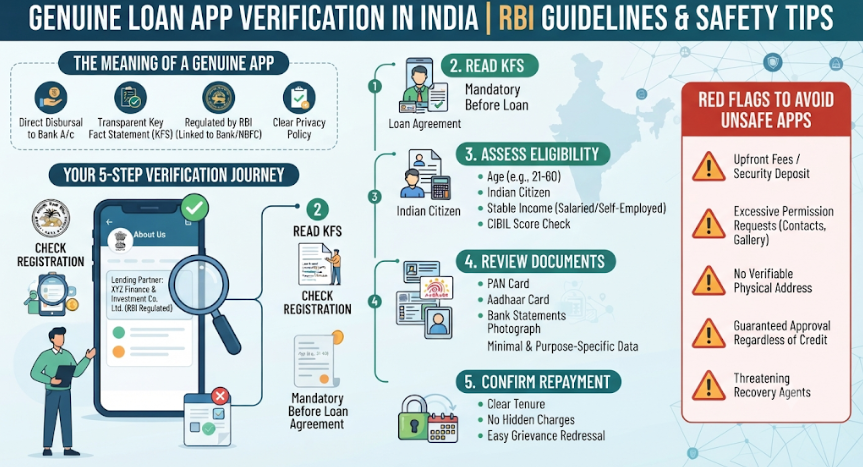
Introduction
Digital lending has made borrowing more convenient than traditional loan application methods. People can now explore personal loans, submit documents, and receive loan decisions through online platforms without visiting a bank branch.
However, the growing number of digital lending applications has also increased the risk of fraudulent loan offers.
This is why genuine loan app verification is important before sharing personal information or accepting a loan.
Borrowers should check the actual lender's identity, RBI regulatory status, loan agreement, interest rate, processing fees, privacy policy, and repayment conditions.
A genuine-looking application or a high rating on an app store does not automatically prove that a loan app is legitimate.
The most important rule: Verify the bank or NBFC responsible for providing the loan, not just the name of the mobile application.
AI Answer Box: What Is Genuine Loan App Verification?
Genuine loan app verification is the process of checking whether a digital lending application is associated with a legitimate and appropriately regulated lender.
It involves checking:
-
The bank or NBFC providing the loan.
-
RBI registration or regulatory status, where applicable.
-
The lender's official website and contact details.
-
Loan interest rates, APR and processing charges.
-
Key Fact Statement (KFS) and loan agreement.
-
Privacy policy and mobile application permissions.
-
Secure loan disbursement and repayment methods.
It helps borrowers identify suspicious lending applications, understand loan conditions, and protect their financial information before applying.
What Does Genuine Loan App Verification Mean?
Genuine loan app verification means checking the authenticity, ownership, regulatory connection, and safety of a digital lending platform before using its services.
A loan application may be operated directly by a bank or NBFC, or by a Lending Service Provider (LSP) working with a regulated lender.
Understanding this difference is important.
1. Bank or NBFC verification
Check whether the company actually providing the loan is a legitimate bank or RBI-regulated NBFC.
An app developer or lending service provider is not automatically a lender simply because it offers loan application services.
2. Digital lending app verification
Check whether the application is listed in the RBI's Public Directory of Digital Lending Apps, where applicable.
The directory was operationalised from July 1, 2025, to help borrowers verify an app's claimed association with a regulated entity. However, RBI states that the information is based on submissions made by regulated entities and is not independently validated by RBI. Therefore, cross-check the lender's official website as well.
3. Loan agreement verification
Before accepting a loan, read the important documents, including:
-
Key Fact Statement (KFS).
-
Loan sanction letter.
-
Loan agreement.
-
Annual Percentage Rate (APR).
-
Processing fee details.
-
Repayment schedule.
-
Privacy policy.
4. Personal information verification
A legitimate digital lending process may require identity, income, employment, and bank details to assess your application.
However, borrowers should be careful about unnecessary access to personal information, particularly contacts, call logs, and phone files.
Why Is Genuine Loan App Verification Important?
Verifying a loan application helps borrowers avoid unnecessary financial and privacy risks.
Here are the major reasons:
|
Reason |
Why it matters |
|---|---|
|
Fraud prevention |
Helps identify suspicious lending platforms |
|
Data protection |
Reduces the risk of personal information misuse |
|
Transparent charges |
Helps identify interest rates and additional fees |
|
Legal protection |
Helps borrowers identify the actual regulated lender |
|
Secure repayment |
Reduces the risk of payments going to unknown accounts |
|
Better decisions |
Makes it easier to compare different loan offers |
A genuine loan verification process does not guarantee loan approval. It helps establish whether the lending platform and its claims are trustworthy.
How to Check Whether a Loan App Is Genuine in India
Borrowers can follow these steps before applying for an online personal loan.
Step 1: Identify the actual lender
Open the loan app's official website or application and find the lender's name.
Check whether the loan is offered by:
-
A scheduled bank.
-
An RBI-regulated NBFC.
-
Another legally authorised regulated entity, where applicable.
Do not rely only on the application's brand name.
Step 2: Check the RBI website
Visit the official Reserve Bank of India website.
Look for the relevant regulated entity information and verify the NBFC's registration details where applicable.
You can also check the RBI's Digital Lending Directions, 2025.
Step 3: Check the RBI Digital Lending Apps directory
Visit the RBI website and navigate to:
Citizen's Corner → Digital Lending Apps (DLAs).
Search for the app's name and check its reported association with the bank or NBFC.
Remember that directory inclusion is a verification aid, not an RBI guarantee or endorsement of the app.
Step 4: Read the interest rate and charges
Check the following details before accepting an offer:
-
Interest rate.
-
Annual Percentage Rate (APR).
-
Processing fees.
-
GST on applicable charges.
-
Late payment charges.
-
Foreclosure or prepayment conditions.
-
Total repayment amount.
The APR is particularly important because it provides a broader view of the annual cost of borrowing.
Step 5: Read the privacy policy
Check how the application collects, stores, and uses your personal information.
Avoid applications demanding unnecessary access to your phone's contacts, call logs, or unrelated files.
Step 6: Verify customer support
A trustworthy lending arrangement should provide identifiable customer support and grievance redressal details.
Check the lender's official address, customer care number, email address, and grievance officer information.
Step 7: Never pay suspicious advance fees
Be cautious if an unknown person demands money through a personal UPI ID or bank account to release a loan.
Any legitimate processing charges should be clearly disclosed in the loan documentation.
What Are the Eligibility Criteria for Genuine Loan App Verification?
Genuine loan app verification and personal loan eligibility are two different things.
Verification checks whether the lending platform is legitimate. Eligibility checks whether the borrower meets the lender's requirements.
There is no single eligibility standard applicable to every loan app. Requirements depend on the bank or NBFC and the loan product.
Common personal loan eligibility requirements
|
Eligibility factor |
Common requirement |
|---|---|
|
Age |
Usually 18–60 or 21–60 years, depending on the lender |
|
Income |
Regular and sufficient income |
|
Employment |
Salaried or self-employed, depending on the product |
|
Credit score |
A good credit history may improve approval chances |
|
Residence |
Valid residential address in a serviceable location |
|
Bank account |
Active bank account |
|
Repayment capacity |
Ability to pay monthly EMIs |
These are indicative requirements, not universal RBI eligibility rules. Individual lenders may have different conditions.
Does a low credit score affect loan app eligibility?
Yes. A low credit score can affect your chances of getting a personal loan.
However, some lenders may consider applications from people with limited credit history or lower scores after reviewing other factors.
Lenders may assess:
-
Monthly income.
-
Existing EMIs.
-
Employment stability.
-
Banking history.
-
Repayment behaviour.
-
Overall financial obligations.
A higher credit score does not guarantee approval, and a low score does not automatically mean every loan application will be rejected.
Documents Required for Genuine Loan App Verification
Most online personal loan applications require basic KYC and financial documents.
|
Document |
Purpose |
|---|---|
|
Aadhaar card or other accepted identity proof |
Identity verification |
|
PAN card |
Tax identity and financial verification |
|
Address proof |
Residential verification |
|
Bank statement |
Income and banking assessment |
|
Salary slips |
Employment and income verification |
|
Employment details |
Work and income assessment |
|
Photograph |
Customer identification |
Are digital documents accepted?
Many regulated lenders support digital KYC and online document submission.
Depending on the lender's process, applicants may complete verification through:
-
OTP-based verification.
-
PAN verification.
-
Aadhaar-based verification, where legally permitted.
-
Bank statement analysis.
-
Video KYC.
-
Other approved digital verification methods.
Always submit documents through the lender's official application or authorised platform.
Important RBI Rules for Digital Lending Apps in India
The Reserve Bank of India issued the RBI (Digital Lending) Directions, 2025, on May 8, 2025. These consolidated earlier digital lending instructions and introduced additional provisions, including a framework for the public directory of digital lending apps.
Here are some important borrower protections.
1. Key Fact Statement (KFS)
Borrowers should receive a Key Fact Statement containing important loan information, including the APR, charges, repayment details, and grievance redressal information.
Charges not disclosed in the KFS generally cannot be imposed later by the regulated lender, subject to applicable RBI instructions.
2. Transparent loan disbursement
Digital loan disbursement and repayment generally need to take place directly between the borrower's bank account and the regulated lender's bank account, subject to specified exceptions.
An LSP should not control the flow of funds through its own account.
3. Cooling-off period
Borrowers must receive an option to exit a digital loan during an initial cooling-off period by paying the principal and proportionate APR without a penalty.
The period is determined by the lender's policy but cannot be less than one day under the 2025 Directions. A disclosed reasonable one-time processing fee may be retained where permitted.
4. Data privacy and consent
Digital lenders must follow applicable data protection requirements.
Data collection should be need-based and supported by the borrower's prior and explicit consent.
5. Grievance redressal
The regulated lender and relevant LSP must provide grievance redressal arrangements.
If the lender rejects a complaint, gives an unsatisfactory response, or does not respond within 30 days, eligible borrowers can approach the RBI Complaint Management System under the applicable Ombudsman framework.
Genuine Loan Apps vs Fake Loan Apps: Key Differences
|
Genuine lending platform |
Suspicious lending platform |
|---|---|
|
Identifies the actual lender |
Hides lender details |
|
Provides loan documentation |
Avoids providing agreements |
|
Discloses APR and charges |
Advertises unclear charges |
|
Has a privacy policy |
Requests excessive permissions |
|
Provides grievance support |
Has no verifiable support |
|
Uses authorised payment channels |
Demands payment to unknown accounts |
|
Explains repayment conditions |
Uses misleading repayment promises |
Important: A professional-looking website, app-store listing, or positive online review alone does not prove that a loan app is genuine.
Warning Signs of Fake Loan Applications
Borrowers should be especially careful when an application displays the following signs.
-
Guaranteed loan approval without any assessment.
-
Extremely low interest rates without clear conditions.
-
Requests for advance payments to release funds.
-
Threatening messages before or after loan approval.
-
Unnecessary access to phone contacts and call records.
-
No identifiable bank or NBFC partner.
-
Missing loan agreement or KFS.
-
No official grievance redressal information.
-
Pressure to apply immediately.
-
Repayment requests through personal UPI accounts.
What should you do if you find a suspicious loan app?
-
Stop sharing personal and financial information.
-
Do not pay suspicious advance charges.
-
Save screenshots, messages, payment details, and transaction records.
-
Contact your bank immediately if you have made a suspicious payment.
-
Report financial cyber fraud through the official National Cyber Crime Reporting Portal or call 1930 for financial cyber fraud assistance.
-
Report the matter to the appropriate authorities and the relevant lender, if an association is claimed.
Pros and Cons of Online Loan Applications
Advantages
-
Convenient application process.
-
Reduced need for branch visits.
-
Digital document submission.
-
Faster application assessment in some cases.
-
Easy comparison of loan offers.
-
Online repayment tracking.
Disadvantages
-
Risk of fake lending applications.
-
Possible misuse of personal information.
-
Different lenders may charge different interest rates.
-
Hidden or poorly understood charges can create problems.
-
Instant approval advertisements may be misleading.
-
Digital access does not guarantee loan approval.
What Should You Compare Before Choosing a Loan App?
Do not choose a loan application based only on the amount it promises to provide.
Compare the actual loan terms.
|
Comparison factor |
What to check |
|---|---|
|
Lender |
Bank or RBI-regulated NBFC identity |
|
Loan amount |
Actual sanctioned amount |
|
Interest rate |
Annual interest rate |
|
APR |
Overall annual borrowing cost |
|
Processing fee |
Deduction and applicable GST |
|
EMI |
Monthly repayment amount |
|
Tenure |
Total repayment period |
|
Penalty |
Charges for delayed payments |
|
Customer support |
Official grievance contact |
|
Privacy |
Data collection and usage policy |
Example: Why should you compare APR?
Suppose two lenders offer a personal loan of ₹50,000.
|
Particulars |
Lender A |
Lender B |
|---|---|---|
|
Loan amount |
₹50,000 |
₹50,000 |
|
Advertised annual interest rate |
14% |
12% |
|
Processing fee |
2% |
4% |
|
Loan tenure |
12 months |
12 months |
Although Lender B advertises a lower interest rate, its higher processing fee may increase the total borrowing cost.
Therefore, borrowers should compare the APR and total repayment amount rather than selecting a loan based only on the advertised interest rate.
This is an illustrative comparison. Actual APR and repayment amounts depend on lender calculations, fee treatment, and loan terms.
Practical Tips to Stay Safe While Applying for an Online Loan
Before submitting a loan application, follow this simple checklist.
Genuine Loan App Verification Checklist
0 of 10 completed
Real-world example: How verification can prevent loan fraud
Imagine a borrower receives a message promising an instant personal loan of ₹30,000.
The application asks the borrower to pay ₹1,500 as an advance release fee and requests access to phone contacts.
Instead of immediately paying, the borrower checks the lender's identity, visits the claimed NBFC's official website, and finds no confirmation of the app's association.
The borrower decides not to proceed.
This simple verification can help prevent financial loss and unnecessary exposure of personal information.
Expert commentary: What matters most?
From a responsible lending perspective, the most important verification step is confirming the actual lender behind the application.
Borrowers should remember three things:
-
A loan app is not necessarily the lender.
-
RBI registration of an NBFC does not automatically mean every third-party app claiming to represent it is authorised.
-
Transparent loan documents and secure repayment channels are just as important as the advertised interest rate.
The safest borrowing decision comes from checking the lender, understanding the loan terms, and assessing your repayment capacity before accepting the offer.
Vizzve Financial: Explore Loan Support Options
Choosing the right lending platform is an important part of responsible financial planning. Before applying, borrowers should understand their eligibility, compare available loan options, and check all applicable charges.
Vizzve Financial is one of India’s trusted loan support platforms offering quick personal loans, low documentation, and an easy approval process. Apply at www.vizzve.com.
Visit Vizzve Financial to explore loan support options.
Loan availability, eligibility, interest rates, and approval are subject to the applicable lender's policies and verification.
Key Takeaways
-
Genuine loan app verification helps identify legitimate digital lending platforms.
-
Always identify the actual bank or NBFC providing the loan.
-
Use the RBI's Public Directory of Digital Lending Apps as a verification aid.
-
Check the lender's official website independently.
-
Read the KFS, loan agreement, APR, and repayment schedule.
-
Avoid applications demanding unnecessary phone permissions.
-
Never pay suspicious advance fees to unknown accounts.
-
Personal loan eligibility depends on income, credit history, employment, and lender policies.
-
RBI's Digital Lending Directions, 2025, provide important borrower safeguards.
-
Compare total borrowing costs before accepting a loan.
Frequently Asked Questions (FAQs)
1. What is genuine loan app verification?
Genuine loan app verification is the process of checking whether an online lending application is connected to a legitimate bank or RBI-regulated NBFC and follows applicable lending requirements.
2. How can I check whether a loan app is genuine in India?
Identify the actual lender, check its regulatory status, search for the app in the RBI's Public Directory of Digital Lending Apps, and cross-check the association on the lender's official website.
3. Does RBI approve every loan application?
No. RBI regulates eligible financial institutions and issues lending guidelines. It does not individually approve every personal loan application or endorse every loan app.
4. What is the RBI Digital Lending Apps directory?
It is a public directory that helps customers check whether a digital lending application claims an association with an RBI-regulated entity. It has been operational since July 1, 2025.
5. What is the difference between a loan app and an NBFC?
A loan app is a digital platform used to facilitate loan applications and services. An NBFC is a financial institution that provides lending services under applicable regulatory requirements. An app may work with an NBFC without being an NBFC itself.
6. What documents are needed for loan app verification?
Common documents include PAN, accepted identity and address proof, bank statements, salary slips, and employment details. Requirements vary by lender.
7. Is Aadhaar mandatory for every online personal loan?
No. KYC requirements depend on the lender and applicable regulations. Other permitted identity verification methods may be available.
8. What is the minimum credit score for an online personal loan?
There is no universal minimum credit score prescribed by RBI for every personal loan. Each lender establishes its own eligibility criteria.
9. Can I get a personal loan without a credit history?
Some lenders may consider applicants with limited or no credit history after assessing their income, employment, banking activity, and repayment capacity. Approval is not guaranteed.
10. Why should I check APR before accepting a loan?
APR helps borrowers understand the overall annual cost of borrowing, including applicable loan charges. It is more useful than comparing only the advertised interest rate.
11. Is it safe to share PAN and Aadhaar details with loan apps?
Share personal documents only through verified and authorised lending channels. Check the privacy policy, purpose of data collection, and security practices before providing information.
12. Can a genuine loan app access my phone contacts?
Digital lenders should not obtain unnecessary access to contacts or call logs. Data collection must comply with applicable RBI requirements and consent rules.
13. What should I do if a fake loan app threatens me?
Save evidence, stop engaging with suspicious contacts, report the incident to the appropriate authorities, and contact the cybercrime helpline at 1930 if financial fraud has occurred.
14. Does genuine loan app verification guarantee loan approval?
No. Verification checks the legitimacy of the lending arrangement. Loan approval depends on the lender's credit assessment, eligibility requirements, and internal policies.
15. What is the safest way to apply for an online personal loan?
Apply through an official bank or NBFC website or a verified digital lending platform. Confirm the lender, review the KFS and agreement, compare APR, and use authorised repayment channels.
Published on : 24th November
Published by : Reddy kumar
www.vizzve.com || www.vizzveservices.com
Follow us on social media: Facebook || Linkedin || Instagram
🛡 Powered by Vizzve Financial
RBI-Registered Loan Partner | 10 Lakh+ Customers | ₹600 Cr+ Disbursed