

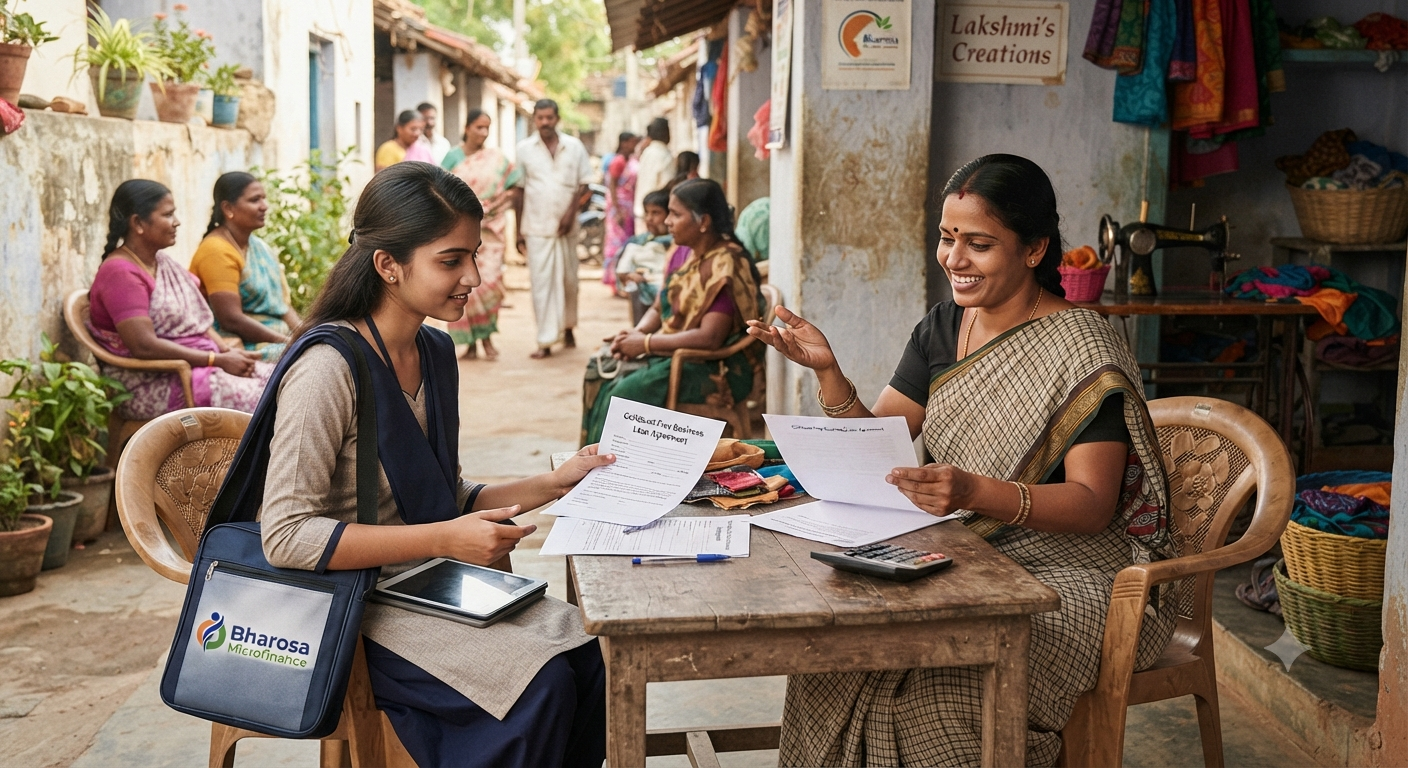
Microfinance plays an important role in improving financial access for low-income households, small business owners, women entrepreneurs and people living in rural and semi-urban areas. It provides access to small financial services, particularly credit, to individuals who may have limited access to traditional banking facilities.
In India, microfinance supports financial inclusion by helping people access loans for income-generating activities, small businesses, agriculture-related needs and household requirements.
Understanding the meaning of microfinance, eligibility criteria, loan features, interest rates and repayment conditions can help borrowers make informed financial decisions.
1. What Is Microfinance in India? Meaning and Overview
Microfinance refers to financial services designed primarily for low-income individuals and households who may not have easy access to conventional banking services.
These services can include:
-
Small-value loans
-
Savings-related services
-
Microinsurance
-
Financial literacy support
-
Other basic financial services
In India, microfinance institutions (MFIs), banks, small finance banks and certain non-banking financial companies provide microfinance-related services.
The main objective is to support financial inclusion by providing access to suitable financial products for underserved communities.
Example: A woman running a small tailoring business in a rural area may need funds to purchase a sewing machine or additional materials. A microfinance loan can help her invest in the business and potentially increase her income.
2. How Does Microfinance Work in India?
Microfinance generally follows a structured lending process designed to assess borrowers' financial needs and repayment capacity.
Step 1: Identify the Financial Requirement
The borrower identifies the purpose of borrowing, such as expanding a small business, purchasing equipment or meeting another eligible financial requirement.
Step 2: Contact a Microfinance Institution
The applicant approaches a bank, NBFC-MFI, small finance bank or another eligible lending institution offering microfinance products.
Step 3: Complete the Application
The borrower provides basic personal, household and income-related information.
Step 4: Complete KYC Verification
The financial institution verifies the applicant's identity and other required details using accepted KYC documents.
Step 5: Household Income and Repayment Assessment
The lender evaluates household income, existing loan obligations and repayment capacity before making a lending decision.
Step 6: Loan Approval and Disbursal
If the applicant meets the applicable requirements, the lender may approve and disburse the loan according to the agreed terms.
Step 7: Repay According to the Schedule
Borrowers repay the loan through the agreed instalment schedule. They should maintain sufficient funds to meet repayment commitments on time.
3. Microfinance Loan Eligibility Criteria in India
Microfinance eligibility depends on the lender's policies, the borrower's financial circumstances and applicable RBI regulations.
Under the RBI framework, a microfinance loan is a collateral-free loan given to a household with an annual household income of up to ₹3 lakh. The household includes the husband, wife and unmarried children.
Common eligibility considerations include:
-
Household Income: Annual household income must fall within the applicable ₹3 lakh threshold for classification as a microfinance loan.
-
Age: Applicants must meet the lender's minimum age requirements.
-
Identity Proof: Valid KYC documents must be provided.
-
Income Assessment: The lender evaluates household income and financial circumstances.
-
Existing Loans: Current borrowing and repayment obligations are considered.
-
Repayment Capacity: Applicants should have sufficient household income to manage instalments.
Eligibility is assessed by the lending institution. Meeting the income definition alone does not guarantee loan approval.
4. Documents Required for Microfinance Loans
Applicants may be asked to provide the following documents:
|
Document |
Purpose |
|---|---|
|
Aadhaar or accepted identity proof |
Identity verification |
|
PAN, where applicable |
Financial identification |
|
Address proof |
Residential verification |
|
Bank account details |
Loan-related transactions |
|
Income information |
Household income assessment |
|
Mobile number |
Communication and verification |
|
Photographs, if required |
Applicant identification |
The exact documentation requirements depend on the institution and its KYC policies.
5. Important Features and Key Facts About Microfinance
Microfinance has several features that distinguish it from conventional lending.
Collateral-Free Lending: RBI-defined microfinance loans are provided without collateral or security.
Small-Value Credit: These loans are generally designed around the financial requirements of low-income households.
Household-Based Assessment: Lenders assess household income and total repayment obligations rather than considering only the individual applicant.
Flexible Repayment: Regulated lenders must have policies providing flexibility in repayment periodicity according to borrowers' requirements.
Financial Inclusion: Microfinance helps underserved communities access formal financial services.
Different Lending Institutions: Banks, small finance banks and NBFC-MFIs are among the institutions that provide microfinance loans.
6. Interest Rates, EMI and Repayment Rules
Microfinance borrowers should understand the total cost of borrowing before accepting a loan.
Important financial factors include:
-
Interest rate charged by the lender.
-
Processing fees and applicable taxes.
-
Annual Percentage Rate (APR).
-
Loan tenure and repayment frequency.
-
Total repayment amount.
-
Late payment charges, where applicable.
An important RBI protection concerns household indebtedness.
The monthly repayment obligations of a household towards all outstanding loans, including the proposed loan, must not exceed 50% of monthly household income under the applicable regulatory framework.
For example, if a household earns ₹20,000 per month, its total monthly loan repayment obligations should generally remain within ₹10,000.
Borrowers should avoid taking additional loans if repayments would create financial pressure.
7. Benefits and Limitations of Microfinance
Benefits
-
Improves access to formal credit.
-
Supports small businesses and self-employment.
-
Helps women entrepreneurs access financial resources.
-
Provides collateral-free borrowing.
-
Encourages financial inclusion in rural communities.
-
Can support income-generating activities.
Limitations
-
Loan amounts may be relatively small.
-
Interest rates and charges vary between lenders.
-
Frequent repayments can create financial pressure.
-
Multiple borrowings may increase household debt.
-
Approval depends on financial assessment and lender policies.
8. Role of Microfinance in India's Financial Inclusion
Microfinance contributes to India's financial inclusion efforts by helping underserved communities access formal credit.
Women-led businesses, small retailers, agricultural households, artisans and self-employed individuals may benefit from suitable microfinance products.
Microfinance institutions also support borrowers through group-based lending models, financial awareness initiatives and local-level customer support.
However, responsible lending and transparent loan pricing are essential to ensure that credit improves household financial stability rather than increasing debt burdens.
9. Microfinance vs Traditional Bank Loans
|
Comparison |
Microfinance |
Traditional Bank Loan |
|---|---|---|
|
Target borrowers |
Low-income households |
Wider customer segments |
|
Loan size |
Generally smaller |
Varies widely |
|
Collateral |
No collateral for RBI-defined microfinance loans |
Depends on loan type |
|
Income assessment |
Household-based |
Depends on product |
|
Repayment |
Flexible periodicity policies |
Depends on loan agreement |
|
Purpose |
Financial inclusion and household needs |
Personal and business needs |
The right borrowing option depends on the applicant's financial requirements and repayment capacity.
10. How to Choose a Safe Microfinance Institution
Before applying for a microfinance loan, borrowers should:
-
Verify the institution's regulatory status.
-
Understand the interest rate and APR.
-
Request and review the Key Fact Statement (KFS).
-
Check processing fees and additional charges.
-
Understand the repayment schedule.
-
Confirm the official customer support details.
-
Avoid unauthorized agents and advance-fee promises.
-
Keep copies of loan documents and payment receipts.
Choosing a transparent and appropriately regulated lender can help reduce financial risks.
11. Final Thoughts
Microfinance in India is an important financial inclusion mechanism that provides collateral-free credit to eligible low-income households. It can help individuals support small businesses, improve income opportunities and access formal financial services.
However, borrowers should understand eligibility requirements, interest rates, repayment obligations and lending terms before applying.
Responsible borrowing, transparent lending practices and careful financial planning can make microfinance a useful financial resource for underserved communities.
Frequently Asked Questions (FAQs)
1. What is microfinance in simple words?
Microfinance refers to financial services, particularly small collateral-free loans, designed to support low-income individuals and households.
2. What is the income limit for microfinance loans in India?
Under RBI regulations, a microfinance loan is a collateral-free loan given to a household with annual income of up to ₹3 lakh.
3. Who is eligible for a microfinance loan?
Applicants belonging to eligible low-income households may qualify, subject to KYC, income assessment and lender-specific requirements.
4. Are microfinance loans collateral-free?
Yes. A loan classified as microfinance under RBI regulations must be collateral-free.
5. Can women apply for microfinance loans?
Yes. Women can apply individually or through eligible group-based lending arrangements, subject to lender requirements.
6. What documents are required for microfinance?
Common requirements include identity proof, address details, mobile number and household income information.
7. What is the 50% repayment rule in microfinance?
Total monthly household loan repayment obligations must not exceed 50% of monthly household income under the applicable RBI framework.
8. Are microfinance loans available in rural areas?
Yes. Microfinance services are available in many rural and semi-urban areas through regulated financial institutions.
9. Can microfinance loans be used for personal expenses?
Yes. RBI's definition covers collateral-free loans to eligible low-income households irrespective of end use, subject to lender policies.
10. Do microfinance loans require a high CIBIL score?
There is no universal high CIBIL score requirement under the RBI definition. Lenders assess credit history and repayment capacity according to their policies.
11. Is microfinance the same as a personal loan?
No. Microfinance is a regulated category of collateral-free lending for qualifying low-income households, while personal loans can serve a wider range of borrowers.
12. How can borrowers check whether a microfinance lender is genuine?
Check its regulatory status, official website, loan documentation, KFS, interest rate disclosures and customer support details
Published on : 26th November 2026
Published by : shibam nath
www.vizzve.com || www.vizzveservices.com
Follow us on social media: Facebook || Linkedin || Instagram
🛡 Powered by Vizzve Financial
RBI-Registered Loan Partner | 10 Lakh+ Customers | ₹600 Cr+ Disbursed